
2026 COST ANSWER
Heat Exchanger Replacement Costs About $1,250–$3,000 Installed
Angi's April 2026 national data places heat-exchanger replacement at $1,250–$3,000, with an average around $1,750.
HomeGuide uses a similar out-of-warranty range of $1,000–$3,000.
The surprising part is the cost split.
HomeGuide currently estimates the heat exchanger itself around $350–$850, while installation labor commonly runs $650–$2,150.
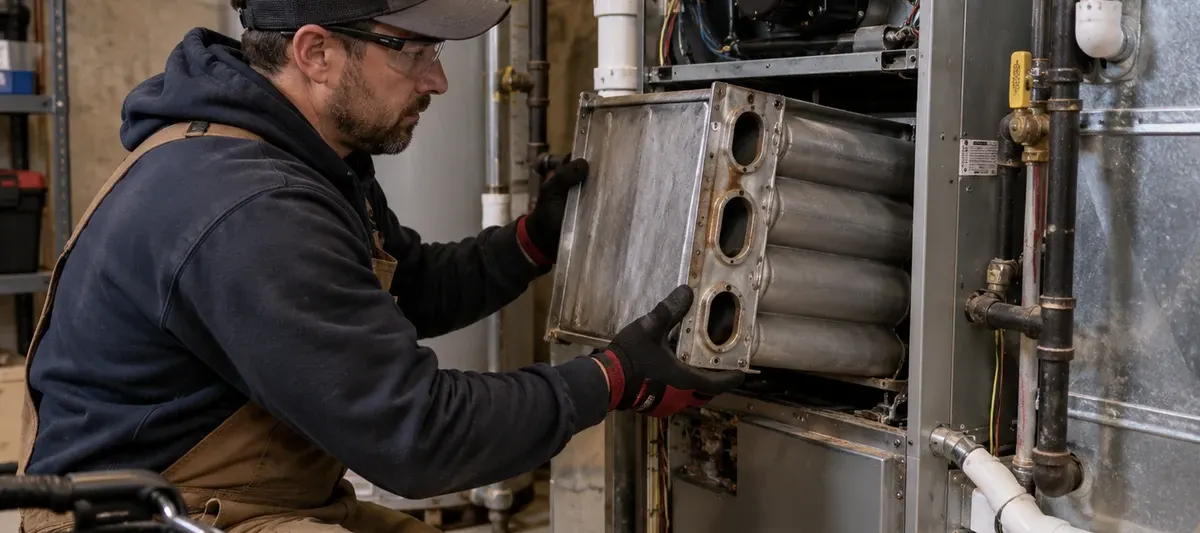
That imbalance exists because the exchanger sits deep inside the furnace. A technician may have to disconnect and remove burners, panels, controls, blower-related components or other assemblies before the old exchanger can come out—and then rebuild and test the furnace afterward.
The financial question is therefore not simply “How much does the part cost?” It is “How much labor is required to put a major new component inside this particular furnace, and how much useful life remains around it?”
WHY THIS PART MATTERS
What a Furnace Heat Exchanger Does—and Why a Breach Matters
Trane describes these as the exchanger's two essential functions: transferring combustion heat into the home's airflow while keeping combustion byproducts contained so they can be vented outside.
That is also why a confirmed crack or breach is not equivalent to a noisy blower or a failed igniter. It involves the physical barrier separating those two air streams.
THE MOST IMPORTANT WORD IS “CONFIRMED”
How Technicians Diagnose a Failed Heat Exchanger
A heat exchanger is difficult for a homeowner to inspect and parts of it can also be difficult for a technician to view directly without the right access or equipment.
Warning signs can support a diagnosis, but signs such as short cycling, soot, unusual flame behavior, odors or corrosion can overlap with other furnace problems.
Trane explicitly recommends professional evaluation because the symptoms of a cracked exchanger can resemble other furnace faults.
Crack, hole, corrosion, failed seam or another condition?
Primary exchanger, secondary exchanger or another furnace component?
Visual inspection, camera, combustion testing or another professional method?
Ask whether the technician can show photographs, video or test findings.
Age alone, overheating, airflow restriction, oversizing or corrosion?
A high-dollar component diagnosis should produce more information than “the furnace is old and the exchanger is bad.”
A COST GUIDE IS NOT A SAFE WAY TO TEST A CRACKED EXCHANGER
Heat Exchanger Safety Comes Before Repair-vs.-Replace Economics
Carrier describes a cracked heat exchanger as a critical furnace failure because combustion gases, including carbon monoxide, may escape their intended path.
Trane similarly advises shutting the furnace down and obtaining qualified HVAC evaluation when a cracked exchanger is suspected.
This report therefore focuses on the cost decision after professional diagnosis. It is not a procedure for operating or testing a furnace suspected of having a combustion safety problem.
WHY LABOR CAN COST MORE THAN THE PART
Heat Exchanger Labor Is Expensive Because the Furnace Must Be Disassembled
Shut down fuel and electrical service and prepare the appliance for safe disassembly.
Remove components and panels necessary to physically reach the exchanger assembly.
Install the exact compatible exchanger and required seals or associated parts.
Restore burners, controls, panels and components disturbed during access.
Verify safe startup and correct furnace operation after the repair.
HomeGuide's labor range of $650–$2,150 illustrates why a relatively modest component can produce a four-figure installed invoice.
Angi similarly notes that larger and high-efficiency units can require more time and currently estimates many replacements at roughly four to eight hours, depending on system and access.
PRIMARY VS. SECONDARY HEAT EXCHANGER
Primary vs. Secondary Heat Exchangers: Different Replacement Scopes
Primary heat exchanger
Combustion gases transfer heat through the main exchanger before leaving through the venting system.
$1,000–$3,000HomeGuide installed planning rangePrimary + secondary exchanger
High-efficiency furnaces extract additional heat from the exhaust, creating condensation and adding a second exchanger stage.
$1,000–$2,000HomeGuide secondary-exchanger replacement rangeTrane notes that furnaces below 90 AFUE generally use a primary exchanger, while high-efficiency furnaces at 90 AFUE or above use both primary and secondary heat exchangers.
A quote should therefore name the exact assembly rather than simply stating “replace heat exchanger.”
CHECK THE WARRANTY BEFORE DISCUSSING FURNACE AGE
Warranty Coverage Can Change Heat Exchanger Replacement Cost
Heat exchangers frequently carry longer manufacturer coverage than some other furnace components. HomeGuide notes warranties commonly ranging from 10 to 20 years or, on some products, the lifetime of the furnace.
The exact contract matters more than the generic promise.
Confirm model, serial number, installation date, registration and applicable manufacturer terms.
A free replacement part does not automatically cover several hours of technician labor.
Freight, processing or dealer-specific charges may remain outside manufacturer part coverage.
Gaskets, seals, venting corrections or other damaged components may create separate line items.
“Lifetime heat exchanger warranty” does not necessarily mean “zero-dollar heat exchanger replacement.”
REPLACING THE METAL IS NOT THE END OF THE DIAGNOSIS
Why Heat Exchangers Fail: Overheating, Corrosion and Condensate
Age and thermal cycling
The exchanger expands when heated and contracts after the burner shuts down. Years of repeated cycling can eventually contribute to fatigue.
Restricted airflow
Trane identifies repeated overheating as a crack risk. Dirty filters, blocked returns or another airflow problem can prevent heat from being carried away as intended.
Oversized furnace
An oversized appliance may short-cycle frequently, repeatedly heating and cooling the exchanger and increasing thermal stress.
Rust or corrosion
Moisture and condensation can weaken exchanger material over time, particularly where condensate management is part of the furnace design.
This distinction matters because the replacement exchanger inherits the same ductwork, blower, filters, sizing and installation conditions as the old one.
If the original failed prematurely because of an unresolved operating condition, replacing only the damaged metal may restore the furnace without correcting the stress that damaged it.
AIRFLOW BELONGS IN THE REPAIR CONVERSATION
Airflow Problems Can Contribute to Heat Exchanger Failure
If airflow is materially restricted, the exchanger can operate at higher temperatures than intended.
That does not mean every cracked exchanger was caused by ductwork. It means airflow is worth checking when the failure history points toward repeated overheating.
THE CAPITAL DECISION
Heat Exchanger Replacement vs. Furnace Replacement: Compare Like With Like
This is the core economic difference.
A new exchanger gives the existing furnace a major new component. It does not make the blower, control board, inducer, gas valve or other remaining parts the same age as the exchanger.
Conversely, a full furnace replacement costs more and may involve venting, gas, electrical, drain or transition work that a component repair does not require.
For full installed furnace economics, compare the separateFurnace Replacement Costreport rather than treating the equipment price alone as the alternative.
AGE IS CONTEXT, NOT AN AUTOMATIC VERDICT
Furnace Age and Warranty Change the $2,000 Repair Decision
- Exchanger part under warranty
- No meaningful repair history
- Blower and controls operating normally
- Failure cause understood and corrected
Here the repair can preserve a substantial amount of otherwise useful equipment life.
- Warranty expired
- Full exchanger + labor cost due
- Other major components are also old
- Recent repairs are beginning to accumulate
Here the same exchanger price buys a major repair inside equipment that may already be approaching a broader replacement decision.
HomeGuide uses a fairly conservative rule of thumb: exchanger replacement makes most sense on a furnace under roughly 10 years old, without other problems, when the repair remains substantially cheaper than a new furnace.
Angi similarly advises giving full replacement more weight once equipment reaches roughly 10–15 years or when major repair cost begins approaching a large share of replacement cost.
Those are budgeting heuristics, not mechanical laws. Actual furnace condition, warranty, local replacement cost and repair history matter more than one age cutoff.
HIGH-EFFICIENCY FURNACES ADD ANOTHER FAILURE PATH
Secondary Heat Exchangers Add Condensate and High-Efficiency Complexity
Condensing furnaces intentionally extract enough heat from combustion gases to create water vapor condensation.
Carrier notes that condensate problems in high-efficiency furnaces can contribute to water-related issues, while Trane identifies corrosion as one route by which exchanger material can weaken.
If the secondary exchanger has failed, the proposal should make clear whether the quote covers only that assembly or a broader exchanger kit.
WHAT CAN SIT OUTSIDE THE BASE QUOTE?
Permits, Disposal and Corrective Work Can Raise the Final Cost
Angi's current planning allowance for cleanup and old-component disposal.
Angi planning range where local authorities require permitting or inspection.
A second opinion or specialist inspection may be separate from the replacement contract.
Airflow, venting, condensate or other underlying conditions may need their own repair.
QUOTE REVIEW
How to Compare Heat Exchanger Replacement Quotes
What defect was confirmed and how?
Primary, secondary or complete assembly?
Which replacement component matches the furnace?
What portion of the component price is covered?
Removal, teardown, installation and reassembly included?
Seals, gaskets or required replacement components?
Was airflow, overheating or another contributing condition checked?
What verification is performed after reassembly?
Old exchanger removal and cleanup included?
What warranty applies to the new part and installation labor?
A useful proposal tells you which exchanger is being replaced, how the diagnosis was established, what warranty pays for, what labor includes and how the furnace will be checked after reassembly.
THREE QUOTES · THREE DIFFERENT DECISIONS
Separate Warranty Coverage From Furnace Age Before Deciding
Seven-year-old furnace. Manufacturer supplies the exchanger. Homeowner primarily pays labor and related materials.
Eleven-year-old furnace. Exchanger and labor both chargeable. Other major components currently appear serviceable.
Seventeen-year-old furnace with previous blower and ignition work. The exchanger repair leaves nearly every other component at its existing age.
These are illustrative decision shapes, not property-specific quotations.
THE BOTTOM LINE
Why Heat Exchanger Replacement Labor Is Expensive
For 2026 planning, use $1,250–$3,000 as a practical national starting range for professional replacement.
Then adjust the decision around five facts:
- Is the exchanger failure clearly documented?
- Is the part covered by manufacturer warranty?
- How much labor is required for this furnace design?
- Was an underlying overheating, airflow or corrosion issue identified?
- How much remaining furnace life surrounds the new exchanger?
On a younger furnace with strong warranty coverage, a heat-exchanger replacement can be a very different economic proposition from the same repair on a fifteen-year-old appliance.
The price of the exchanger matters. The age and condition of everything you are putting it back into matters more.
SOURCES & METHODOLOGY
Sources and Methodology for Heat Exchanger Replacement Costs
Repair Cost Ledger treats heat-exchanger replacement as a component-level furnace decision. Current U.S. cost ranges were compared across Angi and HomeGuide. Heat-exchanger function, failure modes and safety context were reviewed against current technical guidance from Trane and Carrier.
Actual diagnosis, model compatibility, warranty eligibility, repair procedure, permits and combustion-safety requirements depend on the furnace and jurisdiction. Heat-exchanger work is professional HVAC work, not a homeowner repair procedure.