
THE TANK MAY NOT BE THE EXPENSIVE PART
Drain Field Replacement Costs $3,000–$15,000 Even When the Septic Tank Is Still Usable
That distinction matters because homeowners often hear“your septic system is failing” when the actual problem is narrower.
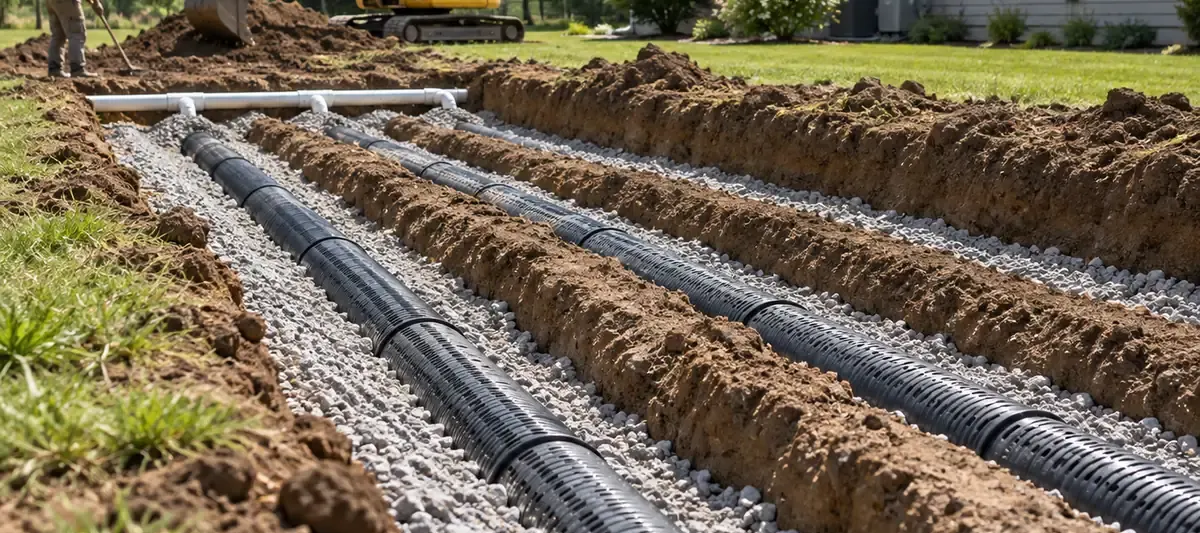
The tank may still be structurally sound. The outlet may still work. The expensive failure may be happening several yards away, where wastewater is supposed to disperse into soil.
HomeGuide's current national data places drain or leach field replacement at $3,000–$15,000, with an average around $7,900. Repair or rejuvenation work commonly falls around $1,000–$5,000.
Those numbers make more sense once the project is separated into three different questions:
- Is wastewater reaching the field correctly?
- Can the existing field still accept and disperse it?
- If not, can another approved absorption area fit on the property?
FIRST: PRICE THE RIGHT PART OF THE SEPTIC SYSTEM
The drain field begins where tank treatment ends
EPA describes conventional onsite systems in essentially this sequence: wastewater enters the tank, liquid effluent leaves the tank and the drainfield distributes it into soil for further treatment.
If the tank is the failed component, use the broaderSeptic System Replacement Costguide. This report assumes the economic question has narrowed to the absorption / dispersal side of the system.
DO NOT REPLACE A FIELD FROM ONE SYMPTOM ALONE
Standing water above the field is serious. It still does not tell you which buried component failed.
Can indicate that wastewater is no longer moving through the onsite system normally.
EPA identifies surfacing or ponding above the drainfield as a sign that the system may be malfunctioning.
One set of laterals may be overloaded while another receives too little flow.
High groundwater can limit the soil's ability to accept effluent even when field piping itself is intact.
“The field is wet” is evidence of a problem. It is not yet a replacement design.
WHAT A USEFUL INSPECTION TRIES TO SEPARATE
How Drain Field Failure Is Diagnosed Before Replacement
Sludge, scum, effluent filter, inlet, outlet and structural integrity.
Verify that the distribution box is intact and that field lines are receiving reasonably equal flow.
Camera inspection may help identify blocked or collapsed accessible lines where appropriate.
Excavation in selected locations may reveal wastewater ponding inside the field.
Determine whether groundwater is influencing the absorption area.
Water-use history and design capacity help distinguish chronic overload from a purely physical field defect.
That inspection sequence matters economically because a damaged distribution box can cost dramatically less to correct than abandoning and rebuilding an entire absorption area.
REPAIR, REJUVENATE OR BUILD A NEW FIELD?
The $1,500 decision and the $12,000 decision should not be made from the same level of evidence
Localized repair
$1,000–$5,000 typical repair envelope- Distribution-box correction
- Selected field-line repair
- Localized piping / distribution problem
- Some rejuvenation approaches
Appropriate only where diagnosis shows that the whole absorption area does not need replacement.
Full replacement
$3,000–$15,000 typical field range- Old absorption area no longer functions adequately
- New field location or layout required
- Soil / groundwater constraints affect design
- Existing trenches or field geometry cannot be reused
A replacement is a site-design project as much as an excavation project.
WHEN THE FAILURE REALLY IS THE FIELD LINE
Leach Line Repair Can Cost Less Than Full Drain Field Replacement
HomeGuide currently places septic field-line replacement around $20–$45 per linear foot.
But replacing pipe only makes sense when the failure is actually attributable to pipe or distribution condition.
New perforated pipe cannot correct soil that is saturated, unsuitable or hydraulically overloaded. This is one of the most important distinctions between a line repair and a field replacement.
THE SOIL IS PART OF THE WASTEWATER SYSTEM
Soil Conditions Can Make or Break a New Drain Field
EPA identifies unsuitable soil, excessive slope and high groundwater as conditions capable of causing hydraulic failure in soil-based septic systems.
That is why the cost of replacing a drainfield can change substantially before the first excavator arrives.
A soil or percolation evaluation commonly costs around $600–$2,000 according to HomeGuide's current drainfield data.
That expense is small relative to the consequence of discovering that a conventional replacement cannot legally or physically fit the property.
FIELD SIZE IS NOT SIMPLY THE SIZE OF THE LAWN
The usable absorption area is what remains after soil, capacity and setbacks are applied
The visible yard can contain property lines, wells, structures, driveways, slopes, trees and other restrictions that reduce the area available for wastewater dispersal.
A property with a preserved reserve field can therefore have a much simpler replacement path than a similar-size lot where the original field already occupies the only suitable area.
WHY DRAINFIELDS FAIL
Some failures begin in the soil. Others begin years earlier inside the septic tank.
Solids migrate out of the tank
EPA warns that inadequate maintenance can allow solids to reach and clog the drainfield.
Hydraulic overload
More water reaches the system than the absorption area can adequately handle.
High groundwater
The field may not have the unsaturated soil conditions required for proper treatment and dispersal.
Unsuitable soil / site
Poor original siting can create a system that struggles even without one obvious broken component.
Compaction or physical damage
Vehicle traffic and heavy use over the absorption area can damage piping and reduce soil performance.
Roots / site intrusion
Trees and large plantings can interfere with piping and the protected field area.
PUMPING CAN BE NECESSARY WITHOUT BEING THE REPAIR
An emptied tank can buy inspection access and temporary relief. It cannot restore failed soil.
Pumping is ordinary septic maintenance and may also be part of the preparation for drainfield work.
But if wastewater is surfacing because the absorption area can no longer accept normal flow, removing liquid from the tank does not permanently change the condition of that field.
Treat repeated emergency pumping as a service event, not automatic proof that the underlying dispersal problem has been solved.
THE DISTRIBUTION BOX IS SMALL ENOUGH TO BE OVERLOOKED
Uneven distribution can make part of a field look failed while another part is barely being used
EPA specifically includes distribution-box condition and equal flow to drain lines among the items that may be reviewed during a septic inspection.
That makes the D-box an important diagnostic checkpoint before a homeowner jumps from “one side of the field is wet” to“replace the entire drainfield.”
FIELD TYPE CHANGES THE BUDGET
Conventional and Mound Drain Fields Have Different Replacement Costs
HomeGuide field-specific replacement benchmark. Often the least complex route where soil and groundwater conditions permit.
Additional treatment and equipment can move the project into a different cost class.
Climate- and site-specific system rather than a universal replacement option.
Elevated sand and pumped distribution can be required where native soil conditions do not allow a conventional field.
These are planning ranges from HomeGuide's field-replacement dataset, not a menu from which a homeowner chooses a system. Local approval and site conditions determine which designs are allowed.
THE FIELD PRICE ENDS WHERE THE YARD REPAIR BEGINS
Excavation and Yard Restoration Add to Drain Field Replacement Cost
Open trenches or field area for the approved system.
Piping, chambers, distribution components or required media.
Follow local requirements for old lines and disturbed area.
Restore drainage and safe final contours.
Topsoil, seed or sod after required inspections are complete.
HomeGuide currently estimates sod installation around $1–$2 per square foot. Moving a field to an entirely new area can also add connecting pipe, old-field abandonment and broader grading work.
WHEN THE NEW FIELD CANNOT GO WHERE THE OLD ONE WAS
Moving the absorption area can turn a straightforward replacement into a $5,500–$21,500 site project
HomeGuide's current data places moving a leach field around $5,500–$21,500.
That larger range reflects more than a new set of trenches. The system may need a new connecting route from the tank, excavation or abandonment of the old field, grading and restoration across another part of the property.
THIS IS PERMITTED WASTEWATER INFRASTRUCTURE
Do not treat the new field location as a landscaping decision
Septic-system requirements are established locally and can involve health, environmental or building authorities depending on the jurisdiction.
HomeGuide uses a national planning range of approximately $250–$650 for drainfield permits, but actual local fees and required professional services vary.
A quote should identify responsibility for:
- site or soil evaluation;
- system design;
- permit submission;
- required inspection before backfill;
- final approval;
- as-built or system records where required.
FOUR PROJECTS THAT ALL GET CALLED “A BAD LEACH FIELD”
Drain Field Repair and Replacement Cost Examples: $1,500 to $15,000+
Distribution problem
Inspection finds an uneven or damaged distribution component while the absorption area remains usable.
Localized lateral failure
Selected field lines require excavation and replacement without abandoning the entire approved field.
Conventional field replacement
The old absorption area is no longer serviceable, but the property still has suitable soil and an uncomplicated replacement location.
Difficult site / alternative design
Groundwater, soil or available-area constraints require a mound, pumped or engineered solution and broader site work.
NORMALIZE THE BIDS
How to Compare Drain Field Replacement Quotes
“Replace drainfield” is not enough scope to compare bids. A useful quote identifies the approved system, field quantity, distribution work and condition of the yard when the contractor leaves.
THE DECISION
Confirm What Failed Before Authorizing Full Drain Field Replacement
For 2026 planning, $3,000–$15,000 is a practical national range for full drainfield replacement, while $1,000–$5,000 captures many smaller repair or rejuvenation projects.
Those ranges should be applied only after separating four things:
- tank condition;
- distribution condition;
- absorption-field performance;
- soil and site suitability.
The most expensive mistake is replacing a field without understanding the site problem that caused it to fail.
The second most expensive mistake is replacing the entire onsite system when only one smaller component actually failed.
SOURCES & METHODOLOGY
Sources and Methodology for Drain Field Replacement Costs
Repair Cost Ledger treats the tank, distribution system and absorption area as separate cost components. Field-specific pricing was reviewed against HomeGuide's current drain/leach-field dataset, with Angi's July 2026 tank-and-field replacement data used as a broader system comparison. Diagnostic and failure-mechanism context was checked against U.S. Environmental Protection Agency septic guidance.
Septic design, sizing, reserve-area requirements, setbacks, permitting, approved technologies and abandonment procedures are jurisdiction-specific. National ranges are budgeting references rather than site approvals.