
2026 NATIONAL COST ANSWER
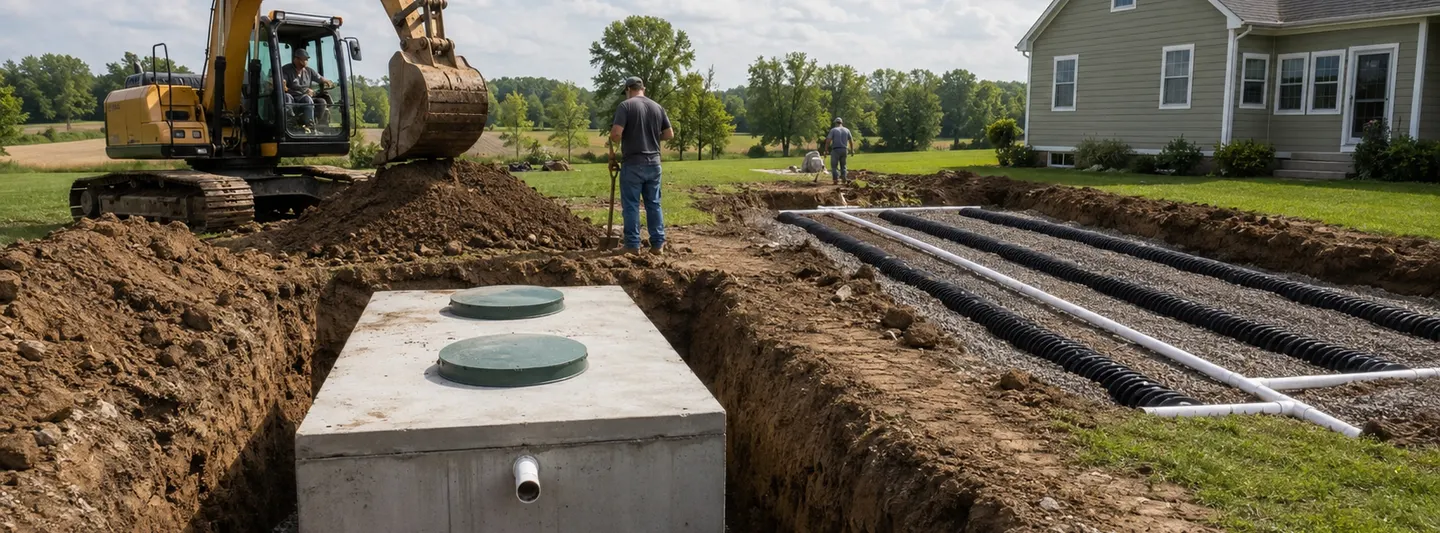
Replacing a septic tank and drain field commonly costs about $5,000–$12,000, while difficult drainfields and engineered systems can push a full replacement toward $20,000 or substantially more.
Angi's July 8, 2026 national replacement guide puts a septic tank + drain field replacement at $5,000–$12,000. Its broader 2026 septic-installation data places most systems at $3,591–$12,463, with an average around $8,023.
HomeGuide uses a wider replacement envelope: $4,500–$20,000 for a septic tank and leach field, and $3,000–$15,000 for drainfield replacement alone. Engineered systems can move into an entirely different price tier.
FIRST QUESTION: WHAT ACTUALLY FAILED?
A septic tank problem and a drainfield problem are not the same replacement
EPA describes the septic tank as the watertight vessel that receives household wastewater, separates solids and floatable material, and sends liquid effluent onward for soil treatment.
These parts move or divide effluent toward the absorption area. A failed component can sometimes be repaired without replacing the whole system.
EPA says conventional systems discharge effluent through buried piping or chambers so the soil can provide further treatment.
The replacement design has to fit the property that exists today, not simply copy a decades-old layout automatically.
“My septic failed” is a symptom-level description. A replacement quote should identify whether the tank, distribution components, absorption area—or the complete system—is being replaced.
SEPTIC REPLACEMENT IS A SITE-APPROVAL PROJECT BEFORE IT IS AN EXCAVATION PROJECT
The contractor may need a new design even if the old system occupied the property for decades
EPA says septic-system design varies according to household size, soil type, site slope, lot size, proximity to sensitive water bodies, weather and local regulations. Those factors explain why replacing a failed system can reveal a more expensive project than the homeowner expected from the old layout.
HOUSE CAPACITYHow much wastewater must the system be designed to handle? Local design rules often connect required capacity to bedroom count or another approved occupancy basis.
SOILCan the site accept and treat effluent at the required rate? Soil evaluation determines whether a conventional field is viable.
GROUNDWATER / BEDROCKIs there enough usable soil beneath the dispersal area? High groundwater or shallow limiting layers can force an alternative design.
SETBACKSCan the field fit legally around wells, structures and property constraints? The usable area can be smaller than the visible lawn.
RESERVE AREAIs a replacement absorption area already designated? A reserve field can materially change the difficulty of replacing a failed original field.
The homeowner's most useful pre-bid documents may therefore be old septic permits, as-built drawings, property records and prior inspection reports. EPA's 2026 homebuyer guidance specifically recommends using records and inspection information to understand an existing system.
PERC TESTS AND SOIL EVALUATION ARE SMALL COSTS WITH LARGE DESIGN CONSEQUENCES
A $1,000 soil result can decide whether the replacement is a $7,000 conventional project or a five-figure engineered system
Angi's current national septic-installation guide prices soil / percolation testing at roughly $700–$2,000. Its July 2026 tank-and-field replacement guide uses an average near $1,300. HomeGuide's drainfield guide uses $600–$2,000.
This is the lower-complexity replacement path when soil, slope, groundwater and available area satisfy the local design.
Chambers, pumps, pressure distribution or another approved design can change the installed price and future maintenance.
Angi prices engineered systems around $7,000–$20,000 in many cases; HomeGuide's broader engineered category reaches $15,000–$50,000.
SYSTEM TYPE CAN MOVE THE PROJECT INTO A DIFFERENT BUDGET CLASS
Conventional, mound and aerobic systems solve different site constraints
EPA's current septic-system guide lists conventional systems, chamber systems, drip distribution, aerobic treatment units, mound systems, recirculating sand filters and other decentralized designs. The correct choice is site-specific rather than a homeowner upgrade menu.
HomeGuide benchmark. EPA describes a tank feeding a subsurface trench or bed where soil provides additional treatment.
Angi's current benchmark for a common gravity-oriented treatment design where site conditions permit.
Angi benchmark. EPA says ATUs inject oxygen to increase treatment activity and can be useful where lot, soil or water-quality constraints make conventional systems unsuitable.
Angi benchmark. EPA describes mound systems as elevated drainfields used where site conditions require additional vertical separation.
Angi engineered-system benchmark for a design that adds treatment media where conventional soil treatment is not enough.
These ranges should not be used to choose a technology by price. Alternative systems can include pumps, controls, alarms and ongoing maintenance that a gravity conventional system does not require in the same way. EPA specifically notes that aerobic systems should be expected to require regular lifetime maintenance.
REPAIR THE FAILED COMPONENT OR REPLACE THE SYSTEM?
The cheapest septic project is often the one that proves the drainfield still works
Angi's March 2026 septic-repair data puts many repairs at $627–$3,040. HomeGuide uses $600–$3,000 on average for septic-tank repair and $1,000–$5,000 for drainfield rejuvenation / repair, compared with $3,000–$15,000 for drain field replacement.
PUMP / BAFFLE / FILTERComponent repair can restore function without disturbing the entire absorption area.
DISTRIBUTION BOXLocalized distribution repair can be much smaller than replacing a functioning tank and field.
TANK FAILURETank replacement does not automatically prove the existing field must also be abandoned.
FIELD FAILUREDrainfield replacement / redesign can dominate the project even if the tank itself remains usable.
MULTIPLE / SYSTEMIC FAILURESComplete replacement becomes the cleaner comparison when several major components are at end of life.
Ask the inspector to name the failed component before the installer prices the replacement component.
WHY THE DRAINFIELD CAN COST MORE THAN THE TANK
The tank is a product; the field is a site-built treatment area
Angi prices a common 1,000-gallon tank itself at roughly $900–$1,500. HomeGuide likewise uses about $1,000–$1,500 for an average 1,000-gallon tank, yet drainfield replacement alone runs $3,000–$15,000 in HomeGuide's current data.
1,000-gallon tank-only benchmark from Angi.
HomeGuide drainfield replacement range.
The field cost includes far more than perforated pipe. The installer is constructing a treatment and dispersal area that has to match the approved soil and site conditions. That is why shopping only by tank gallons can badly underestimate a complete replacement.
SITE COSTS CAN ARRIVE BEFORE AND AFTER THE SEPTIC CONTRACTOR
Permits, excavation, trees and yard restoration belong in the same project budget
Angi's current installation guide uses $450–$2,300 for permits and $700–$2,000 for soil testing. Its engineered-system guide puts excavation around $1,200–$4,500 and land preparation around $1,600–$8,000 in more complex jobs.
SOIL / PERC$700–$2,000 · Angi Design input rather than optional decoration.
PERMITS$450–$2,300 · Angi Jurisdictional approval can vary substantially; some local fees are lower or higher.
EXCAVATION$1,200–$4,500 · engineered context A useful separate benchmark where difficult site work is not bundled.
TREE REMOVAL$400–$1,200 · HomeGuide context Drainfield location can collide with existing landscaping or root systems.
YARD CLOSEOUTDefine grade + seed / sod + hardscape separately“Backfill included” does not necessarily mean the property is restored.
These figures should not simply be stacked on top of every national installation range because contractor packages differ. Their value is in checking whether a low bid has omitted a known site requirement.
THE RESERVE DRAINFIELD CAN BE WORTH MORE THAN EMPTY LAWN
Do not casually build, pave or drive over the area your property may need for future replacement
EPA's maintenance guidance tells homeowners to protect the drainfield, keep vehicles off it and avoid deep-rooted planting that can damage the system. For replacement planning, the same principle extends to any designated reserve absorption area: future replacement capacity can be a critical property asset.
Local rules and soil condition determine whether the same area can be reused.
A documented reserve area can reduce the uncertainty of finding a new compliant field location.
Check septic plans before treating open ground as unrestricted building area.
A COMPLETE REPLACEMENT IS A SEQUENCE OF APPROVALS AND HANDOFFS
The excavator should not be the first person to define the new system
01Inspect failure identify tank, distribution and field condition.
02Recover records old permit, as-built, bedroom / design capacity and reserve area.
03Evaluate site soil / perc, groundwater, slope, setbacks and usable area.
04Approve design conventional or required alternative / engineered system.
05Price full scope tank, field, pumps, electrical, excavation, removal and restoration.
06Install build the approved treatment and dispersal system.
07Inspect / document complete required jurisdictional inspection before burial / closeout.
08Restore property grading, vegetation and any disturbed surface.
THE SOIL IS THE LAST TREATMENT COMPONENT
Why replacing the tank does not automatically solve a failed drainfield
EPA describes the drainfield and underlying soil as the part of a conventional system that receives septic-tank effluent for further treatment and dispersal. That is why a replacement can be cheap when the original site remains suitable—and expensive when the site requires a different way to create that treatment zone.
THE $250–$500 MAINTENANCE BILL EXISTS TO AVOID THE $5,000–$15,000 FAILURE BILL
EPA's replacement-cost comparison makes routine septic maintenance unusually easy to justify
EPA's current “Why Maintain Your Septic System” guidance says regular maintenance of about $250–$500 every three to five years is inexpensive compared with repairing or replacing a malfunctioning conventional system, which it places at roughly $5,000–$15,000. Alternative systems can cost more.
Maintenance cannot make every drainfield permanent. But inspection, pumping and protecting the field can prevent avoidable loading and give the homeowner earlier evidence that a component is deteriorating before sewage backup becomes the first diagnostic test.
SEVEN SEPTIC REPLACEMENT COST FILES
The approved site design determines which national price range is relevant
HomeGuide's current conventional-system benchmark is $3,500–$8,500. This is the cleanest lower-complexity model when a conventional design remains approved.
Angi's July 2026 national range is $5,000–$12,000. HomeGuide's broader combined range is $4,500–$20,000, showing how widely site conditions can spread bids.
HomeGuide uses $3,000–$15,000. Do not buy a new tank automatically if inspection shows the failure is confined to the absorption area.
Angi's current engineered-system benchmark is $10,000–$20,000. The added cost pays for a more complex approved treatment / dispersal design rather than merely a “premium tank.”
Angi currently uses $10,000–$20,000. EPA notes that ATUs use oxygen to increase treatment and should be expected to require ongoing maintenance.
Angi's current repair range is $627–$3,040. A failed pump, baffle or distribution component can belong to a repair budget rather than a complete excavation.
Angi uses roughly $7,000–$20,000 for engineered systems with some jobs reaching $25,000; HomeGuide's broader engineered category reaches $15,000–$50,000. This is why soil evaluation belongs before a confident replacement estimate.
THE 12-POINT SEPTIC REPLACEMENT QUOTE TEST
A complete bid should match an approved site design—not merely list a tank size
01Failure diagnosis — tank, D-box / pump, field or complete system?
02Design capacity — what household / bedroom basis is the new system sized for?
03Soil evaluation — perc / soil work complete and included?
04Approved system type — conventional, chamber, mound, aerobic, sand filter or another local design?
05Tank — gallon capacity, material and whether old tank removal / abandonment is included?
06Drainfield — location, footprint / trenches and distribution method?
07Pumps / controls — dose tank, pump, alarm or electrical scope where required?
08Excavation — clearing, rock, groundwater, hauling and unsuitable soil assumptions?
09Permit / engineering — design, permit, inspection and engineer / soil-professional fees included?
10Old system — abandon, crush, pump, remove or leave components according to local requirements?
11Property restoration — final grade, topsoil, seed / sod, trees, fences and hardscape?
12Closeout — final inspection, as-built / record drawing and operating instructions?
The strongest septic quote prices an approved wastewater solution for the property—not a generic tank-and-trench package.
WHY THERE IS NO SEPTIC REPLACEMENT CALCULATOR
Bedroom count and tank gallons cannot predict what the soil will approve
A calculator could ask for bedrooms, choose a tank size and multiply a nominal drainfield area by a national rate. That would ignore the main reason septic replacement prices spread so widely: two neighboring properties can require different dispersal designs because soil, groundwater, slope or available replacement area differs.
The more useful budgeting sequence is: diagnose the failed component → recover the existing design → complete required soil / site work → identify the approved replacement type → compare contractor scopes. Once the system type is approved, the national price bands above become much more meaningful.
COMMON COST QUESTIONS
Septic system replacement cost in plain terms
How much does it cost to replace a septic tank and drain field? Angi's July 2026 national range is $5,000–$12,000. HomeGuide uses a broader $4,500–$20,000 range.
How much does a drainfield replacement cost? HomeGuide currently uses $3,000–$15,000. Angi's replacement data commonly centers around $5,000–$12,000 depending on field type.
How much does a conventional septic system cost? HomeGuide's current installed range is $3,500–$8,500.
How much does a mound septic system cost? Angi's current engineered-system benchmark is about $10,000–$20,000.
How much does an aerobic septic system cost? Angi currently uses about $10,000–$20,000 for aerobic systems.
How much does a perc test cost? Angi uses $700–$2,000 for soil / percolation testing in its current national installation guide; HomeGuide uses $600–$2,000 for drainfield planning.
How much do septic permits cost? Angi's current national installation data uses $450–$2,300, although actual local fees vary widely.
Can I replace only the septic tank? Potentially, if inspection and local approval show the drainfield and other components remain serviceable. A failed tank does not by itself prove the absorption area must be replaced.
Can I replace only the drainfield? Potentially, if the tank remains usable and the replacement absorption design is approved for the property.
METHODOLOGY & SOURCES
Current 2026 pricing kept separate from EPA system-design and maintenance guidance
Pricing was reviewed August 8, 2026. Angi's current national replacement / installation datasets provide tank-and-field, testing, permit and engineered-system cost ranges. HomeGuide provides an independent drainfield and conventional / alternative-system cross-check. EPA sources are used for system function, design constraints, system types and maintenance—not contractor price quotes.
$5,000–$12,000 combined replacement; system-type examples; ~$1,300 perc-testing context and labor share.
02 · ANGI · AUG 2026Septic System Installation Cost$3,591–$12,463 common installation range; ~$8,023 average; $700–$2,000 soil testing; $450–$2,300 permits; tank-size context.
03 · ANGI · CURRENT 2026 GUIDEEngineered Septic System Cost$7,000–$20,000 typical engineered range; mound, aerobic and sand-filter pricing; excavation, engineering and site-prep context.
04 · HOMEGUIDE · CURRENT GUIDEDrain / Leach Field Replacement Cost$3,000–$15,000 field replacement; $4,500–$20,000 tank + field; $600–$2,000 perc testing; permit and site-cost context.
05 · HOMEGUIDE · CURRENT GUIDESeptic Tank System Cost$3,500–$8,500 conventional system; $4,000–$15,000 alternative; $15,000–$50,000 engineered; tank-only benchmarks.
06 · U.S. EPA · JUN 10 2026How Septic Systems WorkCurrent explanation of tank treatment, drainfield dispersal and the role of soil in conventional and alternative systems.
07 · U.S. EPA · MAY 4 2026Types of Septic SystemsConventional, chamber, drip, aerobic, mound, sand-filter and other onsite wastewater designs and site-use cases.
08 · U.S. EPA · MAR 11 2026Why Maintain Your Septic System$250–$500 maintenance every 3–5 years versus roughly $5,000–$15,000 repair / replacement for malfunctioning conventional systems.
This is U.S. cost-planning information. Septic design, sizing, soil evaluation, reserve-area rules, setbacks, permits, approved system types, abandonment procedures and installer / engineer licensing are controlled locally. Obtain the required site evaluation and approved design before treating a national replacement range as a contractor quote.