
THE PRICE, WITHOUT THE GUESSWORK
Most ductwork repairs cost $200–$1,000. The expensive part is often getting to the problem, not fixing it.
You turn the air conditioning on. The living room cools down, but the bedroom stays warm. It's easy to assume the AC is failing. Sometimes, though, the cool air is simply escaping through a gap in the duct on its way to that room.
For U.S. homeowners in 2026, HomeGuide reports a typical ductwork repair cost of $200–$1,000, averaging around $600. See HomeGuide's 2026 repair prices. Angi's wider dataset runs from $200 to $2,100, covering a broader mix of damage, materials and hard-to-reach locations. See Angi's October 2026 update.
These are two different research ranges, not a low price and a high price to combine. A $250 visit to reconnect an exposed duct is not the same job as finding and replacing torn ducts above a finished ceiling. Neither number is a quote for your house.
“Can you show me where air is leaking or where the duct is damaged?” A clear answer is more useful than being told the whole system is old.
START WITH WHAT YOU CAN SEE OR FEEL
What's actually happening in your house?
You do not need to know how duct pressure works to describe the problem. The clues below help you have a better first conversation with an HVAC contractor. None of them proves a duct leak by itself.
One room never gets comfortable
Maybe the bedroom is hot while the hallway is cool. A disconnected, crushed or badly routed duct might be keeping air from reaching that room. But a closed damper, dirty filter or the HVAC equipment itself can cause similar trouble.
Ask the contractor to check airflow at the room and look for a damaged branch.You feel air blowing into the attic or basement
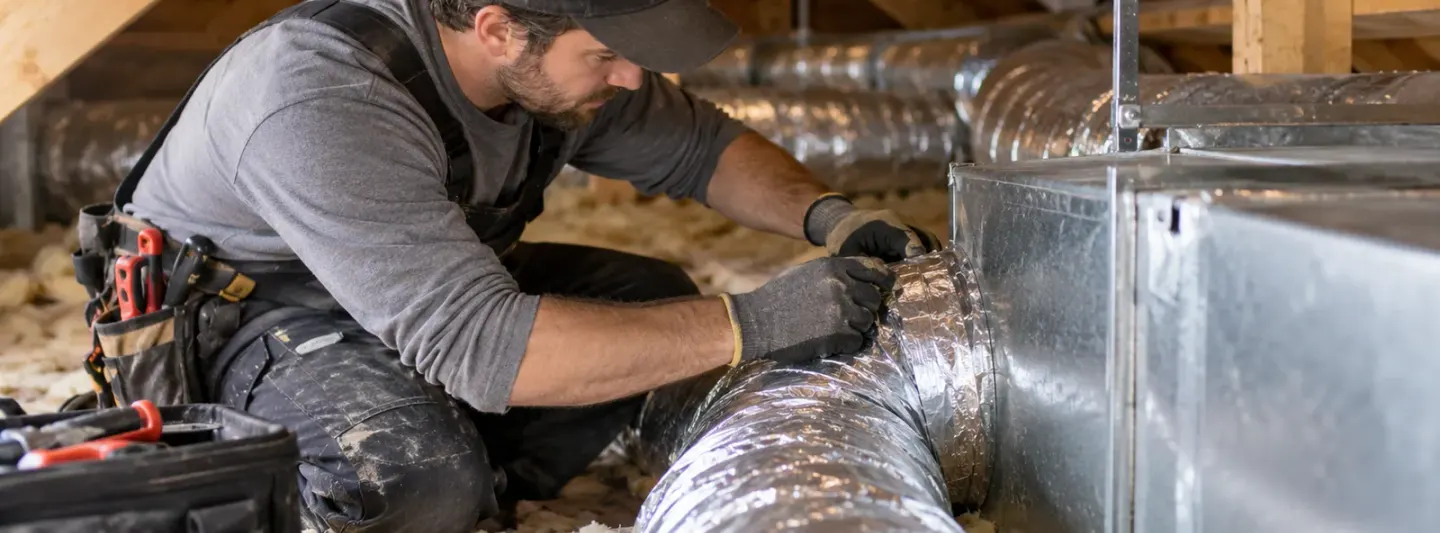
If you notice a strong draft from an exposed duct joint while the system runs, the pieces may have pulled apart or the old seal may have failed. This is often more straightforward than a problem hidden in a wall.
Ask whether the duct can be reconnected and sealed without replacement.A flexible duct looks flattened
Those soft, bendable ducts should not be tightly kinked or squashed. Sometimes a section can be straightened and supported. If the inner lining is torn, replacing that branch may be more reliable.
Ask if the damaged length can be replaced on its own.There's water, a musty smell or signs of pests
This is not simply a “tape the hole” job. The contractor needs to find out what caused the moisture or damage. Wet or moldy duct insulation may need replacing rather than patching.
Ask for the cause and the affected material to be identified before authorizing treatment.ENERGY STAR says duct leaks, poorly connected ducts and crushed flexible runs are common causes of uncomfortable rooms and wasted heating or cooling. It recommends checking the full system rather than judging one duct in isolation. Read ENERGY STAR's homeowner guidance.
WHAT YOU MAY ACTUALLY PAY FOR
A leak, a loose joint and a ruined duct section are three different repairs.
Below are national planning figures from HomeGuide. They describe alternative jobs—you would not usually add every row to a single invoice. Prices change with the number of problem areas, duct material and access.
| What needs fixing | Planning range | What the work usually means |
|---|---|---|
| Loose vent or register connection | $100–$250 | Securing a small, accessible connection |
| Sealing duct air leaks | $150–$500 | Closing gaps at joints and seams |
| Patching small holes or cracks | $200–$600 | Repairing damage where the material can stay |
| Reconnecting a disconnected duct | $250–$700 | Refitting and sealing loose sections |
| Repairing duct insulation | $200–$800 | Restoring damaged insulation around usable ducts |
| Replacing a failed duct section | $400–$1,500 | Removing and replacing a limited damaged run |
Source: HomeGuide, Ductwork Repair Cost (2026). Some jobs involve more than one line item; request an itemized quote to see which costs overlap.
Air escapes at one reachable joint.
An HVAC technician can often fit the duct back together and seal the joint with materials designed for air ducts. The duct itself may still be perfectly usable.
The flexible duct is torn or crushed.
If a section has lost its shape or its inner liner is badly damaged, replacing that part is usually more sensible than hiding the damage under tape.
A note about the tape in the garage: regular cloth “duct tape” is not the recommended fix for air ducts. ENERGY STAR recommends duct mastic or suitable metal-backed tape for sealing accessible connections. Always use products rated for the duct and follow the manufacturer's directions.
WHAT AN ITEMIZED ESTIMATE COULD LOOK LIKE
Two example bills, and why one costs much more
These are made-up examples to show how an invoice adds up. They are not reported customer experiences, collected bids or average prices for each line. Real contractors may combine items, charge a minimum call-out fee or use different labor rates.
A loose connection in plain sight
One duct has slipped out of place near the furnace. The contractor can reach it without opening a ceiling.
- Visit and diagnosis
- $120
- Reconnect and seal joint
- $230
- Check airflow after repair
- $70
- Illustrative total
- $420
No wall opening or replacement duct required.
One damaged branch needs replacing
A flexible duct has collapsed. The old section must come out, and the new one needs to be supported and insulated correctly.
- Visit and diagnosis
- $175
- Remove and replace damaged run
- $600
- Insulation and supports
- $200
- Extra labor for difficult access
- $300
- Illustrative total
- $1,275
This is an illustration of a more involved repair, not a typical quote.
See the difference? The more expensive job is not necessarily fixing a larger number of feet. Getting into a cramped space, replacing damaged material and checking the finished airflow can take most of the time.
WHY TWO NEIGHBORS GET DIFFERENT QUOTES
Where the duct runs can matter as much as what broke.
A broken connection above an open basement ceiling is easy to inspect. The same problem behind finished drywall may need an access opening, a second trade to close it and possibly repainting. Those are real costs, even though the duct repair itself hasn't changed.
Usually easier to reach and show to the homeowner. A visible disconnected joint may be a small job.
Low clearance, insulation and tight turns slow the work. A contractor may need to replace crushed flexible ducts rather than just reseal them.
Ask who will open and repair the drywall. An HVAC estimate may cover the duct but not the finished surface.
Angi's 2026 duct-leak-testing guide puts professional testing at $115–$450 in many cases. Testing is not included in every repair price. Ask whether diagnosis or post-repair verification is already covered before paying for it twice.
BEFORE SOMEONE RECOMMENDS A NEW SYSTEM
When is repair enough—and when should you replace the ducts?
Don't decide based on age alone. Start with what's wrong with the system, how much of it is affected and whether the duct layout can still move enough air to the rooms.
One or two joints leak, a short section has pulled loose, the ducts are the right size, and the surrounding material is in good condition.
Ask for the exact damaged locations.One branch is torn, crushed or water-damaged, but the main duct system works well. You may be able to replace just the bad run.
Ask which rooms that section serves.Damage appears in many places, the ducts are poorly sized or the old layout has major airflow problems. Repeating small repairs could leave the real issue untouched.
Ask what testing supports that recommendation.Our Ductwork Replacement Cost guide covers new duct systems, whole-house pricing and design considerations. If the contractor suspects the heating or cooling equipment instead, the HVAC Replacement Cost guide helps separate the two decisions.
ENERGY STAR estimates that roughly 20%–30% of moving air can be lost through leaky or badly connected ducts in a typical home. That's a reason to investigate leakage—not a promise that any particular repair will cut your utility bill by 30%. Source: ENERGY STAR.
A BETTER WAY TO BUY THIS REPAIR
Ask for a quote you can actually understand.
Here's a short checklist you can use on the phone or when the technician visits. You don't need every possible test on a small job, but you should know exactly what you're paying for.
- What's the cause?Is it an air leak, disconnected duct, crushed branch, moisture issue or a problem with the HVAC equipment?
- Which sections are included?Ask the contractor to identify the locations and show photos if the ducts are hard to see.
- How will you seal or replace them?Look for appropriate duct materials, secure connections and proper support—not ordinary cloth duct tape.
- Is opening and repairing the ceiling included?Separate access work from drywall finishing so the final bill isn't a surprise.
- What does the price include?Diagnosis, materials, labor, insulation, travel, testing, permits if applicable, cleanup, and warranty terms.
- How will we know the fix worked?Ask about checking the affected room's airflow or performing a leak test when the problem calls for one.
If one room is uncomfortable, you don't automatically need a new AC or a whole new duct system. Start by identifying the specific fault. Pay to fix what is actually broken—and make sure someone checks that the air gets where it needs to go afterward.
WHERE THE INFORMATION COMES FROM
Sources, dates and what these numbers mean
Repair Cost Ledger uses published national U.S. ranges to help readers understand the size of a job before requesting a local estimate. HomeGuide and Angi include different projects in their datasets, so we show their ranges separately. The two sample bills are educational arithmetic, not prices taken from actual customers. This guide is about repairs to existing ducts, not cleaning the whole HVAC system or replacing every duct in the house.
- HomeGuide — Ductwork Repair Cost (2026): typical repair range and prices by type of repair.
- Angi — Ductwork Repair Cost (updated October 15, 2026): wider repair range and access considerations.
- Angi — Cost to Check Air Ducts for Leaks (2026): separate diagnostic testing reference.
- ENERGY STAR — Duct Sealing: leak symptoms, appropriate sealing materials and energy-loss context.
- ENERGY STAR — Hiring a Duct Contractor: inspecting, repairing and checking airflow.
- U.S. EPA — Should You Have the Air Ducts in Your Home Cleaned?: water-damaged materials, contamination and fixing the underlying cause.
Research checked October 17, 2026. Prices are national planning ranges in U.S. dollars and may differ substantially by contractor, region and condition of the system.