
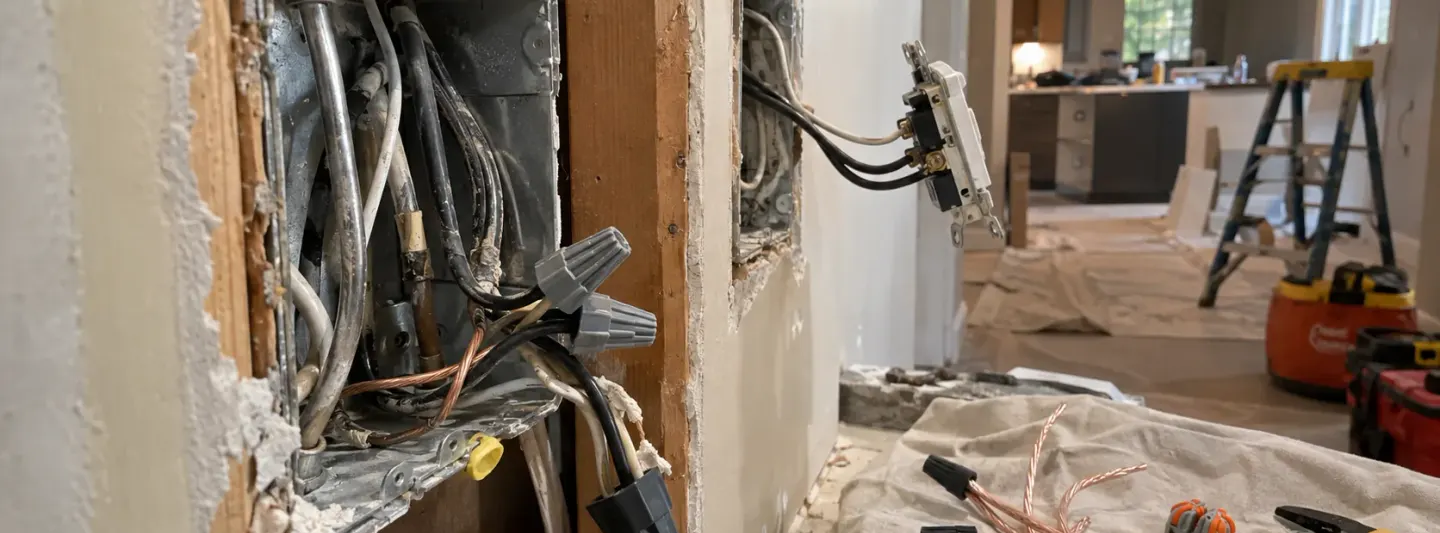
START WITH THE DECISION
Finding aluminum branch wiring does not automatically mean the house needs a complete copper rewire.
THE THREE PERMANENT PATHS
CPSC Publication 516 identifies complete copper replacement, COPALUM connection repair and AlumiConn connection repair as permanent approaches to older aluminum branch-circuit wiring.
Those three options describe very different projects.
A full copper rewire replaces the older aluminum wires that feed outlets, switches, lights and other household circuits with new copper wiring. COPALUM and AlumiConn take a different approach. The aluminum wiring stays in the walls, but the places where it connects to outlets, switches, fixtures or other wires are repaired using an aluminum-to-copper connection system.
The cost question therefore comes after the scope question. A quote for forty connection repairs should not be compared directly with a quote to rewire every branch circuit in the house.
Repair affected aluminum connections with a listed set-screw connector and copper pigtail.
Repair aluminum connections with the proprietary crimp system described in CPSC guidance.
Install new copper branch circuits and abandon or remove the original aluminum wiring.
2026 COST MODEL
Repairing the connections and rewiring the house are two very different jobs.
There is no single national database that prices every AlumiConn or COPALUM remediation project. Connection counts, local electrician rates, installer availability and documentation requirements vary too much for one per-home number to describe every market accurately.
Current 2026 contractor and cost-guide pricing nevertheless gives a useful planning framework. AlumiConn whole-home remediation commonly appears in roughly the $1,500–$7,500 planning band, while COPALUM projects are frequently quoted higher because the system requires specialized tooling and trained installers. Large houses, high device counts and difficult junction boxes can exceed those figures.
Full copper replacement moves into conventional whole-house rewiring economics. Current national cost guides place professional rewiring at approximately $2–$5 per square foot as a useful first-pass range before unusually difficult access, panel work and finish restoration.
These ranges are not interchangeable. Connector remediation is primarily a connection-count project. Rewiring is primarily a circuit-routing and access project.
IDENTIFY THE RIGHT WIRING FIRST
Aluminum at the main panel does not automatically mean the house has the older wiring problem.
The aluminum-wiring problem discussed by the U.S. Consumer Product Safety Commission mainly concerns the smaller wires that were used decades ago for ordinary household circuits—the wiring that feeds outlets, switches and lights.
CPSC research focused especially on 15- and 20-amp household circuits installed with aluminum wire. This type of wiring became common in the mid-1960s and is most strongly associated with homes wired during the late 1960s and early 1970s.
That should not be confused with every aluminum conductor found in a modern electrical system. Larger aluminum conductors are still used for services and feeders. Finding aluminum at the service entrance does not, by itself, establish that the house has the older branch-circuit condition discussed in this report.
Smaller conductors serving ordinary receptacles, switches, lighting circuits and connected equipment.
Larger conductors used elsewhere in electrical distribution are a different application and need their own assessment.
Do not remove receptacles, switches or panel covers to identify wiring unless you are qualified to perform that work. CPSC guidance specifically advises consumers without electrical training not to inspect or repair these systems themselves.
WHY THE CONNECTIONS MATTER
The main concern is usually where the aluminum wire connects to something else.
The wire hidden inside the wall is only part of the story. The troublesome points are often the places where aluminum wire connects to an outlet, switch, another wire or a piece of equipment. A poor connection can create extra electrical resistance and heat.
Publication 516 cites a national survey in which pre-1972 aluminum-wired homes were 55 times more likely than copper-wired homes to have at least one outlet connection reach the survey's defined “Fire Hazard Conditions.”
That statistic needs context. The study addressed outlet connections in the homes surveyed; it was not a statement that every aluminum-wired home will experience a fire, and CPSC notes that the survey did not establish comparable information for homes wired after 1972.
THE KEY BUDGET IDEA
A complete connection repair has to look beyond outlets.
CPSC's permanent-repair guidance extends to aluminum connections at switches, outlets, dimmers, fixtures, appliances, junction boxes and panel locations. A proposal that prices only the visible receptacles may therefore be counting devices rather than counting the complete affected connection system.
CONNECTION MAP
Do not count only outlets. Count every place where the aluminum wiring connects.
Connection of the branch-circuit wire at the panel, plus identification of the circuit it serves.
Splices may exist where no switch or receptacle is visible.
Line, load and additional splices can create multiple aluminum connections.
A device location can contain incoming, outgoing and pigtail connections.
Lights and appliances that are wired directly into the house can also contain aluminum connection points that need to be included.
This distinction explains why “$50 per outlet” is not a reliable whole-house formula. An outlet is only one visible device. A connection is any point where the aluminum wire joins an outlet, switch, fixture, another wire or piece of equipment. A single box can contain several conductors, while a hidden junction box may contain no receptacle at all.
Before comparing bids, ask each electrician what the quoted quantity represents: devices, electrical boxes, connectors, circuits or individual aluminum-wire connection points.
THE THREE PERMANENT METHODS
CPSC Publication 516 gives homeowners a much better framework than “pigtail or rewire.”
Complete copper replacement
The aluminum branch conductors leave the active system.New copper branch circuits replace the old aluminum conductors. CPSC describes this as the best method available, while also acknowledging that it can be impractical or prohibitively expensive in some houses.
COPALUM
A permanent crimp repair at the connection points.With COPALUM, a short piece of copper wire is permanently joined to the existing aluminum wire using a specialized crimping system. CPSC cites decades of field experience and requires the repair to address the aluminum connections throughout the home.
AlumiConn
A CPSC-recognized permanent alternative.AlumiConn uses a small connector with separate screw terminals to join the existing aluminum wire to a short piece of copper wire. CPSC identifies it as the next-best permanent alternative where COPALUM is unavailable.
ALUMICONN COST LOGIC
AlumiConn is generally priced by how much connection work exists, not by house square footage alone.
Current 2026 field pricing illustrates the model. One Dallas–Fort Worth electrical contractor publishes roughly $45–$85 per outlet or switch for AlumiConn work and approximately $3,000–$7,500 for many whole-home projects in that market.
That is a regional contractor example, not a national tariff. It is useful because it shows how the job is priced: inspection, device removal, conductor preparation, connector installation, copper pigtails, reassembly, testing and documentation repeated across many locations.
Number of affected boxes
A small townhouse and a large detached house may have radically different device counts.
Conductors inside each box
A box with several cables and splices can require more work than a simple end-of-run receptacle.
Box volume
Adding connectors and copper pigtails can create practical space constraints in existing electrical boxes.
Access to fixtures and junctions
Ceiling fixtures, appliances and less-accessible boxes can increase labor beyond ordinary wall devices.
COPALUM COST LOGIC
COPALUM uses a different repair method and is not available from every electrician.
COPALUM uses a dedicated crimp system rather than an ordinary hand-installed wire connector. CPSC describes the process as creating a permanent aluminum-to-copper repair using special tooling and dies.
That specialization matters economically. Installer availability varies by region, so COPALUM pricing can reflect not only device count but the smaller pool of professionals equipped and trained to perform the method.
A current 2026 DFW contractor example places COPALUM around $60–$110 per connection, higher than its published AlumiConn range. Other markets can differ materially.
The important comparison is therefore not “which connector costs less at a supplier?” It is the installed whole-system scope, including every connection the repair is intended to address.
WHAT CPSC DOES NOT TREAT AS A COMPLETE PERMANENT REPAIR
The word “pigtail” alone does not tell you whether the repair method is acceptable.
Both COPALUM and AlumiConn end with a short copper wire connected to the original aluminum. An ordinary twist-on wire connector can look similar from the outside, but it is not the same repair method.
CPSC-sponsored testing found substantial overheating among twist-on connector repairs and does not recommend that approach as a permanent solution. Publication 516 also describes CO/ALR switches and receptacles, by themselves, as an incomplete repair because they do not address all connection types in the system.
This is a particularly useful quote-review question: “Which specific CPSC repair method does this proposal use?”
FULL COPPER REWIRE
With a full rewire, the main cost becomes getting new copper wire through the house.
Current national pricing places professional residential rewiring at about $2–$4 per square foot in Angi's 2026 data and approximately $3–$5 per square foot in HomeAdvisor's 2026 guide.
These calculated bands combine the two current national per-square-foot benchmarks. They are planning ranges rather than aluminum-specific contractor quotations.
Older aluminum-wired homes can exceed them when electricians have to work around plaster, masonry, finished basements, complex additions or limited attic and crawl-space access.
Our separate whole-house rewiring cost guide covers that broader project in detail. The important point here is that full rewiring removes the aluminum branch conductors from active service rather than remediating their existing connection points.
WHAT ELSE CAN ENTER THE REWIRE BUDGET?
Do not let an aluminum-wiring quote quietly absorb unrelated electrical upgrades.
A 1960s or early-1970s house may have other electrical conditions that are discovered during the same inspection. Those issues may be sensible to address at the same time, but they should remain visible as separate scope lines.
A panel replacement is not automatically required merely because branch wiring is aluminum.
Upgrading the home to 200-amp service can provide more electrical capacity, but it does not by itself repair the older aluminum-wire connections.
Protection upgrades may be triggered by the project or local requirements and should be priced separately.
If the electrician finds problems with the home's grounding or bonding—the safety paths that help fault current return safely—those corrections may be priced separately.
Modernization adds value, but it is not part of a like-for-like aluminum remediation comparison.
A complete rewire may involve drywall, plaster, trim and paint that connector remediation largely avoids.
REPAIR VS. REWIRE
The least invasive repair and the most complete replacement can both be rational.
Connection remediation preserves the installed aluminum conductors and minimizes wall disturbance. Copper replacement removes the old branch wiring from active service but usually costs more and can create substantial access and finish work. The decision should account for wiring condition, house access, project plans, electrician findings and any written requirements from insurers, lenders or local authorities.
INSURANCE & REAL ESTATE
Do not choose the repair method based on an assumed insurance rule.
Insurance companies, lenders and buyers can treat older aluminum branch wiring differently. Requirements can vary by company, state, underwriting program and documentation.
Before spending several thousand dollars on remediation, ask the party whose approval matters what it will accept in writing. A technically recognized repair and an insurer's internal underwriting requirement are related questions, but they are not the same question.
Documentation can also matter. Keep the electrician's scope, permit or inspection records where applicable, repair method, affected locations and final invoice rather than relying on a future seller disclosure that merely says “aluminum wiring pigtailed.”
HOW TO COMPARE QUOTES
Normalize the scope before comparing the totals.
Does the inspection identify actual aluminum branch circuits rather than simply aluminum somewhere in the panel?
Is the proposal copper replacement, COPALUM or AlumiConn?
Does “50” mean devices, boxes, connectors, circuits or connection points?
Are fixtures, appliances, junction boxes and panel terminations included where affected?
What happens if overheating or damaged insulation is discovered after a device is opened?
Is panel modification included, optional or unnecessary?
Local requirements should be stated rather than assumed.
Ask what records you receive when the repair is complete.
WHEN A CHEAP QUOTE DESERVES A SECOND LOOK
Low price is most suspicious when the scope omits connection points.
WARNING SIGNS
Some symptoms call for an electrician before they call for a cost comparison.
CPSC has historically identified warning signs including warm switch or receptacle cover plates, burning-plastic odors, flickering lights, arcing, smoke and circuits that stop working.
Those symptoms are not a DIY diagnostic checklist. If overheating, smoke, burning odor or arcing is present, the priority is professional electrical evaluation rather than opening devices to investigate the connection yourself.
FAQ
Questions homeowners usually ask after aluminum wiring appears on an inspection report.
Does every house with aluminum wiring need to be rewired?
No. CPSC Publication 516 recognizes permanent connection-level repair methods in addition to complete copper replacement. The actual scope depends on the wiring present, its condition and the repair method selected.
Is AlumiConn considered a permanent repair?
CPSC Publication 516 identifies AlumiConn as an acceptable alternative permanent repair method when COPALUM is unavailable. The agency stresses qualified installation and careful workmanship.
Is COPALUM better than AlumiConn?
CPSC describes COPALUM as having a much longer field history and AlumiConn as the next-best alternative where COPALUM is unavailable. Availability, installer access and project requirements can influence the practical choice.
Are purple aluminum-to-copper wire nuts a permanent repair?
CPSC does not recommend ordinary twist-on connector pigtailing as a permanent repair for the older aluminum branch-circuit problem addressed in Publication 516.
Can I just install CO/ALR outlets and switches?
CPSC considers CO/ALR devices alone an incomplete repair because they do not address other connection types such as fixtures, hardwired equipment and junction-box splices.
Does aluminum wiring at the main service mean the house has this problem?
Not necessarily. This report concerns older aluminum branch-circuit conductors. Larger aluminum service and feeder conductors are a different application and should not automatically be treated as the same condition.
How much does a full copper rewire cost?
Current 2026 national guides place general residential rewiring around $2–$5 per square foot as a useful first-pass planning range. Access, wall finishes, panel work and local labor can move the final price substantially.
HOW WE BUILT THIS 2026 COST GUIDE
Safety guidance and market pricing are deliberately separated.
The repair-method discussion in this report follows U.S. Consumer Product Safety Commission Publication 516, Repairing Aluminum Wiring. CPSC is used to define the older branch-circuit problem and the repair methods the agency recognizes as permanent.
National copper-rewiring ranges are based on current 2026 Angi and HomeAdvisor cost data. Connection-remediation pricing is less standardized nationally, so we use current market guides and contractor pricing only as planning evidence and label regional examples as such.
We do not convert those regional prices into a false national average. The correct quote depends on the actual number of affected connections, local labor, method availability and the condition discovered when each box is opened.
Cost evidence reviewed September 21, 2026. Electrical work and inspection requirements vary by jurisdiction.