
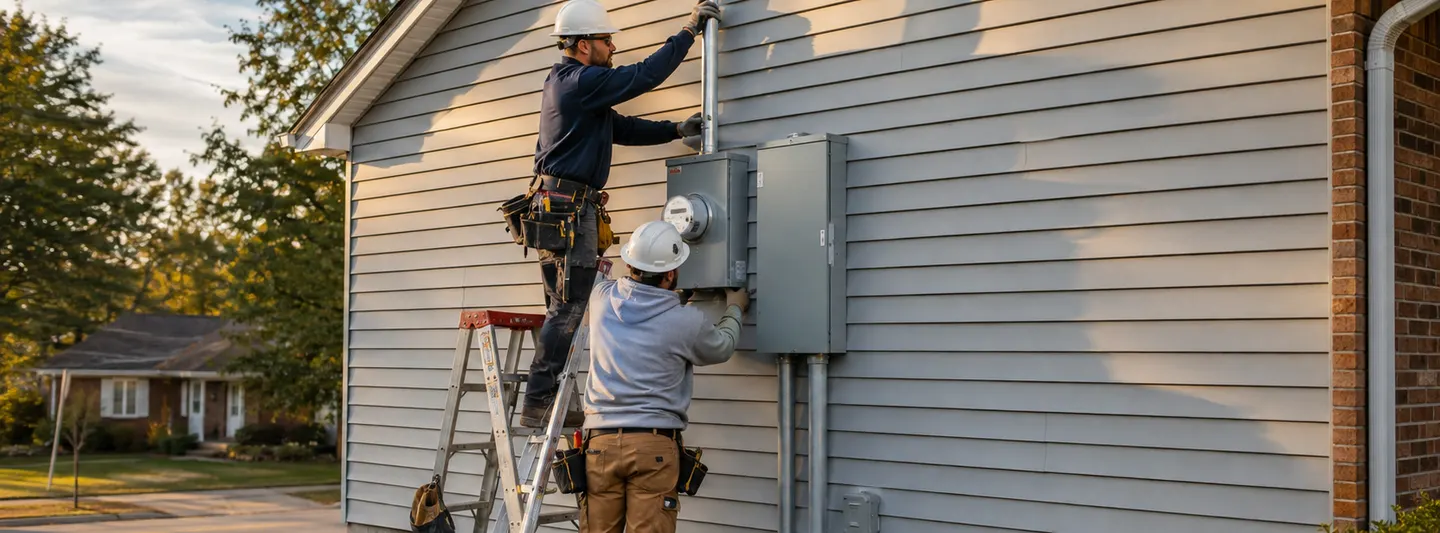
2026 NATIONAL COST ANSWER
A straightforward 200-amp service upgrade is commonly quoted around $750–$3,000 in current national consumer-cost data. The project can exceed $4,000—and sometimes far more—when the service route, meter, mast, underground work, panel location or existing wiring also has to change.
Angi's July 9, 2026 dedicated 200-amp service guide uses $750–$2,000 for a professional upgrade and says that benchmark includes a new panel, wiring and meter socket installation. A separate current Angi electrical-service-line guide uses about $1,300–$3,000 as its 200-amp upgrade average.
HomeGuide's current electrical-panel data uses $1,300–$1,600 for a 100-to-200-amp panel upgrade and $1,800–$2,500 where a new 200-amp service panel is required. Those figures are useful baselines, but they do not price every possible utility-side or long service-route condition.
WHY DO CURRENT SOURCES DISAGREE?
Because “200-amp service upgrade” is used for both a compact equipment change and a service-path construction project
The electrician can change the panel / service equipment and meter interface without moving the panel, trenching a yard or rebuilding a long service entrance.
The physical scope crosses the breaker box and now includes more of the electrical path between the utility connection and the home's distribution.
Length and site access become quantities. The job can move far above the simple national panel / service-equipment averages.
DOE / NREL electrification research gives a useful upper-bound warning: panel and service constraints can create projects from a few thousand dollars into much larger five-figure territory and can require utility coordination over extended timelines. That research is not a national contractor-price average; it demonstrates why difficult service infrastructure should not be forced into a $2,000 consumer benchmark.
DEFINE THE POWER PATH BEFORE YOU DEFINE THE PRICE
A 200-amp service begins upstream of the breaker panel
HomeGuide's current electrical-work pricing guide describes service replacement as potentially including the meter, service drop, disconnect, panel, wiring, piping and weatherhead. Which pieces belong to the homeowner, electrician or utility varies by utility and jurisdiction.
01 · UTILITY SOURCETransformer / distribution connection The utility determines the upstream connection and whether its infrastructure can support the requested service.
02 · SERVICE DROP OR LATERALOverhead wire or underground service path The physical method changes cost, construction and ownership questions.
03 · WEATHERHEAD / MAST OR UNDERGROUND ENTRYThe conductors reach the building Overhead service often has a mast / riser; underground service has a buried route and entry arrangement.
04 · METER EQUIPMENTUtility metering interface The meter socket / enclosure has its own amp rating and utility requirements.
05 · SERVICE DISCONNECT / MAIN EQUIPMENTThe 200-amp service reaches building distribution Existing arrangements vary; modern service equipment may combine functions differently from older installations.
06 · BRANCH-CIRCUIT PANELPower is distributed to the house This is the visible breaker box most homeowners call “the electrical panel.”
Before accepting a price, draw a line from the utility connection to the main breaker and ask the contractor to mark exactly which segments the quote replaces.
OVERHEAD AND UNDERGROUND 200A UPGRADES HAVE DIFFERENT COST LOGIC
An overhead project concentrates cost in service equipment and mast work; an underground project can turn distance into excavation
HomeGuide currently puts a complete electrical mast / riser replacement around $500–$1,700. Replacing wires and cable to the service drop runs about $500–$4,500 depending on length and access.
HomeGuide's February 2026 power-line data uses $10–$25 per linear foot for underground power lines versus $5–$15 per foot for above-ground lines in its national model.
Those linear-foot figures are most useful where the homeowner is actually responsible for the relevant route. A utility may own or pay for part of the service path under its tariff, while another utility may require customer-paid conduit, trench, meter equipment or service entrance work. Ownership has to be resolved before multiplying feet by a rate.
THE UTILITY BOUNDARY IS THE BIGGEST REASON THIS ARTICLE DOES NOT HAVE A NATIONAL CALCULATOR
The electrician cannot price work the utility may own, replace, subsidize or require differently in every territory
HomeGuide explicitly advises checking with the local utility before replacing service-entrance cable because, in some areas, the utility handles everything from the pole to the meter socket. That boundary can change the homeowner's bill by thousands.
OWNERWho owns the service drop / lateral? Do not assume the visible wire between pole and house is homeowner property.
METERWho supplies or approves the meter socket? Utilities commonly maintain equipment standards even when the electrician installs the enclosure.
TRANSFORMERCan existing utility infrastructure serve the requested capacity? The answer can affect schedule even where the homeowner does not pay the entire upstream infrastructure cost directly.
DISCONNECTWho schedules the outage and reconnection? A service upgrade requires de-energized work and a coordinated path back to an energized, inspected service.
UNDERGROUNDWho trenches, provides conduit and pulls conductors? These responsibilities vary widely and should be allocated in writing.
THREE SERVICE COMPONENTS CAN EACH BECOME THEIR OWN LINE ITEM
Meter box, mast and service-entrance conductors explain much of the gap between a panel price and a full service price
HomeGuide's current new meter-box installation range. The enclosure itself costs much less; labor, service configuration and utility requirements drive the installed project.
HomeGuide's current mast replacement range. Its material guide notes that homes with 200-amp service commonly use a 2-inch service mast, while final sizing and construction follow applicable requirements.
HomeGuide's range to replace wires and cables to the service drop, varying with length and accessibility. Underground work is generally more expensive because excavation can enter the project.
These are not three automatic add-ons to a $1,300 panel. A contractor's full-service quote may already include one or all of them, and a utility may control part of the work. The value of the ranges is to identify why a quote can legitimately exceed the price of the breaker box itself.
A 200A PANEL AND A 200A SERVICE ARE DIFFERENT PROCUREMENT ENDPOINTS
The panel can be rated for 200 amps while the property still has a lower-amperage service feeding it
Angi's current electrical-panel guide states the distinction directly: installing a new 200-amp panel alone does not provide the full benefit of a 200-amp service if exterior wiring and meter equipment remain rated for 100 or 150 amps.
Breaker box, main breaker / panel hardware and transfer of existing circuits. This can be done at the same service amperage.
Every required component between the utility connection and the building's service equipment must support the intended 200-amp rating.
If you only need a same-amperage panel replacement or more breaker spaces, our Electrical Panel Upgrade Cost report is the better benchmark. This article is for the project where the service capacity itself is moving toward 200 amps.
DO THE LOAD CALCULATION BEFORE YOU BUY 200 AMPS
Heat pumps, EV chargers and electric appliances can justify more capacity—but none is automatic proof by itself
DOE-supported home-electrification guidance distinguishes between physical breaker space and actual service capacity and warns against sizing a service by simply adding the ratings printed on every breaker. Accepted residential load-calculation methods account for diversity in household loads.
STRONGER CASEExisting load + documented future loads exceed available service capacity The electrician can show the calculation and the new 200-amp design solves a quantified constraint.
WEAKER CASE“The panel is old, so you need 200 amps” Age can justify replacement but does not by itself calculate required service capacity.
WEAKER CASE“All the breakers add up to more than 100 amps” DOE guidance specifically explains why simple breaker arithmetic is not the residential service-load calculation.
ALTERNATIVE CASELoad management or efficient equipment keeps demand within the existing service DOE identifies approved load-management approaches as a possible alternative in appropriate electrification projects.
A 200-amp service can still be a sensible long-term choice. The point is to separate capacity need from equipment marketing, then decide whether the additional infrastructure cost buys useful headroom.
THE ELECTRICIAN MAY FINISH THE PHYSICAL WORK IN A DAY WHILE THE PROJECT TAKES WEEKS TO COORDINATE
Utility and inspection dependencies are part of service-upgrade cost even when they do not appear as labor hours
01Load calculation + scope Confirm 200 amps is the target and identify panel, meter and service-route work.
02Utility application / approval where required Resolve meter requirements, service point, transformer / lateral questions and utility scheduling.
03Permit HomeGuide's current electrical-permit benchmark is about $50–$350, though local charges can differ materially.
04Disconnect Power is de-energized so service equipment can be changed safely.
05Electrical construction Panel / disconnect, meter equipment, service conductors, mast or underground entry are completed according to the defined scope.
06Inspection The authority having jurisdiction completes required inspection before or as part of the reconnection sequence.
07Utility reconnect / meter The completed service is returned to normal operation under the local process.
WHEN DOES A 200A UPGRADE BECOME A $5,000–$10,000+ PROJECT?
Usually when the job stops being an equipment swap and becomes site work, routing work or old-house correction
HomeGuide's February 2026 model. Only apply it to customer-paid route length after utility responsibilities are defined.
Angi's current panel-relocation range. Moving the distribution endpoint can change branch wiring and the service route simultaneously.
HomeGuide's current wire / cable replacement range to the service drop, depending on distance and accessibility.
Meter-box installation $500–$2,100; mast / riser replacement $500–$1,700 in HomeGuide's current national data.
A new 200-amp service does not automatically mean every branch circuit in the house is being rewired. Price any required wiring correction as its own scope.
DOE / NREL research on affordable electrification has documented that panel and service constraints can cost customers $2,000–$30,000 in difficult cases and take months because of labor and utility coordination. That range is intentionally not used as the article's “average.” It is evidence that a complicated service project can leave the normal residential panel benchmark behind.
THE 200A RATING HAS TO SURVIVE THE ENTIRE REQUIRED PATH
Where the contractor's line stops determines what the quote means
The diagram is deliberately below the pricing and scope discussion. Its purpose is not to teach electrical installation; it shows why the same phrase—“upgrade to 200 amps”—can describe a breaker-panel project or a much larger service-path project.
SIX 200-AMP SERVICE COST FILES
Use the scenario with the same endpoint—not the number closest to your contractor's quote
Angi's dedicated current 200-amp guide uses $750–$2,000. This is the low-complexity reference, not a promise for a project that needs trenching or panel relocation.
Angi's July 2026 electrical-service-line guide uses $1,300–$3,000 average for a 200-amp upgrade and warns that relocation / older wiring can push the project beyond $4,000.
HomeGuide uses $1,800–$2,500. Confirm whether meter equipment and service entrance work are included before treating this as a complete 100-to-200-amp service price.
HomeGuide's mast / riser replacement range is $500–$1,700. That amount can sit on top of or inside the service quote depending on the contractor's endpoint.
HomeGuide uses $10–$25 per foot for underground power-line installation in its current national model. Resolve utility ownership before applying that rate to the property.
A 200-amp service does not repair unrelated branch wiring. Keep those corrections separate so a high project total does not get mislabeled as “the cost of 200 amps.”
BID ENDPOINT TEST · $1,900 VS $4,600
The higher quote is not overpriced until the physical endpoints match
New 200A main panel.
Transfer existing circuits.
Permit included.
Existing meter / service entrance retained.
Utility-side work excluded.
New 200A service equipment.
New meter enclosure.
New overhead mast / service entrance conductors.
Utility disconnect / reconnect coordination.
Permit + inspection included.
Bid A stops at a different point. To compare them, determine whether the existing meter, mast and conductors can legally and practically remain for the desired 200-amp service. If they can, Bid B may contain unnecessary scope. If they cannot, Bid A may be incomplete for the stated goal.
WHY THERE IS NO 200-AMP COST CALCULATOR ON THIS PAGE
The obvious formula would create false precision
A calculator that starts with “200 amps = $X” and adds underground feet × $10–$25 would look useful but could be wrong at the most important point: the homeowner may not own or pay for that segment of the service lateral. Likewise, meter and mast costs may already be included in the electrician's base service quote.
The more defensible workflow is: load calculation → define utility ownership → mark the quote endpoint → price only the customer-paid components. Once those facts are known, a local contractor quote is more informative than a national calculator.
HIGH-INTENT PRICE ANSWERS
200-amp service upgrade cost in plain terms
How much does it cost to upgrade from 100 amps to 200 amps? Current national consumer guides put straightforward work around $750–$3,000, depending on scope. Difficult service-route, meter, relocation, utility or wiring work can push the project far higher.
How much does a 200-amp service panel cost? HomeGuide currently uses $1,800–$2,500 for a new 200-amp service panel. Confirm whether that price includes meter and service-entrance work.
How much does a 200-amp panel alone cost installed? Angi's August 2026 panel data uses $1,300–$2,000 for a 200-amp panel plus installation. A 200A panel does not automatically mean the property has been converted to full 200A service.
How much does a new electrical meter box cost? HomeGuide currently uses $500–$2,100 installed, depending on amperage, configuration and project requirements.
How much does a service mast cost to replace? HomeGuide's current range is $500–$1,700 installed.
How much does underground electrical service cost? HomeGuide's February 2026 national model uses $10–$25 per foot for underground power lines versus $5–$15 per foot for above-ground. The homeowner's actual responsibility depends on the utility boundary.
Do I need 200 amps for a heat pump or EV charger? Not automatically. DOE-backed guidance recommends calculating the existing and proposed load and recognizes load-management approaches where appropriate.
Does upgrading to 200 amps mean rewiring the entire house? No. Service capacity and branch-circuit wiring are separate scopes. Existing wiring may require corrections in some homes, but whole-house rewiring is not inherently included in a 200-amp service upgrade.
METHODOLOGY & SOURCES
Current 2026 pricing separated from utility ownership and service-capacity planning
Pricing was reviewed August 9, 2026. Angi's July 9, 2026 service guides provide current 200-amp market benchmarks. HomeGuide is used for panel / service-panel, meter, mast, service-line and overhead / underground cost components. DOE / NREL sources support the load- calculation and electrification-capacity context and are not treated as contractor-price averages.
$750–$2,000 professional 200A upgrade benchmark; panel, wiring, meter socket, permit and inspection context.
02 · ANGI · UPDATED JUL. 9 2026Electrical Service Line Cost$1,300–$3,000 average 200A upgrade context; underground service lines and higher-cost project conditions.
03 · HOMEGUIDE · CURRENTElectrical Panel / 200A Service Panel Cost$1,300–$1,600 for 100A-to-200A panel upgrade; $1,800–$2,500 for a new 200A service panel.
04 · HOMEGUIDE · CURRENT 2026 GUIDEElectric Meter Box Cost$500–$2,100 installed meter box; 200A box material context; $500–$1,700 mast / riser and service-line considerations.
05 · HOMEGUIDE · CURRENT 2026 GUIDEElectrical Mast / Riser Cost$500–$1,700 mast replacement; $500–$4,500 wires / cable to service drop; utility-ownership warning.
06 · HOMEGUIDE · FEB. 13 2026New Electrical Service Line Cost$10–$25/ft underground and $5–$15/ft above-ground national line-installation model; meter, panel and permit context.
07 · DOE BUILDING SCIENCE EDUCATION / BENEFITHome Electrification and Electric Panel UpgradesPhysical space vs capacity, residential load-calculation methods and load-management alternatives.
08 · U.S. DOE / NRELAffordable Residential ElectrificationResearch context on high-cost panel / service constraints and utility-coordination timelines in difficult electrification projects.
This is U.S. cost-planning information, not electrical installation guidance. Service ownership, meter requirements, conductor sizing, grounding / bonding, disconnect configuration, utility procedures, load calculations, permits and inspection vary by property and jurisdiction. A qualified electrician and the serving utility must determine the final 200-amp service design.