
THE 2026 PRICE IS THE STARTING POINT
Most boiler replacements land around $4,500–$10,000 in current national planning data, but an older heating system can make the boiler itself only one part of the invoice.
This Old House's April 2026 cost guide places a typical installed boiler replacement at $4,500–$10,000.
Angi's August 3, 2026 national dataset reports an average installation cost of $5,912, with its complete dataset stretching from roughly $600 to $12,000 depending on boiler type, fuel, capacity and project conditions.
That unusually broad lower-to-upper range is easier to understand when the project is separated into two things: the new boiler and the existing heating system it has to join.
BEFORE SHOPPING FOR A BOILER
Take an inventory of the heating system that is staying in the house.
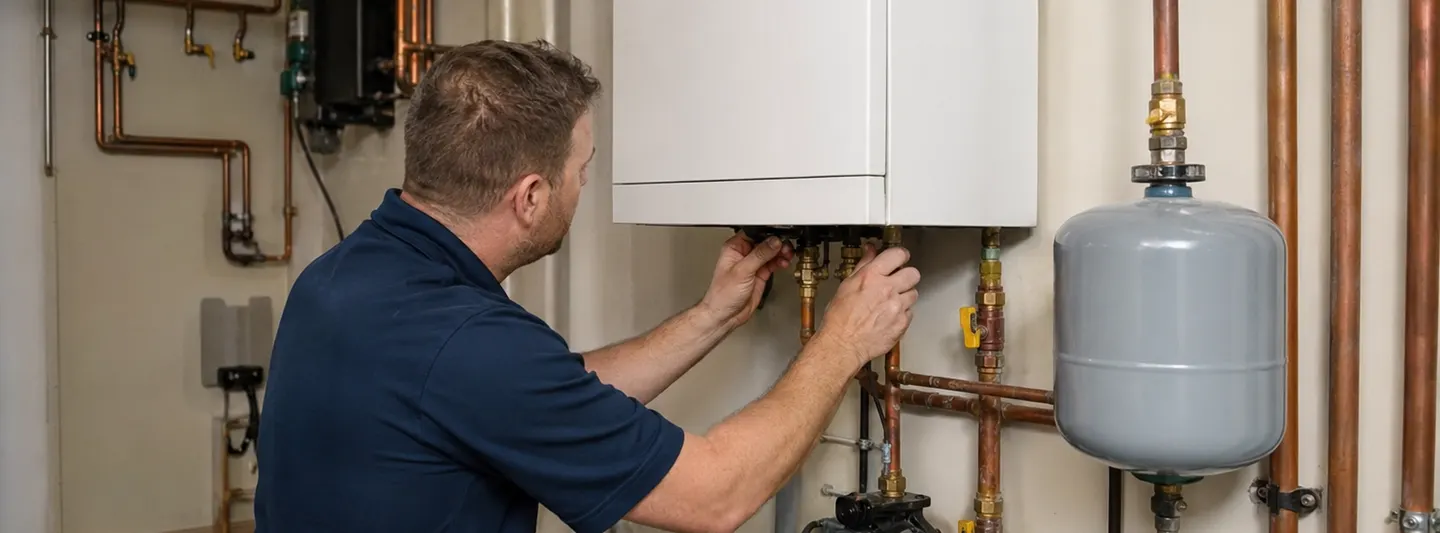
A furnace replacement mostly interacts with an air distribution system. A boiler belongs to a water- or steam-based heating system, which means the mechanical room can contain equipment that remains long after the boiler itself is removed.
Fuel, output, efficiency, combustion design and controls begin here.
Gas, oil, propane or electric infrastructure determines what the replacement can use without conversion work.
A new combustion appliance may not use the old exhaust path in exactly the same way.
Existing circulators, zone valves and related hydronic components may be reused, replaced or redesigned.
Baseboards, radiators, radiant loops or other existing heat emitters define the temperatures and flow the system has historically used.
Multiple heating zones can make the controls around the boiler almost as important as the boiler's own control board.
The economical replacement preserves equipment that is still useful.
Existing radiation, piping and controls do not automatically need replacement because the boiler has failed. A like-for-like project can often retain substantial portions of the hydronic system.
This is one reason a boiler replacement can be more economical than replacing the entire heating system. The distribution infrastructure already exists.
But old infrastructure does not become compatible simply because keeping it is cheaper.
Deteriorated components, incompatible controls, incorrect venting, failed pumps, leaking valves or a system design that does not match the new equipment can create legitimate additional work.
The useful question is therefore not “Are they replacing more than the boiler?” but “Why does each additional component need to change?”
FUEL CHANGES BOTH EQUIPMENT AND INSTALLATION
Current 2026 pricing spans several very different boiler categories.
Angi's August 2026 dataset gives the following broad installed planning ranges by fuel. These ranges overlap heavily because boiler output, manufacturer, efficiency and installation complexity remain important.
Common residential fuel where gas service already exists. Venting and combustion configuration remain part of the installation.
Particularly relevant to older cold-climate housing stock. Fuel storage and combustion equipment remain part of the wider system.
Similar combustion-system considerations to gas, but with a different fuel supply arrangement.
Eliminates combustion venting but shifts attention to available electrical capacity and operating economics.
I would use those numbers to establish whether a proposal is broadly plausible, not to choose a fuel. Fuel availability, local energy prices, climate and the infrastructure already in the house can matter more than the national equipment range.
HOUSE SIZE IS A BUDGET INPUT, NOT A LOAD CALCULATION
Published square-foot estimates are useful for budgeting. They should not become the equipment-sizing method.
Angi currently estimates roughly $5,100–$7,800 for a boiler serving a 2,000-square-foot home, while This Old House gives a similar $5,000–$8,000 planning range.
Those figures are helpful before bids arrive, but two 2,000-square-foot houses do not necessarily have identical heating loads. Climate, insulation, air leakage, windows, building geometry and indoor temperature assumptions all affect how much heat the building actually needs.
Oversizing is not an upgrade simply because the larger unit costs more. The capacity should follow the building's heating requirement and the distribution system rather than automatically copying an old nameplate.
HIGH EFFICIENCY CAN CHANGE THE INSTALLATION
A 95% boiler is not necessarily a drop-in version of an older atmospheric boiler.
ENERGY STAR currently requires certified residential gas boilers to reach at least 90% AFUE and certified oil boilers to reach at least 87% AFUE. AFUE expresses the relationship between annual fuel input and useful heating output.
High-efficiency condensing gas boilers recover additional heat from combustion gases. That efficiency changes the exhaust conditions, which is why DOE replacement analyses specifically account for venting modifications and condensate handling when older boilers are replaced by condensing equipment.
May have been designed around hotter exhaust from a different boiler category.
Vent materials, routing and condensate disposal become explicit parts of the replacement design.
That means a higher-efficiency proposal can legitimately contain work that does not appear in a lower-efficiency replacement quote. The right comparison is the complete installed system, not equipment AFUE in isolation.
Buying a condensing boiler does not guarantee that the heating system will spend all winter condensing.
Condensing boilers achieve their highest efficiencies by recovering heat from water vapor in the combustion gases. DOE Building America guidance explains that lower return water temperatures help make that condensation possible.
Existing radiators or baseboards, control strategy and system temperatures therefore influence how the new boiler operates after installation.
This does not mean an older hydronic system cannot use a condensing boiler. It means that the equipment rating and the operating conditions of the complete system are two different questions.
OLDER BOILER ROOMS DESERVE A DIFFERENT KIND OF ESTIMATE
Removal can expose costs that have nothing to do with the price of the replacement boiler.
Large older boilers can require more labor to dismantle and move out of a basement or constrained mechanical room.
Existing combustion venting needs to be evaluated against the requirements of the replacement equipment.
Replacement day can reveal components that are already leaking, seized, corroded or no longer appropriate.
Angi specifically identifies asbestos-related work as a potential additional cost around very old boiler systems. Suspect materials require appropriate evaluation rather than casual demolition.
THE REPLACEMENT DECISION IS NOT PURELY ABOUT AGE
A repair can still make sense when the rest of the boiler is healthy and the failure is contained.
Angi's August 2026 boiler-repair guide puts professional repairs broadly between $95 and $1,500. That is far below a typical full replacement when the problem is repairable and the boiler still has a reasonable remaining life.
ENERGY STAR suggests considering replacement when a furnace or boiler is more than about 15 years old, particularly when repairs are becoming frequent or heating bills are increasing.
I would treat age as a reason to widen the comparison rather than an automatic demolition date. The condition of the heat exchanger, controls, combustion system and surrounding hydronic equipment still matters.
TWO BOILER QUOTES · FIND THE SCOPE DIFFERENCE
The useful comparison is what each contractor intends to leave behind when the heat comes back on.
A MORE USEFUL WAY TO THINK ABOUT THE TOTAL
The installed price is a boiler plus the cost of making the existing heating system accept it properly.
This framework also explains why a $6,000 bid and a $9,000 bid can both be defensible. If the cheaper proposal retains sound existing pumps, venting and controls while the more expensive proposal replaces all of them without a clear reason, the difference deserves scrutiny. If the expensive proposal is correcting known compatibility or safety issues, the two bids are not buying the same finished system.
SOURCES CHECKED AUGUST 24, 2026
Current market estimates are separated from efficiency and boiler-system guidance.
Repair Cost Ledger provides cost-planning information rather than HVAC design, combustion-safety, electrical, asbestos, engineering or code advice. Boiler sizing and installation depend on the building's actual heating load, existing distribution system, fuel, venting, equipment manufacturer requirements and applicable local codes.