
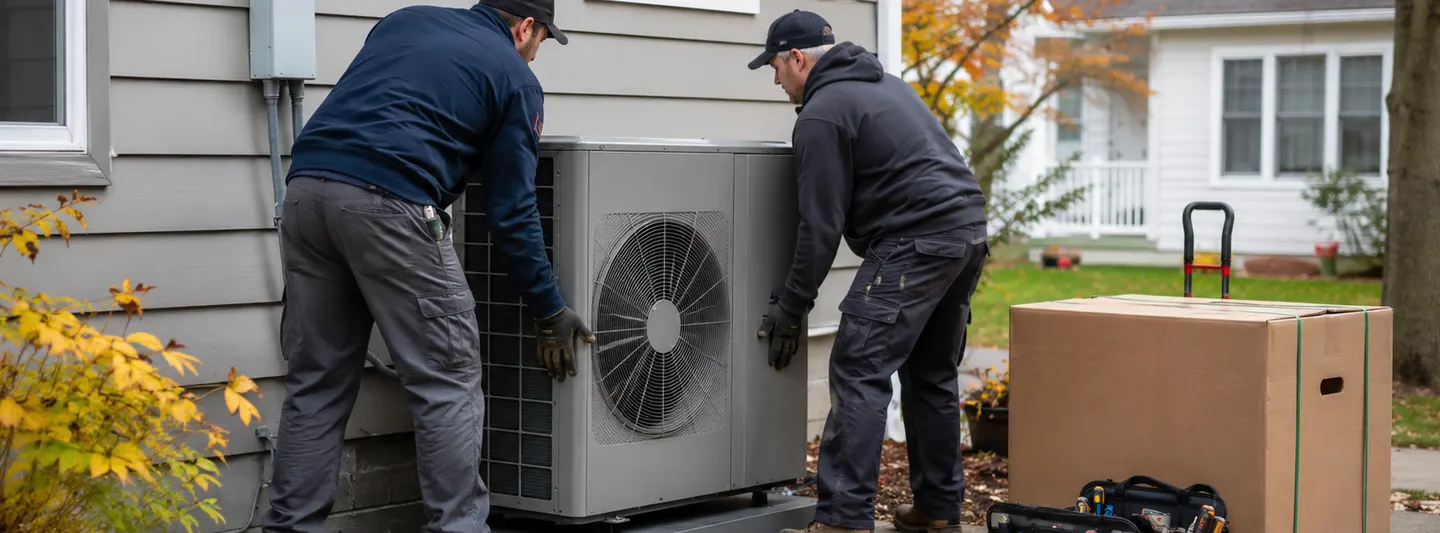
2026 AIR-SOURCE REPLACEMENT COST
A central ducted air-source heat pump costs about $4,000–$12,000 installed. Angi's current national data puts most heat-pump projects around $4,237–$7,943, with an average near $6,087.
HomeGuide's current air-source heat-pump guide uses $4,000–$12,000 installed, including about $1,500–$7,000+ for equipment and $2,000–$3,500 for installation labor. A typical 3-ton system in its dataset runs roughly $5,700–$8,500.
Angi's current 2026 heat-pump dataset reports $4,237–$7,943 for most homeowners, with about $6,087 average. Its full observed range extends from roughly $1,454 to $12,000 because system type and project scope vary.
HEAT PUMP QUOTE-GAP CALCULATOR
Start with the contractor's quote, then expose the costs the proposal explicitly leaves out
Enter the quoted heat-pump price and select only items the proposal says are excluded. Published replacement ranges often disagree because one quote is equipment-focused while another includes indoor equipment, electrical work, line sets, removal or site work.
WHY CAN TWO CURRENT COST GUIDES DIFFER BY MORE THAN $10,000?
“Heat pump installation” is being used for three different capital projects
Ducts, electrical service, pad, refrigerant route and indoor equipment may already be suitable. This is the cleanest path toward the lower national replacement ranges.
Outdoor unit and indoor air handler / coil are replaced together. Controls, line set, pad or limited duct work may also enter the quote.
Now the contractor may be adding electrical capacity, backup heat, a compatible air handler, a new control strategy and changes to the old furnace / venting infrastructure.
A conversion from hydronic boiler heat has a different starting point because the existing distribution system may use water rather than ducts. Compare that baseline in the boiler replacement cost guide.
HomeGuide's own current pages illustrate the distinction. Its air-source-specific guide uses $4,000–$12,000 installed, while its broader heat-pump guide uses $10,000–$25,000+ for common air-source systems in an average-sized house and explicitly includes the air-handler context. Neither number should be applied blindly to a quote without knowing the scope.
The first line of a heat-pump comparison should read “replacement,” “complete system,” or “conversion.” Only then does the price become meaningful.
A HEAT PUMP HAS TO WIN TWO DESIGN DAYS
The cooling load may select one capacity while the coldest heating conditions test whether that same system can carry the house
ENERGY STAR's current consumer guidance says proper sizing is essential and recommends that the contractor verify the system using Manual J. That matters more for heat pumps than a simple “replace the old tonnage” rule because the equipment is being asked to satisfy both cooling and heating loads.
Bigger is not automatically better. ENERGY STAR warns that both oversized and undersized HVAC equipment can compromise comfort and performance.
Heating capacity is not constant across all outdoor temperatures. Cold-climate selection therefore requires low-ambient performance data.
This is the core reason the article does not include a square-foot sizing calculator. HomeGuide's 3-ton range is useful for pricing a contractor-selected 3-ton unit. It is not evidence that a particular 2,000-square-foot house should have a 3-ton heat pump.
IN A COLD CLIMATE, THE MOST IMPORTANT NUMBER MAY BE HIDING BELOW SEER2 AND HSPF2
Ask what heating capacity remains at 5°F
ENERGY STAR's current Cold Climate designation requires a qualifying heat pump to demonstrate a COP of at least 1.75 at 5°F and to retain at least 70% of its 47°F heating capacity at 5°F. The specification also requires controls verification so the low-ambient test performance reflects how the unit's native controls operate.
Useful starting capacity, but not the cold-weather answer.
ENERGY STAR Cold Climate requires ≥70% capacity retention.
Low-temperature efficiency must also clear the current criterion.
DOE's Residential Cold Climate Heat Pump Challenge exists for exactly this reason: conventional heat-pump capacity and efficiency can decline as outdoor temperatures fall, while newer cold-climate technology is designed to maintain stronger low-ambient performance.
BACKUP HEAT IS PART OF THE HEAT-PUMP PRICE EVEN WHEN IT RARELY RUNS
The design question is not whether backup exists; it is when, how and how much of it the house needs
ENERGY STAR says a Cold Climate air-source heat pump can continue operating below 5°F, while pairing it with a backup energy source can provide heating when conditions become even more demanding. Backup may be electric resistance or a dual-fuel furnace, depending on the system design.
The strips can create a large electrical load compared with the compressor alone. Panel / service capacity should be checked before the equipment is ordered.
The system can use the heat pump through much of the season while retaining combustion heat as the backup strategy.
Stronger capacity retention can reduce how much supplemental heat is required, but the house load and local design temperature still control the design.
The quote should identify the backup equipment, its capacity and the control strategy. A homeowner comparing an $8,000 project and a $13,000 project may otherwise miss that one price includes the heat source that carries the house during the coldest hours and the other does not.
CONVERSION COST IS WHERE THE HVAC CONTRACTOR MEETS THE ELECTRICIAN
Replacing a gas furnace + AC with a heat pump can move money out of the mechanical quote and into the electrical scope
HomeGuide's current broad heat-pump guide lists an electrical panel upgrade at $1,800–$2,500 when the existing panel cannot support the project. Its air-source installation breakdown uses $200–$500 for ordinary electrical work where major service upgrades are not required.
PANEL$1,800–$2,500 if an upgrade is required This is not a universal heat-pump charge. It applies when the existing electrical capacity is insufficient.
AIR HANDLER$1,500–$3,400+ replacement benchmark HomeGuide's current indoor-unit range where the existing air handler is incompatible or being replaced separately.
LINE SET$15–$25 / linear ft. for longer new runs Relevant where the old refrigerant route cannot simply be reused under the selected manufacturer's requirements.
PAD$300–$500 HomeGuide's current outdoor-unit pad allowance where the project needs a new base.
REMOVAL$200–$500 Old-equipment removal / disposal benchmark in HomeGuide's broad heat-pump project data.
PERMIT$100–$300+ HomeGuide's air-source guide; actual HVAC / electrical permits vary by jurisdiction.
These amounts should never all be stacked onto every $4,000–$12,000 installation. Many contractors already include several of them. That is exactly why the calculator above asks for confirmed exclusions instead of automatically inflating the national base price.
THE HEATING AND COOLING RATINGS BELONG TO THE CERTIFIED SYSTEM COMBINATION
Match the indoor unit and outdoor unit before comparing SEER2, HSPF2 or cold-climate performance
AHRI's public certification directory is the primary place to verify performance-certified heat-pump combinations. AHRI explains that the directory lets consumers search certified ratings and download certificates for residential air-source heat-pump systems.
OUTDOOR MODELCompressor + outdoor heat exchanger — exact model, capacity class and refrigerant.
INDOOR MODELAir handler / coil — the indoor model that creates the certified combination.
AHRI REFERENCECertificate identity — use the unique certified reference rather than relying on a sales brochure.
SEER2 / HSPF2Seasonal cooling / heating ratings — compare the exact matched system, not a family maximum.
5°F DATACold-climate capacity + COP where relevant — especially important in heating-dominated climates.
HEAT PUMPS CAN EXPOSE A DUCT PROBLEM THAT A HOTTER FURNACE MASKED
Airflow matters because the heat pump delivers comfort through the same distribution network
HomeGuide's broad heat-pump guide uses $40–$65 per linear foot for new ductwork. The air-source guide also warns that existing ducts may require sealing, resizing or replacement if they are not correctly sized or sealed for the new system.
This is the lowest-infrastructure replacement case and helps explain why direct heat-pump replacements can sit near the lower market range.
The project can remain a heat-pump replacement while gaining several labor and material line items outside the equipment price.
At that point the comparison should use our Ductwork Replacement Cost report rather than hiding the duct budget inside a heat-pump average.
DO NOT BUY A HEAT PUMP FROM A NATIONAL “SAVINGS PERCENTAGE”
Operating economics depend on what fuel the heat pump replaces, local utility rates and how much backup heat the design uses
A heat pump can be highly efficient because it moves heat rather than generating all useful heat directly from electric resistance. But a national operating-cost promise is not transferable to every home. Replacing electric resistance, propane, oil or a modern natural-gas furnace creates different economics in different utility territories.
OLD HEATWhat annual fuel / electricity use is actually being displaced?
NEW RATEWhat does electricity cost in your utility territory and rate plan?
CLIMATEHow many hours occur near the heat pump's low-temperature operating range?
BACKUPHow often will resistance or dual-fuel backup be called?
EFFICIENCYWhat does the exact certified system deliver at relevant temperatures?
That is enough information to build a local operating-cost model later. It is deliberately not turned into a national payback calculator here, because doing so would require assumptions about utility prices and weather that change faster than the equipment-cost data.
REPAIR OR REPLACE THE HEAT PUMP?
A $410 average repair is easy to defend; repeated four-figure repairs on an aging system deserve a replacement bid
Angi's May 2, 2026 heat-pump repair guide places the average repair at about $161–$661, with roughly $410 average. HomeGuide uses $150–$650 for minor repairs and up to $2,500+ for major heat-pump repairs.
Repair economics are strong when the rest of the system is healthy.
Compressor, coil or repeated refrigerant work can change the capital decision.
Check load, low-temperature capacity, ducts and electrical scope before repeating the old specification.
Angi's current replacement guidance points homeowners toward replacement when a unit is older, inefficient or facing repair costs around 30%–50% of replacement. Treat that percentage as a consumer decision trigger rather than a universal mechanical rule.
WHY 5°F PERFORMANCE CHANGES THE PURCHASE
Heating load rises as outdoor temperature falls while heat-pump capacity is being tested in the opposite direction
This is a conceptual procurement graphic, not a load calculation. ENERGY STAR's cold-climate criteria give the homeowner a real certified checkpoint at 5°F: at least 70% capacity retention relative to 47°F and COP of at least 1.75. The home's actual load curve still has to be calculated locally.
SEVEN HEAT-PUMP REPLACEMENT FILES
The correct benchmark changes when the project boundary changes
HomeGuide's current 3-ton air-source range is $5,700–$8,500 installed. This is the cleanest reference for a like-for-like central replacement.
HomeGuide uses $6,500–$11,000. Capacity should come from the heating / cooling load, not the cost table.
HomeGuide's broad whole-home guide uses $10,000–$25,000+. This explains why a complete system can legitimately sit far above a replacement-only national average.
Compare the exact 5°F output and backup design before comparing equipment price. A cheaper unit that needs much more supplemental heat is not the same heating system.
If a panel upgrade is genuinely required, HomeGuide's current planning allowance is $1,800–$2,500 before other conversion-specific scope.
HomeGuide uses $40–$65 per linear foot for new ductwork. Keep that quantity separate so the heat-pump price itself does not appear artificially high.
Once repair moves beyond routine $161–$661 territory, compare the repair against a replacement that corrects sizing, low-temperature performance and infrastructure rather than simply copying the old unit.
IF TWO HEAT-PUMP BIDS DIFFER BY $6,000, READ THEM IN THIS ORDER
The sequence usually reveals the difference faster than comparing brands
FIRSTProject boundary Is each bid replacement-only, complete system or conversion?
SECONDIndoor + outdoor model combination Are both contractors pricing a complete AHRI-certified match?
THIRDHeating design Same Manual J load, design temperature, 5°F capacity and backup strategy?
FOURTHDuct scope Reuse, modification or replacement?
FIFTHElectrical scope Ordinary circuit work, auxiliary heat, or full panel / service upgrade?
SIXTHCloseout Permit, line set, pad, controls, removal, startup / commissioning and warranties included?
Only after those six lines match does “Brand A costs $2,000 more than Brand B” become a useful statement.
HIGH-INTENT PRICE ANSWERS
Heat pump replacement cost in plain terms
How much does an air-source heat pump cost in 2026? HomeGuide currently uses $4,000–$12,000 installed for central ducted air-source systems. Angi says most projects run $4,237–$7,943.
How much does a 3-ton heat pump cost? HomeGuide's current installed range is $5,700–$8,500.
How much does a 4-ton heat pump cost? HomeGuide currently uses $6,500–$11,000 installed.
Why do some heat-pump quotes exceed $15,000? Complete systems and conversions can include the air handler, electrical upgrades, backup heat, ducts, line sets, controls, removal and other infrastructure beyond an equipment-focused replacement.
How much can an electrical panel upgrade add? HomeGuide's current heat-pump planning range is $1,800–$2,500 where the existing panel actually needs upgrading.
What qualifies as an ENERGY STAR Cold Climate heat pump? Current criteria include COP ≥1.75 at 5°F and at least 70% of the 47°F heating capacity retained at 5°F, along with the applicable ENERGY STAR SEER2 / HSPF2 criteria and controls verification.
Does a cold-climate heat pump still need backup heat? It depends on the building load and local design temperature. ENERGY STAR notes that cold-climate ASHPs continue operating below 5°F, while backup can support the home at more demanding conditions.
How much does heat-pump repair cost? Angi's May 2026 national range is $161–$661, about $410 average. HomeGuide uses $150–$650 for minor repairs and up to $2,500+ for major repairs.
METHODOLOGY & SOURCES
Current 2026 replacement pricing kept separate from certified low-temperature performance
Pricing was reviewed August 9, 2026. HomeGuide's air-source page is the primary replacement-cost dataset; its broader heat-pump guide is used deliberately to show how complete-system boundaries change the national range. Angi provides a current independent market cross-check. ENERGY STAR, DOE and AHRI provide technical criteria, low-temperature performance context and certification tools.
$4,000–$12,000 installed; $5,700–$8,500 for 3 ton; $6,500–$11,000 for 4 ton; labor, electrical and permit breakdown.
02 · HOMEGUIDE · OCT 30 2025 · CURRENT 2026 GUIDEComplete Heat Pump Cost$10,000–$25,000+ broad air-source project range; air handler, panel, line-set, pad, removal, duct and efficiency context.
03 · ANGI · CURRENT 2026 DATAHeat Pump Costs and Installation Costs$4,237–$7,943 for most projects; ~$6,087 average; current national independent pricing cross-check.
04 · ANGI · MAY 2 2026Heat Pump Repair Cost$161–$661 average repair range and ~$410 national average.
05 · ENERGY STAR · CURRENTHeat Pump Key Product CriteriaCurrent ducted / non-ducted ENERGY STAR criteria and Cold Climate requirements: COP ≥1.75 at 5°F and ≥70% capacity retention.
06 · ENERGY STAR · CURRENTAir-Source Heat PumpsProper sizing, cold-climate use and backup-heating consumer guidance.
07 · U.S. DOE · CURRENTResidential Cold Climate Heat Pump ChallengePrimary DOE context on capacity / efficiency decline in colder weather and next-generation cold-climate performance.
08 · AHRI · CURRENTDirectory of Certified Product PerformancePublic source for certified HVACR equipment combinations, ratings and heat-pump certificates.
This is U.S. cost-planning information. Heat-pump capacity, Manual J load, low-ambient performance, backup heat, electrical load, ducts, refrigerant, controls, permits and installation requirements depend on the actual building, climate, equipment combination and jurisdiction. Final design should follow the selected manufacturer's data and a qualified HVAC contractor's load / system design.