
2026 COMMERCIAL COST ANSWER
A commercial rooftop HVAC replacement commonly starts around $15,000 for a small packaged RTU and can exceed $50,000 for larger or more advanced units. Current 2026 per-ton planning data is about $2,800–$3,500 per ton for smaller RTUs and $1,800–$2,500 per ton for larger commercial units.
A January 2026 commercial replacement guide places small packaged rooftop units at about $15,000 to start and larger, advanced RTUs at $50,000+. A May 2026 facilities- management dataset gives the more useful fleet-planning metric: $2,800–$3,500 per ton for smaller units and $1,800–$2,500 per ton for larger commercial RTUs.
HomeGuide's current broader commercial-HVAC guide uses $6,000–$30,000+ for commercial HVAC installation, depending on equipment type, building size and layout. That broad number should not be used as a universal rooftop-unit price: RTUs, split systems, VRF and central plants are different capital projects.
2026 RTU FLEET BUDGET PLANNER
Estimate the installed capacity first, then keep crane, curb and electrical scope visible
OxMaint's May 2026 commercial RTU dataset uses $2,800–$3,500 per ton for smaller rooftop units and $1,800–$2,500 per ton for larger commercial units. The tool applies that capacity model, then optionally adds one project-level $3,000–$8,000 allowance for common crane, electrical and curb extras.
DEFINE THE REPLACEMENT ENDPOINT
“Replace the RTU” can mean set a new cabinet on the old curb—or redesign everything from roof opening to BAS point list
Similar capacity, compatible curb, existing duct transitions, electrical service and controls retained where appropriate. This is the closest commercial equivalent to a straightforward equipment replacement.
Equipment changes footprint or supply / return openings. The project adds a curb adapter, duct transition or roof-interface work.
New disconnect, feeder, controls, sensors, BAS integration or economizer sequence extends the project beyond mechanical setting.
Capacity, zoning, ventilation, heating type, heat-pump strategy or duct system changes. The old unit's tonnage is now historical data, not the design answer.
This distinction matters because DOE identifies packaged HVAC—including rooftop units—as serving more than half of U.S. commercial building floor space. A huge part of the replacement market is therefore a repeatable equipment problem, but not every replacement is truly “drop-in.”
TONNAGE IS USEFUL FOR CAPITAL PLANNING, NOT FOR SIZING THE BUILDING
Per-ton cost falls as units get larger because one 25-ton cabinet is not five separate 5-ton projects
OxMaint's May 19, 2026 benchmark shows the scale effect directly: $2,800–$3,500 per ton for smaller RTUs versus $1,800–$2,500 per ton for larger commercial units. The calculator above uses exactly those two pricing lenses.
5-TON SMALL RTU$14,000–$17,500 capacity model Before project-specific crane, curb and electrical extras.
10-TON SMALL RTU$28,000–$35,000 capacity model Useful for budget forecasting, not as a substitute for a local proposal.
20-TON LARGE RTU$36,000–$50,000 capacity model Larger-equipment per-ton economics begin to matter.
50-TON LARGE RTU$90,000–$125,000 capacity model At this size, access, rigging, controls and building operations can become major project variables.
Do not reverse this arithmetic into a sizing rule. Commercial load depends on occupancy, envelope, ventilation, internal gains, operating hours, zoning and process loads. “The old unit was 10 tons” is evidence about the existing asset—not proof that the replacement should also be 10 tons.
THE ROOF CURB IS A SMALL PIECE OF STEEL WITH OUTSIZED PROCUREMENT VALUE
When the new unit fits the old curb, the project can avoid an adapter, roof opening changes and some duct transition work
Current manufacturer product lines make the issue unusually visible. Trane markets its 3–25-ton Foundation rooftop units specifically for replacement and says their footprint is designed to avoid the added cost and hassle of a curb adapter in compatible applications. Carrier likewise publishes replacement platforms and dedicated competitor curb adapter kits across current commercial RTU families.
FOOTPRINTDoes the cabinet physically match the existing curb? Brand and model changes can alter dimensions even at the same nominal tonnage.
SUPPLY / RETURNDo the duct openings align? A compatible footprint does not automatically mean identical duct geometry.
ROOF CONDITIONCan the existing curb / flashing remain? HVAC and roofing scope meet at the curb. Existing leakage or damaged roofing should not be hidden by the new cabinet.
WEIGHTDoes the replacement change structural loading? Larger or differently configured units can trigger structural review.
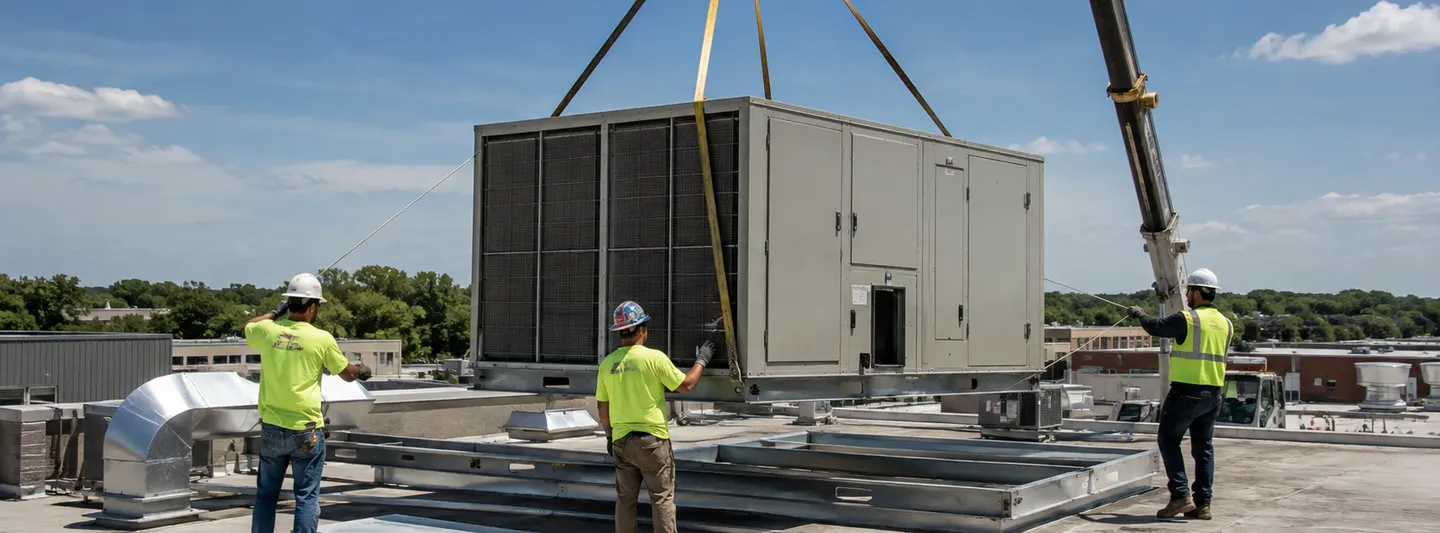
CRANE DAY IS A SCHEDULING ASSET, NOT JUST A RENTAL LINE
The cheapest lift is often the one that replaces several planned RTUs in one coordinated mobilization
OxMaint says crane mobilization, curb adapters and electrical upgrades are the three most frequently missed RTU replacement items and places their combined typical addition around $3,000–$8,000 beyond the base equipment quote. The exact mix varies by project.
BEFORE LIFTNew unit staged + old unit disconnected Verify rigging points, roof access, curb strategy, weather and electrical / gas readiness before the crane clock starts.
LIFT 01Old RTU off The roof opening is now exposed and the building is committed to the replacement sequence.
CURB WINDOWAdapter / gasket / transition ready Field fabrication during crane mobilization is expensive schedule risk.
LIFT 02New RTU set Alignment and roof-interface work determine whether mechanical connection can proceed immediately.
AFTER LIFTElectrical, gas, controls, startup and commissioning A successful crane set is not the operational endpoint.
For portfolios with several aging rooftop units, coordinated replacement can reduce repeated mobilization. But batching should not mean replacing healthy equipment merely to “use the crane.” Use asset age, repair history, criticality and expected remaining life to choose which units belong in the same capital project.
THE NEW RTU HAS TO CONNECT TO THE BUILDING'S CONTROL LOGIC, NOT ONLY ITS DUCTWORK
Economizers, ventilation, sensors and BAS integration can separate a mechanical replacement from a complete operational replacement
DOE's rooftop-unit replacement guidance identifies variable- or multi-speed fan control, integrated economizer control and demand-controlled ventilation as important high-performance RTU features. ENERGY STAR says certified light commercial HVAC equipment uses approximately 17% less energy than standard equipment.
Confirm whether the replacement includes economizer hardware, sensors and commissioning—not merely an economizer-capable cabinet.
Retail, office, restaurant and assembly occupancies can have very different ventilation requirements at equal square footage.
A new unit controller may need gateway, programming or point verification before the facility team can see and command it properly.
Fan, economizer, heating, cooling, alarms and occupancy schedules should be verified as operating functions rather than assumed from factory defaults.
2026 IS A REAL REFRIGERANT TRANSITION YEAR FOR LIGHT-COMMERCIAL EQUIPMENT
New replacement platforms increasingly use R-454B, while legacy R-410A equipment remains in the installed base
EPA's Technology Transitions program restricts higher-GWP HFCs in specified new refrigeration, air-conditioning and heat-pump equipment and systems. The agency's current sector page lists a 700 GWP limit for stationary residential and light commercial air-conditioning / heat-pump products beginning with the January 1, 2025 manufacture / import compliance date.
TRANE FOUNDATION3–25 tons · R-454B Current replacement-focused rooftop line.
TRANE PRECEDENT3–25 tons · R-454B Current gas/electric, electric/electric, heat-pump and hybrid options.
TRANE INTELLIPAK20–150 tons · R-454B Current large packaged rooftop platform.
CARRIER WEATHERMAKER / WEATHERMASTERCurrent R-454B replacement platforms available Carrier's current U.S. commercial range includes replacement-oriented R-454B rooftop products.
Refrigerant transition is therefore a procurement issue, not a reason to panic-replace every operating R-410A unit. For a planned 2026 project, ask which refrigerant the exact model uses, what service procedures and safety requirements apply, and whether the contractor's technicians / tools are prepared for that platform.
LIKE-FOR-LIKE IS A PROCUREMENT STRATEGY, NOT A LOAD CALCULATION
The old RTU footprint can deserve replication while the old tonnage deserves verification
Same occupancy pattern, same envelope, acceptable comfort, stable ventilation needs and a properly performing existing distribution system can favor a fast replacement strategy.
Tenant density, kitchen exhaust, process loads, additions, zoning, envelope upgrades or electrification can make the old unit nameplate a poor replacement target.
The distinction matters economically. A same-footprint replacement can avoid curb and duct changes, while a properly justified redesign may reduce total installed tonnage, change heating type or solve comfort problems that a literal swap would preserve for another 15 years.
COMMERCIAL HVAC HAS A FOURTH COST COLUMN: DOWNTIME
The replacement schedule should be designed around the space that loses conditioning below each unit
Current commercial replacement guidance repeatedly identifies business disruption as part of the decision. DOE's proactive-RTU work was built around replacing aging rooftop units before failure, when owners can plan equipment selection and installation rather than buying during an emergency.
RETAILCustomer-facing temperature + open hours Night or early-morning lifts may cost more but protect revenue hours.
RESTAURANTDining comfort + kitchen makeup / exhaust interactions Replacing the comfort RTU without checking ventilation relationships can create a new operating problem.
OFFICEZone impact can make one RTU more critical than its tonnage suggests Prioritize conference, server-adjacent or densely occupied zones appropriately.
WAREHOUSEProduct / process sensitivity can dominate comfort Not every warehouse requires continuous comfort cooling, but some stored products or operations do.
MULTI-TENANTOne roof can contain several capital owners in practice Map each RTU to the tenant / lease area it serves before phasing replacements.
REPAIR OR REPLACE? USE ASSET HISTORY, NOT A SINGLE AGE NUMBER
A planned $30,000 replacement can be cheaper than a sequence of compressor failures, emergency labor and tenant disruption
OxMaint's current 2026 RTU dataset uses 15–20 years as a typical well-maintained commercial rooftop-unit life and says poor preventive-maintenance history can accelerate failure. That is a planning benchmark, not an automatic retirement age.
A younger unit with available parts, acceptable efficiency and a one-off component problem can still have substantial remaining value.
Track cumulative spend by asset rather than treating every emergency work order as an independent decision.
Scheduled replacement can buy time for equipment selection, curb verification, controls integration and tenant coordination.
A 20-RTU ROOF SHOULD BE MANAGED AS A CAPITAL PORTFOLIO
Replace the worst assets first, but design the fleet so future replacements get easier
1Criticality Which RTU failure closes revenue space, process space or a key tenant area?
2Repair history Which assets consume the most service dollars and emergency calls?
3Age / refrigerant / parts Which units have shrinking serviceability or poor future parts economics?
4Energy / controls condition Which RTUs have the largest operating-performance gap?
5Crane / roof grouping Which justified replacements can share mobilization and roof access?
DOE's Better Buildings work treats rooftop replacement as an asset- management opportunity because RTUs are so widespread in commercial buildings. Standardizing replacement families, controls and curb strategy across a portfolio can make the next replacement easier to price, stock, commission and maintain.
THE REPLACEMENT PATH
Most “hidden costs” sit between the new RTU and the building
The visual is a procurement map, not an installation diagram. Trane and Carrier both emphasize replacement footprints / curb compatibility in current commercial rooftop products, which is strong evidence that the interface between old roof opening and new cabinet is a real replacement cost center.
SIX COMMERCIAL HVAC COST FILES
Use the scenario that matches the equipment count and replacement endpoint
Current 2026 commercial guides place small rooftop replacements around $8,000–$18,000 in one regional contractor dataset, while another 2026 guide says small packaged RTUs commonly start around $15,000.
OxMaint's small-unit model yields approximately $28,000–$35,000 before separately excluded crane, electrical and curb extras.
The current larger-unit model yields about $36,000–$50,000 before project-specific extras.
A May 2026 Minnesota commercial contractor guide uses $20,000–$45,000 for mid-sized RTUs, including equipment / labor and potentially crane, permit, startup and commissioning.
The same regional 2026 dataset uses $50,000–$120,000+ for large commercial RTUs. Large applied rooftop units can reach far beyond light-commercial scope.
OxMaint's small-unit capacity model produces about $112,000–$140,000 before common project extras. A coordinated crane plan and standardized replacement family can materially change execution compared with four emergency swaps.
A COMMERCIAL HVAC BID SHOULD READ LIKE AN EQUIPMENT SCHEDULE
Normalize the scope before comparing $/ton
UNITExact manufacturer + model + capacity Include heating configuration and refrigerant, not merely “10-ton RTU.”
CURBReuse, new curb or adapter? State model / fabrication and roof-interface responsibility.
CRANEIncluded lift window and rigging? Clarify road closure, permits or special access if applicable.
ELECTRICAL / GASReuse or modify? Disconnect, feeder, gas piping and safeties should have a defined endpoint.
CONTROLSThermostat only or BAS integration? Include programming, sensors and point verification where required.
ECONOMIZER / VENTILATIONHardware + sequence + startup? Do not assume factory-installed means commissioned.
DUCT / AIRFLOWExisting transitions retained or modified? Confirm the unit can serve the distribution system it is connected to.
STARTUPCommissioning / functional verification endpoint The project should finish with an operating system, not only an energized cabinet.
After these eight lines match, cost per ton becomes useful. Before they match, it can reward the contractor who omitted the most scope.
HIGH-INTENT PRICE ANSWERS
Commercial HVAC replacement cost in plain terms
How much does commercial HVAC replacement cost in 2026? Broad commercial HVAC installation can start around $6,000–$30,000+ in HomeGuide's current model, but packaged rooftop replacements commonly start around $15,000 and larger RTUs can exceed $50,000.
How much does a commercial rooftop unit cost per ton? OxMaint's May 2026 planning data uses $2,800–$3,500 per ton for smaller RTUs and $1,800–$2,500 per ton for larger commercial units.
How much does a 10-ton commercial RTU cost? The current smaller-unit per-ton model yields about $28,000–$35,000 before separately excluded crane, curb and electrical extras.
How much does a 20-ton commercial RTU cost? The current larger-unit model yields about $36,000–$50,000 before project-specific crane, controls, electrical or curb work.
How much can crane, curb and electrical work add? OxMaint says these three commonly missed items collectively add about $3,000–$8,000 beyond a base equipment quote in typical RTU projects.
Why does a curb adapter matter? The adapter lets a new RTU fit an existing roof curb / duct opening when cabinet footprints differ. Both Trane and Carrier currently market replacement platforms around curb compatibility.
Are 2026 commercial rooftop units using R-454B? Many current light-commercial replacement families do. Trane's Foundation and Precedent lines list R-454B, and Carrier markets current U.S. R-454B rooftop replacement platforms. Exact refrigerant depends on model.
Should a commercial RTU be replaced at 15 years? Not automatically. Current facilities-planning data uses roughly 15–20 years as a common well-maintained RTU lifespan, but repair history, criticality, parts availability, efficiency and downtime risk should drive the capital decision.
METHODOLOGY & SOURCES
Current 2026 cost data separated from manufacturer and federal technical sources
Pricing was reviewed August 9, 2026. OxMaint provides the primary current per-ton RTU model and common missed-cost allowance. Chill Heating & Cooling supplies a current 2026 commercial-unit range by system type, and a current regional contractor guide is used only as a cross-check for small / mid / large RTU replacement bands. HomeGuide supplies a broader commercial-HVAC baseline. DOE, ENERGY STAR, EPA, Trane and Carrier are used for market prevalence, high-performance features, refrigerant transition and current replacement-platform details.
$2,800–$3,500/ton smaller RTUs; $1,800–$2,500/ton larger RTUs; crane, curb and electrical extras; 15–20-year lifecycle planning context.
02 · CHILL HEATING & COOLING · JAN. 24 2026Commercial HVAC Replacement CostSmall packaged rooftop units around $15,000 to start; larger advanced RTUs $50,000+; commercial system-type and building-scale comparisons.
03 · NORSE MECHANICAL · MAY 11 2026 · REGIONAL CROSS-CHECKCommercial RTU Replacement Cost$8,000–$18,000 small, $20,000–$45,000 mid-sized and $50,000–$120,000+ large RTUs in a Minnesota contractor dataset.
04 · HOMEGUIDE · CURRENT 2026 GUIDECommercial HVAC Cost$6,000–$30,000+ broad commercial HVAC installation baseline; building size, layout and equipment type identified as cost variables.
05 · U.S. DOE · BETTER BUILDINGSUpgrade Your RTU to High EfficiencyPackaged HVAC / rooftop-unit prevalence across U.S. commercial floor space and replacement / high-efficiency planning resources.
06 · U.S. DOE · RTU REPLACEMENT GUIDANCEReplacing and Retrofitting Rooftop UnitsHigh-performance features including variable / multi-speed fan control, integrated economizer control and demand-controlled ventilation.
07 · ENERGY STAR · CURRENTLight Commercial Heating & CoolingENERGY STAR certified light-commercial HVAC equipment uses approximately 17% less energy than standard equipment.
08 · U.S. EPA · CURRENT 2026Technology Transitions HFC RestrictionsCurrent federal sector restrictions and 700-GWP product limit for stationary residential / light-commercial AC and heat-pump products.
09 · TRANE · CURRENT PRODUCT DATAFoundation Rooftop Replacement Platform3–25 tons, R-454B, replacement-focused footprint and curb-compatibility design.
10 · CARRIER · CURRENT PRODUCT RANGECommercial Rooftop UnitsCurrent U.S. packaged rooftop replacement platforms, including R-454B product families and replacement-oriented configuration options.
This is U.S. commercial property cost-planning information. Final HVAC capacity, ventilation, equipment type, refrigerant, electrical service, gas heat, curb / structural compatibility, controls, economizer, ductwork, permits and commissioning depend on the building, climate, occupancy, adopted code and project design. Commercial HVAC replacement should be engineered and installed by appropriately qualified professionals.