
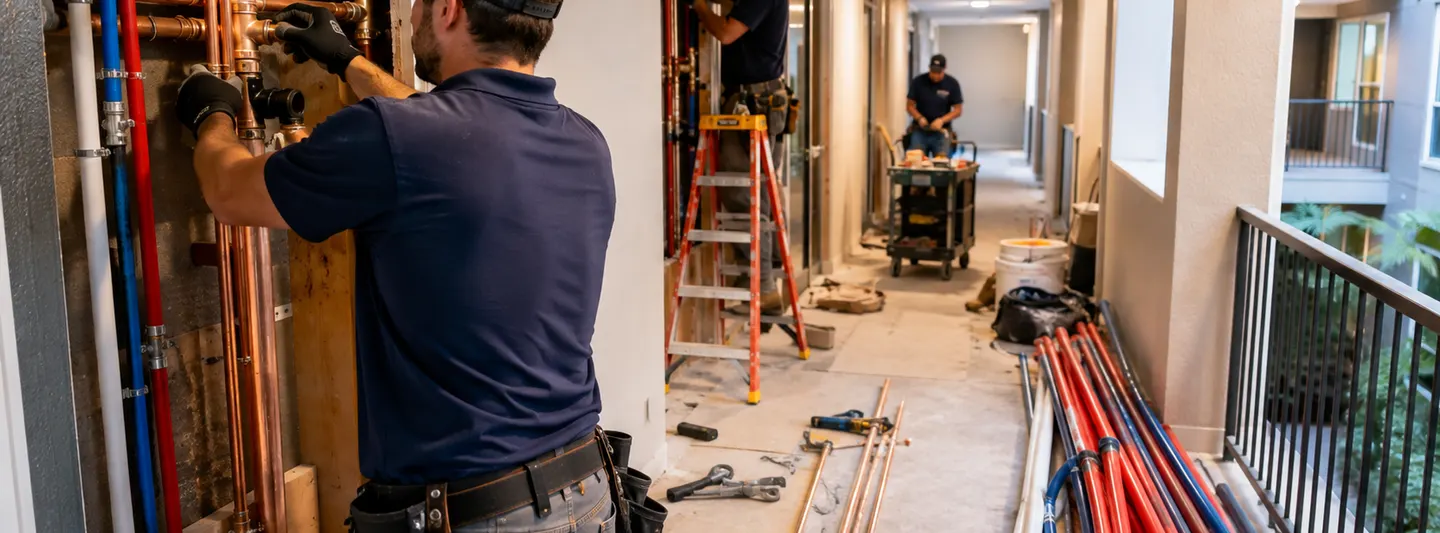
2026 MULTIFAMILY COST ANSWER
There is no trustworthy single national apartment-repipe rate. A current 2026 Houston multifamily benchmark is $3,000–$6,400 per unit for complete PEX supply repiping and $5,500–$8,500 per unit for copper. At 100 apartments, that is roughly $300,000–$640,000 for PEX supply work before building-specific scope pushes the project higher.
Tell Projects' current Houston multifamily guide breaks complete PEX supply repiping into $1,800–$3,500 per unit for supply piping, $400–$800 for fixture connections and valves, $600–$1,500 for wall opening / restoration and $200–$600 for permit / inspection, producing a stated total around $3,000–$6,400 per apartment.
The same current regional dataset uses $5,500–$8,500 per unit for full copper repiping. Angi's August 3, 2026 single-family data provides a useful national sanity check on labor intensity: professional house repiping ranges from $1,250–$22,000, with about 70% of total cost attributed to labor. Multifamily repetition can create production efficiencies, but occupied buildings add coordination that single-family pricing does not contain.
WHY THIS PAGE DOES NOT INVENT A NATIONAL MULTIFAMILY AVERAGE
The public 2026 pricing data is regional; the national evidence is much stronger on project structure than on one universal dollar-per-door number
National multifamily repipe specialists generally require a site visit rather than publishing a single per-unit price. Replumb Specialties explicitly says multifamily pricing requires a site visit because project scopes vary greatly. Repipe Specialists frames occupied multifamily work as a systematic series of individual-unit upgrades and reports more than 80,000 units completed, but does not publish a universal national cost per door.
That is the correct signal. A garden-style property with repeated one-bedroom stacks can be production-friendly. A 16-story concrete tower with central hot-water recirculation, pressure-management requirements and high-finish occupied apartments is a different capital project.
Use published per-unit numbers to understand order of magnitude. Use riser count, unit types, access strategy and finish endpoint to understand your building.
MULTIFAMILY REPIPE SCALE PLANNER
Turn a current per-unit benchmark into a portfolio-scale capital number
This tool uses a current 2026 Houston multifamily contractor benchmark: $3,000–$6,400 per unit for complete PEX supply repiping and $5,500–$8,500 per unit for copper. It is intentionally labeled regional; use it to understand scale, not as a national bid substitute.
MAP THE BUILDING BEFORE COUNTING APARTMENTS
A multifamily domestic-water system has at least four procurement layers
Incoming water, backflow / pressure equipment, central hot-water plant and major horizontal distribution can sit outside the in-unit quote.
Risers move hot and cold water between stories. Uponor's current U.S. commercial line includes PEX-a up to 3 inches specifically for domestic-water and hydronic riser applications.
Horizontal distribution connects risers to unit groups. Its access can be very different in corridor ceilings, shafts, slabs or finished walls.
Kitchens, bathrooms, laundry and appliance connections create the repeated per-door production scope most owners see first.
An owner should be able to point to each layer and say replace, retain or alternate. If the proposal only lists “100 apartment units,” there is no way to know whether the most failure-prone central piping is actually included.
RISER COUNT CAN MATTER MORE THAN UNIT COUNT
One hundred units in ten identical stacks can be easier to repipe than sixty units scattered across irregular plumbing chases
Uponor's Summerland Apartments case is a useful physical example: two 16-story concrete towers with failing galvanized plumbing were repiped using PEX from 1/2 inch through 3 inches, allowing the installation to transition from vertical risers into individual suites. The project used four installers and—including drywall repair, paint and finishing—ran nine months.
STACKED UNITSRepeated bathroom / kitchen geometry One planned opening strategy can repeat vertically and across similar units.
RISER SHAFTSVertical access determines production Existing shafts or accessible chases can reduce finish demolition.
CONCRETE FLOORSHorizontal routing becomes more constrained A flexible material may reduce opening size, but the building still needs an engineered route from riser to fixtures.
MIXED UNIT TYPESStudios, one-bedrooms and two-bedrooms need separate takeoffs A single “per unit” rate can hide meaningful bathroom / fixture-count differences.
PEX VS COPPER BECOMES A LABOR DECISION AT MULTIFAMILY SCALE
The material-price gap matters, but the number of joints, hot-work steps and wall openings matters more across hundreds of repeated rooms
Angi's August 2026 material data puts PEX around $0.40–$2 per linear foot and copper around $2–$8 per foot before installation. Its house-repipe data says labor accounts for roughly 70% of total project cost. That is why a flexible piping strategy can influence multifamily economics through installation time as well as raw material.
Current Uponor commercial PEX-a products extend from in-unit distribution to vertical risers up to 3 inches. Long coil lengths and flexibility can reduce fittings and facilitate routing.
Copper remains a valid project material, but current regional multifamily pricing shows a meaningful labor / material premium. Local code, owner standards and project conditions still control selection.
Material selection should therefore be made at the system level: pipe, fittings, supports, firestopping, insulation, hot-water recirculation conditions, pressure, temperature, installer familiarity and manufacturer requirements. Do not choose a multifamily system from raw tubing price alone.
THE PRODUCTION UNIT IS NOT THE APARTMENT. IT IS THE APARTMENT RETURNED TO THE RESIDENT.
A successful occupied repipe ends every workday with water restored, openings controlled and the next units ready
Current multifamily specialists converge on the same operating model. Repipe Specialists says unit plumbing can be completed in one day while residents remain in place. A current San Diego apartment-repipe contractor describes unit-by-unit scheduling, water-off windows measured in hours, same-day drywall patching, pressure testing and inspection before final wall close.
07:00Access + protection Confirm resident access, work-zone protection and exact openings before shutdown.
WATER OFFIsolate the smallest practical section The valve strategy determines whether one unit, one stack or an entire building loses service.
ROUGH-INRun new branches / connect the planned scope Repeatable unit types create production value only when material kits and opening locations are standardized.
TESTPressure test before closure Close walls after the new piping has passed the required test / inspection sequence.
RESTOREReturn water service Occupied-unit scheduling should define the maximum planned outage window.
HANDOFFPatch, clean and document The owner needs the unit returned to a known finish endpoint before the crew advances to the next door.
DRYWALL IS NOT A MINOR ADD-ON WHEN IT REPEATS 400 TIMES
The finish endpoint should be priced per unit and written into the production schedule
The current Houston benchmark allocates $600–$1,500 per unit to wall opening and restoration, including drywall cutting, patching and painting at pipe-access points. Across 100 units, that one scope is roughly $60,000–$150,000.
Lowest plumbing contract, highest coordination burden. The owner takes responsibility for resident-facing finish completion.
Plumbing contractor or partner closes openings; final paint match remains an owner / painting scope.
Higher per-unit price but a cleaner occupied-unit handoff and fewer trades for property management to coordinate.
Uponor's Summerland case explicitly included drywall repair, painting and finishing in the nine-month repipe timeline. That is the right way to think about finish work: not a cleanup detail after plumbing, but part of the throughput of the capital project.
HIGHER BUILDINGS ADD HYDRAULIC SCOPE THAT A PER-UNIT RATE CANNOT SEE
Pressure zones, booster equipment and hot-water recirculation belong in the engineering file before material is ordered
IAPMO's current Water Demand Calculator can estimate whole-building, hot-water, cold-water, branch and riser demand for residential buildings, including multifamily dwellings under applicable UPC / WE•Stand provisions. That is a useful reminder that a repipe should be right-sized as a water-distribution system, not simply replace every old diameter with the same new diameter by habit.
PRESSURE ZONESLower floors and upper floors may not operate under the same pressure conditions Tall buildings can require pressure-management strategies that do not exist in a garden-apartment project.
BOOSTER PUMPSCentral equipment may be retained, adjusted or replaced The repipe scope should say whether pumping equipment is part of the capital project.
HOT-WATER RETURNRecirculation is a continuous operating system Pipe material, temperature, velocity, balancing and pump operation need to be considered together.
PIPE SIZINGRepeated fixtures create diversity—not simultaneous full demand Modern demand methods exist specifically to avoid oversized residential distribution systems.
Current GF Building Flow Solutions / Uponor commercial guidance also emphasizes pressure, temperature and velocity management for recirculating systems and recommends monitoring pressure-zone conditions and booster-pump operation in commercial installations.
SUPPLY REPIPE AND DRAIN / WASTE / VENT REPLACEMENT ARE DIFFERENT PROJECTS
A new PEX supply system does not repair failing cast-iron stacks
Repipe Specialists separates domestic supply piping from drain, waste and vent piping in its multifamily service structure. That distinction belongs in every owner budget.
Risers, mains, unit branches, valves, fixture connections, recirculation and pressure management.
Stacks, branches, cast-iron or other drain piping, vent systems, floor / ceiling openings and potentially different access paths.
The current Houston multifamily dataset adds $1,500–$3,000 per unit when cast-iron drain / waste replacement is included alongside the supply repipe. Treat that as a regional planning benchmark, not a national promise; vertical stack access and building construction can alter drain-replacement cost dramatically.
THE BEST REPIPE CAN MAKE THE NEXT LEAK CHEAPER
Isolation strategy determines how many residents lose water during future maintenance
Necessary as a top-level control but too broad for routine unit maintenance.
Multi-building garden complexes gain operating resilience when each building can be isolated independently.
Useful during phased construction and later repairs if the piping architecture supports it.
Future fixture or branch work can occur without shutting down neighboring apartments.
The owner is not only buying new pipe. The project is a rare opportunity to improve maintainability. A slightly higher valve / access scope today can reduce tomorrow's emergency outage footprint.
THE CHEAPEST PRODUCTION PLAN REPEATS THE SAME UNIT UNTIL THE CREW STOPS THINKING ABOUT THE ROUTE
Standardization converts a complicated building into a sequence of repeatable work packages
01Survey + destructive pilot Confirm hidden conditions before pricing hundreds of identical openings.
02Build unit-type maps Studio, 1BR, 2BR and accessible / renovated variants get separate standard routes.
03Complete a pilot stack Measure actual plumber hours, restoration hours, outage window and material usage.
04Lock the repeatable detail Standardize openings, fittings, valves, kits and resident notices.
05Run building / floor / stack phases Keep enough water service available to protect habitability and operations.
06Close unit-by-unit Test, restore water, patch, clean and document before the resident handoff.
Replumb Specialties says it uses resident information packets, pipe- replacement schedules, color-shaded in-unit work maps and project overviews. Repipe Specialists similarly emphasizes specialized teams, onsite project management and occupied-building communication. These are not marketing extras at multifamily scale; they are production controls.
THE BUILDING-WIDE REPIPE PATH
The per-unit price sits downstream of mains and risers
This is a procurement diagram, not a plumbing design. Its purpose is to show why “$4,500 per unit” does not tell the owner whether the main, risers and recirculation system are included. Uponor's current commercial product structure explicitly spans risers, mains and in-unit piping.
SIX APARTMENT REPIPE COST FILES
Scale the current benchmark—but keep the building conditions attached to it
Current Houston benchmark: $30,000–$64,000 for complete PEX supply repiping. Small buildings may lose some bulk-production efficiency relative to larger repeated projects.
Regional scale: $75,000–$160,000 before project-specific mains, difficult access or nonstandard finish scope.
Regional scale: $150,000–$320,000. At this point resident communication, daily closeout and unit-type standardization become major cost controls.
Regional scale: $300,000–$640,000. Adding the Houston DWV benchmark would add another $150,000–$300,000.
Current Houston copper scaling: $550,000–$850,000 before building-specific central distribution, high-rise or unusual finish scope.
Uponor's Summerland case involved two 16-story concrete towers, 1/2-inch through 3-inch piping, risers-to-suite transitions and a nine-month process including drywall, paint and finishing. Use this as evidence of scope complexity—not as a dollar benchmark.
NORMALIZE THE MULTIFAMILY BID BY SYSTEM BOUNDARY
Per-unit price becomes useful only after these eight lines match
UNITSExact door count + unit-type mix Separate studios, one-bedrooms, two-bedrooms and unusual renovated layouts.
RISERSIncluded or retained? State count, material and vertical endpoint.
MAINSMechanical-room / horizontal distribution included? Do not assume “whole property” means central piping.
HOT WATERRecirculation and balancing included? Domestic hot-water return can be a distinct large-diameter system.
UNIT BRANCHESWhich fixtures / valves receive new piping? Define kitchens, baths, laundry and appliance connections.
DWVSupply only or drain / waste / vent too? These are separate systems and separate capital budgets.
FINISHESOpen wall, patch, prime or paint? The resident handoff endpoint should be explicit.
OCCUPANCYDaily water-off window + resident communication Define access procedure, testing and water-restoration target.
When these eight lines match, divide by apartment count. Before they match, the lowest $/unit quote may simply stop earlier in the building.
HIGH-INTENT PRICE ANSWERS
Apartment building repipe cost in plain terms
How much does it cost to repipe an apartment building in 2026? No reliable single national per-unit average is publicly available. A current Houston multifamily benchmark is $3,000–$6,400 per unit for complete PEX supply repiping and $5,500–$8,500 per unit for copper.
How much does it cost to repipe a 50-unit apartment building? Using the current Houston PEX benchmark only, roughly $150,000–$320,000. The actual U.S. project can vary materially with risers, access, central piping, local labor and finish restoration.
How much does it cost to repipe a 100-unit apartment building? The same regional PEX benchmark scales to about $300,000–$640,000; copper scales to about $550,000–$850,000.
Does apartment repiping include drywall repair? Sometimes. The current Houston dataset allocates $600–$1,500 per unit for wall opening and restoration. National specialists also market turnkey processes with drywall / finish coordination, but proposals must state the finish endpoint.
Can tenants stay during an apartment repipe? Often, yes. Current multifamily specialists describe occupied unit-by-unit workflows with water shutoffs measured in hours and unit plumbing completed within a working day in suitable projects.
Is PEX suitable for apartment-building risers? Current Uponor U.S. commercial systems include PEX-a up to 3 inches for domestic-water and hydronic riser applications. Final material, sizing, support and system design remain project / code specific.
Does a supply repipe replace cast-iron drains? No. Domestic supply and drain / waste / vent systems are different scopes. A current Houston benchmark adds $1,500–$3,000 per unit for cast-iron drain / waste replacement when included.
What is the biggest apartment-repipe cost driver? At building scale, the decisive variables are usually riser / stack geometry, occupied access, finish restoration, unit-type repetition, central mains / recirculation and whether the project also replaces DWV piping.
METHODOLOGY & SOURCES
Current regional pricing kept separate from national multifamily construction evidence
Pricing was reviewed August 9, 2026. Tell Projects supplies the current Houston per-unit PEX, copper, restoration, permit and DWV benchmarks. Those numbers are labeled regional throughout the article. Angi's August 2026 national single-family data is used only to cross-check material and labor relationships—not to claim a national apartment-building price. Repipe Specialists, Replumb Specialties, Uponor / GF Building Flow Solutions and IAPMO support occupied-unit, riser, system-design and building-water-distribution context.
$3,000–$6,400/unit complete PEX supply; $5,500–$8,500 copper; supply, fixture connections, wall restoration, permits, DWV and occupied-project cost breakdown.
02 · ANGI · UPDATED AUG. 3 2026House Repipe CostNational material / labor cross-check: $1,250–$22,000 professional house repiping, ~70% labor, PEX $0.40–$2/ft and copper $2–$8/ft.
03 · REPIPE SPECIALISTS · CURRENT MULTIFAMILY PROCESSOccupied Multifamily Repiping80,000+ units reported; unit plumbing completed in one day, residents remain in place, onsite project management and separate domestic-supply / DWV service scopes.
04 · REPLUMB SPECIALTIES · CURRENTTurnkey Multifamily Repipe ServicesOccupied apartments, condos, hotels and assisted living; resident packets, schedules, unit work maps and project-management workflow.
05 · UPONOR / GF BUILDING FLOW SOLUTIONS · CURRENT U.S.PEX Risers and MainsPEX-a up to 3 inches for domestic-water / hydronic risers; large-dimension risers, prefabrication, long runs and in-unit distribution context.
06 · UPONOR CASE STUDY · 16-STORY MULTIFAMILYSummerland Apartments RepipeTwo 16-story towers; galvanized replacement; 1/2-inch to 3-inch PEX; riser-to-suite transitions; four installers; nine months including drywall, paint and finishing.
07 · IAPMO · CURRENTWater Demand CalculatorResidential including multifamily whole-building, hot / cold branch and riser demand calculations under applicable UPC / WE•Stand provisions.
08 · CURRENT OCCUPIED-UNIT PROCESS EXAMPLEApartment Repipe WorkflowUnit-by-unit scheduling, water-off windows measured in hours, same-day drywall patch, pressure testing and occupied-building handoff example.
This is U.S. multifamily property cost-planning information. The published per-unit pricing in this article is a current Houston regional benchmark, not a universal national rate. Final system design depends on local code, pipe material, water chemistry, building height, pressure, temperature, hot-water recirculation, demand, access, firestopping, resident logistics, permits and existing conditions. Multifamily repiping should be designed and installed by appropriately qualified professionals.