
2026 COST RANGE
A meter-box replacement commonly costs $500–$2,100, but the service around it can push the project much higher.
THE PLANNING NUMBER
For a straightforward residential replacement, use roughly $500–$2,100 as a first-pass budget. A 400-amp installation or a project involving the mast, service conductors, relocation or broader service work can move toward $5,000 or more.
HomeGuide's current national data places outside electrical meter-box replacement at $500–$2,100. Angi's July 2026 dataset uses a broader $500–$5,000 range, with about $1,000 as its typical project figure.
The difference between a $700 project and a $3,000 project is rarely explained by the sheet-metal box alone. The meter socket sits in the service entrance — the part of the electrical system that connects utility power to the home's main service equipment.
HomeGuide's ranges are slightly tighter — approximately $500–$1,000 for 100 amps, $800–$2,000 for 200 amps and $1,500–$5,000 for 400 amps — which reinforces the same basic pattern: capacity and project scope matter far more than the retail price of the enclosure.
KNOW WHICH BOX IS BEING REPLACED
The electric meter, meter socket and breaker panel are three different pieces of equipment.
Homeowners often use “meter box,” “electric box” and “panel” interchangeably. An electrician does not.
The utility's overhead wires bring electricity from the street or utility pole to the house.
The weatherhead is the cap where the overhead wires enter, while the mast is the rigid pipe that supports and protects those wires.
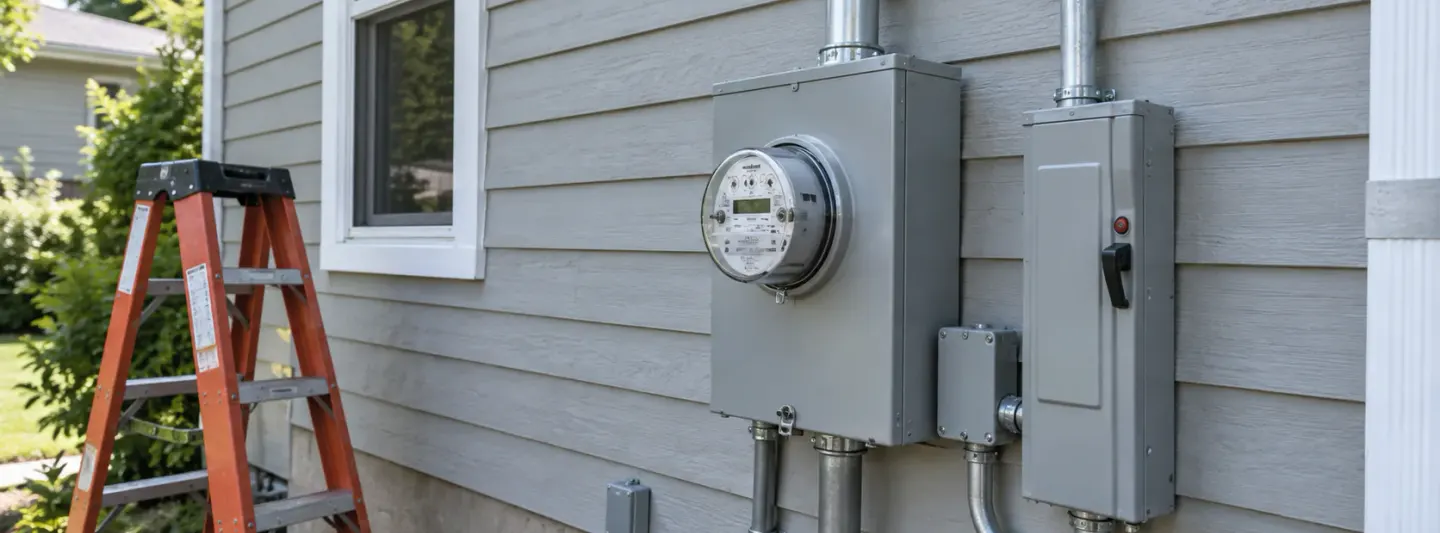
This is the outdoor box that the electric meter plugs into.
The main disconnect can shut off power to the whole home, and the panel sends electricity to the individual circuits inside the house.
The electric meter is the measuring device with the display. In many utility territories it belongs to the power company.
The meter socket, also called the meter base, meter can or meter enclosure, is simply the outdoor box that the electric meter plugs into. In many areas the homeowner owns this box even when the utility company owns the meter itself, but the exact responsibility depends on the utility.
The electrical panel contains breakers and distributes power to the home's circuits. Replacing the meter socket does not automatically mean the panel is being replaced.
FOUR PROJECTS THAT GET CALLED “METER REPLACEMENT”
Before comparing prices, identify how far the electrician's scope extends.
Replace a damaged or obsolete enclosure while compatible service equipment remains.
Storm, corrosion or physical damage extends above the meter into the overhead service entrance.
A higher-amperage service can require conductors and related equipment sized for the new capacity.
Meter equipment, conductors, disconnect, grounding and panel work may become one coordinated project.
These scopes should not be compared as though they were competing prices for the same repair. A $900 meter-socket-only proposal can be more expensive on a like-for-like basis than a $2,500 proposal that also includes a service mast, new conductors and code-related work.
THE HARDWARE IS NOT THE BILL
A $100–$350 meter socket can still become a $1,500 installed project.
Angi currently prices the meter enclosure itself at roughly $50–$500, depending on capacity and configuration. Its 200-amp equipment range is approximately $100–$350 before installation.
HomeGuide publishes similar equipment prices, with many 200-amp boxes around $100–$350.
Installed cost is higher because the electrician is working on the home's service entrance, not installing a passive cabinet.
Utility disconnect
Power generally has to be disconnected or otherwise made safe under utility procedures before the socket can be replaced.
Permit and inspection
Angi currently suggests approximately $150–$300 as a permit planning allowance, although fees are jurisdiction-specific.
Service reconnection
The utility may need inspection approval or another authorization before restoring power.
Existing equipment condition
Corroded conductors, an obsolete mast, damaged grounding or incompatible service equipment can expand the job.
100, 150, 200 OR 400 AMPS?
Replacing a damaged meter box is not the same as upgrading the home's electrical service.
Putting in a 200-amp meter box does not automatically turn a 100-amp home into a 200-amp home. The wires, panel and other service equipment also have to be designed for that capacity.
Increasing the home's electrical capacity can involve much more than the meter box. The main wires bringing electricity into the house—called service-entrance conductors—may need to be larger, and the main shutoff, panel and electrical safety connections may also need to change.
Angi's current replacement range for many smaller residential services.
Intermediate residential capacity; existing installation determines the actual scope.
Common modern residential meter capacity, before larger service-upgrade work.
Large residential installations require substantially different equipment and service planning.
A meter enclosure's amp rating tells you what the equipment is designed to accommodate. It does not establish that the home's conductors, panel, utility service and load calculation support that amperage.
THE UTILITY BOUNDARY
The utility company may own the meter while you own the box that holds it.
Utility rules differ, so ownership should always be verified locally. But several U.S. utilities publish a common arrangement.
Unitil states that it repairs the service lines to the residence and the electric meter, while the property owner is responsible for the weatherhead, service-entrance cable, meter base and main service panel.
Duquesne Light similarly identifies the meter base as the customer's responsibility and the meter itself as utility-owned equipment.
This distinction also explains why an electrician cannot necessarily arrive, pull the utility meter and replace the socket without coordination.
The meter may be sealed utility equipment, and the utility can impose specifications on the socket that it is willing to energize.
UTILITY-APPROVED EQUIPMENT
Even a code-compliant meter box may not be one your utility will connect.
Consumers Energy, for example, publishes an approved meter-socket list and states that it will install electric service only to an approved socket.
That is an important procurement detail. The electrician must satisfy the adopted electrical code, the local inspection authority and the serving utility's service requirements.
The meter socket must be listed and rated for its intended electrical application.
The installation must comply with the electrical rules enforced by the local inspector or building authority.
Socket type, position, service arrangement and approved equipment can be utility-specific.
After the work passes the required inspection, the utility's procedures determine when power can be turned back on.
WHY THE POWER GOES OFF
This job happens where utility power enters the home.
The meter box is connected to the wires bringing utility power into the house. Before an electrician can replace it, that power normally has to be shut off safely and later restored. That utility coordination is one reason the job costs much more than changing an outlet or light switch.
WHY METER BOXES GET REPLACED
Rust on the cover and heat damage inside the socket are not the same failure.
Exterior service equipment lives in rain, temperature swings and humidity for decades.
Loose or deteriorated electrical connections can produce localized overheating.
Falling limbs, service-drop movement and exterior impacts can damage the enclosure or mast.
An older socket may need replacement when service work requires equipment meeting current utility specifications.
Some damage can remain localized. HomeGuide currently estimates replacement of a simple meter-box cover at roughly $120–$370 installed and meter-lug replacement around $100–$240 installed where the surrounding equipment is still suitable.
Those are very different repairs from replacing a burned or obsolete meter socket. An electrician needs to determine whether the enclosure and internal components remain suitable rather than assuming a cosmetic cover repair solves internal deterioration.
THE MAST, WEATHERHEAD & RISER
When overhead-service damage continues above the meter, the project becomes larger.
HomeGuide currently places electrical mast or riser replacement around $500–$1,700.
The mast is the rigid pipe above the meter that supports or protects the main incoming electrical wires. Storms, fallen branches, movement of the overhead utility line or deterioration where the mast passes through the roof or wall can turn a meter-box replacement into a larger repair.
METER-ONLY SCOPE
Socket, enclosure, fittings and direct connections around the meter location.SERVICE-ENTRANCE SCOPE
The mast, the weatherhead at its top, the main incoming wires, the main shutoff, safety grounding and the electrical panel can each add separate costs.METER BOX VS. PANEL UPGRADE
Replacing the exterior socket does not add breaker spaces or automatically increase electrical capacity.
The electrical panel comes after the meter in the home's electrical system. If it is in good condition and appropriately rated, replacing a failed meter socket may leave the panel untouched.
If the project is really a service upgrade, the panel may become part of the scope. That is where homeowners should move to our electrical panel upgrade cost guide or 200-amp service upgrade cost guide rather than treating the entire project as meter-box replacement.
The service rating can remain unchanged when the existing system remains compatible and adequate.
Conductors, disconnect equipment, panel, grounding and utility coordination can all enter the project.
EXTERIOR DISCONNECTS & CODE SCOPE
A meter-box replacement does not always trigger a complete electrical-service rebuild.
Newer electrical codes include rules for an emergency shutoff outside many homes. Whether those rules affect a meter-box replacement depends on how much of the service is being changed and which version of the electrical code the local jurisdiction has adopted.
For example, 2023 NEC Section 230.85 contains rules for outdoor emergency shutoffs at homes. It also includes replacement provisions for projects limited to equipment such as the meter socket, the main incoming wires or the conduit and fittings that protect those wires.
That is why a national cost guide cannot say that every meter-box job needs a new outdoor disconnect—or that none do. The electrician and local inspector have to apply the rules to the actual work being performed.
THREE PROJECT SHAPES
One meter-box search can hide three different electrical projects.
200-amp socket replacement
$750–$2,000Current Angi planning range for many 200-amp meter-box replacements.
- Existing service capacity retained
- Mast remains usable
- Panel remains usable
- Normal utility coordination
Meter plus service mast
Meter cost + mast scopeA storm-damaged overhead service can extend beyond the meter enclosure.
- Damaged riser or weatherhead
- Utility disconnect/reconnect
- Exterior hardware
- Possible roof or siding work
Meter as part of a service upgrade
Separate service budgetThe meter socket is only one component in a larger capacity project.
- New service conductors
- Disconnect or panel work
- Grounding/bonding scope
- Utility approval and possible infrastructure changes
HOW TO READ THE QUOTE
Every meter-box estimate should tell you where the project starts and where it stops.
Identify the amp rating and exact meter equipment being installed.
Confirm that the proposed socket is acceptable to the serving utility.
State whether service capacity is staying the same or increasing.
State whether the mast, weatherhead and other equipment above the meter are included.
State whether the home's main incoming electrical wires stay in place or are being replaced.
State whether the main shutoff or electrical panel is also included in the project.
State who handles local approvals and whether the fees are included.
Define who schedules the disconnect, meter removal and restoration of service.
COSTS THAT GET LOST BETWEEN QUOTES
Normalize these line items before deciding which electrician is cheaper.
SAFETY BOUNDARY
The meter socket is not a homeowner-accessible electrical box.
Do not remove a utility seal, pull an electric meter or open energized service equipment. Meter-socket replacement is licensed-electrician work and normally requires coordination with the serving utility.
The service side of a residential electrical installation presents hazards that ordinary branch-circuit troubleshooting does not. The safe project sequence is established by the electrician, utility and local inspection process.
FAQ
Questions to answer before authorizing meter work.
Who owns the meter box?
In many U.S. utility territories, the utility owns the electric meter while the property owner owns and maintains the meter base or socket. Ownership boundaries vary, so confirm with the serving utility before arranging work.
How much does a 200-amp meter box cost to replace?
Angi currently places many installed 200-amp meter-box replacements around $750–$2,000. HomeGuide uses approximately $800–$2,000. Additional service work can push the project higher.
Does replacing a meter box require replacing the electrical panel?
Not automatically. A compatible panel in suitable condition can remain when the meter socket is replaced at the existing service rating. Panel work belongs in the scope when condition, capacity or project requirements demand it.
Can an electrician replace the box without the utility?
Utility procedures vary, but the meter and incoming service involve utility-controlled equipment and power. Many replacements require the utility to disconnect, remove or authorize access to the meter and later restore service.
Can I replace a 100-amp meter box with a 200-amp box?
Installing a higher-rated box does not by itself create a 200-amp service. Conductors, service equipment, utility requirements and the home's electrical load all have to support the intended rating.
How long does meter-box replacement take?
Angi currently describes many installations as roughly four to eight hours before additional rewiring or broader service work. The total outage window also depends on utility and inspection scheduling.
Can only a damaged meter-box cover be replaced?
Sometimes. If the enclosure and electrical components remain suitable, a localized cover repair can be much cheaper. Internal corrosion, heat damage or obsolete equipment can make full replacement necessary.
HOW WE BUILT THIS 2026 COST GUIDE
We separated the price of the socket from the price of the service around it.
National cost ranges are triangulated primarily from Angi's July 2026 meter-box data and HomeGuide's current meter-box cost report. We use ranges rather than one national average because 100-, 200- and 400-amp installations represent materially different projects.
Equipment ownership and utility coordination were checked against published utility guidance from Unitil, Duquesne Light and Consumers Energy. Those examples illustrate common U.S. arrangements but are not universal rules.
Code discussion is deliberately narrow. NEC requirements depend on the edition and amendments adopted locally, and the classification of a socket-only replacement can differ from replacement of broader service equipment.
Cost and utility information reviewed September 21, 2026. Local utility specifications and adopted electrical codes control the actual installation.