
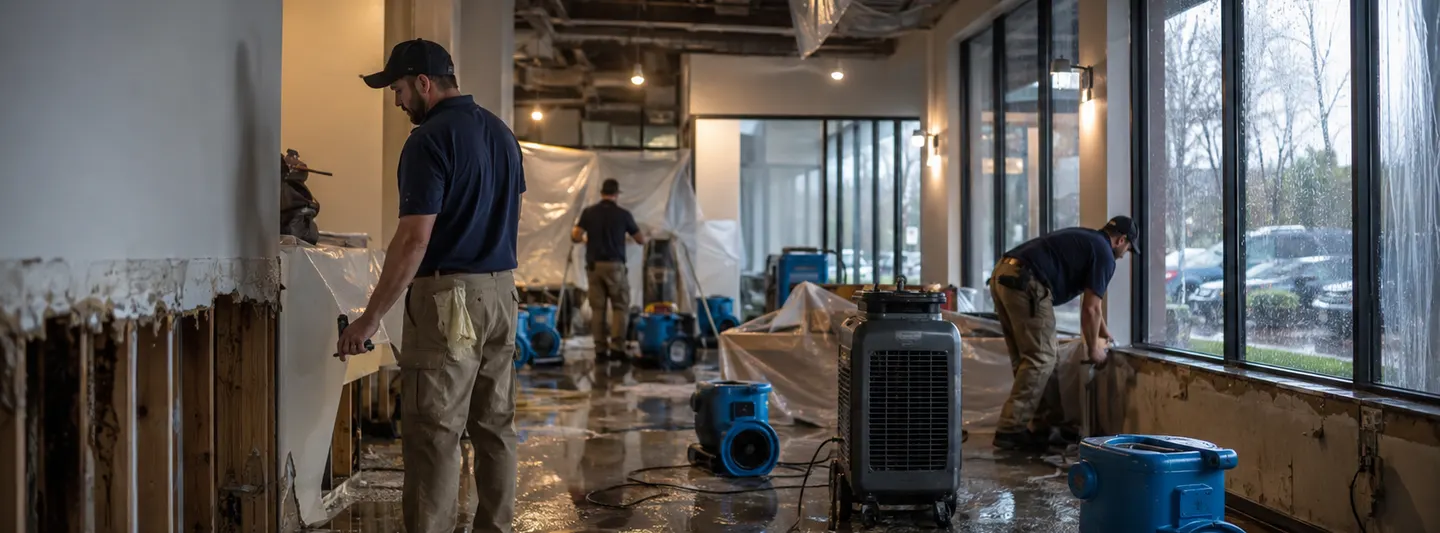
2026 COMMERCIAL COST ANSWER
Commercial water damage restoration commonly starts around $4–$12 per affected square foot, with small commercial losses around $5,000 and large facilities easily moving beyond $100,000. The final reconstruction budget can be much higher than the initial mitigation invoice.
A dedicated 2026 commercial cost dataset currently uses $4–$12 per square foot, about $5,000 for a small suite, roughly $25,000 as a planning average, and $100,000+ for larger facility losses. It gives property-type examples ranging from small offices to multi-floor buildings.
HomeGuide's February 6, 2026 national water-restoration guide provides a strong cross-check for the mitigation layer: $4–$6/sq. ft. for Category 1 extraction and drying, $6–$9 for Category 2, and $9–$12 for Category 3. Those are water-removal / drying benchmarks, not a complete commercial rebuild price.
THERE ARE THREE COST LEDGERS AFTER A COMMERCIAL WATER LOSS
Mitigation, reconstruction and operational recovery should not be collapsed into one vague “restoration” number
Source control, extraction, moisture inspection, material removal, drying equipment, dehumidification, containment where required, monitoring and documentation.
Drywall, ceilings, flooring, insulation, millwork, paint, electrical, mechanical and other finishes or systems that cannot simply be dried and returned to service.
Which areas can remain open, which equipment / inventory must move, what work must occur after hours, and which revenue-critical zones should reopen first.
Commercial owners get into trouble when the first emergency invoice is mistaken for the whole project. HomeGuide explicitly separates water extraction / drying from later material repair. IICRC S500 likewise treats water restoration as a process involving inspection, drying, structural restoration, contents and large / catastrophic projects—not merely pumping out standing water.
THE AFFECTED FOOTPRINT IS NOT THE PUDDLE
Commercial water travels under flooring, through wall assemblies, down shafts and into adjacent tenant spaces
IICRC's January 2026 water-category position statement says the initial response should identify the extent of water migration, the general size of affected areas, the materials involved and immediate secondary-damage concerns. That is the cost footprint the owner needs.
VISIBLE WATERWhat can be seen immediately Standing water is the starting point, not the final square-foot quantity.
MIGRATIONWhere did moisture travel? Under carpet tile, raised flooring, partitions, insulation, elevator / plumbing penetrations and adjacent rooms.
AFFECTED MATERIALWhat assemblies are actually wet? Two equal floor areas can require very different drying plans if one is polished concrete and the other contains gypsum, insulation, carpet, millwork and layered floor systems.
FUNCTIONAL ZONEWhat business use is attached to the wet area? A 2,000-square-foot stockroom, server room, restaurant kitchen and office suite do not create the same operational recovery problem.
The commercial quantity is “affected square feet by assembly and use,” not simply “square feet of water.”
WATER CATEGORY CHANGES THE WORK BEFORE IT CHANGES THE PRICE
IICRC's current 2026 position statement makes contamination controls a scope decision—not a cosmetic add-on
The current ANSI/IICRC S500 remains the 2021 Fifth Edition while its consensus body works on the next revision. In January 2026, IICRC published a position statement clarifying water-category determination for weather-related events and the restoration response.
HomeGuide's current extraction / drying benchmark is $4–$6 per square foot. IICRC says restoration can proceed without contamination controls when the preliminary determination is Category 1.
HomeGuide uses $6–$9 per square foot. IICRC's 2026 position statement says Category 2 intrusions should be remediated before restorative drying and require contamination controls / worker protection.
HomeGuide uses $9–$12 per square foot. IICRC likewise requires remediation before restorative drying, contamination controls and appropriate worker protection for Category 3 water.
Category is not a permanent label that should be guessed from a photo. IICRC defines the preliminary determination as a professional determination of water category used to establish scope, and its 2026 statement emphasizes inspection, source, migration, contamination and site conditions.
MITIGATION STOPS THE LOSS FROM GROWING; BUILD-BACK RETURNS THE SPACE TO USE
The restoration contractor's first invoice may end with exposed studs and dry concrete
STABILIZESource control + safety + immediate extraction IICRC says the underlying source / cause is the property owner's responsibility unless the restorer is separately contracted to correct it.
MAPMoisture inspection + migration boundaries The project moves from visible water to measurable wet assemblies.
REMOVENon-salvageable / contamination-affected material Demolition extent changes sharply with material type and water category.
DRYAir movement + dehumidification + monitoring Cotton GDS describes commercial work as including extraction, structural drying, dehumidification and daily moisture monitoring.
VERIFYDrying goals / dry standards reached IICRC's 2026 position statement says the initial response should establish dry standards and drying goals.
REBUILDFinishes and systems return Drywall, flooring, ceilings, paint and equipment restoration can be a separate contractor / phase after mitigation is complete.
HomeGuide's current repair benchmarks show why the second invoice can overtake the first: drywall around $1.50–$3.50/sq. ft., carpet replacement $2–$8, hardwood $7–$25, plaster $2–$10, and mold remediation $15–$30 where that separate scope is actually required.
THE MOISTURE MAP IS THE COMMERCIAL CHANGE-ORDER CONTROL
Daily readings convert “keep drying until it feels dry” into a documented project boundary
Cotton GDS describes its commercial process as beginning with an assessment, followed by a rough order of magnitude and moisture map, then affected-material removal and daily monitoring until drying standards are met. That workflow is valuable even when a different contractor performs the job.
DAY 0Initial affected-area map Mark wet flooring, walls, ceiling assemblies, columns, contents and adjacent spaces—not only the location of standing water.
EQUIPMENT PLANWhich zones are being dried with which equipment? Large losses can contain separate zones with different assemblies and drying behavior.
DAILY LOGWhat changed since the last visit? Moisture readings, equipment movement and material removal should explain why the scope grows or contracts.
DRY STANDARDWhat endpoint allows equipment removal? A written drying target makes the equipment duration auditable.
HANDOFFWhich spaces are ready for reconstruction? Build-back can begin by zone instead of waiting for the entire property if the project design allows it.
COMMERCIAL CONTENTS CAN COST MORE TO MOVE THAN THE FLOOR COSTS TO DRY
Inventory, electronics, documents and equipment create restoration quantities that residential cost-per-foot models do not capture
IICRC S500 explicitly includes contents evaluation, restoration and remediation within the water-damage standard. Cotton GDS lists content cleaning, manipulation and inventory, wet-document / vital-record recovery, electronics / data recovery and HVAC cleaning among its commercial water-loss services.
A warehouse aisle can be physically easy to dry while thousands of stored units make access and documentation expensive.
Large commercial restorers offer document drying / freeze-drying because paper loss cannot always be solved by replacing drywall.
Server, controls, POS equipment and industrial electronics can require vendor or specialist evaluation outside the building-drying invoice.
IICRC S500 includes HVAC restoration as a distinct component; commercial restorers may coordinate cleaning or specialist assessment where needed.
THE FASTEST COMMERCIAL RESTORATION IS NOT ALWAYS THE FASTEST WHOLE-BUILDING RESTORATION
The better objective may be to reopen the critical 20% of the building while the remaining 80% continues drying
Commercial projects have one design variable residential guides rarely need to price: continued operations. The restoration plan can isolate zones, change working hours and prioritize specific areas so that the business does not wait for the slowest room before reopening anything.
OFFICERestore access + core work areas before low-priority storage The value is often in getting staff back into functional zones.
RETAILSeparate customer space from active mitigation Containment, safe access and after-hours work may be worth more than maximum daytime production speed.
RESTAURANTKitchen / utility systems can control reopening A dry dining room does not reopen the business if wet kitchen, electrical or sanitation-related spaces remain unavailable.
WAREHOUSERestore receiving / shipping lanes strategically Large open floor areas can dry efficiently, but inventory movement can control the real schedule.
MULTI-TENANTOne vertical water path can create several separate occupancy problems A leak from one floor may create ceilings, walls and contents work in multiple tenant suites below.
LARGE-LOSS MOBILIZATION IS A COST DRIVER BEFORE THE FIRST AIR MOVER IS PLACED
Night response, temporary power, desiccant drying and large equipment fleets belong in the commercial scope—not hidden inside a residential average
HomeGuide notes that after-hours emergencies carry added cost. Large commercial restoration providers add another layer: rapid mobilization, desiccant / refrigerant drying, emergency power, content manipulation, daily monitoring and specialized recovery services.
The owner may rationally pay more for immediate work when delay would expand the affected footprint or keep a critical area closed.
Emergency power or distribution can become a project item on large losses where the existing electrical system cannot support the deployed equipment.
Large open buildings, dense assemblies and low-temperature spaces can require different dehumidification strategies.
Badging, escorts, alarm zones, loading docks and tenant access can become legitimate labor / logistics constraints.
IICRC S500 explicitly includes large or catastrophic restoration projects within its scope, where mobilization planning becomes more complex.
REOPENING IS A SEQUENCE, NOT A DATE
Restore dependencies in the order the business needs them
01Stop the source and establish safe access No recovery plan matters while water continues entering or the area remains unsafe.
02Protect revenue-critical assets Move inventory, electronics, records or tenant property where the loss is still expanding.
03Create independent drying zones Separate areas by contamination, assembly, use and operational priority.
04Dry the critical path first where technically appropriate Reopening reception, shipping, kitchen or production support may have more operational value than drying every square foot simultaneously.
05Release dry zones to build-back Reconstruction can begin behind the mitigation crew instead of waiting for the slowest zone when project conditions permit.
06Close with moisture / scope documentation The owner needs a record of affected areas, removal, drying and completed restoration for facilities management and future maintenance.
ONE BUILDING · FOUR WATER-LOSS ZONES
Commercial square footage becomes useful only after the loss is divided into functional restoration zones
AMitigation quantity standing water + wet assemblies.
BInvestigation quantity moisture beyond the visible loss.
CContents quantity move / inventory / recover / return.
DOperational quantity critical business area prioritized for release.
The diagram is conceptual, not a drying plan. Its purpose is to show why a single affected-area number can hide several different commercial workloads. IICRC's 2026 position statement specifically calls for identifying water migration, affected materials, structure use and customer priorities during the initial response.
SIX COMMERCIAL WATER-LOSS COST FILES
Use the scenario that matches the building and loss—not a residential average with an extra zero
A dedicated 2026 commercial pricing dataset starts small suites around $5,000, with an average example around $12,000. Fast source control and limited material removal are what keep this project small.
HomeGuide's current Category 1 extraction / drying rate yields roughly $20,000–$30,000 before build-back, contents or operational logistics.
HomeGuide's $9–$12 rate yields about $45,000–$60,000 for the extraction / drying layer. IICRC's current position statement adds remediation and contamination controls before restorative drying.
The dedicated commercial dataset uses roughly $12,000 low / $30,000 average / $60,000 high. The meaningful project question is whether kitchen systems and required operating areas can be returned to use.
Current dedicated commercial pricing uses roughly $20,000–$120,000, with a $50,000 planning average. Inventory and equipment manipulation can create a second labor stream.
The same dataset ranges from roughly $40,000 to $250,000 for multi-floor losses. One source event can create separate ceiling, wall, flooring and contents zones on every level below.
A $38,000 MITIGATION BID AND A $62,000 “RESTORATION” BID MAY NOT BE COMPETING BIDS
Normalize the endpoint before comparing the total
AREASame affected moisture footprint? Compare mapped wet areas, not just visible standing-water area.
CATEGORYSame contamination determination? Controls, demolition and worker-protection scope can differ materially.
MITIGATION ENDPOINTDry structure or rebuilt space? One bid may stop after drying; the other may include drywall, flooring and paint.
EQUIPMENTSame equipment days and monitoring? Ask what measurements determine removal rather than comparing machine counts alone.
CONTENTSMove / inventory / recovery included? A large commercial contents scope can sit outside the building estimate.
OPERATIONSSame work hours, containment and reopening assumptions? Night work or phased operations can be intentional premium scope.
RECONSTRUCTIONSame finish standard? Rough drywall, paint-ready wall and fully painted tenant space are different contract endpoints.
Only after those seven lines match should the owner compare dollars per affected square foot.
WHY THIS COMMERCIAL ARTICLE DOES NOT REPEAT THE WATER-DAMAGE CALCULATOR
A second area calculator would add less value than a better incident map
Repair Cost Ledger already has a dedicated Water Damage Repair Cost per Square Foot calculator for area-based residential planning. Commercial restoration has the same basic relationship between affected area and mitigation cost, but the high-value variables are different: zones, operations, contents, multi-floor migration, after-hours work and reconstruction endpoints.
A commercial calculator that asks only for building square footage would encourage the wrong quantity. A more defensible workflow is: map the affected footprint → determine category → separate mitigation from build-back → quantify contents / operations → normalize contractor scopes.
HIGH-INTENT PRICE ANSWERS
Commercial water damage restoration cost in plain terms
How much does commercial water damage restoration cost in 2026? A dedicated 2026 commercial dataset uses roughly $4–$12 per affected square foot, from around $5,000 for small losses to $100,000+ for larger facilities.
How much does clean-water extraction and drying cost? HomeGuide's February 2026 national benchmark is $4–$6 per affected square foot for Category 1.
How much does Category 2 water mitigation cost? HomeGuide currently uses $6–$9 per square foot.
How much does Category 3 water mitigation cost? HomeGuide currently uses $9–$12 per square foot. IICRC's January 2026 position statement says Category 3 work requires remediation before restorative drying plus contamination controls and worker protection.
How much can a 5,000-square-foot commercial water loss cost? The mitigation layer alone can be roughly $20,000–$60,000 using HomeGuide's current Category 1 through Category 3 extraction / drying rates.
Does commercial water restoration include reconstruction? Not automatically. Extraction, material removal and structural drying may be one scope; drywall, flooring, paint, millwork and systems rebuild can be a second contract or phase.
What makes a commercial loss more expensive than a residential one? Larger affected zones, multi-floor migration, contents / inventory, specialized equipment, after-hours work, tenant coordination, temporary power and the need to keep part of the facility operating.
What documentation should a commercial restoration project produce? IICRC's current standard framework includes inspections, documentation and risk management. Large commercial restorers also commonly use moisture maps and daily moisture-monitoring records.
METHODOLOGY & SOURCES
Commercial pricing separated from professional water-restoration standards
Pricing was reviewed August 9, 2026. A dedicated 2026 commercial water-damage dataset supplies the commercial $4–$12/sq.-ft. and facility-size planning ranges. HomeGuide's February 2026 national dataset supplies the stronger Category 1 / 2 / 3 extraction and material-repair benchmarks. IICRC is the primary source for the current S500 standard status and 2026 water-category position statement. Cotton GDS is used only to illustrate contemporary large-commercial restoration workflow and services, not as a pricing source.
$4–$12/sq. ft.; $5,000 small-loss baseline; ~$25,000 planning average; $100,000+ large losses; office, retail, restaurant, warehouse and multi-floor examples.
02 · HOMEGUIDE · FEB. 6 2026Water Damage Restoration Cost$4–$6/sq. ft. Category 1; $6–$9 Category 2; $9–$12 Category 3; material repair, timing, after-hours and restoration-process benchmarks.
03 · IICRC · CURRENT 2026 STATUSANSI/IICRC S500Current Fifth Edition (2021) remains active while the next revision is in development; applies to residential, commercial, institutional and large / catastrophic water restoration.
04 · IICRC · JAN. 2026 POSITION STATEMENTCategory of Water and Weather-Related EventsInitial information, water migration, preliminary category determination, dry standards, Category 2 / 3 contamination controls and worker-protection guidance.
05 · COTTON GDS · COMMERCIAL PROCESSCommercial Water RestorationMoisture mapping, extraction, structural drying, dehumidification, contents, documents, emergency power, electronics, daily monitoring and large-commercial response workflow.
06 · ANGI · MAY 30 2026Water Damage Repair CostCurrent independent national cross-check: roughly $3–$7.50/sq. ft. on average, with cost driven by water type, extent and source.
This is U.S. commercial property cost-planning information. Actual water-loss scope depends on source, category, affected assemblies, contamination, electrical / structural conditions, HVAC, contents, occupancy, local requirements and the professional drying plan. This article does not provide insurance-coverage or business-income advice.