
2026 NATIONAL COST ANSWER
Water-damaged ceiling repair commonly costs about $400–$1,600, while a simple ceiling repair can stay near $200–$500 and a larger structural or finish problem can move into several thousand dollars.
HomeGuide's current national ceiling-repair guide places major ceiling repairs for water damage, sagging or replacement around $400–$1,200, with minor ceiling repairs around $200–$500. Its dedicated drywall-repair guide places drywall ceiling repair at $350–$1,500+.
Angi's May 2026 water-damage guide puts ceiling repair at roughly $450–$1,600. Its May 2026 general ceiling-repair data is much broader—about $150–$4,420—because ceiling material, structural damage, source repair and finish complexity can turn a patch into a larger construction project.
small holes / cracks / limited finish work
useful current cross-source planning band
HomeGuide current drywall-ceiling range
The cheapest ceiling repair is the one performed after the water source is actually stopped and the cavity above is known to be dry.
Painting a brown ring can make the symptom disappear while leaving the reason for the stain untouched. A roof leak, plumbing joint, tub or shower, HVAC condensate line, appliance connection or attic condensation can all wet a ceiling from above.
The ceiling itself is therefore only one layer of the project. A useful estimate separates source repair, hidden-cavity work and visible finish restoration instead of presenting one unexplained number.
THE THREE-SCOPE MODEL
One stain can belong to three different contractors and three different invoices
roofing · plumbing · HVAC condensate · bathroom fixture · appliance
wet insulation · framing · concealed drywall face · electrical / duct interfaces
drywall / plaster · joint compound · texture · stain block · paint
A $600 ceiling patch can be perfectly reasonable as Scope C and still be an incomplete project if Scope A has not happened. Conversely, a $1,200 plumbing repair above the room does not automatically include opening, drying and refinishing the damaged ceiling below.
A STAIN IS NOT A DAMAGE CLASSIFICATION
Color tells you water was there. Shape and size do not tell you what remains serviceable.
EPA's mold guidance says gypsum drywall may sometimes be dried in place when there is no obvious swelling and seams remain intact. If those conditions are not met, removal may be necessary. That is far more useful than deciding from stain diameter alone.
If the source is stopped, the board remains structurally sound and the cavity is dry, the visible work may be stain blocking, surface preparation and repainting rather than board replacement.
Paper facing, gypsum core or joint areas that have deformed may no longer be good candidates for a cosmetic-only repair.
Keep people away from an actively sagging ceiling and have the water source and overhead assembly evaluated before treating it as a drywall-finishing job.
EPA advises drying wet materials within 24–48 hours in most cases to help prevent mold growth. A recurring leak deserves more investigation than a one-time stain.
DRYWALL CEILING ECONOMICS
The patch is cheap material. Overhead access, finishing and matching are where the invoice grows.
HomeGuide's current drywall repair guide places a small drywall repair around $300–$500, larger damaged areas around $500–$800+, and drywall ceiling repair around $350–$1,500+. Angi's August 2026 drywall guide puts water-damage drywall repair around $600–$1,550 on average.
remove deteriorated board and expose the cavity when required.
backing, fasteners and panel thickness must suit the existing ceiling.
several finish steps can be needed to make the repair disappear.
the repaired board is only the substrate for the visible finish.
PLASTER IS NOT DRYWALL WITH A DIFFERENT NAME
Water can damage plaster finish, keys, lath attachment or the substrate behind it
HomeGuide's general ceiling guide uses a broad $300–$1,200 average for plaster or drywall ceiling repair, but plaster can move far beyond ordinary patch economics when a large area loses bond or decorative finish must be replicated.
Angi's current August 2026 plaster guide places professional plaster repair broadly around $2,000–$7,200 across many damage types and project sizes. That is not a ceiling-water-damage quote, but it shows why an ornate or widespread plaster problem should not be forced into a drywall-patch benchmark.
THE EXPENSIVE PART MAY BE ABOVE THE FINISH
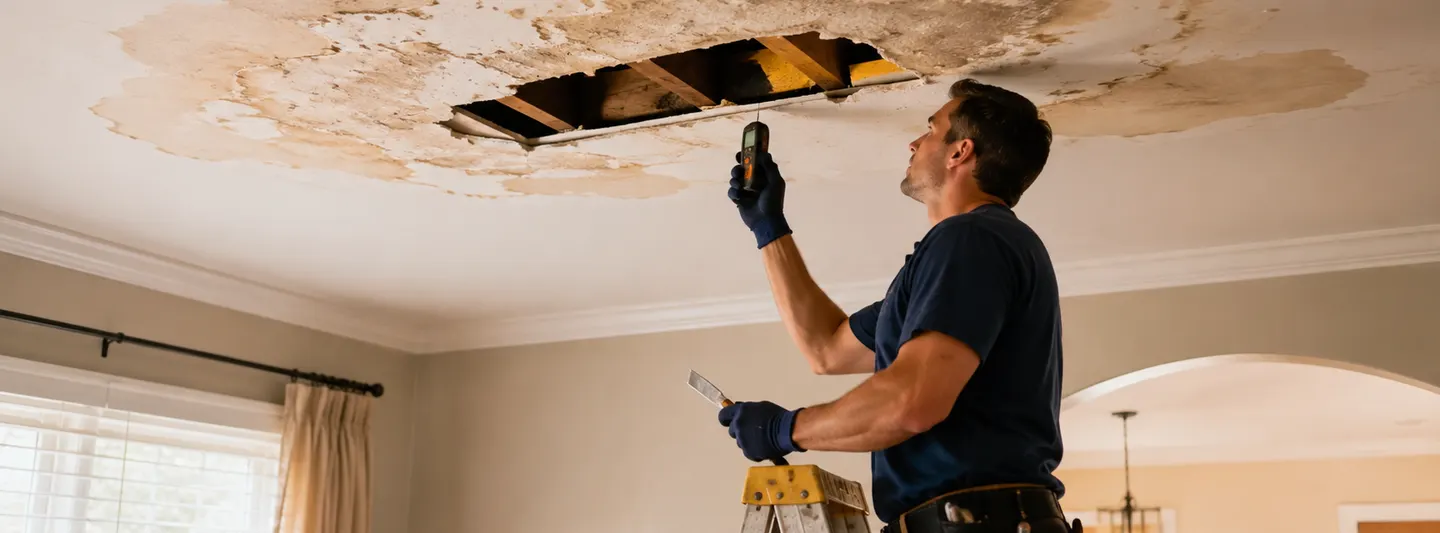
A ceiling repair can expose insulation, framing, ducts, wiring and the underside of the floor or roof above
INSULATIONCan it dry, or does it need removal? Wet insulation can slow cavity drying and may lose performance or become unsuitable depending on material and contamination.
FRAMINGIs the wood merely wet or physically deteriorated? Drying sound framing is different from repairing rot or structural damage.
ELECTRICALDid water reach a light, fan, junction or wiring? Electrical exposure belongs to a qualified trade, not the drywall-finishing scope.
DUCT / HVACCould condensation be the source instead of a roof or pipe leak? Building America notes that moisture can condense when warm humid air contacts cold surfaces in walls and attics.
SAGGING CHANGES THE URGENCY
A ceiling holding water is no longer just a finish defect
Angi's current ceiling-repair guide specifically identifies water damage and structural issues as factors that can increase ceiling repair cost and warns that damaged ceilings can worsen if left unresolved. A bulge or sag indicates that the board or plaster may have lost stiffness, attachment or support.
Keep occupants away from a visibly sagging area, especially around ceiling fixtures, and address the water source before attempting a cosmetic repair. If the ceiling has partially collapsed, the repair scope begins with safe removal and inspection of what is above it.
Do not stand beneath active sagging or attempt unsafe drainage through an energized fixture area.
THE REPAIR MAY BE SMALL; THE PAINTING AREA MAY NOT BE
Texture and sheen continuity often decide whether a technically sound patch still looks repaired
HomeGuide's current drywall-installation data places ceiling texturing around $1–$2 per square foot. Its texture guide puts general drywall texture around $0.80–$2.00 per square foot. Those rates are most useful on larger areas; small repairs still face minimum labor.
Flat ceiling paint can make blending easier than glossy finishes, but age, smoke, sunlight and previous touch-ups can make the original color difficult to reproduce. A contractor may therefore recommend painting the entire ceiling plane rather than only the patched square.
THE SOURCE BELONGS ON A SEPARATE LINE
Ceiling cost should not hide the repair that prevented the next stain
Our Roof Leak Repair Cost report uses HomeGuide's 2026 range for a small leak before secondary damage. Flashing, valleys or deck damage can move much higher.
A ceiling contractor can replace drywall, but a leaking supply, drain, tub or shower connection needs its own plumbing scope.
Air-handler pans, condensate lines and cold duct surfaces can create water above ceilings. Repainting below does not change the HVAC condition.
Building America says warm moist air leaking into cold attics can condense on sheathing and eventually contribute to mold or rot.
THE 24–48 HOUR DECISION WINDOW
Drying speed changes whether the project remains a ceiling repair or becomes a moisture-remediation project
EPA's February 2026 homeowner mold guide says that when wet or damp areas and materials are dried within 24–48 hours, mold will not grow in most cases. EPA's December 2025 mold training material similarly says drywall may be dried in place when there is no obvious swelling and seams remain intact.
That does not mean every older ceiling stain contains mold or every 49-hour incident needs professional remediation. It means elapsed time and hidden moisture should inform the inspection instead of assuming a dry-looking painted surface represents the entire assembly.
WHEN THE CEILING REPAIR BECOMES A ROOM REPAIR
Water damage can be localized while finish continuity forces a broader visual scope
Homeowners often expect the visible repair area to match the wet area. That is reasonable for demolition, but not always for finishing. Joint compound has to be feathered beyond a patch. Texture has to blend into the existing field. Primer may be needed wherever staining occurred. Paint can require a larger logical break to avoid a visible rectangle around the repaired board.
Good repair does not require removing an entire ceiling when a localized section can be cut back to sound material and supported properly.
Tape and compound need width to flatten transitions. This creates a larger finishing zone than the physical opening.
Orange peel, knockdown, popcorn or hand-applied textures can be visually difficult to stop exactly at the patch perimeter.
A small patch can justify repainting the full ceiling plane if old paint has faded or the sheen makes touch-up lines obvious.
This is not the same as allowing a contractor to enlarge scope without explanation. The quote should distinguish the area being demolished from the area being finished. When those two quantities differ, the reason should be visible in the scope.
WHY THIS ARTICLE DOES NOT USE A CEILING COST CALCULATOR
A four-square-foot patch can cost more than twenty square feet multiplied by an online unit rate
Ceiling work has strong minimum-job economics. Protecting the room, setting up overhead access, cutting to framing, installing backing, hanging a patch, taping, waiting for compound, sanding, matching texture, priming and painting all happen even when the damaged opening is small. A simple “square feet × price” calculator would therefore understate many real small repairs.
The opposite problem appears on larger losses. A 100-square-foot wet ceiling might include only 30 square feet of board replacement, 100 square feet of stain treatment, an entire 250-square-foot ceiling paint field, wet insulation above, and a plumbing repair in the room upstairs. One area input cannot represent those scopes honestly.
looks precise but hides source, cavity, minimum labor and finish continuity.
three scopes that can be priced and approved independently.
FIVE CEILING WATER-DAMAGE FILES
The size of the stain is less useful than the number of layers the repair crosses
No active moisture remains and the drywall is flat. The project may stay near minor ceiling-repair economics—surface preparation, stain-blocking primer and paint rather than board replacement.
Source repair sits on the plumbing invoice. Drywall patching, finishing and paint belong on the ceiling invoice. HomeGuide's $350–$1,500+ drywall-ceiling range is more useful here than multiplying four square feet by a low unit rate.
The visible board repair can be modest while cavity drying, insulation removal and roof repair expand the complete incident. Compare each scope separately instead of asking one contractor for an unexplained “water damage” total.
Keep people clear, stop the source, safely remove unstable material and inspect the cavity. This belongs at the major-repair end of the range rather than a cosmetic stain treatment.
The wet area can be small while restoration requires skilled plaster repair and matching across a much larger ceiling field. Angi's broad 2026 plaster range shows why this can exceed ordinary drywall economics.
A CEILING-WATER-DAMAGE QUOTE SHOULD TELL A STORY
Seven lines are enough to show whether the contractor priced the cause, the cavity and the finish
01Known / suspected source — what released the water?
02Source status — repaired, included in this contract, or assigned to another trade?
03Ceiling material — drywall, plaster, acoustic tile or another system?
04Opening / removal — how much material is being removed and why?
05Cavity work — insulation, framing, electrical or HVAC inspection / drying?
06Finish scope — tape, compound, plaster, texture, primer and paint boundaries?
07Hidden-condition rule — what happens if opening the ceiling reveals broader damage?
“Repair water-damaged ceiling — $1,250” is a price. It is not yet a scope.
COMMON COST QUESTIONS
Ceiling water damage repair in plain terms
How much does it cost to repair a water-damaged ceiling? HomeGuide uses $400–$1,200 for major water-damage / sagging ceiling repair, while Angi's May 2026 water-damage guide uses about $450–$1,600 for ceiling repair.
How much does drywall ceiling repair cost? HomeGuide's current drywall-repair guide publishes approximately $350–$1,500+ for drywall ceiling repair. Angi's August 2026 drywall guide places water-damage drywall repair around $600–$1,550 on average.
Can stained drywall be painted instead of replaced? Sometimes. EPA says drywall may sometimes be dried in place if there is no obvious swelling and seams remain intact. The leak must be stopped and hidden moisture addressed before cosmetic repair.
How much does ceiling texture add? HomeGuide's current drywall-installation guide uses roughly $1–$2 per square foot for texturing a drywall ceiling, though small jobs can face minimum labor and blending costs.
Why does a tiny ceiling patch cost hundreds of dollars? Overhead protection, cutting, backing, fastening, multiple compound / sanding stages, texture matching and paint do not shrink in direct proportion to the damaged square footage.
Does ceiling repair include fixing the roof or pipe leak? Not automatically. Source repair may be a separate roofer, plumber or HVAC scope. Confirm that boundary before comparing bids.
Should a sagging wet ceiling be left alone? A visibly sagging or bulging wet ceiling can release material or water. Keep people away from the affected area and have the active source and overhead assembly evaluated safely.
METHODOLOGY & SOURCES
Current ceiling pricing plus primary moisture-control guidance
Pricing was reviewed August 8, 2026. HomeGuide and Angi provide current national consumer cost benchmarks. EPA and U.S. Department of Energy Building America resources are used for drywall drying, 24–48-hour moisture control and attic-condensation context.
$200–$500 minor; $400–$1,200 major water-damage / sagging repair; plaster and drywall ceiling context.
02 · HOMEGUIDE · CURRENT 2026 GUIDEDrywall Repair Cost$300–$500 small repair; $500–$800+ larger damage; $350–$1,500+ drywall ceiling repair.
03 · ANGI · MAY 2026Ceiling Repair Cost$150–$4,420 broad professional ceiling-repair range; material and structural-source cost context.
04 · ANGI · MAY 2026Water Damage Restoration Cost$450–$1,600 current ceiling-repair benchmark within water-damage projects.
05 · ANGI · AUG 2026Drywall Repair Cost$600–$1,550 current water-damage drywall-repair benchmark and mold context.
06 · U.S. EPA · DEC 2025Water-Damaged Materials GuidanceDrywall may be dried in place if there is no obvious swelling and seams remain intact; otherwise removal may be necessary.
07 · U.S. EPA · FEB 2026A Brief Guide to Mold, Moisture and Your HomeEPA 24–48-hour drying guidance for water-damaged materials and areas.
08 · DOE / BUILDING AMERICAManaging Indoor Humidity and VentilationAir leakage, cold surfaces, attic / wall condensation and hidden moisture context.
This report is U.S. cost-planning information, not a remote safety or structural assessment. Active leaks, sagging ceilings, wet electrical fixtures, mold or damaged framing can require qualified professional evaluation.