
2026 NATIONAL COST ANSWER
A minor roof leak costs about $150–$1,000 to repair. Once water has damaged roofing layers or the interior, the project can reach $1,000–$6,000+.
HomeGuide's February 2026 national data separates roof leaks by consequence rather than by stain size: $150–$1,000 for small leaks with no water damage, $1,000–$3,000 for larger leaks with some water damage, and $3,000–$6,000+ when structural or extensive interior damage is involved.
Angi's March 2026 roof-leak dataset is narrower for ordinary professional repairs, at roughly $700–$3,000, with many homeowners paying around $900. The gap between the datasets is useful: “roof leak repair” can mean resealing one penetration or rebuilding roofing, underlayment, decking and interior finishes after months of water entry.
Small leak caught before secondary damage.
Broader opening, underlayment or localized water damage.
Decking, framing or substantial interior restoration.
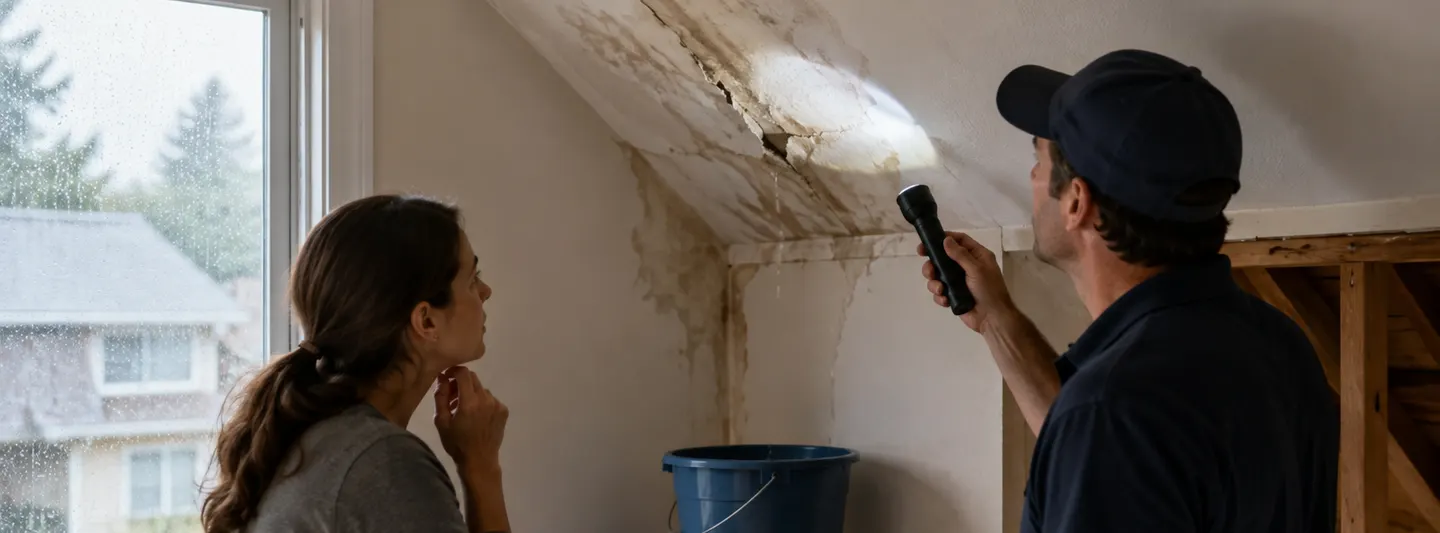
The ceiling stain is a witness, not the crime scene.Water can enter uphill, travel along decking or framing, and become visible several feet away.
U.S. Department of Energy Building America guidance describes vents, chimneys, skylights, flue stacks and other penetrations as weak points in the roof's water-control layer. Roof-wall joints and valleys create similar risk because several layers must overlap so water continues moving down and out of the building.
When the penetration is a masonry chimney, the roof flashing may be only one layer of the problem. The chimney repair cost guide separates flashing from crown, mortar, masonry and liner work.
This article therefore has no calculator. Before diagnosis, a square footage input creates more confidence than information. A two-inch failed pipe boot can create a ceiling stain across several feet, while a large visible stain can still originate from one flashing detail. The valuable cost model is the path of water through the assembly.
THE LEAK PATH
Water usually crosses more than one location before the homeowner sees it
Entry point. A boot, flashing joint, missing shingle, valley, fastener or membrane detail allows water past the primary covering.
Travel path. Water follows gravity, seams and framing. It can move on top of underlayment, along the underside of sheathing or down a rafter before dripping.
Visible symptom. Drywall or insulation finally becomes wet enough to show a stain. The horizontal distance between stain and entry point is not itself a repair-cost metric.
BUILD A LEAK FILE BEFORE THE ROOFER ARRIVES
Weather history can narrow the investigation without putting the homeowner on the roof
A leak that appears during every ordinary rain behaves differently from one that appears only in wind-driven rain or after snow begins to melt. Recording those conditions does not diagnose the roof, but it gives the contractor a better starting point.
TIMEWhen did moisture first become visible? Photograph the stain and record whether it grew during the event.
RAINLight rain, prolonged rain or wind-driven rain? The direction and duration of water exposure can matter at walls, flashings and penetrations.
SNOW / ICEDid the symptom begin during melt rather than rainfall? Ice-dam conditions can create a different water path near eaves.
ATTICCan staining be observed safely from a normal attic walkway? Note damp sheathing, dark trails or wet insulation without walking on framing or disturbing unsafe materials.
HISTORYHas this exact area leaked before? Previous patch locations can be more useful than a generic roof-age estimate.
Department of Energy pre-retrofit guidance similarly recommends inspecting attics for water staining and damp wood and comparing interior observations with the known locations of plumbing stacks, flues and chimneys.
WHAT COMMON LEAK LOCATIONS COST IN 2026
Location matters because each detail requires a different amount of roof to be opened
A small component with a complete penetration around it
HomeGuide's current range for replacing a cracked plumbing pipe boot is $250–$600 on average, with some repairs reaching $1,500+ depending on material, pitch and surrounding work. The real scope is not the rubber part alone: adjacent shingles and flashing must remain correctly integrated.
Reseal, reflash or replace
HomeGuide puts a leaking roof-vent repair around $100–$500 and complete vent replacement around $200–$700. If the vent itself is serviceable but flashing has failed, the repair may stay at the low end. Damaged surrounding roofing expands the opening.
A narrow leak location with a wide reconstruction zone
Two roof planes concentrate runoff into the valley. Current HomeGuide data puts ordinary valley leak repair around $300–$1,500, but restoration can reach $6,000+ when damaged decking, underlayment and surrounding shingles must be replaced.
Glass, curb, seals and flashing are different failure points
Current HomeGuide data places many skylight leak repairs at $225–$800. If the unit itself is beyond repair, replacement is approximately $800–$2,400 before unusual interior or roof work.
The leak may belong to roofing, masonry or both
HomeGuide distinguishes small flashing / crack work from major chimney issues such as crown replacement or rebuilding. Contractors should identify whether water is crossing roof flashing, masonry, the crown, cap or a joint rather than assigning every chimney-area stain to the shingles.
Cheap when exposure is brief and underlying layers remain dry
HomeGuide puts replacement of up to roughly 25 asphalt shingles around $100–$300. A larger 100-square-foot roof section commonly moves to about $350–$1,000, and structural damage can push the same visible event above $3,000.
WHY “JUST CAULK IT” IS SOMETIMES TOO SMALL A REPAIR
Flashing works because of geometry and layering, not because metal is waterproof
Building America says roof water-control materials should overlap in “shingle fashion” so water is directed down and out. At roof penetrations, flashing must connect continuously with underlayment and the roof covering. At roof-wall intersections, step flashing, adhesive membrane and kick-out flashing can all be part of the drainage path.
Sealant or a small correction may be appropriate when the flashing itself and surrounding assembly remain correctly integrated.
Current HomeGuide flashing data puts many minor repairs around $200–$500 and major repair / complete replacement around $500–$1,500+.
Building America specifically calls for repairing damaged sheathing and framing when roof-wall flashing has allowed water into the assembly.
THE SAME LEAK LOCATION CAN COST DIFFERENTLY ON DIFFERENT ROOF SYSTEMS
Repair access and material compatibility can matter more than the amount of water that entered
A plumbing vent through asphalt shingles, standing-seam metal and tile can fail at the same penetration but require very different work to expose and rebuild the detail. The roofer has to remove enough of the surrounding roof system to reach the water-control layer without damaging material that is meant to remain.
ASPHALT SHINGLESUsually the easiest repair field to open and rebuild. Matching old shingles can still become difficult when the existing color or product line has aged or disappeared.
METALPanel seams, fasteners and trim can expand a local repair. HomeGuide's February 2026 metal-roof data places many residential leak repairs around $200–$1,000, while broader metal repair runs about $5–$15 per square foot.
TILEThe visible tile may not be the waterproofing failure. Angi's 2026 tile data puts many leak-detection and repair projects around $400–$1,500. Tiles may need to be carefully removed to reach damaged underlayment or flashing below.
SLATESpecialized material handling raises the consequence of access. HomeGuide's current slate-repair guide places many residential repairs around $500–$2,100. Breaking surrounding serviceable slate while trying to reach one detail can materially increase the job.
This is why a useful roof-leak proposal identifies both the failed detail and the roof system that must be disturbed to reach it. Leak severity alone cannot explain labor.
WHEN DIAGNOSIS ITSELF HAS VALUE
A contractor who spends time proving the source may be cheaper than a contractor who starts patching immediately
Some leaks are obvious: one missing shingle after a storm, a split pipe boot or visibly displaced flashing. Others are intermittent and only appear with a particular wind direction, long-duration rain or snow melt. In those cases, the investigation can involve attic inspection, exterior detail review, moisture tracing and selective opening.
The homeowner should not confuse “no immediate repair performed” with “nothing of value happened.” If the diagnosis eliminates the wrong chimney, proves that the stain originates at a sidewall several feet uphill or determines that broad attic moisture is condensation rather than rain entry, it can prevent paying for a repair that would never have solved the symptom.
The lowest-value roof-leak invoice is the one that successfully patches something that was never leaking.
NOT EVERY WET ROOF DECK STARTED WITH RAIN
Condensation can imitate a roof leak from inside the attic
Building America identifies roof leaks, condensation from diffusion or air leakage, and built-in construction moisture as different moisture risks in roof assemblies. In cold-weather attic guidance, it recommends limiting warm moist indoor air leakage to cold roof sheathing and controlling indoor humidity.
This matters when staining appears without a matching rain event, moisture is broad rather than localized, or frost / condensation is visible on the underside of roof sheathing. Plumbing or HVAC condensation can also create wet areas near penetrations.
flashing · covering · penetration · valley · ice dam
air leakage · condensation · plumbing · duct / fan issue
COLD-CLIMATE LEAKS
An ice-dam leak has a roof symptom and a building-heat mechanism
HomeGuide puts ice-dam removal around $350–$1,500 and leak repair / restoration after ice-dam damage around $1,500–$5,000+. But removal and repair are not the same as preventing recurrence.
Building America materials on ice-dam prevention emphasize attic air sealing, insulation and ventilation strategies because heat escaping from the building can warm the roof deck. That means a durable fix can involve both roof water protection and the thermal / air-control conditions beneath it.
EMERGENCY LEAK VS. PERMANENT REPAIR
Stopping tonight's rain is a different objective from reconstructing the failed detail
During active weather, the first objective may be to limit additional water entry safely. Temporary tarping or another professional dry-in method can buy time until conditions allow permanent repair.
Avoid unsafe roof access in rain, wind, ice or darkness. Move contents where practical and contain interior dripping without contacting electrical hazards.
Professional temporary protection can stabilize the situation but does not necessarily restore the underlying flashing or membrane.
Inspect when conditions are suitable and document any concealed damage exposed during the permanent repair.
Replace damaged roof layers and separately address interior moisture consequences.
THE FOUR-SENTENCE ROOF-LEAK PROPOSAL
A good scope should explain the leak in chronological order
01Where water is believed to enter.“Leak traced to failed step flashing at the east dormer sidewall.”
02What must be removed to reach it.“Remove surrounding shingles and lower siding courses to expose flashing and underlayment.”
03What will restore the water-control layer.“Replace damaged membrane and step flashing; add correctly integrated kick-out flashing at the eave.”
04What happens if hidden damage appears.“Additional sheathing / framing requires documented approval at the stated unit price or separate structural scope.”
That four-sentence structure is more valuable than a long generic checklist because it lets the homeowner understand cause → access → repair → contingency.
WHEN A LEAK BECOMES A REPLACEMENT CONVERSATION
One leak does not automatically condemn the roof; repeated failure across the system changes the economics
Surrounding roof covering remains serviceable, replacement material can integrate cleanly and there is no broad history of failures.
Valleys, flashings, field roofing and penetrations all show deterioration, or repairs repeatedly require opening additional old material.
Large-scale tear-off, underlayment replacement and broad re-shingling can approach replacement-type labor while preserving much of the existing roof.
HomeGuide's current full roof replacement range is $5,700–$16,000. That does not create a universal repair-vs-replace threshold; it gives context when a leak proposal starts moving into several thousand dollars.
See Roof Repair Cost for the broader repair decision and Roof Replacement Cost for full-system replacement scope.
FOUR ROOF-LEAK FILES
The repair price follows the layer depth, not the diameter of the stain
The roofer identifies a cracked pipe boot; nearby shingles and deck are dry and serviceable. HomeGuide's current $250–$600 pipe-boot range is a reasonable benchmark because the project stays at the penetration layer.
Opening the valley reveals failed underlayment but sound decking. The ordinary $300–$1,500 valley range becomes the starting point, with added cost for the wider roofing area needed to rebuild the water-control layers.
Step flashing is wrong, wall sheathing is damaged and roof deck is soft. A flashing-only price is no longer the relevant comparison. The project belongs in HomeGuide's $1,000–$6,000+ water-damage spectrum depending on the full exposed scope.
Evidence does not line up with one exterior entry point. The next step is moisture / attic diagnosis, not paying a roofer to spread sealant across the roof. Condensation and air leakage need to be ruled in or out.
AFTER THE REPAIR
The best proof is not that the ceiling was repainted—it is that the leak mechanism was changed
ENTRYPhoto of failed detail before removal.
OPENPhoto of underlayment / deck condition after access.
REPAIRPhoto of new flashing or water-control detail before final covering.
CLOSEPhoto of completed roof surface and affected location.
INTERIORDo not close wet interior assemblies until drying / damage has been addressed.
A repair that documents those stages creates a record of what was actually changed. That is far more useful later than an invoice that says only “fixed leak.”
COMMON COST QUESTIONS
Roof leak repair in plain terms
How much does a small roof leak cost to repair? HomeGuide's February 2026 range is about $150–$1,000 when the leak has not caused meaningful secondary water damage.
How much if there is water damage? HomeGuide uses $1,000–$3,000 for moderate leaks with some water damage and $3,000–$6,000+ when structural or extensive interior damage is involved.
How much is a leaking roof vent? About $100–$500 to repair in current HomeGuide data, while complete vent replacement commonly runs $200–$700.
How much is a leaking valley? Around $300–$1,500 for ordinary valley leak repair. Extensive deck, underlayment and surrounding shingle restoration can reach $6,000+.
How much is leaking flashing? HomeGuide's dedicated 2026 guide places minor flashing repair around $200–$500 and major / complete replacement around $500–$1,500+.
Can a roof leak be repaired from inside? An interior patch may manage a symptom or temporarily catch water, but HomeGuide notes that the underlying exterior source still has to be addressed. Building America likewise treats flashing and roof water-control layers as exterior drainage details.
How long does a roof-leak repair take? HomeGuide says many repairs take from about 30 minutes to a full day, while leaks involving structural or interior restoration can take several days across multiple trades.
METHODOLOGY & SOURCES
Current price evidence plus roof-water-management guidance
Cost data was reviewed August 8, 2026. HomeGuide provides the primary current national cost breakdown by severity and leak location. Angi provides an independent 2026 market cross-check. Building America sources are used for water-control, flashing, attic moisture and condensation principles.
$150–$1,000 minor; $1,000–$3,000 moderate; $3,000–$6,000+ major, plus leak-location ranges.
02 · ANGI · MAR 2026Roof Leak Repair Cost$700–$3,000 national professional-repair range, with many projects around $900.
03 · HOMEGUIDE · JAN 2026Roof Flashing Repair Cost$200–$500 minor flashing repair and $500–$1,500+ major / replacement context.
04 · DOE / BUILDING AMERICAFlashing of Penetrations in Existing RoofsContinuous water-control layer, penetration weak points, drainage and shingle-fashion integration.
05 · DOE / BUILDING AMERICAFlashing of Roof-Wall Intersections in Existing HomesStep flashing, kick-out flashing, membrane integration and damaged sheathing / framing repair.
06 · DOE / BUILDING AMERICAPre-Retrofit Assessment of Attics, Ceilings & RoofsAttic leak evidence, damp wood, roof penetrations and plumbing / condensation differentiation.
07 · DOE / BUILDING AMERICACondensation Control in Attics and RoofsInterior air leakage, roof-sheathing condensation and humidity-control context.
This report is cost-planning information, not a remote roof diagnosis. Active leaks can involve electrical, structural, mold or fall hazards. Roof access should be left to qualified professionals when conditions are unsafe.