
2026 NATIONAL COST ANSWER
Water damage restoration costs about $2,000–$6,000 on average, but the same search term covers incidents from a $150 localized cleanup to a $100,000 disaster.
HomeGuide's February 2026 national data places average water damage restoration at $2,000–$6,000. Its broader range starts around $150 for very limited damage and can reach $100,000 in severe whole-home or disaster situations.
Angi's August 2026 dataset centers at about $3,867, with a typical published range of $450–$16,000. Those numbers overlap because the final invoice is driven less by the presence of water than by contamination, saturation depth, affected materials and how much reconstruction follows drying.
Do not ask only “How much water is there?” Ask “What did the water touch, how contaminated is it, and what must be removed before the building can be dried?”
The professional restoration process is broader than extraction. ANSI/IICRC S500—the industry standard for professional water damage restoration—covers preliminary evaluation, drying technology, instruments, structural restoration, contents, HVAC, documentation and project risk management. It also treats correction of the original water source as a separate responsibility that must be resolved rather than assumed away.
That is why this article deliberately has no calculator. The next Repair Cost Ledger report is dedicated to Water Damage Repair Cost per Square Foot. This page answers the more important first question: what work is actually inside a restoration project?
THE INCIDENT FILE
A useful restoration estimate follows the chronology of the loss
Burst pipe, roof leak, appliance supply, drain backup, groundwater or storm entry. Drying does not solve an active source.
Identify the water source, affected rooms, materials, hidden cavities and practical safety constraints before demolition.
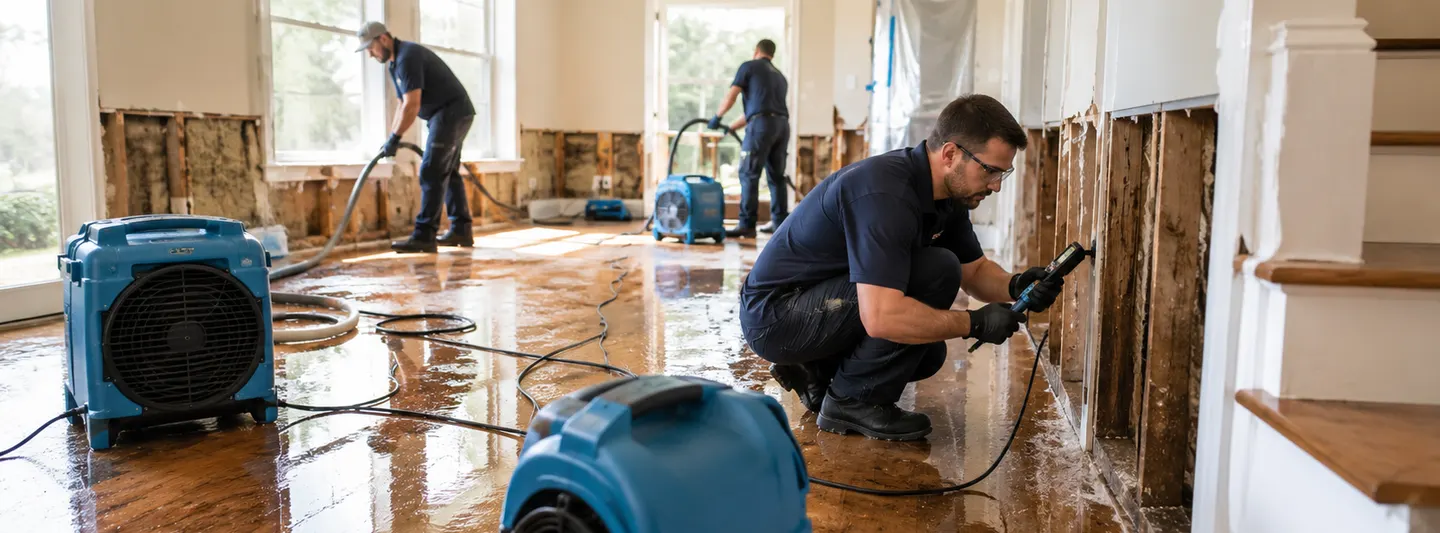
Pumps, extraction equipment and controlled removal reduce the amount of moisture the building materials must release later.
Contaminated, unsalvageable or structurally compromised flooring, drywall, insulation and contents move from drying to demolition.
Air movement, dehumidification and targeted drying continue until the remaining assembly reaches acceptable conditions.
The project should document the condition of materials rather than using the disappearance of visible puddles as the finish line.
Drywall, flooring, trim, insulation, cabinetry and finishes may belong to a separate reconstruction phase or contractor.
TWO DIFFERENT AXES DRIVE THE PRICE
Water category describes contamination. Damage class describes how far the incident has spread.
HomeGuide's 2026 cost guide separates these concepts because they affect different parts of the job. Category changes handling and extraction cost. Class changes the size and depth of the restoration. A small contaminated incident and a large clean-water incident are different projects even when the visible water depth is similar.
What is in the water?
HomeGuide extraction benchmark: $4–$6/sq. ft.
HomeGuide extraction benchmark: $6–$9/sq. ft.
HomeGuide extraction benchmark: $9–$12/sq. ft.
How much of the building is affected?
Minimal, localized damage. HomeGuide: $150–$500.
Significant room-scale damage. HomeGuide: $1,500–$5,000.
Extensive saturation across walls, floors or ceilings. HomeGuide: $5,000–$15,000.
Severe / disaster-scale loss. HomeGuide: $15,000–$100,000.
DRY OR REMOVE?
The cheapest restoration is not the one with the least demolition—it is the one that keeps only material that can safely and credibly remain
EPA guidance for flood cleanup says to sort wet materials and discard items that cannot be cleaned and dried. FEMA's 2025 disaster guidance specifically says drywall and insulation that contacted floodwater should be removed. Clean-water incidents can allow more selective drying when materials remain salvageable.
Decision depends on contamination, material condition, how long it stayed wet and whether both sides / cavities can actually dry.
Porous materials can retain water inside layers that are not visible from the room. Contamination and deterioration can move them from “dry” to “remove.”
EPA notes that floodwater can contain bacteria, chemicals and other hazards. Salvage logic for a clean plumbing loss should not simply be copied onto a flood or sewage event.
Demolition is not automatically evidence of a larger loss. Sometimes selective removal is what makes the remaining structure dryable.
READ THE RESTORATION INVOICE IN PHASES
One total can hide three economically different projects
Emergency mitigation
Source isolation where contracted, extraction, emergency access, moving contents, initial containment and the first response.
Structural drying / remediation
Selective demolition, dehumidification, air movement, cleaning, monitoring, moisture documentation and removal of unsalvageable materials.
Reconstruction
New insulation, drywall, trim, flooring, paint, cabinetry and other building finishes needed to return the property to a finished state.
Angi makes a similar distinction between mitigation—stopping additional damage—and remediation / restoration that follows. The distinction matters because a homeowner may receive a drying invoice before the final rebuild price is known.
HOW A $2,500 LOSS BECOMES AN $8,000 LOSS
The budget expands when water crosses assemblies, not simply when the puddle gets deeper
Water is unusually good at turning one trade into several. A failed refrigerator line may begin as a plumbing event, then wet flooring, enter the subfloor, reach the ceiling below and finally involve drywall, paint and electrical fixtures. The visible source can be smaller than the reconstruction footprint.
A plumber, roofer or appliance technician corrects the cause before widespread material damage develops.
Restoration equipment and monitoring are added because materials absorbed water even though little demolition is required.
Flooring, drywall, trim, cabinetry or insulation must be removed and later rebuilt by restoration crews or separate finish trades.
Framing, electrical systems, HVAC, sewage contamination or mold move the project outside ordinary extraction-and-dry economics.
This is one reason national averages are most useful at the beginning of the conversation, not the end. A $3,867 Angi average tells you the order of magnitude of a common restoration job. It cannot tell you whether the water has crossed one finish layer or three building assemblies.
DOCUMENTATION IS PART OF THE PRODUCT
A restoration company should leave behind more than a row of dehumidifier charges
IICRC S500 includes project documentation and risk management among the components of professional water damage restoration. For the property owner, documentation is valuable because much of the work becomes invisible after reconstruction. Wet drywall is discarded, subfloor is covered again, and moisture readings cannot be recreated months later.
STARTInitial condition source, affected rooms, visible water, material condition and first moisture observations.
OPENDemolition evidence what was removed, what was found behind it and why additional scope was necessary.
DRYProgress record readings, equipment changes and areas that were added or removed from the drying plan.
ENDDrying completion evidence supporting the decision to remove equipment and begin reconstruction.
REBUILDFinal construction scope materials replaced, finishes restored and any unresolved source or prevention work left to another contractor.
This level of record keeping also improves quote comparison. If one proposal contains extraction and four days of equipment while another includes daily monitoring, selective demolition and reconstruction, the totals should not be compared until the work packages are aligned.
THE 24–48 HOUR WINDOW
Time matters because wet materials become a different restoration problem if they stay wet
EPA's current homeowner guidance says water-damaged areas and items should be dried within 24–48 hours to help prevent mold growth. Its flood-cleanup guidance is even more direct: mold can grow on wood, drywall, carpet and furniture if they remain wet for more than 24 hours.
That does not mean a 49-hour-old incident automatically requires a full mold-remediation project. It means delay changes risk and makes moisture history relevant. Hidden cavities behind baseboards, walls, ceilings, cabinets and flooring deserve attention because they can stay wet after the visible surface appears dry.
HomeGuide currently places mold remediation around $15–$30 per square foot or $1,500–$15,000+ total in its water-damage guide. Angi's August 2026 water-damage article uses a narrower mold-removal planning band of roughly $1,200–$3,800. Actual remediation scope depends on what is found, not merely on elapsed time.
RESTORATION DOES NOT FIX THE ORIGINAL FAILURE BY DEFAULT
The drying contractor and the source-repair contractor may be solving different problems
BURST PIPEPlumber fixes the failed supply line. Restoration contractor removes water and dries / rebuilds affected materials.
ROOF LEAKRoofer repairs the water-entry detail. Restoration scope handles wet insulation, ceiling, walls or floors below.
SEWER BACKUPDrain / plumbing problem must be corrected. Contaminated-material handling remains a restoration issue.
GROUNDWATER / FLOODINGDrainage, flood mitigation or waterproofing may be a separate future project. Drying the current loss does not redesign the site.
IICRC S500 explicitly notes that determining and correcting the underlying source or cause is the property owner's responsibility unless that work is separately contracted to the restorer or another specialist. That is an important contract boundary.
REBUILD COST IS MATERIAL-SPECIFIC
After drying, the budget changes from moisture physics to construction finishes
HomeGuide's water-damage guide lists several current reconstruction benchmarks after extraction and drying: drywall $1.50–$3.50/sq. ft., carpet $2–$8/sq. ft., hardwood $7–$25/sq. ft., and plaster $2–$10/sq. ft.. These are material-specific repair / replacement figures, not universal restoration rates.
A restoration company can perform both drying and reconstruction, or those phases can be split among trades. Either model can work. The important budgeting point is knowing whether the estimate in front of you stops at “dry and ready for rebuild” or ends with a finished room.
FOUR WATER-DAMAGE COST FILES
Same square footage, different restoration logic
A plumbing connection fails over a hard floor, water is shut off promptly, baseboard and a limited drywall area are affected, and no broad contamination is present. The project may remain near the lower end of HomeGuide's $2,000–$6,000 average or below it if demolition is minimal.
The visible bathroom area is small, but the loss occupies two levels. Drywall, insulation and ceiling finishes below make the affected assembly larger than the original plumbing footprint. This is a classic case where room square footage understates scope.
Extraction alone runs toward HomeGuide's $9–$12/sq.-ft. Category 3 benchmark, and porous materials contacted by highly contaminated water may require removal rather than ordinary drying.
Walls, floors and contents across several rooms are saturated. HomeGuide places extensive Class 3 restoration around $5,000–$15,000 and disaster-scale Class 4 projects around $15,000–$100,000. Reconstruction and contents can become as important as extraction.
THE RESTORATION SCOPE SHOULD ANSWER SEVEN QUESTIONS
Not a generic checklist—seven boundaries that determine what you are actually buying
01What is the documented source? Is source repair included, excluded or assigned to another trade?
02What category and class are being used? The estimate should make the contamination / extent assumptions visible.
03Which materials are being removed and why? Separate contamination, physical damage and access demolition.
04What is being dried in place? Identify the materials expected to remain rather than treating “dry structure” as an abstraction.
05How is drying progress documented? Baseline and follow-up information are more useful than equipment quantity alone.
06Where does mitigation end? Is final drywall, flooring, trim and paint inside this contract or a later reconstruction scope?
07What changes require approval? Hidden wet cavities, discovered mold, electrical damage or structural issues should have a clear escalation path.
The estimate should let you identify the last dry material and the first reconstructed material.
COMMON COST QUESTIONS
Water damage restoration in plain terms
How much does water damage restoration cost in 2026? HomeGuide's current average is $2,000–$6,000. Angi's August 2026 average is about $3,867, with a published $450–$16,000 range.
How much does water extraction cost? HomeGuide uses $4–$6/sq. ft. for clean water, $6–$9 for gray water and $9–$12 for highly contaminated black water extraction and drying.
Why can a small water loss cost several thousand dollars? Water can travel behind walls and beneath flooring. The invoice may include extraction, selective demolition, drying equipment, monitoring and reconstruction across more than the visibly wet area.
How long should water-damaged materials stay wet? EPA recommends drying water-damaged areas and items within 24–48 hours to help prevent mold growth.
Does restoration include rebuilding drywall and flooring? Sometimes. The drying contractor may also perform reconstruction, or the contract may stop after mitigation / drying. Read the scope for the exact endpoint.
Does every wet wall need demolition? No universal rule applies to every clean-water incident, but contamination, material type, deterioration and whether the assembly can actually be dried all affect salvage. FEMA specifically directs removal of drywall and insulation that contacted floodwaters.
How much can mold add? HomeGuide's water-damage guide currently places mold remediation at $15–$30/sq. ft. or $1,500–$15,000+ total. Actual scope depends on confirmed conditions and affected materials.
METHODOLOGY & SOURCES
Current price evidence plus restoration standards and federal cleanup guidance
Pricing was reviewed August 8, 2026. HomeGuide supplies the primary class, category, extraction and reconstruction benchmarks. Angi provides a current independent market cross-check. IICRC, EPA and FEMA are used for restoration process, drying, contamination and flood-cleanup context.
$2,000–$6,000 average; class pricing; $4–$12/sq.-ft. extraction by water category; rebuild material costs.
02 · ANGI · AUG 2026Water Damage Restoration CostAbout $3,867 average; $450–$16,000 range; current repair and contamination cost context.
03 · ANSI / IICRCS500 Standard for Professional Water Damage RestorationIndustry-standard scope covering evaluation, drying science, instruments, documentation, structure, HVAC and contents.
04 · U.S. EPA · FEB 2026A Brief Guide to Mold, Moisture and Your HomeMoisture control and EPA's 24–48-hour drying guidance.
05 · U.S. EPA · MAR 2026Flood Cleanup to Protect Indoor Air and Your HealthFloodwater hazards, discard / clean / dry logic and mold risk after prolonged wetting.
06 · FEMA · JUL 2025Don't Wait to Clean Up or Make RepairsFlood cleanup guidance including removal of drywall and insulation that contacted floodwaters.
This report provides U.S. property-cost planning information. Floodwater and sewage can contain biological, chemical, electrical and structural hazards; professional assessment may be appropriate before occupants enter or clean affected areas.