
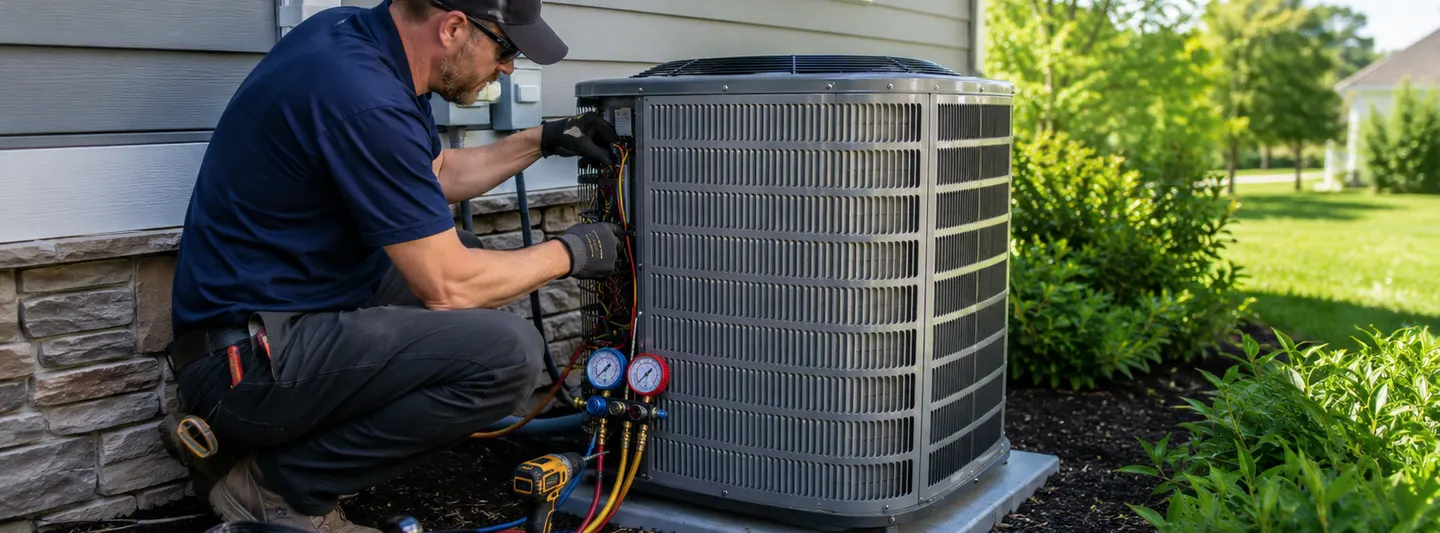
2026 NATIONAL COST ANSWER
A standard central AC replacement commonly costs about $5,000–$8,300, mid-range systems run about $8,300–$12,500, and high-efficiency replacements can reach $14,000+.
HomeGuide's current 2026 guide prices a standard-efficiency replacement at $5,000–$8,300, a mid-range system at $8,300–$12,500, and high-end variable-speed systems at $12,500–$14,000+. Its central-AC-specific installed range is $5,300–$10,500 before major ductwork.
Angi's July 20, 2026 national AC data puts the overall replacement average around $5,976. For central AC specifically, it lists roughly $2,500–$4,500 for the equipment and $3,500–$7,000 for installation, while noting that duct modifications, electrical work and removal can add to the project.
CENTRAL AC REPLACEMENT ESTIMATOR
Estimate a basic installed replacement from contractor-calculated tonnage
This is not an AC sizing calculator. Select the tonnage your contractor has justified with a load calculation. The base ranges use HomeGuide's current installed central-AC pricing by ton and then keep duct and permit work separate.
THE OUTDOOR UNIT DOES NOT HAVE A SEER2 RATING BY ITSELF IN THE WAY MOST HOMEOWNERS THINK
The condenser, evaporator coil and indoor air-moving equipment create the rated split system
AHRI's current homeowner guidance says a split AC's indoor and outdoor units must be properly matched to achieve the expected efficiency and longevity. Its certification directory identifies the certified combination through a unique reference number.
Rejects heat outdoors and drives the refrigeration cycle, but the outdoor model number alone does not define the complete installed rating.
The coil has to match the outdoor unit and refrigerant system. Keeping an old incompatible coil can destroy the logic of buying a new condenser.
The existing furnace may remain in an AC-only project, but blower capability and the certified equipment combination still matter.
AHRI says the certificate verifies that the indoor and outdoor combination has been certified as a properly matched system.
When two contractors quote the “same 3-ton 16-SEER2 AC,” compare model numbers and the AHRI certificate—not the marketing description.
CENTRAL AC COST BY TONNAGE
The installed range rises with capacity, but tonnage should come from the load calculation—not this price list
1.5 TON · 18,000 BTU$4,700–$6,500 basic installed range from HomeGuide.
2 TON · 24,000 BTU$5,000–$6,800 basic installed range from HomeGuide.
2.5 TON · 30,000 BTU$5,400–$7,200 basic installed range from HomeGuide.
3 TON · 36,000 BTU$5,800–$7,800 basic installed range from HomeGuide.
3.5 TON · 42,000 BTU$6,200–$8,300 basic installed range from HomeGuide.
4 TON · 48,000 BTU$6,500–$8,800 basic installed range from HomeGuide.
5 TON · 60,000 BTU$7,000–$9,500+ basic installed range from HomeGuide.
HomeGuide also publishes cost bands by house size—about $6,000–$8,500 for 1,500 square feet and $7,000–$11,500 for 2,000 square feet. Those are useful search and budgeting benchmarks, but both HomeGuide and ENERGY STAR stress that insulation, climate, windows, layout and other load factors affect actual sizing.
SEER2 CHANGES THE PRICE, BUT THE INSTALLED PREMIUM SHOULD BE VISIBLE
Higher efficiency can add thousands before it saves a dollar on the electric bill
HomeGuide's current installed cost bands rise sharply with efficiency: roughly $5,300–$7,900 around its standard tier, $6,700–$9,300 around 15–16 SEER, $7,500–$10,600 around 17–18 SEER, $9,100–$12,200 around 19–21 SEER, and $11,400–$17,300+ at the highest tiers in its dataset.
THE BEST AC REPLACEMENT MAY INCLUDE ZERO NEW DUCTWORK—or THOUSANDS OF DOLLARS OF DUCT WORK
Classify the existing air distribution before comparing equipment quotes
HomeGuide says most AC replacements can reuse existing ducts, while minor sealing and repair runs about $300–$1,500. If ducts are beyond repair, its current replacement range is $1,400–$5,600+. Angi's 2026 new-ductwork range is broader at $3,000–$7,500 for 300 linear feet.
The quote should still confirm airflow and return-air adequacy rather than assuming old ducts are acceptable because they physically exist.
A few hundred to $1,500 can be a better companion to the new unit than replacing otherwise serviceable distribution.
This is often the missing middle between “reuse everything” and “replace all ducts.”
Now the project moves toward full HVAC replacement economics rather than an AC-only change-out.
A $7,500 AC installed on poor ducts and an $11,000 AC project with corrected airflow may not be equivalent purchases.
2026 IS A REFRIGERANT-TRANSITION MARKET
Ask the exact refrigerant before signing the replacement contract
EPA's Technology Transitions rules set a GWP limit of 700 for new stationary residential and light-commercial AC and heat-pump systems, with the installation compliance date reaching January 1, 2026 under the current framework and transition provisions.
EPA's SNAP program lists lower-GWP refrigerants including R-454B and R-32 as acceptable for new residential and light-commercial AC / heat-pump equipment subject to specified use conditions. That does not mean every 2026 central AC uses the same refrigerant or that one refrigerant is universally preferable.
ASK 01Which refrigerant does the proposed matched system use? Put the designation in the contract rather than relying on generic “new refrigerant” language.
ASK 02Are the indoor coil and outdoor unit designed for that refrigerant together? Do not assume an old coil can remain just because it physically fits.
ASK 03Is the existing line set being reused? If so, ask what manufacturer procedures govern size, condition, flushing / cleaning, testing and reuse.
ASK 04What service procedures and components change with the selected refrigerant? Newer lower-GWP refrigerants can have different safety classifications and installation requirements than legacy R-410A systems.
THE $2,000 DIFFERENCE BETWEEN QUOTES MAY BE HIDING IN FIVE SMALL LINE ITEMS
Central AC is a refrigeration project, an airflow project and an electrical project at the same time
Refrigerant piping has to match manufacturer requirements for the new indoor / outdoor combination and installation length.
Angi notes that central systems require condensate drainage and that separate plumbing work can add cost if it is outside the HVAC scope.
Angi notes that central AC uses a dedicated 240-volt circuit and that electrical upgrades can become separate work.
A replacement that needs a new pad, stand, clearance solution or relocation is not a pure equipment swap.
HomeGuide's current permit range for ordinary AC replacement; projects with new ductwork can carry higher permit / inspection costs.
Angi says separate old-system removal is typically about $25–$200, though many contractors include it in the replacement.
CAN YOU KEEP THE EXISTING FURNACE?
Sometimes yes—but the blower and coil relationship must still work with the new AC
In many split systems, the evaporator coil sits with or above the furnace while the condenser sits outdoors. An AC-only replacement can therefore retain the furnace when it remains serviceable and compatible. That does not mean the indoor side should be ignored.
AGEHow much useful furnace life remains? Avoid creating a newly matched cooling project around an indoor unit likely to be replaced soon.
BLOWERCan it deliver the airflow the new coil needs? Rated efficiency depends on more than the condenser.
COIL FITDoes the new certified combination physically and functionally integrate? Ask for the AHRI matched-system reference.
CONTROLSDoes staging / variable operation require a different thermostat or communication setup? Premium compressor features need compatible control logic.
REPAIR OR REPLACE THE CENTRAL AC?
A failed capacitor and a failed compressor do not belong in the same decision
HomeGuide currently places ordinary AC repair around $150–$650. Angi's July 2026 AC replacement guide uses roughly $450–$2,000+ for repairs depending on the failed component. Replacement becomes more defensible as the system ages, repair costs rise and repeated failures accumulate.
A serviceable younger system with one inexpensive failed component usually has very different economics from a compressor failure.
Compare the repair with a matched-system replacement before putting thousands into equipment nearing the end of its useful life.
The decision can move from fixing one component to replacing an aging system that is no longer performing as a complete asset.
HomeGuide uses “repair approaching 50% of replacement cost” as one consumer rule of thumb. Treat that as a budgeting trigger, not a hard engineering threshold. A newer premium system and an old entry-level system can justify different decisions at the same repair price.
WHAT THE CENTRAL AC REPLACEMENT ACTUALLY CONNECTS
The condenser outside is only one half of the refrigeration loop
AHRI's homeowner guidance is useful here: the outdoor condenser and indoor evaporator combination must be properly matched, and the technician should verify airflow and system performance. This is why replacing “just the outside box” is not automatically the right scope.
SEVEN CENTRAL AC COST FILES
The national ranges become useful when the scope is defined precisely
HomeGuide's current basic installed range is $5,800–$7,800. The bid should still identify the indoor coil, outdoor unit and matched-system reference.
HomeGuide uses $6,500–$8,800. If a contractor proposes moving from the old 3-ton unit to 4 tons, request the load calculation and duct-airflow basis before paying for the larger system.
HomeGuide's current house-size range is $7,000–$11,500. The same source still says proper sizing depends on more than square footage.
HomeGuide uses $8,300–$12,500 for its mid-range category. Ask how much of the premium is equipment, controls, matching and any required airflow modification.
HomeGuide's current central AC + ductwork total is $9,000–$16,000. Compare this against a properly scoped AC-only bid plus any required duct repair.
This can be rational when the furnace and blower remain serviceable. The contractor should still document coil compatibility, airflow and the AHRI-certified combination.
Put the exact refrigerant, indoor coil, outdoor unit and line-set treatment into the proposal. EPA's current transition rules make refrigerant compatibility part of a 2026 replacement decision.
THE 15-POINT CENTRAL AC BID NORMALIZER
A quote is complete when you can identify the rated system—not when you recognize the logo on the condenser
01Load calculation — Manual J or equivalent sizing basis?
02Capacity — exact nominal tons / BTU and design rationale?
03Outdoor model — full condenser model number?
04Indoor coil model — exact evaporator coil being installed?
05AHRI reference — certified matched-system number / certificate?
06SEER2 / EER2 — certified rating of the exact installed combination?
07Furnace / blower — retained, replaced or modified; airflow compatibility confirmed?
08Refrigerant — exact refrigerant designation for the new system?
09Line set — reuse, flush / clean, resize or replace?
10Ducts — reuse, repair, resize, add return or replace?
11Condensate — drain / trap / overflow protection scope?
12Electrical — disconnect, circuit and any panel work included?
13Permit / removal — inspection, old equipment and refrigerant handling included?
14Commissioning — airflow, charge, temperature split and controls verified?
15Warranty — parts registration, compressor coverage and labor warranty?
Compare model-number combinations, certified ratings and scope. “3-ton premium AC” is not enough information to compare $9,000 and $12,000 bids.
COMMON COST QUESTIONS
Central AC replacement cost in plain terms
How much does central AC replacement cost in 2026? HomeGuide currently uses $5,000–$8,300 for standard systems, $8,300–$12,500 for mid-range systems and $12,500–$14,000+ for high-end systems.
How much does a 3-ton central AC cost? HomeGuide's current basic installed range is $5,800–$7,800.
How much does a 4-ton central AC cost? HomeGuide's current basic installed range is $6,500–$8,800.
How much does central AC cost for a 2,000-square-foot house? HomeGuide's current planning range is $7,000–$11,500 before major ductwork. The actual tonnage still requires a professional load calculation.
How much does ductwork add? HomeGuide uses $300–$1,500 for minor duct sealing / repair and $1,400–$5,600+ for replacement. Its central AC + ductwork total is $9,000–$16,000.
Can I replace only the outside AC unit? Sometimes, but the indoor coil and other components must be compatible. AHRI recommends verifying the certified matched system. Refrigerant compatibility also matters in 2026.
What is an AHRI reference number? AHRI says it identifies a certified matched indoor / outdoor equipment combination and can be used to generate a Certificate of Product Ratings.
Should I buy the highest SEER2 available? Not automatically. Compare the installed efficiency premium with your cooling climate, utility rates and expected ownership period.
Should I replace the furnace at the same time? Not always. If the furnace and blower remain serviceable and compatible, an AC-only replacement may be reasonable. Ask how the retained indoor equipment affects the certified matched-system rating.
METHODOLOGY & SOURCES
Current 2026 central-AC pricing separated from equipment certification, efficiency and refrigerant rules
Pricing was reviewed August 9, 2026. HomeGuide supplies the primary central-AC installed ranges by efficiency, tonnage, house size and duct scope. Angi's July 20, 2026 update provides an independent current market cross-check. AHRI is used for matched-system certification. ENERGY STAR / DOE provide sizing and efficiency context. EPA provides current refrigerant-transition rules.
$5,000–$8,300 standard; $8,300–$12,500 mid-range; tonnage, home-size, SEER, ducts and permit benchmarks.
02 · ANGI · JUL 20 2026AC Replacement Cost~$5,976 overall average; current central-AC equipment / installation, tonnage, labor, ducts, electrical and removal context.
03 · AHRI · CURRENTAir Conditioners and Heat PumpsMatched indoor / outdoor system guidance, airflow / performance verification and AHRI Certified Reference Number.
04 · AHRI · CURRENTDirectory of Certified Product PerformancePrimary certification directory for residential central AC and heat-pump equipment combinations.
05 · ENERGY STAR · CURRENTProper HVAC SizingManual J recommendation and warning that oversized / undersized equipment can reduce comfort and performance.
06 · U.S. DOE / FEMP · CURRENTEnergy-Efficient Residential Central ACSEER2 framework and region-specific lifetime energy-cost examples for Southeast, Southwest and Northern climates.
07 · U.S. DOE · CURRENTRegional Central AC StandardsNorth, Southeast and Southwest regional efficiency-standard framework for central air conditioners.
08 · U.S. EPA · CURRENT 2026Technology Transitions HFC RestrictionsCurrent HFC restrictions by sector, including the residential / light-commercial AC and heat-pump transition.
09 · U.S. EPA · MAR 2026Residential AC Refrigerant SubstitutesCurrent SNAP acceptability listings and use conditions for refrigerants used in new residential / light-commercial AC equipment.
This is U.S. cost-planning information. AC capacity, matched-system combinations, refrigerant, line-set requirements, airflow, ducts, electrical work, permits and regional efficiency standards depend on the actual home, equipment and jurisdiction. Use a qualified local HVAC contractor's load calculation and manufacturer installation requirements for the final system design.