
START HERE: TWO DIFFERENT PRICES FOR TWO DIFFERENT JOBS
A crawl space drain may cost $800–$3,000. A longer perimeter system can cost considerably more.
You look under your house after a heavy rain and see puddles around the supports. Maybe the ground never seems to dry. Someone offers to install a drain, another contractor recommends a sump pump, and a third suggests sealing the whole crawl space. How do you know what you're actually paying for?
For an interior crawl space drainage system, HomeGuide lists $800–$3,000, describing trenching, gravel, drain pipe and a sump pump. Its separate guide to crawl space French drains quotes $2,000–$8,000, or roughly $20–$40 per linear foot, for more extensive perimeter work.
These published ranges don't contradict one another. They describe different project scopes, and individual quotes may include different equipment. The important question is whether the contractor is draining one wet area or installing a much longer route around the inside edge of the foundation.
Ask the contractor to show you where the water enters, where it will be collected, and exactly where it will leave the property. A drainage system that simply moves the same water to the other side of the foundation isn't much of a solution.
THE MOST EXPENSIVE MISTAKE IS FIXING THE WRONG PROBLEM
Check what's feeding the puddle before digging under the house.
Not every wet crawl space needs an interior French drain. Imagine your gutter ends right beside the foundation. Every storm sends roof water straight against the house. Putting a pump below the floor might remove that water after it arrives, but it doesn't deal with the reason it keeps arriving.
Roof water is running toward the house.
Start with overflowing gutters, a downspout that empties beside the wall, or yard soil that slopes inward. Moving that water away at the surface may solve some cases without a full under-house drain.
The ground stays soaked.
Water may be seeping through the soil or collecting where the ground is naturally low. A drain, a collection pit and possibly a pump may make sense after the source is checked.
Something above it may be leaking.
A supply pipe, a drain line, or an air-conditioning condensate line can cause a localized wet patch. Fixing a plumbing leak first is usually more sensible than installing a whole drainage system.
The U.S. Department of Energy's Building America guidance recommends addressing outdoor drainage and bulk water problems before sealing and insulating the crawl space. That order matters: don't trap an ongoing water problem under a new plastic liner.
There's also a safety distinction. If floodwater may contain sewage, or there's standing water near electrical wiring or equipment, do not climb into the space to investigate yourself. The EPA's flooded-home guidance advises protecting against electrical and contamination hazards and getting qualified help when cleanup is dangerous.
YOU DON'T NEED TO KNOW THE TRADE WORDS
How does a crawl space drainage system actually get water out?
Think of it as giving unwanted water a predictable path out of the house. Instead of sitting on the dirt floor or soaking the area around the supports, water is gathered and directed toward a safe outlet.
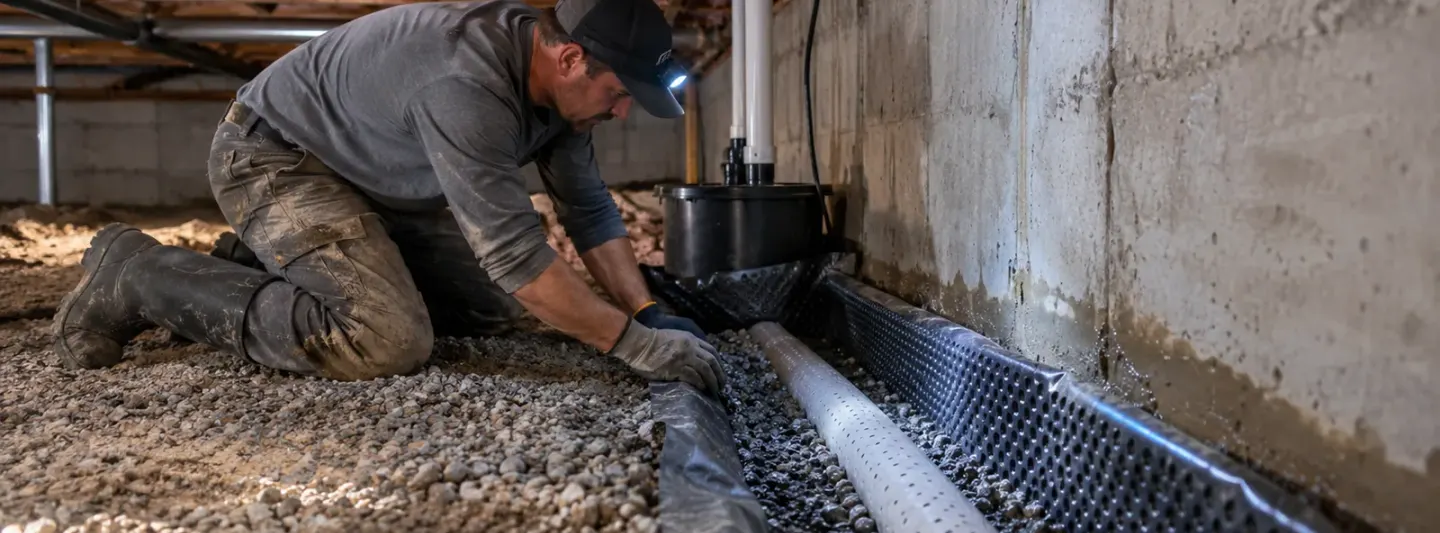
A shallow trench with gravel and a pipe collects water near the wet edge of the crawl space.
The pipe leads toward a lower outlet or a collection pit. The direction of flow has to be planned.
If gravity won't do it, a sump pump pushes water through a discharge line to an approved location away from the foundation.
A French drain is not a special machine. It's a drain made from a trench, gravel and typically a perforated pipe, meaning a pipe with small openings that allow water in. A sump pump is a separate piece of equipment that moves collected water when it can't simply flow downhill.
Under-house systems often need both, but not every job needs a pump. What matters is the route. The Building America sump-pump guide stresses using an appropriate discharge destination and a covered sump pit. Sending pump water straight back beside the foundation can create a loop: the pump moves the water out and it seeps back in.
“Where does the water go after it leaves the pump?”
Ask the contractor to point to the outlet on a sketch or photo, not just promise that the crawl space will be dry.A PRICE LIST THAT DOESN'T MIX UP DIFFERENT PROJECTS
Compare the drain, the pump, and the work outside.
These reference prices help you recognize what a quote is describing. They are not items you should automatically add together: a complete system quote may already include the pump and discharge piping.
| Service or system | Published range | What changes the scope |
|---|---|---|
| Crawl space interior drainage system | $800–$3,000 | Length, wet area, access and included pump/discharge work |
| Crawl space French drain, often perimeter work | $2,000–$8,000 | About $20–$40 per linear foot; total run and connections matter |
| Add a sump pump to an existing drain | $600–$2,500 | Separate addition only if your drain quote excludes it |
| Shallow French drain in the yard | $10–$35/ft | Outdoor route for surface water; not an under-house installed rate |
Sources: HomeGuide drainage-system pricing and HomeGuide French-drain pricing. HomeGuide gives different ranges because its examples are not identical packages. Contractors also use “drain tile,” “perimeter drain,” and “French drain” in varying ways; ask for the actual plan rather than assuming the label describes a fixed installation.
Why does a crawl space drain often cost less per foot than a basement drain? A dirt crawl space floor may allow a trench to be dug without cutting a finished concrete basement slab. But an extremely low crawl space can make every task slower. Good access matters as much as the number of feet.
If the main problem is a leaking basement wall instead, read our interior French drain cost guide. It covers a different kind of project, often involving concrete removal. Our crawl space repair cost guide covers wet insulation, damaged wood and other repairs that a drain alone won't address.
THE NUMBERS MAKE MORE SENSE WHEN THEY'RE CONNECTED TO A SCOPE
Two example quotes, and the questions they leave unanswered
The examples below are hypothetical calculations, not actual contractor invoices, gathered bids or promises of a final price. They show how the same cost-per-foot idea can lead to very different totals.
75 feet of crawl space drain
A contractor measures 75 linear feet along the wet side of the crawl space and quotes $30 per foot for the specified drainage work. That gives a $2,250 subtotal, using a rate inside HomeGuide's published $20–$40 crawl space French-drain range.
Before comparing this with another bid, find out whether it includes a sump pump, discharge pipe, outlet, cleanup and any disturbed vapor barrier. This hypothetical subtotal does not price items that have not been specified.
150 feet around more of the foundation
Another house needs a longer run: 150 linear feet, priced at $40 per foot for the described drain work. That's $6,000 before any separately excluded services. There's no claim that a real contractor will quote that exact figure.
Ask where the water is leaving the house and whether that route is included. A longer drain does not help if the discharge line still empties beside the foundation.
You can see the problem with comparing quotes solely by their totals. If the $2,250 quote includes a complete outlet and the $6,000 quote excludes it, that matters. So do the lengths, the need for a pump, the depth of the trench, and the contractor's plan for keeping water from returning.
WHAT A DRAINAGE SYSTEM DOES NOT AUTOMATICALLY FIX
Be wary of a proposal that quietly bundles everything under the house.
A crawl space can have more than one moisture problem. You may need drainage for water collecting on the floor, but that doesn't mean every other product is part of the same job.
Plastic sheeting helps reduce moisture coming from damp soil. A fuller encapsulation project may also seal walls and add insulation or moisture control equipment. But plastic is not a substitute for a working drain when water is pooling underneath.
If floor joists, insulation or other materials have stayed wet for months, the water problem and the damaged materials may need separate attention. A new drain does not make rotten wood strong again.
Sometimes changing where roof water lands is more useful than digging inside. If work outside is needed as well, compare its estimate separately and check the discharge location.
Removing standing water isn't the same as cleaning contaminated materials or removing mold. The EPA advises quick drying after a flood when safe and warns that some cleanup requires professional help.
A contractor might suggest a dehumidifier to make the air less damp after bulk water is controlled. That can be useful in the right space, but it won't stop a stream of rainwater from entering through the foundation. Our sump pump replacement guide explains when an existing pump has reached the end of its life; replacement isn't the same as installing a new drainage network.
THE CHECKLIST TO TAKE TO TWO CONTRACTORS
Ask for a drawing of the route, not just a promise to “waterproof” everything.
You don't need to understand drainage engineering to compare proposals. You need to know what will change at your house and what happens if it rains hard again.
- Where is the water coming from?Ask whether the contractor checked gutters, outdoor slope and possible plumbing leaks.
- How many feet of drain are included?Ask for the measured route, not just “full system.”
- Does the quote include a sump pump?And if so, does it include a covered pit, power connection and discharge line?
- Where will the water come out?It should go to an appropriate outlet, not back beside the foundation. Local discharge rules may apply.
- What happens to the existing ground cover?Ask who removes and reinstalls any vapor barrier damaged during digging.
- What work is excluded?Check electrical work, yard digging, permits, debris removal, mold treatment and damaged insulation.
- How will you show the system works?Ask whether the contractor will test the pump, check the flow and explain basic maintenance.
QUICK ANSWERS
What homeowners usually want to know next
Can I install a crawl space French drain without a sump pump?
Possibly, if a suitable gravity outlet exists and the system can actually drain to it. Many crawl spaces need a pump because the collected water has nowhere lower to go. The contractor should explain the route rather than simply say every crawl space needs a pump.
Is a French drain the same thing as encapsulation?
No. The drain moves liquid water. Encapsulation reduces moisture entering the space from the ground and outside air, depending on how the system is designed. When standing water is present, manage that first.
Will a crawl space drain fix a musty smell?
It may help if standing water is driving the dampness, but the smell could also involve wet insulation, mold or another moisture source. A contractor needs to identify those issues separately.
Should I get a drainage quote immediately after a flood?
Deal with immediate safety and water removal first. Don't enter an electrically unsafe or possibly contaminated crawl space. Once the source is understood, a contractor can design a repair that reduces future water entry.
Budget $800–$3,000 for the smaller crawl space drainage work described by HomeGuide, or $2,000–$8,000 for a more extensive French drain. Before signing, get the length, pump, outlet and exclusions in writing. The cheapest quote isn't helpful if the water ends up right back under the house.
OUR PRICING METHOD
Sources and important limitations
These figures are published U.S. budgeting references, not an estimate for your home. The drainage industry uses overlapping terms for systems with different lengths and included equipment. We deliberately keep the $800–$3,000 general drainage reference separate from the $2,000–$8,000 crawl space French-drain reference. No local contractor quotes or customer projects were collected for this article.
- HomeGuide — Drainage System Installation Cost (2026): crawl space interior drainage at $800–$3,000, included work and pump considerations.
- HomeGuide — French Drain Cost (2026): crawl space French drains at $2,000–$8,000 and $20–$40 per linear foot, plus related separate services.
- U.S. DOE Building America — Water Management of Existing Crawlspace Floor: investigate and manage bulk water before sealing.
- U.S. DOE Building America — Drain or Sump Pump Installed in Basements or Crawlspaces: pit covers, discharge destinations and system design.
- U.S. EPA — Flooded Home: electrical, contamination and drying precautions.
Editorial research checked October 2026. Dollar amounts are illustrative U.S. installed-cost references and may change with location, space height, soil, drainage length and what a contractor includes. Only a site-specific written proposal establishes your project's price.