
2026 NATIONAL COST ANSWER
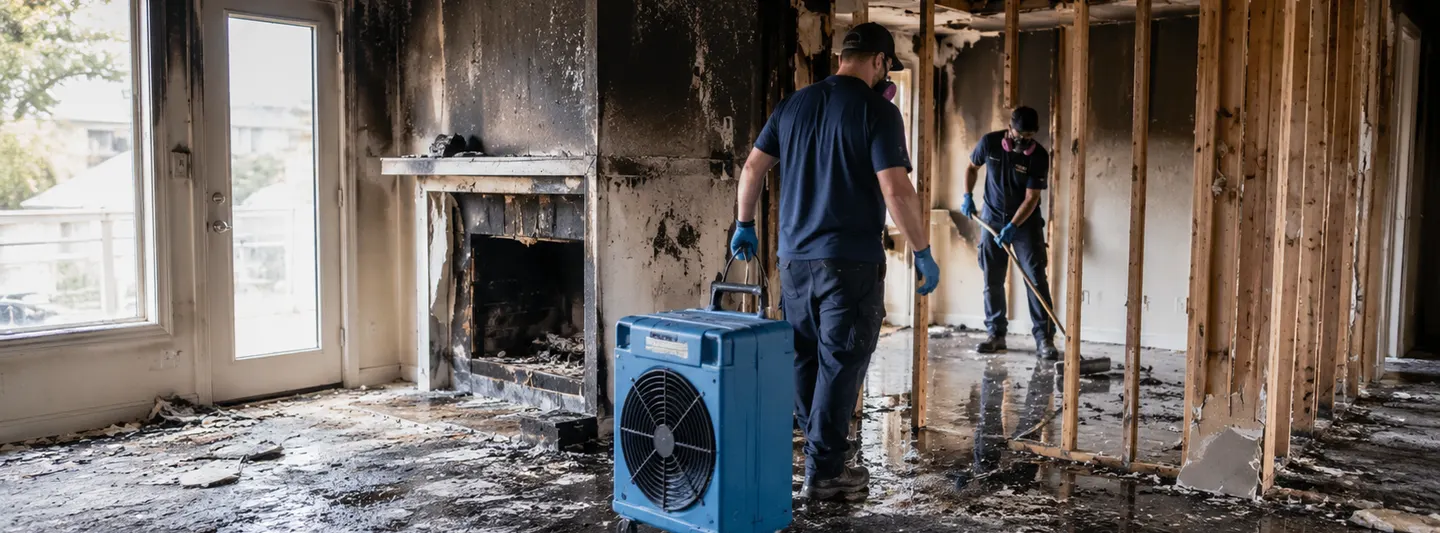
Fire damage restoration costs about $4–$7 per square foot or $8,000–$18,000 on average, but severe structural losses can move far beyond that range.
HomeGuide's current fire-damage cost guide uses $4–$7 per square foot and $8,000–$18,000 as its average restoration range. Its size examples put a 2,000-square-foot home around $8,000–$14,000 and a 3,000-square-foot home around $14,000–$24,500.
Angi's April 2026 data is materially wider: $27,477 average, a typical published range of $3,083–$52,031, and severe structural-loss cases reaching roughly $180,000. The difference is useful: not every dataset is measuring the same mix of smoke-only cleanup, partial restoration and major reconstruction.
The fire may last minutes. The restoration estimate is a map of everything the fire, smoke, water and emergency response touched.
The U.S. Fire Administration explains why. A home can be damaged by flames, heat, smoke and water, while firefighters may also break windows or open roofs and walls to control the fire and confirm hidden fire is out. That means a structurally intact room can still require smoke cleaning, water drying, wall opening and contents work.
The current ANSI/IICRC S700 standard formalizes the same idea. It covers assessment of residue and odor boundaries across the building, HVAC systems and contents, plus source removal, cleaning, odor management, documentation and post-restoration evaluation.
THE FIVE-IMPACT FIRE-LOSS LEDGER
Do not price a fire from the burned room alone
01 · HEAT / CHARWhat building material was physically burned or heat-damaged? This determines whether the project includes repair, partial rebuild or structural replacement.
02 · SMOKE / SOOTHow far did residue travel beyond the flame area? Smoke can make unaffected-looking rooms part of the cleaning and deodorization project.
03 · WATERWhat got wet while the fire was extinguished? Drying can become a second restoration process running alongside fire cleanup.
04 · OPENINGWhat did emergency crews open to reach hidden fire? Roof, ceiling and wall openings can add legitimate reconstruction even where direct flame damage is limited.
05 · CONTENTSWhat can be cleaned, moved, stored or must be replaced? Building square footage does not capture personal-property handling.
SMOKE CAN BE THE LARGEST AREA IN THE LOSS
A small fire can create a whole-house cleaning problem without creating a whole-house rebuild
HomeGuide's fire-damage guide places smoke and soot removal at $500–$5,000. Its separate smoke-remediation guide uses $400–$1,500 for an individual room and $2,000–$12,000 for whole-house smoke remediation.
This is exactly why IICRC S700 focuses on the presence, intensity and boundaries of fire residues and odors. Restoration should not assume every room requires the same method, but it also should not stop automatically at the room where flames were visible.
SMOKE / SOOT REMOVAL$500–$5,000 HomeGuide fire-loss cleanup range.
ROOM / SMALL AREA$400–$1,500 HomeGuide smoke-remediation range.
WHOLE-HOUSE SMOKE$2,000–$12,000 Surface cleaning, air treatment and odor work depending on severity.
THERMAL FOGGING$200–$600 / floor HomeGuide fire-restoration benchmark.
THE SECOND LOSS: WATER USED TO STOP THE FIRST LOSS
Fire suppression can create a drying project inside the fire project
HomeGuide currently places water-damage restoration after a fire around $2,000–$6,000. Angi's 2026 fire-damage data uses approximately $1,000–$6,000 for water damage inside a fire-restoration project.
Water and weather can enter after emergency ventilation or fire damage.
Selective opening may be needed for both fire inspection and drying.
Subfloor, carpet, hardwood and lower floors can become part of the loss.
The budget implication is important: a contractor may have one fire estimate and one water-mitigation estimate for the same event. That is not necessarily duplicate billing. The owner should check whether the two scopes overlap or describe different work packages.
WHEN RESTORATION BECOMES RECONSTRUCTION
Charred framing, compromised roof structure, wiring and opened assemblies move the job beyond cleaning
HomeGuide's current fire-damage guide uses several structural repair benchmarks: $3,000–$6,000 for roof repair, $6,000–$16,000 for roof replacement, $2,000–$6,000+ for electrical repair and $2,000–$20,000+ for floor repair. A structural inspection is listed around $350–$900.
Restore the surface / assembly without replacing its structural role.
Reconstruction begins, but primary framing may remain serviceable.
Framing, sheathing, wiring, insulation and exterior / interior finishes can overlap.
HomeGuide uses about $50/sq. ft. for some partial repairs and roughly $180–$450+/sq. ft. to rebuild a total-loss home.
The total-loss rebuild figure should not be added to the $4–$7 restoration rate. They describe different project depths. Once major reconstruction dominates, the project stops behaving like a cleanup rate multiplied by house area.
FIRE CLASS IS NOT DAMAGE SEVERITY
Class A, B, C, D and K describe what fueled the fire—not how much of the house must be rebuilt
HomeGuide publishes restoration averages by fire class, but a property owner should not read those labels as “minor, moderate, severe.” A contained Class K kitchen fire can leave difficult grease residue while a Class A structural fire can destroy framing across multiple rooms.
CLASS A$8,000–$14,000 ordinary combustibles such as wood, paper and cloth.
CLASS B$12,000–$18,000 flammable liquids such as gas, oil, paint or alcohol.
CLASS C$10,000–$20,000 energized electrical equipment, appliances or wiring.
CLASS K$11,000–$18,000 cooking oils and fats; residue can expand cleaning complexity.
CLASS D$15,000–$25,000 combustible metals, more typical of industrial settings.
CONTENTS CAN BECOME A SECOND PROJECT
Furniture, electronics, clothing and stored property do not fit inside building square-foot pricing
U.S. Fire Administration guidance notes that items not directly burned may still be ruined by smoke or soaked by firefighting water and that anything intended for reuse may need careful cleaning. IICRC S700 also treats contents restoration as a dedicated part of the professional fire process.
DOCUMENTRecord condition before movement Photos, location and item status matter because cleanup changes the scene.
SORTCleanable · specialty salvage · replacement One blanket rule for all contents is rarely useful.
PACK / MOVEContents may need off-site cleaning or storage Labor and logistics can be substantial without changing building area.
RETURN / REPLACECloseout can extend beyond building completion Restored contents and reconstructed rooms may follow different timelines.
HomeGuide lists $300–$1,000 for deodorizing furniture and $500–$5,000+ for electronics replacement among its current examples. Those numbers are best treated as item-specific context, not a universal contents allowance.
HVAC CAN CONNECT ROOMS THAT THE FLAMES NEVER REACHED
Air distribution changes the residue boundary and deserves its own assessment
IICRC S700 explicitly includes HVAC and air-conveyance systems within fire and smoke restoration. IICRC also lists ANSI/IICRC S590 as its current standard for assessing HVAC systems after water, fire or mold events.
HomeGuide's current fire guide puts duct cleaning at $300–$1,000, while its smoke-remediation guide uses $250–$1,200 for HVAC system cleaning. Those figures are useful only after deciding whether the system is actually in scope.
RESTORATION AND REBUILD SHOULD HAVE A HANDOFF POINT
The estimate should show the last cleaned surface and the first new construction material
Goal: retained materials and systems are ready to remain or receive reconstruction.
Studs, joists, sheathing, wiring and cavities can be visible at this point.
Roof, electrical, insulation, drywall, cabinets, flooring, trim and paint.
HomeGuide's structural examples show why this matters. A kitchen repair after fire can run $15,000–$50,000; drywall installation is listed at $8,000–$30,000 on larger fire-damage projects. Those are reconstruction costs that can sit beyond a smoke / soot cleaning scope.
THE FIRST INVOICE MAY BE FOR STABILIZATION, NOT RESTORATION
Board-up, roof protection and utility control can happen before anyone knows the final reconstruction scope
A fire loss often begins with uncertainty. Walls may be open, roof sections may have been cut for ventilation, windows can be broken and utilities may remain disconnected. The U.S. Fire Administration notes that firefighters may open roofs and walls to control the incident and make sure fire is not hidden inside assemblies.
Temporary board-up can be legitimate emergency work even though it does not restore a single finished surface.
Temporary protection can prevent the original fire loss from growing through rain or wind before permanent construction begins.
USFA says not to turn disconnected water, electricity or gas back on yourself after a fire.
Smoke, soot, char, water and emergency openings become harder to reconstruct from memory after demolition and cleaning start.
This sequencing explains why an emergency invoice can look expensive while the permanent repair estimate is still incomplete. Stabilization buys time and prevents additional loss; restoration and reconstruction price the work needed to return the property to use.
WHY HOMEGUIDE AND ANGI DO NOT LAND ON THE SAME “AVERAGE”
Averages are only comparable when the underlying severity mix is comparable
HomeGuide's current model centers on $8,000–$18,000 and a $4–$7/sq.-ft. planning rate. Angi's April 2026 data centers much higher at about $27,477 and extends to approximately $180,000 for severe structural cases. Repair Cost Ledger does not average those figures together.
SMOKE-HEAVY / STRUCTURE-LIGHTLarge cleaning area, limited reconstruction. A whole-house smoke project can involve many rooms while remaining far below a structural-loss rebuild.
MIXED RESTORATIONSmoke + water + selective demolition. This is the kind of middle project where national averages are most useful as a first budget check.
STRUCTURAL-HEAVYFraming, roof, electrical and room reconstruction dominate. The project increasingly behaves like remodeling or rebuilding rather than restoration cleaning.
The practical question is therefore not “Which website has the correct average?” It is “Which published range describes the depth of my project?” A smoke-only cleanup should not be benchmarked against a total-loss rebuild, and a major structural fire should not be forced into a $4–$7 cleanup model.
WHY THIS ARTICLE HAS NO FIRE-RESTORATION CALCULATOR
The $4–$7 rate is useful as a benchmark but too blunt to model a real fire loss responsibly
A calculator using only house size would price a 2,000-square-foot home at $8,000–$14,000, matching HomeGuide's national size model. But two 2,000-square-foot houses can produce completely different losses: one may have smoke throughout the home after a contained kitchen fire; the other may have one destroyed room, an opened roof, 1,000 square feet of water damage and extensive contents handling.
Helps test whether a common restoration total is in the right order of magnitude.
Cannot distinguish smoke-only work from structural replacement, water mitigation or contents.
FIVE FIRE DAMAGE COST FILES
The same fire origin can create very different restoration ledgers
Flame damage remains localized, but oily residue affects kitchen surfaces and smoke reaches adjacent rooms. HomeGuide's Class K planning range is $11,000–$18,000, while a smaller smoke-only project can sit far below that depending on actual scope.
The origin room needs demolition and finish rebuild, while the rest of the home may need smoke cleaning. The correct estimate separates destroyed-room construction from wider residue cleaning.
Roof structure, insulation and ceiling cavities can be affected while firefighting water migrates downward. HomeGuide's $3,000–$6,000 roof-repair and $2,000–$6,000 water-restoration benchmarks can both appear in the same event without being the same work.
HomeGuide's Class C range is $10,000–$20,000 and its electrical repair benchmark is $2,000–$6,000+. The key is whether the electrical number is already included in the fire-restoration total or is a separate trade scope.
Angi's 2026 dataset reaches roughly $180,000 for severe structural cases. HomeGuide uses $180–$450+/sq. ft. to rebuild when a house is a total loss. At this scale, house-rebuild economics matter more than a standard cleanup rate.
NORMALIZE FIRE-RESTORATION BIDS BEFORE COMPARING TOTALS
A $20,000 bid and a $35,000 bid may not end at the same point
01Damage map Which rooms / systems have flame, smoke, soot, water or opening damage?
02Emergency stabilization Board-up, roof tarping, temporary power or security included or separate?
03Water mitigation Extraction and drying included, separately invoiced or already completed?
04Smoke / soot boundary What rooms, surfaces and HVAC components are being cleaned?
05Demolition What materials are removed because they are burned, contaminated or needed for access?
06Contents Pack-out, cleaning, storage and return included or handled separately?
07Odor-management method Which surfaces are cleaned first and what deodorization is actually in scope?
08Reconstruction endpoint Does the bid stop at clean framing or return the room to finished condition?
Compare scopes by impact field—fire, smoke, water, structure and contents—not by one grand total.
BEFORE COST COMES RE-ENTRY
Do not inspect a damaged home for pricing until it has been cleared for safe entry
The U.S. Fire Administration says not to enter a damaged home or apartment unless the fire department says it is safe. It also warns that soot and dirty firefighting water can contain materials that may make people sick, and that floors and walls may not be as safe as they look.
This article is therefore a budgeting framework, not a DIY cleanup sequence. Structural instability, electrical systems, gas service, contaminated residue and hidden hot spots are professional / authority issues before they are cost-comparison issues.
COMMON COST QUESTIONS
Fire damage restoration in plain terms
How much does fire damage restoration cost in 2026? HomeGuide's current average is $8,000–$18,000 or $4–$7/sq. ft. Angi's April 2026 dataset averages about $27,477 with a much broader $3,083–$52,031 typical range.
How much does smoke and soot cleanup cost? HomeGuide's fire guide uses $500–$5,000 for smoke / soot removal. Its dedicated smoke guide uses $400–$1,500 for one room and $2,000–$12,000 for whole-house smoke remediation.
How much does water damage add after a fire? HomeGuide uses $2,000–$6,000 for fire-related water restoration. The water scope can be separate from smoke cleaning and structural repair.
How much does a 2,000-sq.-ft. fire restoration cost? HomeGuide's size model gives approximately $8,000–$14,000, but that figure is not appropriate for a total-loss rebuild or a smoke-only incident.
How much does a whole-house smoke cleanup cost? HomeGuide's current smoke-remediation range is $2,000–$12,000, depending on size and severity.
How much does it cost to rebuild after a major fire? HomeGuide uses about $50/sq. ft. for some partial repairs and roughly $180–$450+/sq. ft. to rebuild a total-loss home.
Does fire restoration include contents? Sometimes. IICRC S700 recognizes contents restoration as a distinct part of professional fire restoration, but local contracts can price pack-out, cleaning, storage and return separately.
Does fire restoration include HVAC cleaning? Not automatically. HomeGuide uses roughly $250–$1,200 for HVAC smoke cleaning in its smoke-remediation guide. The system should first be assessed to determine whether it is impacted.
METHODOLOGY & SOURCES
Current cost evidence plus the current national fire / smoke restoration standard
Pricing was reviewed August 8, 2026. HomeGuide supplies the primary national cost model and line-item restoration benchmarks. Angi supplies an independent 2026 cross-check with a materially broader severity mix. IICRC S700 and U.S. Fire Administration guidance provide the technical framework for residue boundaries, HVAC, contents, documentation and safe post-fire recovery.
$4–$7/sq. ft.; $8,000–$18,000 average; house-size, fire-class, smoke, water and structural repair benchmarks.
02 · ANGI · APR 2026Fire Damage Restoration Cost$27,477 average; $3,083–$52,031 typical range; severe cases up to about $180,000 and current damage-type context.
03 · HOMEGUIDE · CURRENT 2026 GUIDESmoke Remediation Cost$400–$1,500 room; $2,000–$12,000 whole-house; $250–$1,200 HVAC; ozone and smoke-cleaning context.
04 · ANSI / IICRC · S700Standard for Professional Fire and Smoke Damage RestorationAssessment of fire residue / odor boundaries, HVAC, source removal, odor management, contents, documentation and post-restoration evaluation.
05 · IICRC · JAN 2025S700 Publication NoticeConfirms publication of the first ANSI/IICRC S700 national standard and its restoration-work-plan scope.
06 · U.S. FIRE ADMINISTRATION / FEMAAfter the FirePost-fire safety, flames / heat / smoke / water damage, emergency openings, contents and re-entry guidance.
This report provides U.S. property-cost planning information. Do not enter a fire-damaged structure until the fire department or responsible authority says it is safe. Structural, electrical, gas, soot, water and contamination hazards can remain after the fire is out.