
2026 NATIONAL COST ANSWER
Mold remediation costs about $15–$30 per square foot or $1,500–$6,000 on average, with whole-home projects reaching roughly $15,000–$30,000.
HomeGuide's February 2026 national guide places professional mold remediation at $15–$30 per square foot and $1,500–$6,000 on average. Its current size model ranges from $500–$1,500 for small 10–100 sq. ft. projects to $15,000–$30,000 for very large or whole-home contamination.
Angi's current 2026 dataset is narrower around the middle of the market: approximately $2,369 average, with a typical published range of $1,223–$3,757. The difference is useful because a national average describes the center of the market, while HomeGuide's larger range captures attic, HVAC, full-basement and whole-home jobs.
The most important number in a mold quote is not the species name. It is the boundary of the work.What is being contained, removed, cleaned, verified and rebuilt—and what moisture problem is being fixed?
EPA says that when visible mold is present, sampling is unnecessary in most cases. EPA also states that there are no federal airborne mold limits that can be used to declare a building compliant or noncompliant. That makes a species-first sales pitch less useful than a scope-first evaluation in many ordinary residential projects.
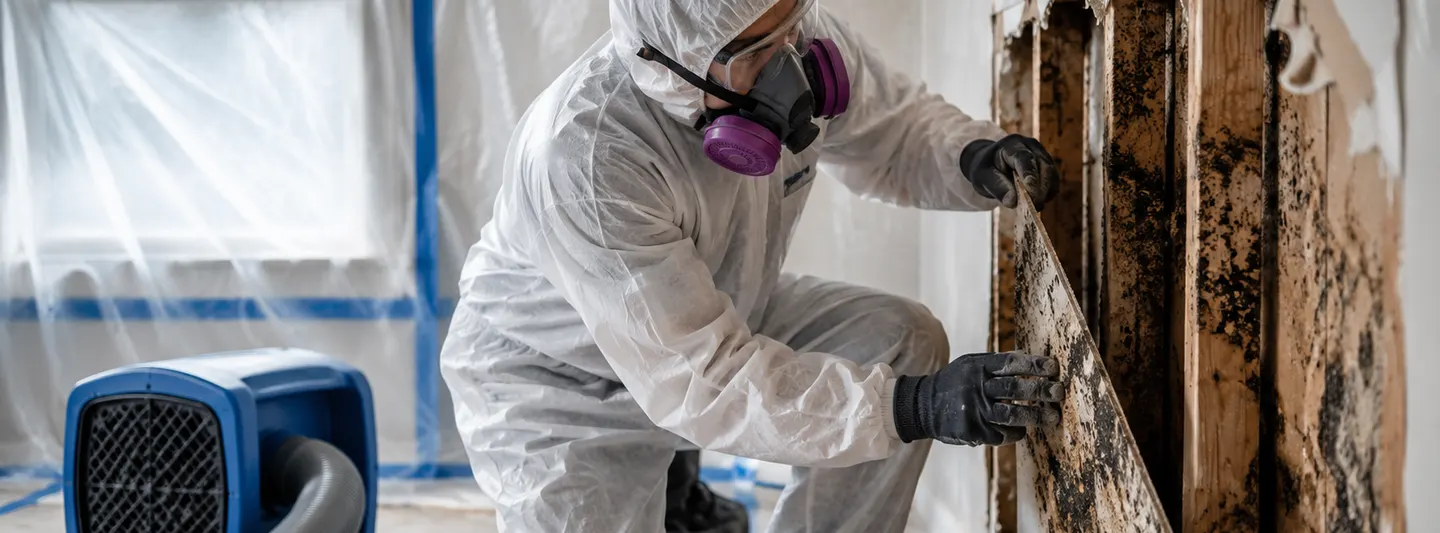
The current ANSI/IICRC S520:2024 standard takes the same broad view of professional remediation. Its scope includes inspection, preliminary determination, structural remediation, HVAC, contents, documentation, risk management and post-remediation verification. In other words: remediation is a controlled building process, not merely spraying a visible patch.
THE REMEDIATION BOUNDARY
A quote should draw an invisible box around the contaminated work area before anyone starts removing material
remove · clean · HEPA · dry
INSIDEWhat surfaces and contents are part of the remediation? A wall cavity, attic bay or crawl space can contain more affected material than the visible face suggests.
EDGEHow will the contractor prevent debris and spores from spreading? Containment and pressure control can become major labor / equipment components on medium and large projects.
OUTSIDEWhat is explicitly not being remediated? A clear boundary makes later change orders easier to understand if demolition reveals additional growth.
SIZE CHANGES THE WORK METHOD, NOT JUST THE MULTIPLICATION
EPA's less-than-10, 10–100 and 100+ sq. ft. bands are planning categories—not health thresholds or universal contractor prices
EPA's current homeowner guidance says that if a moldy area is less than about 10 square feet, in most cases a homeowner can handle cleanup by following EPA techniques. EPA's mold course then treats 10–100 square feet as medium and more than 100 square feet as large for remediation planning.
EPA says homeowners can handle many small areas themselves when the situation is otherwise appropriate. Contaminated-water events, health concerns and complex locations are exceptions.
EPA's course recommends a remediation manager for medium and large projects and generally uses limited containment in the 10–100 sq. ft. range.
EPA generally recommends full containment for areas larger than 100 sq. ft. or when work is likely to spread substantial dust or mold into occupied space.
WHY 100 SQ. FT. CAN COST MORE THAN 100 × $15
Containment creates fixed project costs that a simple per-square-foot calculator cannot model honestly
A straight $15–$30 calculation suggests that 20 sq. ft. costs $300–$600 and 100 sq. ft. costs $1,500–$3,000. HomeGuide's real project bands start around $500–$1,500 for 10–100 sq. ft., which already shows minimum-job economics. Contractor setup does not shrink to zero on a small job.
polyethylene · sealed openings · work-zone preparation
negative pressure / HEPA filtration where the remediation plan requires it
selective demolition · bagging · controlled waste route
HEPA vacuuming · damp cleaning · other method appropriate to material / scope
visual condition · moisture source corrected · documentation / PRV when specified
EPA's containment guidance says limited containment generally uses a single layer of 6-mil fire-retardant polyethylene for 10–100 sq. ft. areas. Full containment for larger or higher-dust work uses more robust separation. That setup cost is a major reason this article does not use a generic mold calculator.
LOCATION CAN MATTER MORE THAN COLOR
A $1,500 wall cavity and a $10,000 HVAC system can contain the same number of visible mold spots
HomeGuide's February 2026 national guide shows how access and building system complexity change the budget:
Visible, accessible surface growth can be relatively inexpensive. Costs rise when plumbing damage extends into wall, floor or subfloor.
Confined access and moisture conditions matter. Prevention can become a separate vapor-barrier, drainage or encapsulation project.
Limited access, insulation and roof / ventilation moisture sources can complicate remediation.
Widespread roof-deck / framing surface area and insulation handling can make a full attic much more expensive than a wall patch.
Finished walls, flooring and hidden cavities can make a partial basement project much larger than the visible patch.
EPA says a suspected mold-contaminated HVAC system should not be run because it may spread contamination through the building.
Broad contamination often includes drywall, carpet, contents, multiple rooms and substantial controlled demolition.
DO YOU NEED TO PAY FOR MOLD TESTING?
If visible mold is already present, EPA says sampling is unnecessary in most cases
This is one of the most useful cost-control facts in the entire topic. EPA says visible mold usually does not need routine sampling before cleanup. EPA also says no federal limits have been established for airborne mold or mold spores, so a sample cannot be used to prove compliance with a federal mold threshold that does not exist.
EPA's default position is that routine sampling is usually unnecessary when visible growth is already present.
EPA identifies situations such as unclear contamination sources, litigation or certain health-related questions where professional sampling may be considered.
EPA notes that surface or air sampling may sometimes help evaluate whether remediation was effective, but it is not universally required.
HomeGuide prices a professional mold inspection around $300–$650 for an average-sized home, while Angi's May 2026 inspection dataset averages approximately $671. The important question is not “Can we test?” but “What decision will the test result change?”
DO NOT LET “BLACK MOLD” REPLACE THE SCOPE DISCUSSION
Color is visible; remediation cost is driven by extent, material, access and control measures
Cost guides publish different prices by mold type, but species-based pricing can distract from the building work. EPA's cleanup framework first asks about size, moisture problem, material and containment. EPA also says routine sampling is usually unnecessary when mold is visibly present.
May not change the demolition or containment plan.
Directly affects labor, access, containment and reconstruction.
If identification is necessary for a defined technical, legal or professional purpose, testing can make sense. But a homeowner should not assume an expensive species test is a prerequisite to removing an obvious mold problem and fixing its moisture source.
MATERIAL DECIDES WHETHER THE JOB IS CLEANING OR DEMOLITION
Nonporous and porous building materials do not create the same remediation scope
The material may remain if it can be cleaned effectively and is otherwise serviceable. The remediation still needs moisture control.
Growth can penetrate or contaminate material that is difficult to clean in place. Removal can become more economical and more reliable.
Surface mold and physically deteriorated framing are different problems. Structural repair belongs on a separate construction line.
IICRC S520 treats HVAC and contents remediation as dedicated components rather than ordinary wall cleaning.
THE REMEDIATION INVOICE MAY END WITH AN OPEN WALL
Reconstruction costs should be visible instead of disappearing inside the word “remediation”
HomeGuide's mold guide separates several common rebuild costs from the remediation itself:
DRYWALL$1.50–$3.50 / sq. ft. replacement of damaged wallboard surface.
INSULATION$1.00–$4.50 / sq. ft. replacement after contaminated or wet insulation is removed.
PAINT$1–$3 / sq. ft. finish work after replacement drywall is ready.
CARPET$2–$8 / sq. ft. including old carpet / pad removal in HomeGuide's current guide.
HARDWOOD$11–$25 / sq. ft. replacement benchmark in the mold-remediation cost guide.
SUBFLOOR$2.20–$4.75 / sq. ft. current HomeGuide replacement benchmark for water-damaged subfloor.
REMOVING MOLD WITHOUT FIXING MOISTURE IS A TEMPORARY PURCHASE
The water source belongs in the remediation plan even if another contractor fixes it
When the moisture investigation traces recurring leakage to a window opening, remediation and repair of the source are separate scopes. The window replacement cost guide covers full-frame work, opening condition and flashing when the window assembly itself needs replacement.
EPA's remediation guidance says the plan should include steps to fix the water or moisture problem or mold may return. IICRC S520 similarly treats building and material science as part of professional remediation.
HomeGuide currently uses $150–$1,000 for small roof leaks and $3,000–$6,000 for larger leak / structural repair conditions.
HomeGuide's mold guide uses roughly $150–$850 for a leaking-pipe repair.
Our Basement Waterproofing Cost report covers the larger water-management project.
HomeGuide uses $2–$4/sq. ft. for installed vapor barrier and $3–$10/sq. ft. for full crawl-space encapsulation.
Cleaning the visible growth does not correct a cold surface, persistent high humidity or air-leakage mechanism.
WHAT DOES “DONE” MEAN?
Post-remediation verification should test the project objective, not manufacture a pass/fail number without context
EPA's current remediation course says completion requires the moisture problem to be fixed and visible mold, mold-damaged materials and moldy odors to be absent. If sampling is used, EPA says indoor types and concentrations should be similar to the local outdoor environment. IICRC S520 lists post-remediation verification as a formal component of professional remediation.
MOISTUREHas the original moisture problem been corrected? A visually clean wall that remains wet is not a durable endpoint.
VISUALAre mold growth, damaged material and work debris removed? The remediation boundary should be visibly clean before reconstruction hides it.
DOCUMENTATIONWhat was removed, retained and cleaned? Photos and scope records make later reconstruction and future investigation easier.
OPTIONAL SAMPLINGIf testing was specified, what question was it designed to answer? EPA does not require routine sampling for every mold project.
FIVE MOLD REMEDIATION COST FILES
Square footage starts the estimate; location and demolition finish it
HomeGuide's bathroom range is $500–$2,000. If the moisture source is surface humidity and the wall assembly remains sound, this can stay near the low end. Hidden plumbing damage moves it toward demolition / rebuild.
Straight $15–$30 math gives $1,200–$2,400. HomeGuide's 10–100 sq. ft. project band is $500–$1,500. A contractor can still price above either range when access, demolition or containment is more complex.
HomeGuide's current partial-basement range is $1,500–$6,000. If drywall and insulation are removed, reconstruction is additional unless clearly included. Waterproofing / drainage should be treated as a separate prevention scope.
HomeGuide uses $2,000–$10,000 for HVAC or duct remediation. EPA advises against running a system known or suspected to be contaminated because airflow may spread mold through the building.
HomeGuide's whole-home planning range is $15,000–$30,000; Angi also publishes $10,000–$30,000 for whole-house remediation. At this scale, a one-line $/sq.-ft. bid is much less useful than a room-by-room remediation and reconstruction scope.
NORMALIZE MOLD BIDS BEFORE COMPARING PRICE
Two contractors can both say “mold remediation” while pricing different projects
01Defined affected area Which rooms, cavities, surfaces and contents are inside the scope?
02Containment level What barriers, pressure control and HVAC isolation are included?
03Removal vs cleaning Which materials are discarded and which are retained / cleaned?
04Testing Is pre- or post-remediation sampling included, and what decision is it intended to support?
05Waste / contents Bagging, disposal, furniture movement and contents treatment included or excluded?
06Moisture-source correction Included, separately contracted or deliberately outside the remediation scope?
07Verification endpoint What condition allows containment to come down and reconstruction to begin?
08Reconstruction Does the price stop at clean framing or include insulation, drywall, paint and flooring?
A cheaper mold bid may simply stop earlier. Compare endpoints before comparing totals.
WHY THERE IS NO MOLD COST CALCULATOR HERE
The published $15–$30 rate is useful, but it becomes misleading when converted into a universal quote engine
At 20 square feet, straight multiplication gives $300–$600. A professional contractor may still need containment setup, PPE, mobilization, disposal and cleanup that make the real minimum larger. At 500 square feet, the same formula gives $7,500–$15,000—but the project may also include difficult attic access, HVAC remediation, contents or reconstruction not represented by area alone.
Compare a defined affected area to the national unit-cost envelope.
Creates false precision and ignores minimum-job / access economics.
COMMON COST QUESTIONS
Mold remediation cost in plain terms
How much does mold remediation cost in 2026? HomeGuide's February 2026 national average is $1,500–$6,000 or $15–$30/sq. ft. Angi's current average is about $2,369, with a typical $1,223–$3,757 range.
How much does 100 square feet of mold remediation cost? HomeGuide places small 10–100 sq. ft. projects around $500–$1,500 and medium 100–300 sq. ft. projects around $1,500–$6,000. Scope, location and containment affect the actual bid.
How much does basement mold removal cost? HomeGuide uses $1,500–$6,000 for a partial basement and $6,000–$15,000 for a full basement.
How much does attic mold removal cost? HomeGuide uses $1,500–$6,000 for a partial attic and $6,000–$15,000 for a full attic.
How much does HVAC mold remediation cost? HomeGuide's current range is $2,000–$10,000. EPA advises not to run an HVAC system known or suspected to be contaminated with mold.
Do I need a mold test before remediation? EPA says routine sampling is unnecessary in most cases when visible mold growth is already present. Testing can still be useful when it is designed to answer a specific unresolved question.
Can I clean a small mold area myself? EPA says areas smaller than about 10 sq. ft. can be handled by the homeowner in many ordinary cases, while larger water damage, contaminated water, HVAC involvement or other complexities may call for professional remediation.
Does mold remediation include new drywall and paint? Not automatically. HomeGuide lists drywall, insulation, paint, carpet, hardwood and subfloor as separate repair costs. Check where the remediation contract ends.
METHODOLOGY & SOURCES
Current U.S. pricing plus EPA and ANSI/IICRC remediation guidance
Pricing was reviewed August 8, 2026. HomeGuide's February 2026 mold guide provides the primary national cost model. Angi supplies a current independent market cross-check. EPA and ANSI/IICRC S520 are used for sizing, containment, sampling, moisture correction and completion principles.
$15–$30/sq. ft.; $1,500–$6,000 average; project-size, location, labor, inspection and reconstruction ranges.
02 · ANGI · 2026 DATAMold Remediation CostAbout $2,369 average; $1,223–$3,757 typical range; attic, basement, wall, HVAC and whole-house context.
03 · U.S. EPA · JUN 2026Mold Cleanup in Your HomeLess-than-10-sq.-ft. homeowner guidance, larger-project professional considerations, contaminated water and HVAC precautions.
04 · U.S. EPAAssessing Mold ProblemsSmall <10, medium 10–100 and large >100 sq. ft. remediation planning bands and moisture-assessment questions.
05 · U.S. EPAContainment and PPELimited containment for many 10–100-sq.-ft. projects and full-containment guidance for larger / higher-spread work.
06 · U.S. EPA · JAN 2026Mold Testing or SamplingVisible mold generally does not require routine sampling; no EPA or federal airborne mold limits have been established.
07 · U.S. EPAEvaluating RemediationMoisture-source correction, visible completion criteria and sampling context after cleanup.
08 · ANSI / IICRC · S520:2024Standard for Professional Mold RemediationCurrent professional standard covering inspection, structural and HVAC remediation, contents, documentation and post-remediation verification.
This report is U.S. property-cost planning information, not medical advice or a remote remediation plan. Mold work can involve contaminated materials, respiratory exposure, confined spaces, electrical hazards and hidden building damage. Use qualified professionals for complex, large or contaminated-water projects.