
THE SHORT ANSWER
Basement waterproofing costs about $6,000 to $18,000 on average in 2026 for a complete system, depending on basement size, foundation type, water source and whether the work is interior, exterior or both.
Current national cost data puts interior basement waterproofing around $6,000–$12,000 for many full-system projects and exterior waterproofing around $10,000–$18,000. An interior French drain commonly costs $4,000–$17,000 or about $40–$85 per linear foot, while a sump pump typically adds $600–$2,500 installed.
The phrase basement waterproofing is unusually broad. One contractor may seal a wall crack. Another may install a drainage channel around the inside perimeter. Another may excavate the entire exterior foundation, install a membrane and rebuild the footing drain. All three can legitimately use the word “waterproofing,” even though the work, disruption and price are completely different.
The most useful way to compare those proposals is to stop asking “What product are you installing?” and instead ask three questions: Where is the water coming from? Where will the proposed system intercept it? Where will the collected water go?
This article deliberately does not include a calculator. Basement area and perimeter are useful once the repair method is known, but they do not tell you whether the correct project is grading, crack injection, an interior drain, exterior excavation, sump capacity or simple humidity control. A neat square-foot estimate would hide the highest-value decision.
START WITH THE WATER PATH
Six problems that homeowners often call “a basement leak”
EPA moisture guidance identifies rainwater, snowmelt, groundwater, plumbing leaks and condensation among foundation moisture concerns. The repair should match the path rather than the appearance of the puddle.
A raised-floor crawl space uses a different enclosure strategy from a basement. If the moisture problem is below a crawl-space floor rather than below-grade basement walls, compare the crawl-space encapsulation cost guide.
EPA recommends maintaining gutters and sloping ground away from the foundation so water does not collect around the building.
Cracks, penetrations and the exterior wall assembly can become the visible pathway.
The puddle may reflect groundwater pressure below the slab rather than a defect at the visible joint itself.
Interior drainage and sump systems are commonly designed around this below-slab water-management problem.
Supply, drain, condensate or appliance leaks can mimic exterior water intrusion.
A basement can feel damp without liquid water penetrating the foundation. Dehumidification and air / vapor management are different projects from excavation.
THE INTERCEPTION TEST
Interior and exterior systems can both work—but they intercept water at different places
Common systems collect seepage at the inside perimeter or below the slab and route it to a sump or other permitted discharge.
DOE guidance describes a continuous drainage plane over dampproofing or exterior insulation that channels water toward a foundation drain and helps relieve hydrostatic pressure.
“Exterior is always better” and “interior drainage fixes everything” are both too simplistic. The useful comparison is source → intercept point → discharge path → maintenance burden.
2026 COST MAP
Basement waterproofing cost by system component
Complete projects often combine several line items. Breaking them out prevents a $15,000 system from being compared directly with a $1,500 crack repair or coating.
| Waterproofing component | 2026 planning range | What it actually does |
|---|---|---|
| Complete basement waterproofing | $6,000–$18,000 | Combined drainage, barriers, sealing, pumps or exterior work depending on the water problem. |
| Interior waterproofing system | $6,000–$12,000 | Common full interior water-management scope. |
| Exterior waterproofing | $10,000–$18,000 | Excavation, exterior wall treatment, drainage and backfill/restoration. |
| Interior basement French drain | $40–$85 / linear ft. | Below-slab or perimeter collection channel; $4,000–$17,000 common total. |
| Deep exterior perimeter drain / weeping tile | $30–$90 / linear ft. | Foundation-depth drainage installed outside the structure. |
| Sump pump installation | $600–$2,500 | Collect and discharge water from a sump basin. |
| Basement dehumidifier | $1,000–$3,000 installed | Controls air humidity; does not stop bulk water entry. |
| Foundation sealing | $1,500–$7,300 | Sealing / coating scope; may include excavation depending on method. |
| Minor interior leak / crack fix | From about $600 | Localized repair where a full perimeter system is not required. |
A $12,000 interior system may already include drainage and a sump pump. An exterior quote may include a membrane and footing drain in one price. Ask what is bundled before building an all-in budget.
INTERIOR DRAINAGE
The hidden product is not the drain channel—it is the complete discharge system
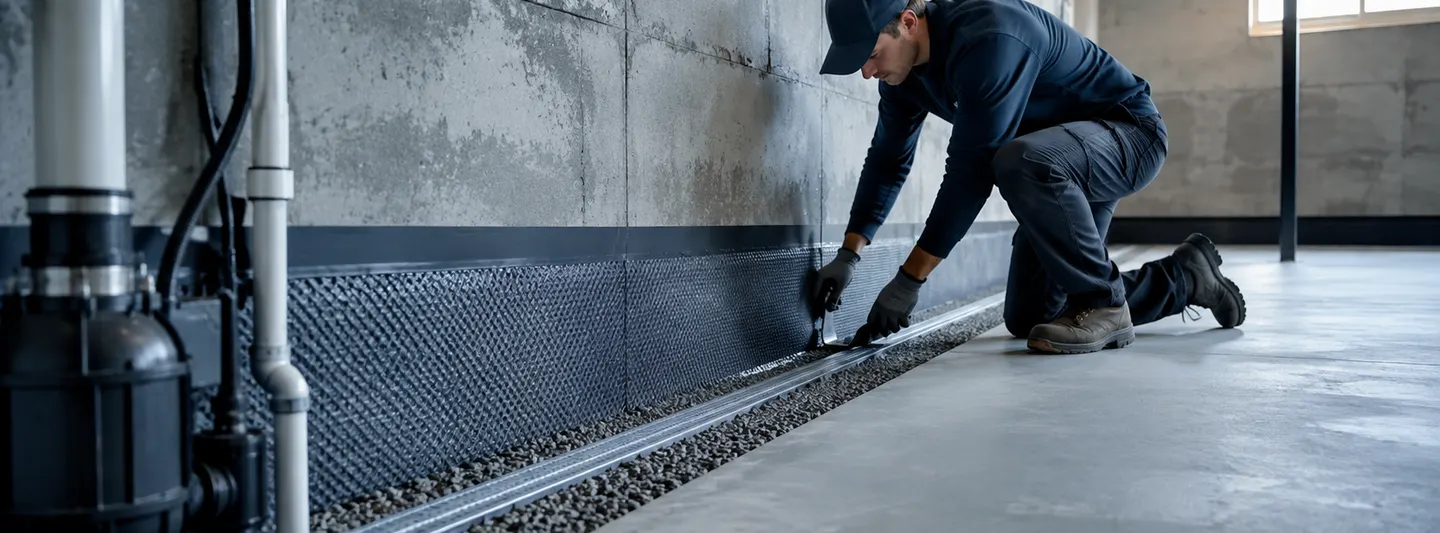
Interior perimeter drainage is one of the most common responses to recurring basement seepage. The visible work may be a narrow trench cut near the wall, but the functioning system is larger: collection, filter / stone or proprietary channel, drain pipe, sump basin, pump, discharge line and an outlet that remains usable during the water event.
HomeGuide currently places an interior basement French drain around $40–$85 per linear foot or $4,000–$17,000 installed. The project gets expensive when the system runs around a large perimeter, passes finished rooms, requires multiple pumps or includes substantial demolition and restoration.
Water at wall base / below slab enters the drainage system.
Pipe or channel carries water along the perimeter.
Sump basin receives water before pumping.
Pump moves water above / away from basement elevation.
Water exits to an allowed location where it will not return.
- Where does water enter the collection system?
- How is the channel serviced if sediment or debris accumulates?
- What pump capacity / redundancy is included?
- Where exactly does the discharge line terminate?
- Who restores slab, drywall, flooring and finished walls?
EXTERIOR WATERPROOFING
Why excavation makes the price jump even before the membrane is installed
Exterior waterproofing acts on the outside face of the below-grade foundation. In a typical major scope, crews excavate to expose the wall, clean and prepare it, repair defects, apply the specified waterproofing or dampproofing assembly, install a drainage plane or protection layer, service or replace footing drainage, then backfill and restore the site.
HomeGuide's current foundation-leak data places exterior waterproofing around $10,000–$18,000. The cost can rise when excavation is deep, access is narrow, patios or decks must be removed, utilities constrain equipment, or the wall itself needs structural repair.
Two identical 40-foot walls can have different prices if one faces open lawn and the other sits behind a deck, AC equipment, utility lines, a narrow side yard or expensive hardscape.
A WORD CONTRACTORS USE LOOSELY
Dampproofing and waterproofing are not automatically the same scope
Often refers to coatings intended to limit moisture migration but not necessarily to bridge cracks or resist every condition associated with bulk water / hydrostatic pressure.
May combine a membrane, drainage plane, protection layer and foundation drainage. Exact performance depends on the specified system and installation.
THE MECHANICAL HEART OF MANY INTERIOR SYSTEMS
A sump pump quote should be judged by failure mode, not horsepower alone
Current installed sump-pump pricing is roughly $600–$2,500. In a basement with active groundwater, the pump may be the component that prevents the drainage system from simply becoming a storage trench during a storm.
That makes reliability questions unusually important. The largest water event may coincide with a power outage, a blocked discharge line, a failed switch or a frozen exterior outlet. A useful proposal should therefore make clear whether backup power, pump redundancy, alarms, check valves and discharge freeze protection are included or separate.
WHEN THE WATER COMES THROUGH ONE CRACK
A localized injection can be the right repair—and still be the wrong whole-basement strategy
Angi's 2026 waterproofing data notes that minor interior fixes such as sealing foundation cracks can begin around $600. Foundation crack injection often remains a much smaller project than a perimeter drainage system.
The key is whether the crack is genuinely the dominant water path. If the basement also leaks along the cove joint, through multiple wall areas or during high-groundwater events, sealing one crack can simply move the visible entry point.
No broader seepage pattern. Localized injection / repair can be a proportionate first scope.
A full water-management strategy may be more useful than pricing every crack independently.
Waterproofing becomes secondary to evaluating the foundation movement itself.
See our foundation crack repair cost guide and bowed basement wall repair cost guide where the water path overlaps with structural damage.
WET AIR IS NOT THE SAME THING AS WATER INTRUSION
A dehumidifier can solve a humidity problem without waterproofing the foundation
EPA emphasizes moisture control as the key to mold control and recommends correcting moisture sources rather than treating mold as an isolated surface issue. A basement can have high humidity from ground moisture, air leakage, HVAC / ventilation conditions or past water events even when no liquid leak is visible.
HomeGuide currently places an installed basement dehumidifier around $1,000–$3,000, while portable units can cost much less. That can be excellent value for an air-humidity problem—but a dehumidifier should not be used to disguise active bulk-water entry.
Dehumidification, air sealing and HVAC / ventilation strategy may be central.
Drainage, sealing, exterior water management or pumping may be required.
THE CHEAPEST WATERPROOFING DOLLAR MAY BE ABOVE GRADE
Gutters and grading deserve attention before a five-figure basement project
EPA explicitly recommends keeping roof gutters clean and ensuring the ground slopes away from the building foundation. These measures do not replace drainage or waterproofing where groundwater is the main problem, but they can reduce the amount of rainwater delivered directly to the foundation perimeter.
This is important economically because a contractor's below-grade proposal may be technically sound while an obvious above-grade water source remains uncorrected. A useful scope identifies both.
THE WATERPROOFING BID AUDIT
Normalize these 14 fields before comparing contractor totals
What path is the contractor claiming to solve?
Outside wall, wall crack, cove joint, below slab or interior channel?
How many linear feet are included?
Pipe, proprietary channel, exterior footing drain or another system?
Exact product and preparation requirements?
Size, location and service access?
Primary pump specification and included controls?
Battery, secondary pump, alarm or none?
Where does collected water physically terminate?
How can the drainage system be maintained?
Landscaping, patio, deck or hardscape included?
Concrete, drywall, flooring and trim included?
Are cracks or bowed walls outside the waterproofing warranty?
Dry basement, installed system, pump, workmanship or specific leak paths?
READ THE WARRANTY AS A HYDROLOGY DOCUMENT
“Lifetime waterproofing warranty” can cover very different things
The useful part of a warranty is not the adjective before the word warranty. It is the definition of failure. One company may warrant water entering through treated wall areas. Another may warrant its drainage system but exclude pump failure, power outages, plumbing leaks, window wells or above-grade water. Transferability can also matter when the house is sold.
THREE WET BASEMENTS
Why identical puddles can justify budgets separated by $15,000
These are representative planning scenarios—not customer cases. Each homeowner sees water on the basement floor after heavy rain, but the actual water path is different.
One wall penetration / crack
$600–$2,000+The water path is localized and there is no evidence of widespread cove-joint or below-slab seepage.
Localized repair categoryGroundwater reaches several perimeter areas
$6,000–$12,000+Interior drainage and sump pumping manage recurring water around a significant portion of the basement.
Full interior system categoryWall assembly + footing drainage need exterior work
$10,000–$18,000+Excavation exposes the below-grade wall so the exterior water control and drainage assembly can be rebuilt.
Exterior waterproofing categoryWHEN TWO CONTRACTORS DISAGREE COMPLETELY
Ask what evidence would prove each proposed water path wrong
Waterproofing proposals often conflict because the wall is hidden by soil outside and finishes inside. One contractor may blame groundwater; another may blame a crack; another may see roof runoff and grading as the dominant cause.
Instead of choosing the most confident explanation, ask each contractor what observations support it: staining height, entry location during rain, groundwater behavior, wall cracks, floor cracks, cove-joint seepage, gutter discharge, exterior grade, pump cycling and whether the basement remains damp during dry weather. Good diagnosis should be falsifiable.
QUICK ANSWERS
Basement waterproofing cost FAQ
How much does basement waterproofing cost in 2026?
HomeGuide currently places complete basement waterproofing around $6,000–$18,000 on average. Angi gives a lower overall average near $5,239 and a common range around $2,460–$8,200 because its data includes smaller interior repairs as well as larger systems.
How much does interior basement waterproofing cost?
Current planning data commonly places a full interior system around $6,000–$12,000. An interior French drain alone commonly costs $40–$85 per linear foot or about $4,000–$17,000 total.
How much does exterior basement waterproofing cost?
Current national estimates commonly place exterior waterproofing around $10,000–$18,000. Excavation depth, site access, wall preparation, footing drainage and exterior restoration can push difficult projects higher.
How much does a basement French drain cost?
HomeGuide's 2026 data places interior basement French drains at $40–$85 per linear foot or roughly $4,000–$17,000 total. Deep exterior perimeter drains / weeping tile commonly run about $30–$90 per linear foot.
How much does a sump pump cost to install?
Current consumer cost data places sump-pump installation around $600–$2,500. Battery backup, secondary pumps, alarms, new electrical work or complex discharge routing can increase the system cost.
Is exterior waterproofing better than interior waterproofing?
Exterior systems intercept water before it crosses the wall, while interior drainage manages water after it reaches the foundation assembly. The better fit depends on the water source, site access, building condition, cost and project objectives.
Will a dehumidifier waterproof my basement?
No. A dehumidifier can control indoor humidity and condensation but does not stop bulk groundwater or rainwater from entering the structure. It is appropriate when air moisture is the actual problem or as part of a broader moisture-control strategy.
Should I fix grading before waterproofing the basement?
Above-grade water management should be evaluated first because EPA recommends maintaining gutters and sloping ground away from the foundation. Grading will not solve every groundwater problem, but sending roof and surface runoff toward the house can worsen foundation moisture.
METHODOLOGY & SOURCES
How Repair Cost Ledger built this basement-waterproofing report
This report is organized around a water-path model because the appropriate waterproofing approach depends on the water source, entry path and point of interception. The central sequence is: source → entry path → interception point → conveyance → discharge → maintenance.
A calculator is not used here because basement size and perimeter do not determine the correct system. A 1,000-square-foot basement can need a $600 crack repair, a $10,000 interior drain system or a $15,000 exterior excavation depending on where the water originates.
Current prices were cross-checked using HomeGuide and Angi 2026 data. EPA and U.S. Department of Energy guidance was used for moisture-source, grading, drainage-plane and foundation-water-control principles.
Cost data reviewed August 8, 2026. Figures are U.S. planning ranges, not local contractor quotes or a diagnosis of a specific basement water problem.