
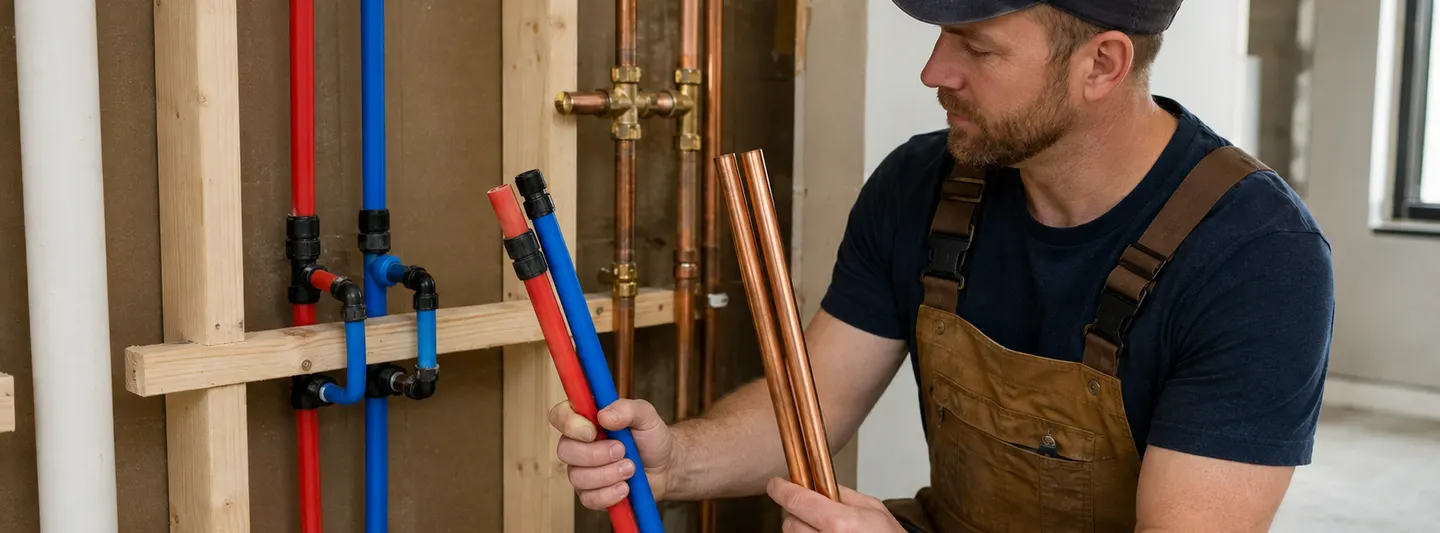
2026 COST COMPARISON
For a 2,000-square-foot home, HomeGuide currently places a PEX repipe around $2,000–$4,000 and a copper repipe around $8,000–$16,000.
Angi's August 2026 repipe data reinforces the underlying price gap: PEX material is about $0.40–$2 per linear foot, while copper is about $2–$8 per linear foot in its current national dataset. Angi also says labor represents roughly 70% of a typical whole-house repipe bill.
That means the copper premium is not just “more expensive pipe.” Copper's rigid installation commonly requires more cutting, measuring, fittings and joint work, while PEX can bend around many direction changes and run longer distances with fewer fittings. DOE Building America and the Plastics Pipe Institute both document PEX layouts that use long direct runs and manifold / homerun designs.
WHY LABOR MATTERS MORE THAN MATERIAL MATH
A $4-per-foot material difference does not explain an $8,000 project difference by itself
A whole-house repipe can contain hundreds of feet of distribution pipe, but the contractor is also opening access, routing around framing, connecting fixtures, supporting the system, testing it and coordinating inspection. Angi's current model assigns about 70% of total cost to labor.
PPI's current design guidance says PEX flexibility allows bending and the use of bend supports in place of many elbows.
Copper systems can use soldered, press-connect, push-connect and other approved joining methods, but the installer still has to create a rigid path through the building.
This does not mean every PEX quote must be cheaper than every copper quote. A simple open-basement copper project can be easier than a PEX repipe in a highly finished, inaccessible house. It means that when the same house and same scope are compared, PEX commonly offers a labor advantage in addition to a material advantage.
ROUTING IS WHERE PEX CAN CHANGE THE PROJECT
The cheapest plumbing material is not useful if the installer still has to destroy the same walls
DOE Building America's core-and-manifold guidance describes PEX systems that run individual small-diameter lines from a central manifold near the water heater to water-use points. PPI's 2026 PEX design material also shows bundled long runs and bend supports that can replace many elbows.
Can be built in either material. Cost depends on the route, fitting count and how accessible the shared trunks are.
DOE notes this approach can create direct paths and individual fixture lines, particularly where PEX flexibility is useful.
DOE encourages compact plumbing layouts when design conditions allow them, reducing the stored water between heater and fixtures.
FITTING COUNT IS A COST VARIABLE AND A DESIGN VARIABLE
PEX flexibility can remove elbows, but PEX systems still depend on properly specified fittings and joints
ASTM maintains multiple active standards for PEX tubing and fitting systems. Its current plastic-pipe standards list ASTM F876-26 for crosslinked polyethylene tubing, while fitting systems use standards such as F1807 and others depending on the joining method.
FEWER ELBOWSPotential labor savings PPI says bend supports can replace most elbows where the product's permitted bend radius and installation instructions are followed.
LONG RUNSPotentially fewer concealed joints Flexible tubing can make long continuous fixture runs feasible.
INSERT FITTINGSInternal geometry still matters PEX systems are not “fitting free.” Product family and joint method should be specified consistently.
TRANSITIONSOld-to-new connections need a defined method Water heater, fixture, manifold and retained-pipe transitions belong in the finished plumbing scope.
HOT-WATER PERFORMANCE IS A LAYOUT QUESTION BEFORE IT IS A MATERIAL QUESTION
A good repipe can reduce the volume of water sitting between the heater and the fixture
DOE Building America recommends compact distribution or central manifold strategies to shorten hot-water runs and reduce water waste while waiting for hot water. PPI's current technical material also documents that PEX has much lower thermal conductivity than copper, but explicitly notes that insulation is still recommended where required by code and installation conditions.
Moving from a sprawling legacy route to a more direct distribution layout can improve delivery regardless of whether the old pipes happened to be copper.
PPI reports substantially lower thermal conductivity for PEX, but that is not a substitute for required insulation or good routing.
Do not pay thousands more for a material expecting it to fix a poor hot-water layout. Ask how far the new hot-water runs will actually travel.
FREEZE RESILIENCE DOES NOT MEAN FREEZE PROOF
PEX can tolerate freezing stress better, but neither system should be designed to freeze
PPI's 2026 technical presentation says PEX remains flexible below freezing and that its elasticity can allow water-filled tubing to expand during a freeze without cracking when it has room to expand. The same guidance says insulation remains recommended where required by code and installation conditions.
Useful resilience in an accidental freeze event, not permission to route pipe through an unprotected freezing zone.
The Copper Development Association's current handbook explicitly says copper water tube should not be subjected to freezing.
A protected pipe path is more important than treating accidental freeze tolerance as the primary material-selection criterion.
PEX HAS AN INSTALLATION CONSTRAINT COPPER DOES NOT SHARE IN THE SAME WAY: UV EXPOSURE
PEX markings and manufacturer limits matter before the tubing disappears behind the wall
ASTM F876 includes UV-resistance classifications for PEX. PPI explains that the PEX material designation code communicates tested chlorine and UV resistance. Product-specific limits still control: for example, Uponor publishes defined UV exposure ratings for its PEX products rather than treating all PEX as indefinitely sunlight resistant.
COPPER IS DURABLE, BUT WATER CHEMISTRY STILL MATTERS
“Copper lasts forever” is not a useful specification
The Copper Development Association's current technical material treats corrosion control as a water-chemistry issue. Its 2026 water-quality guidance discusses pH, alkalinity, dissolved inorganic carbon, disinfectants and inhibitors as factors in maintaining protective films inside copper service lines.
COPPER QUESTIONWhat has the existing copper done in this water? A history of pinhole leaks or corrosion deserves diagnosis before automatically reinstalling the same material.
PEX QUESTIONWhat product rating is being installed? ASTM and PPI use chlorine-resistance classifications because hot, chlorinated water exposure is part of long-term PEX qualification.
BOTH MATERIALSUse approved potable-water products EPA's current lead-free rule applies to pipes, fittings and fixtures used for water intended for human consumption.
WHEN DOES EACH MATERIAL MAKE THE STRONGER ECONOMIC CASE?
Choose from the house conditions, not from a generic pros-and-cons list
Flexibility and longer continuous runs can reduce fitting work and may reduce the amount of finish opening required to reach fixtures.
Current HomeGuide installed benchmarks place PEX far below copper in a 2,000-square-foot house, making PEX the obvious price leader where both materials are otherwise acceptable.
DOE specifically documents central manifold designs using individual PEX runs, making the material a natural fit for that distribution strategy.
Copper remains an established potable-water plumbing material with mature joining methods and extensive technical guidance.
An unfinished basement, exposed mechanical space or remodel can reduce the routing advantage that PEX offers in finished walls.
A theoretically cheaper material is poor value if the local trade cannot install, service or permit the chosen system confidently.
WHERE THE INSTALLED COST DIFFERENCE COMES FROM
The pipe material changes the path the installer has to build
This is intentionally a lower-page visual. The useful buying decision happens above: installed price, labor, route, fittings and house conditions. The drawing only explains why flexibility can translate into installation economics.
SIX PEX VS. COPPER COST FILES
Same house size does not mean the same material premium
HomeGuide's current benchmark is $2,000–$4,000. Compare fixture coverage, wall restoration and old-pipe treatment before treating a local bid above this range as automatically expensive.
HomeGuide's current benchmark is $8,000–$16,000. The difference reflects more than tubing cost; whole-project labor and rigid routing contribute to the premium.
Exposed horizontal piping reduces the amount of finished-wall work and makes a rigid route easier to fabricate.
Vertical transitions and limited cavities raise the value of a flexible system that can use longer continuous runs.
If demolition is already part of the remodel, access savings become smaller and the owner can weigh the material premium more directly.
Do not automatically replace deteriorated copper with more copper without asking what contributed to the existing failure pattern.
THE PEX-VS.-COPPER BID NORMALIZER
Make the contractors quote the same finished system before deciding what the material premium buys
01Fixture coverage — exactly the same sinks, baths, showers, toilets and appliances?
02Hot / cold coverage — both proposals replacing the same supply branches?
03Routing — same general path, or is one contractor avoiding more demolition?
04Distribution design — trunk-and-branch, manifold / homerun or mixed?
05Pipe specification — product family, sizes and applicable standards identified?
06Fittings / joints — fitting system and transition points defined?
07Valves / manifold — retained, replaced or added?
08Insulation — same hot / cold insulation scope where required?
09Drywall endpoint — open walls, patched walls or painted walls?
10Old pipe — removed, partially removed or abandoned in place?
11Permit / inspection — included in both totals?
12Warranty / closeout — same testing, documentation and workmanship coverage?
The copper premium is meaningful only after both bids deliver the same plumbing coverage and the same finished walls.
WHY THERE IS NO “PEX VS. COPPER SAVINGS CALCULATOR”
The published cost gap is real; the percentage savings is house-specific
A calculator could divide the HomeGuide midpoint for PEX by the midpoint for copper and produce an impressive percentage. It would not tell a homeowner whether their finished two-story house has the same labor difference as an open-basement ranch.
The more useful comparison is to obtain two normalized scopes and calculate the actual copper premium on that house: copper total minus PEX total, after equalizing drywall, permits, fixture coverage and routing. That is a real purchasing number rather than a national average dressed up as precision.
COMMON COST QUESTIONS
PEX vs. copper repiping in plain terms
Which is cheaper, PEX or copper? PEX. Angi currently uses $0.40–$2/ft for PEX material versus $2–$8/ft for copper, and HomeGuide's installed 2,000-square-foot examples are $2,000–$4,000 PEX versus $8,000–$16,000 copper.
How much does it cost to repipe a 2,000-square-foot house with PEX? HomeGuide's current planning range is $2,000–$4,000.
How much does it cost to repipe a 2,000-square-foot house with copper? HomeGuide's current planning range is $8,000–$16,000.
Why is PEX cheaper to install? It starts with a lower material price and its flexibility can reduce fitting count and simplify routing. Angi also says labor is roughly 70% of a repipe bill, so installation efficiency matters.
Does PEX handle freezing better than copper? PPI says PEX has greater freeze-break resistance because it remains flexible and can expand during an accidental freeze. It still should be routed and insulated to avoid freezing.
Can PEX be exposed to sunlight? PEX products have defined UV-resistance ratings under ASTM F876 / manufacturer specifications. They should not be treated as indefinitely UV resistant.
Is copper always more durable? Material performance depends on installation and service conditions. The Copper Development Association's own technical guidance discusses water chemistry and corrosion control rather than treating copper as immune to corrosion.
Should I replace old copper with PEX? PEX is often the lower-cost repipe option, but the decision should consider the old failure mechanism, local code, water chemistry, route, contractor expertise and the complete installed scope.
METHODOLOGY & SOURCES
Current 2026 cost data plus primary technical sources for PEX design, copper conditions and potable-water requirements
Pricing was reviewed August 8, 2026. Angi provides current material and whole-house labor data. HomeGuide supplies the 2,000-square-foot installed PEX / copper benchmarks. DOE / PNNL and PPI are used for plumbing-layout and PEX installation concepts. ASTM provides current PEX standards listings. Copper Development Association sources are used for copper technical conditions. EPA provides the federal lead-free plumbing requirement.
PEX $0.40–$2/lf; copper $2–$8/lf; whole-project cost and current labor-share context.
02 · ANGI · CURRENT 2026 GUIDEPEX vs. Copper PlumbingCurrent direct PEX / copper material-cost comparison and homeowner-selection context.
03 · HOMEGUIDE · CURRENT GUIDEInstall or Replace Plumbing Pipes2,000-sq.-ft. PEX $2,000–$4,000; copper $8,000–$16,000; whole-house repipe context.
04 · DOE / PNNL · BUILDING AMERICACore and Manifold PlumbingCompact hot-water distribution and individual PEX homerun / manifold layouts.
05 · PPI · 2026Designing PEX Plumbing SystemsPEX flexibility, bend supports, thermal conductivity, freeze-break resistance and installation-design considerations.
06 · ASTM · CURRENTPlastic Pipe StandardsCurrent listing including ASTM F876-26 for PEX tubing and related fitting-system standards.
07 · COPPER DEVELOPMENT ASSOCIATION · 2026 HOSTED EDITIONCopper Tube HandbookCopper water-tube installation and service guidance, including freezing and corrosion considerations.
08 · COPPER DEVELOPMENT ASSOCIATION · MAY 2026Copper and Water QualityCurrent technical discussion of water chemistry, protective films and corrosion-control conditions.
09 · U.S. EPA · CURRENTLead-Free Plumbing RequirementsFederal 0.25% weighted-average wetted-surface definition for regulated pipes, fittings and fixtures used for drinking water.
This is U.S. cost-planning information. PEX and copper suitability depends on local plumbing code, water chemistry, temperature, installation route, product specification, joining system and contractor practice. Use the local plumber's engineered / code-compliant scope for the final material decision.