
2026 NATIONAL COST ANSWER
Main water line replacement costs $2,000–$5,000 on average, with installed pricing around $50–$200 per linear foot for trenched work and $70–$250 per foot for trenchless replacement.
HomeGuide's current national guide places the average residential water-line replacement at $3,500, with a typical $2,000–$5,000 project range. Trenched replacement is $50–$200 per linear foot; trenchless work is $70–$250 per linear foot.
Angi's July 9, 2026 data centers lower, at about $1,705 average and roughly $50–$150 per linear foot, while noting difficult access can push installed pricing to $250 per foot. Rather than average the two datasets together, this guide uses them as different views of project size and difficulty.
MAIN WATER LINE REPLACEMENT ESTIMATOR
Estimate the buried service line, then add only the connection items your bid actually includes
The base model uses HomeGuide's current installed ranges: $50–$200 per linear foot for trenched replacement and $70–$250 per linear foot for trenchless replacement. Optional items are kept separate so they are not silently counted twice.
DEFINE THE REPLACEMENT BOUNDARY BEFORE COMPARING PRICE
“Replace the main water line” can describe several different endpoints
This is not automatically part of the homeowner's private replacement project. Utility ownership and connection rules vary.
The connection can include utility-owned and customer-owned components. The proposal should identify which side is actually being changed.
This is the line most homeowners mean when they search “main water line replacement cost.”
Valve, pressure regulation and transition fittings can become separate line items at the house end.
A 40-foot bid and a 55-foot bid are not competing prices until both contractors start and stop at the same physical points.
REPAIR OR REPLACE?
A leaking service line does not automatically require replacing every foot to the street
HomeGuide places water-line repair at $400–$1,500 on average. Angi's March 2026 repair guide uses $340–$1,500 for a main water-line leak repair and about $100–$200 per linear foot for repair work.
A small damaged section can be economical to expose and replace if the rest of the line is in decent condition.
If access is expensive, reopening the same yard or driveway for future failures changes the economics of a one-section repair.
HomeGuide says full replacement may be the only practical option when the line is very old or severely damaged.
Angi suggests replacement becomes worth pricing when repeated repairs approach a large share of replacement cost. That is a useful budgeting prompt, not a universal engineering rule. Actual condition and local restrictions on older pipe materials should control the decision.
DEPTH IS A LABOR MULTIPLIER THE PIPE PRICE DOES NOT SHOW
A water line in a warm climate can be a different excavation project from one buried below a deep frost line
HomeGuide says water lines in warmer regions may be less than 3 feet deep, while lines in colder climates can be 8 feet or deeper because of frost conditions. Angi likewise notes that severe-winter markets often require the line below a deeper frost line.
SHALLOW / OPEN ACCESSLess excavation volume Soil handling and trench production can remain relatively straightforward.
DEEP TRENCHMore excavation + working-space constraints Depth increases machine time, spoil handling and the complexity of safe access.
ROCK / ROOTSProgress slows even when footage stays constant Angi specifically identifies rocks and root systems as common cost-driving obstructions.
OTHER UTILITIESThe straight path may not be available Existing gas, electric, communications or drainage can influence routing and excavation.
TRENCHED VS. TRENCHLESS: PRICE THE YARD AFTER THE PIPE
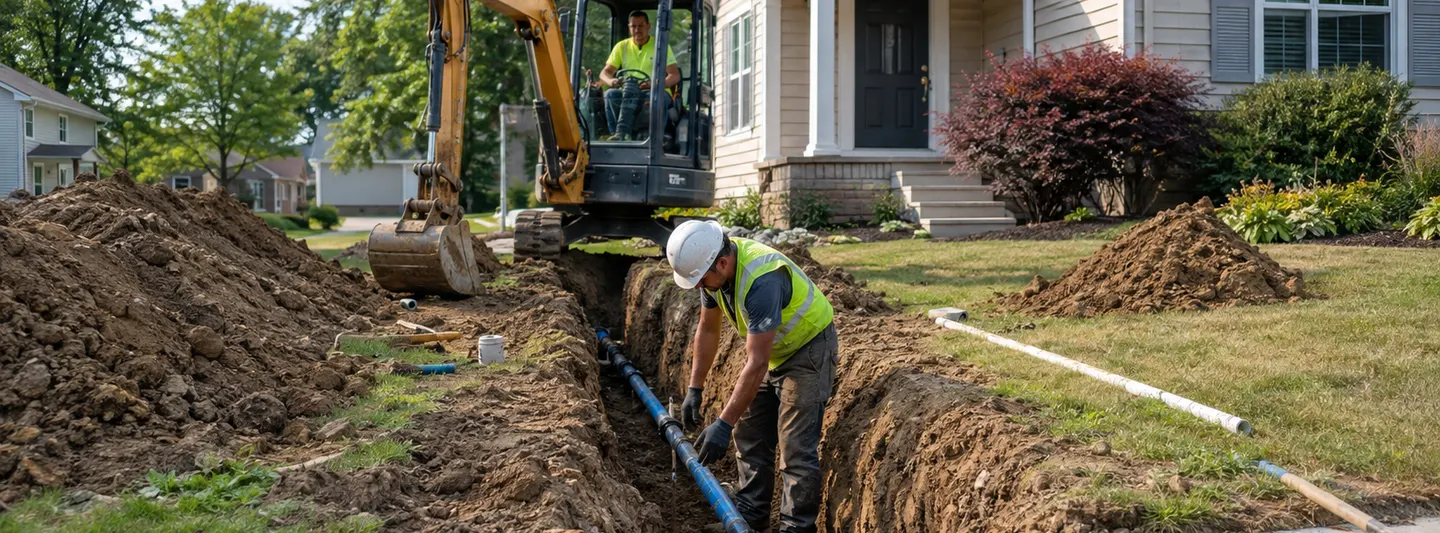
Traditional digging can be cheaper underground and more expensive once the surface is rebuilt
HomeGuide's current installed comparison is $50–$200/ft trenched versus $70–$250/ft trenchless. Angi's current trenchless model is around $75–$150/ft, while its trenched projects can run $1,500–$13,000 before landscaping and surface restoration.
Direct access is useful when the route itself needs correction or the surface above is inexpensive to disturb.
$50–$200 / lf · HomeGuideThe value case grows under driveways, established landscaping or other finished surfaces where full-length excavation has a second repair cost.
$70–$250 / lf · HomeGuideHomeGuide lists driveway repair at roughly $100–$400 for small work and $600–$3,000 for major damage. Those are examples of the costs that should sit beside—not disappear inside—the installation method.
LOW PRESSURE IS A SYMPTOM, NOT A LENGTH MEASUREMENT
Before replacing a buried service line for “bad pressure,” separate supply-line restriction from the rest of the plumbing system
HomeGuide lists falling water pressure as one sign that a main water service may need replacement, but the symptom does not identify the failed component by itself. A pressure regulator, shut-off valve, interior piping, meter-side restriction or leak can change what the homeowner experiences at a faucet.
This supports checking the service line and common upstream components, but it does not prove that every buried foot needs replacement.
A single bathroom or fixture behaving differently points toward branch plumbing or fixture-level restrictions before a yard excavation.
HomeGuide also identifies unexplained water-bill increases, saturated lawn areas and unusually green spots as service-line warning signs.
HomeGuide says most residential service lines are roughly 3/4 to 1 inch. If a contractor proposes changing size, the quote should explain the design reason and any valve / connection changes it creates.
This matters because “replace the line to fix pressure” can hide two decisions: is the existing service defective, and is the proposed new service size appropriate? A detailed bid should separate diagnosis from upsizing rather than presenting one as proof of the other.
THE PIPE MATERIAL IS CHEAP COMPARED WITH THE INSTALLED LINE
A $1–$10 pipe can sit inside a $50–$250 installed linear foot
HomeGuide's current material-only ranges are $0.50–$5/ft for PVC, $0.50–$5/ft for PEX / polyethylene, $2–$10+/ft for copper, $2–$10/ft for cast iron, and $6–$13/ft for fiberglass.
Low material cost does not imply universal suitability. Soil, temperature, local code and service application matter.
Flexibility can simplify routing. Product approval and installation details are jurisdiction-specific.
Higher material price, with local water chemistry and corrosion considerations relevant to selection.
Corrosion, age and prior repairs can be the reason the project exists in the first place.
Do not choose a water-service material from a national cost article. Use the local plumbing code, utility requirements, soil / climate conditions and the contractor's specified product.
THE LAST FIVE FEET CAN CONTAIN MORE LINE ITEMS THAN THE FIRST FIFTY
Meter, tap, shut-off and pressure control deserve their own scope
SHUT-OFF VALVE$250–$600 HomeGuide benchmark when replacement is needed during the project.
PRESSURE REGULATOR$150–$350 HomeGuide benchmark where pressure regulation is part of the service assembly.
TAP CONNECTION$300–$500 HomeGuide's current part-and-labor benchmark for the connection between city line and service line.
PERMIT$30–$500 HomeGuide national range; Angi uses roughly $100–$500 in its current 2026 dataset.
INSPECTION$100–$500 context HomeGuide uses $100–$200+ for plumbing inspection; Angi uses $150–$500 before city-main connection.
A contractor may include several of these inside one lump sum. That is fine. The purpose of separating them here is to prevent false comparison: a $5,000 quote with valve, tap and permit can be more complete than a $4,300 quote that excludes all three.
IF THE SERVICE LINE MAY BE LEAD, CHECK THE UTILITY BEFORE PAYING FOR A PRIVATE REPLACEMENT
Federal lead-service-line rules and funding can change the project pathway
EPA estimated in March 2026 that about 4 million lead service lines still serve properties in U.S. communities. EPA's Lead and Copper Rule Improvements require water systems to identify and replace lead pipes on the rule's replacement schedule, with the first LCRI program year beginning November 1, 2027.
EPA required initial inventories under the prior rule by October 16, 2024. The LCRI baseline inventory is due November 1, 2027.
EPA's inventory categories matter because a galvanized line can qualify as GRR based on its relationship to lead service material.
EPA publishes federal and non-federal funding resources for lead service-line identification and replacement.
Public and private ownership can split at a local boundary even when the replacement program is designed around the entire service line.
WHO OWNS THE PIPE?
Responsibility is local, and the physical boundary is not always obvious from the yard
HomeGuide describes the city's distribution pipe as the water main and the line serving the house as the service line. Angi likewise warns homeowners to determine whether they or the city are responsible for portions beyond the property boundary.
DO NOT ASSUMEproperty line = ownership line Water-system rules, meter location and tariff / municipal policy can define responsibility differently.
DO NOT ASSUMEcurb = ownership line A curb stop can be an operational point without answering every private-cost question.
DO CONFIRMexact replacement endpoints with the utility Especially before work approaches the meter, tap, right-of-way or public main.
DO CONFIRMpermit / inspection / approved contractor rules The connection to a public drinking-water system is not an ordinary yard excavation.
THE SERVICE-LINE COST CORRIDOR
The buried pipe is one line; the budget is a sequence of zones
The graphic is intentionally lower on the page. The decision starts with price, method, depth and responsibility. The picture is useful afterward because it shows why a single “price per foot” can miss connection work at both ends of the buried run.
SIX WATER-LINE COST FILES
The same footage behaves differently when depth, surface and endpoints change
HomeGuide's $50–$200/ft trenched range implies $1,000–$4,000 before optional connection items. This is the kind of job that can sit near ordinary national averages.
The broad installed range becomes $2,000–$8,000. Depth, permit, valve / tap work and surface restoration determine where a local bid lands inside or outside that envelope.
HomeGuide's $70–$250/ft range gives $2,800–$10,000. A higher underground price can still win if it avoids substantial hardscape demolition and repair.
A deep frost-line installation can carry more labor than a similar length in a warm market. Do not benchmark both only by horizontal footage.
HomeGuide's repair average is $400–$1,500. If diagnosis shows one accessible failure and the line remains serviceable, replacement may not be the first-value option.
EPA's current LCRI framework and funding resources make service-line inventory status relevant to planning. Confirm the utility's record, ownership and replacement pathway before paying privately.
THE 10-POINT WATER-LINE QUOTE TEST
A good bid tells you where the new service starts, where it ends and what happens to everything above it
01Start / end points — exact physical replacement boundary?
02Length — measured linear footage of new service line?
03Depth / route — approximate burial depth and proposed path?
04Method — open trench, boring / trenchless or mixed approach?
05Pipe — material, nominal size and specified product?
06Connections — tap, meter-side work, building connection and transition fittings?
07Valve / regulator — included, retained or separately priced?
08Permits / inspection — contractor-paid, owner-paid or excluded?
09Surface restoration — soil, lawn, concrete, driveway and landscaping endpoint?
10Utility responsibility — any work or cost outside the private contractor's boundary?
The winning bid is not the lowest $/ft. It is the lowest defensible total for the same finished service line and the same restored property.
COMMON COST QUESTIONS
Main water line replacement cost in plain terms
How much does a main water line replacement cost in 2026? HomeGuide's current average is $2,000–$5,000, with a $3,500 national midpoint in its dataset. Angi's July 2026 average is about $1,705.
How much does water line replacement cost per foot? HomeGuide uses $50–$200/ft for trenched work and $70–$250/ft for trenchless. Angi uses about $50–$150/ft on average and up to $250/ft for difficult access.
How much does 40 feet of water line cost? About $2,000–$8,000 for trenched replacement or $2,800–$10,000 for trenchless work using HomeGuide's current broad installed ranges.
How much does main water line repair cost? HomeGuide uses $400–$1,500 on average. Angi's March 2026 leak-repair guide uses about $340–$1,500.
Is trenchless water line replacement cheaper? Not necessarily underground. It can reduce the total project bill when conventional trenching would require expensive landscaping, driveway or hardscape repair.
How much does a new water shut-off valve add? HomeGuide's current main-water-line guide uses $250–$600.
What if my service line is lead? Check the water utility's service-line inventory and replacement / funding program before treating the job as an ordinary private replacement. EPA estimates about 4 million lead service lines remain in U.S. communities.
Who owns the water line from the street to the house? Responsibility varies by utility and jurisdiction. Confirm the exact public / private boundary, meter arrangement and connection rules locally.
METHODOLOGY & SOURCES
Current 2026 market pricing separated from service-line ownership and federal lead-line planning
Pricing was reviewed August 8, 2026. HomeGuide provides the primary national method, material and connection-cost model. Angi's July 2026 update supplies an independent current market cross-check. EPA sources are used only for lead-service-line inventory, replacement-program and funding context.
$2,000–$5,000 average; $50–$200/ft trenched; $70–$250/ft trenchless; depth, materials, valves, regulator, tap, permit and driveway context.
02 · ANGI · JUL 9 2026Main Water Line Replacement Cost$1,705 average; $50–$150/ft average installed cost, up to $250/ft difficult access; trenchless, trenching, materials, permits and labor.
03 · ANGI · MAR 18 2026Main Water Line Repair Cost$340–$1,500 main water-line leak repair and $100–$200/ft repair context.
04 · U.S. EPA · MAR 2026Lead Service LinesEPA estimate of roughly 4 million lead service lines and current inventory, replacement-planning and funding resources.
05 · U.S. EPA · CURRENTLead and Copper Rule ImprovementsCurrent federal framework requiring water systems to identify and replace lead pipes on the LCRI schedule.
06 · U.S. EPA · LCRI FACT SHEETService-Line Inventory and Replacement RequirementsInitial inventory, November 1 2027 baseline inventory / plan, service-line categories and replacement-program timing.
This report is U.S. cost-planning information. Service-line ownership, approved materials, burial depth, frost protection, meter / tap work, permits, utility standards and lead-service-line programs vary by jurisdiction. Confirm utility and plumbing requirements before construction.