
2026 NATIONAL COST ANSWER
Slab leak repair typically costs about $630–$4,400, with Angi's current national average around $2,300. Direct access, pipe lining and rerouting sit in very different budget ranges.
Angi's July 20, 2026 cost data places professional slab-leak repair at $630–$4,400 and says leak detection itself averages about $280. Its related July 2026 rerouting guide uses about $2,800 average for slab-leak repair and notes difficult leaks beneath cabinets can reach roughly $4,000.
HomeGuide's current national guide separates the project by method: $700–$5,000 for breaking into the slab and replacing damaged pipe, $500–$3,500 for pipe lining, and $3,900–$7,500 for rerouting plumbing instead of reopening the slab.
THE THREE-INVOICE MODEL
A slab leak is easier to budget when you stop treating it as one plumbing number
Confirm that pressurized plumbing under the slab is actually leaking and narrow down the location before demolition.
Open the slab and repair the failed section, line a suitable pipe, or abandon the under-slab run and reroute it.
Concrete, flooring, cabinets, drywall, paint and water-damaged materials return the space to usable condition.
This model solves a common budgeting error: comparing one contractor's plumbing-only price with another contractor's plumbing-plus-restoration price. It also explains why two homeowners with the same failed pipe can spend very different totals. One leak may sit beneath an unfinished garage slab; another may sit beneath a finished kitchen.
The slab leak itself is underground. The expensive part may be everything the contractor must cross to reach it.
LEAK DETECTION IS A PURCHASE, NOT A FORMALITY
Hundreds spent locating the leak can protect thousands of dollars in flooring and concrete
Angi's current slab-leak data says leak detection averages about $280. Its broader 2026 water-leak guidance puts professional leak detection around $100–$500. Detection is especially valuable under a slab because exploratory demolition is expensive.
METER / FLOW EVIDENCEIs water moving when fixtures are off? EPA WaterSense notes that flow-monitoring devices can identify irregular use patterns that may indicate a leak.
PRESSURE / ISOLATIONWhich part of the plumbing system is losing pressure? A plumber may isolate sections before deciding that the leak belongs to an under-slab supply run.
ACOUSTIC LOCATIONWhere is pressurized water escaping? Angi describes electronic acoustic listening devices as a method for identifying underground water-leak locations from their sound.
THERMAL CLUEDoes the floor show an abnormal temperature pattern? Angi's July 2026 slab-leak guidance notes thermal imaging can help narrow the source, particularly where hot-water leakage changes surface temperature.
MARKED REPAIR POINTWhere will the contractor actually open or bypass? The diagnosis should end in a physical repair plan rather than a vague statement that “the slab is leaking.”
OPTION 1 · OPEN THE SLAB AND FIX THE PIPE
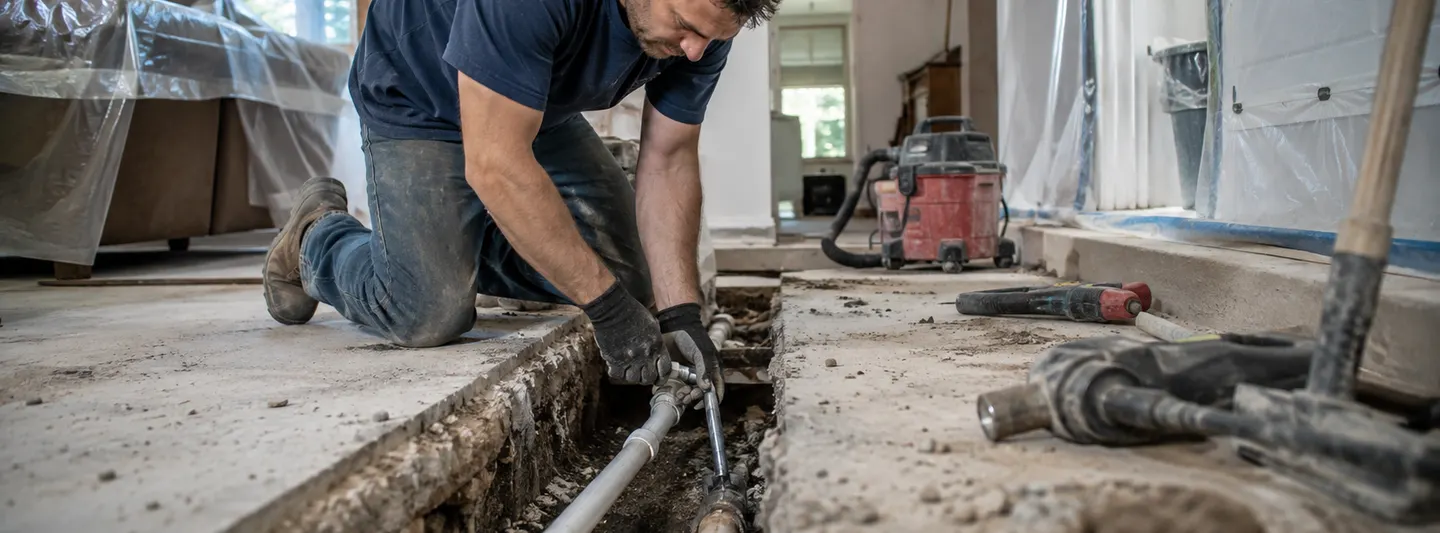
Direct repair is strongest when one localized failure can be reached without destroying a high-value room
HomeGuide prices breaking into the foundation and replacing damaged pipe at $700–$5,000. It separately lists $500–$3,000 for breaking the slab or digging a trench to reach badly damaged piping. These ranges overlap because contractor scopes package access and pipe work differently.
Plain concrete can be opened and patched without reproducing an expensive finished floor.
Plumbing access is straightforward but flooring must be removed, matched and restored after the pipe is repaired.
Angi notes that repairs beneath cabinetry can push a project toward the upper end because access itself becomes construction work.
The direct method has one major advantage: the plumber reaches the failed section physically and can replace it rather than designing a new route around it. Its disadvantage is equally obvious: the path to the pipe can be more valuable than the pipe repair.
OPTION 2 · LINE A SUITABLE PIPE
Pipe lining avoids opening the slab, but only when the host pipe and defect fit the rehabilitation method
HomeGuide uses $500–$3,500 for pipe lining in its slab leak guide and $90–$250 per linear foot for CIPP in its current sewer / pipe-lining pricing. The technologies used on a particular potable-water or drainage application must be appropriate to that system; “lining” is not one universal repair product.
PIPE SYSTEMSupply, drain or other line? The selected rehabilitation product must be designed and approved for the actual service.
HOST CONDITIONIs there enough usable pipe to rehabilitate? A coating or liner does not magically correct every crushed, misaligned or structurally failed condition.
ACCESSWhere does the equipment enter?“No slab demolition” does not necessarily mean zero access work elsewhere.
FINISHED DIAMETERWhat does the repaired internal passage become? The installer should specify the finished system, not simply the word “epoxy.”
For homeowners, lining should be evaluated as a specific alternative to the proposed direct repair or reroute, not as the automatic premium “no-dig” choice.
OPTION 3 · ABANDON THE FAILED UNDER-SLAB RUN
Rerouting can spend more on plumbing now to stop reopening the concrete later
HomeGuide places rerouting at $3,900–$7,500 on average. Angi's July 8, 2026 guide describes rerouting through walls or attic space as a way to solve persistent slab leaks without breaking into the foundation.
Hard to reach each time it fails.
More plumbing work today, potentially better serviceability tomorrow.
The reroute economics become stronger when the existing under-slab piping is not behaving like one isolated defect. If several failures have occurred, the choice is no longer merely “$1,500 spot repair vs. $5,000 reroute.” It becomes “how many times are we willing to buy slab access for this distribution system?”
THE PLUMBER CAN FINISH BEFORE THE HOUSE IS FINISHED
Build-back is where many slab-leak budgets become incomplete
HomeGuide says the plumbing repair itself often takes 1–3 days, while projects involving damaged flooring or cabinets can continue for several weeks. That is a useful distinction: stopping the leak and restoring the room are separate milestones.
Define whether the plumbing contractor replaces the broken slab section or leaves concrete work to another trade.
Tile, wood and other continuous finishes can require a larger visible repair area than the actual plumbing opening.
A leak beneath fixed cabinets changes access and can turn a plumbing repair into a small kitchen reconstruction.
A reroute may avoid concrete while creating new wall and ceiling openings along the replacement path.
The leak may have damaged finishes outside the access opening. Repairing the pipe does not automatically dry or rebuild those materials.
Normalize bids to the same endpoint: leak stopped, concrete closed, floor restored, walls finished—or clearly assign each missing item to another contractor.
THE FIRST SLAB LEAK AND THE THIRD SLAB LEAK ARE DIFFERENT FINANCIAL DECISIONS
Failure history changes the value of paying for another spot repair
A localized direct repair can be the most economical response to an isolated failure. But if a house has already had multiple under-slab supply leaks, each new repair carries both a plumbing invoice and another access / restoration event.
One clearly diagnosed defect, otherwise serviceable pipe and easy access create the strongest case for a localized repair.
The history now provides evidence that the under-slab system may be failing as an asset rather than at one random point.
Repeatedly repairing tile, wood or cabinetry can make the cheaper pipe intervention the more expensive ownership strategy.
There is no universal rule that a second leak means “repipe the house.” The useful question is whether new failures are isolated or whether the repair history, pipe material and condition justify abandoning the inaccessible route. Our Whole-House Repipe Cost guide provides the broader system-replacement benchmarks.
SIGNS THAT JUSTIFY INVESTIGATION—NOT AUTOMATIC JACKHAMMERING
The evidence tells you to locate a leak; it does not tell you which repair method to buy
HomeGuide lists abrupt water-bill increases, unexpected pressure changes, running-water sounds when fixtures are off and warm floor areas above hot-water lines among common slab-leak indicators. Angi likewise cites running-water sounds, warm spots and foundation / floor symptoms.
HIGHER BILLPossible continuous water use — compare meter / utility data before assuming location.
WARM FLOORPotential hot-water leak clue — useful for narrowing investigation, not proof by itself.
RUNNING-WATER SOUNDFlow while fixtures appear off — supports pressure-side leak diagnosis.
PRESSURE CHANGESystem symptom — can have causes other than one under-slab leak.
WET / DAMAGED FINISHLeak consequence — moisture location may not equal pipe-break location.
THREE WAYS TO SOLVE ONE LEAK LOCATION
The method changes the construction path more than the defect itself
DIRECT reaches the failed pipe physically.
LINING rehabilitates a suitable existing run.
REROUTE abandons the inaccessible path and creates a new one.
The diagram belongs here rather than above the cost answer. Once the homeowner understands the three budget paths, the picture clarifies why methods that repair the same leak can produce very different demolition and restoration work.
SEVEN SLAB-LEAK COST FILES
The room above the leak can matter as much as the pipe below it
Angi's lower-end slab-leak figure begins around $630. A localized failure beneath plain concrete is the type of project most likely to remain near the lower end because restoration is limited.
HomeGuide's current direct repair range is $700–$5,000. Ask whether that local quote includes concrete closeout and the floor above it.
Angi says repairs tucked beneath cabinets can push slab-leak work toward about $4,000. The pipe may be ordinary; the route to it is not.
HomeGuide uses $500–$3,500 for slab-leak pipe lining. Confirm what pipe system is being lined and what access / preparation is included before comparing with a spot repair.
HomeGuide's current range is $3,900–$7,500. This can be rational after recurring failures or where the finished floor makes direct access disproportionately destructive.
Price the new spot repair, a reroute and—where appropriate—a wider repipe on the same page. The lowest immediate invoice may not be the lowest likely ownership cost.
Even after the leak is fixed in 1–3 days, HomeGuide notes flooring or cabinetry damage can extend the project for weeks. Budget the restoration contractor separately if it is excluded.
THE SLAB-LEAK BID NORMALIZER
Every proposal should tell the same story from diagnosis to finished room
01Leak evidence — what test confirms an active leak?
02Location — where is the leak believed to be and how precisely was it located?
03Pipe system — hot supply, cold supply, drain or another line?
04Repair method — direct access, lining, reroute or broader repipe?
05Why this method — what condition makes it preferable to the alternatives?
06Demolition — concrete, flooring, cabinets, drywall or ceiling openings included?
07Pipe scope — exact section repaired, lined or abandoned / rerouted?
08Concrete closeout — slab patch included or assigned to another trade?
09Finish closeout — flooring, drywall, texture, paint and cabinets included or excluded?
10Water damage — drying / damaged-material repair included or separate?
11Permit / inspection — included where required?
12Warranty / repeat failure — what exact repaired section and workmanship are covered?
Compare the house after repair—not just the pipe after repair.
WHY THERE IS NO SLAB-LEAK CALCULATOR
The decisive input is method and access, not square footage
A 6-inch pipe defect beneath a garage can cost less than the same 6-inch defect beneath a stone kitchen floor and fixed cabinetry. Likewise, a $5,000 reroute can intentionally avoid the physical leak location altogether. There is no stable national relationship between “square feet of house” and “cost to fix one under-slab leak.”
A credible calculator would therefore have to guess at demolition, pipe condition, room finish, repair method and reroute feasibility—the exact decisions a plumber must diagnose. Publishing a precise-looking result would add less value than the method ranges and bid-normalization framework above.
COMMON COST QUESTIONS
Slab leak repair cost in plain terms
How much does slab leak repair cost in 2026? Angi's current national range is $630–$4,400, with an average around $2,300. HomeGuide uses different ranges depending on repair method.
How much does slab leak detection cost? Angi says detection averages about $280, while its general professional leak-detection range is about $100–$500.
How much does it cost to break the slab and repair the pipe? HomeGuide currently uses $700–$5,000 for digging into the foundation and replacing damaged pipe.
How much does pipe lining cost for a slab leak? HomeGuide uses $500–$3,500 in its slab-leak guide.
How much does plumbing rerouting cost? HomeGuide's current average is $3,900–$7,500.
Is rerouting better than breaking the slab? Not universally. Rerouting becomes attractive when the under-slab path is repeatedly failing or the floor above is expensive to open. Direct repair can be more economical for one accessible isolated defect.
How long does slab leak repair take? HomeGuide says plumbers can often complete the plumbing repair in 1–3 days, while flooring or cabinet restoration can extend the overall project for weeks.
When should I consider a whole-house repipe? Repeated slab leaks, broader pipe deterioration or an inaccessible legacy distribution system justify pricing rerouting or repiping against another isolated slab repair.
METHODOLOGY & SOURCES
Current 2026 cost data separated by repair method, with leak-detection guidance kept distinct from repair pricing
Pricing was reviewed August 8, 2026. Angi provides the current national repair range and detection average. HomeGuide is used for method-specific direct-access, lining and reroute pricing. EPA WaterSense provides current context on household leak monitoring and the value of detecting irregular water use.
$630–$4,400 current range; ~$2,300 average; ~$280 leak-detection cost; access and build-back cost drivers.
02 · ANGI · JUL 8 2026Rerouting Plumbing Lines in a Slab FoundationCurrent slab-leak repair context, difficult-access pricing and rerouting through walls / attic instead of reopening the slab.
03 · HOMEGUIDE · CURRENT 2026 GUIDESlab Leak Repair Cost$700–$5,000 direct access / pipe replacement; $500–$3,500 lining; $3,900–$7,500 rerouting; concrete access, permits and timing.
04 · ANGI · JUL 2026How to Find a Water Leak$100–$500 professional leak detection and current homeowner diagnostic context.
05 · ANGI · CURRENTUnderground Water Leak DetectionElectronic / acoustic listening-device explanation for locating pressurized underground leaks.
06 · U.S. EPA · FEB 27 2026Leak Detection and Flow Monitoring DevicesCurrent WaterSense guidance on irregular-flow monitoring, leak alerts, water waste and damage reduction.
07 · U.S. EPA · MAR 13 2026Fix a Leak WeekCurrent national household-leak water-waste statistics and leak-maintenance context.
This report is U.S. cost-planning information. Slab-leak diagnosis, piping material, repair method, permits, structural access, potable-water product requirements and finish restoration vary by house and jurisdiction. A local licensed plumber should diagnose the active leak before demolition or rerouting.