
THE SHORT ANSWER
Pier and beam foundation repairs typically cost $1,500 to $15,000 in the U.S., while broader market estimates can extend from roughly $800 to $25,000 depending on what is actually being repaired.
The range is wide because “pier and beam repair” can mean anything from reshimming a low area to replacing damaged beams, reinforcing several piers, correcting crawl-space moisture and underpinning a settling section of the house. Leveling alone commonly falls around $1,500–$10,000.
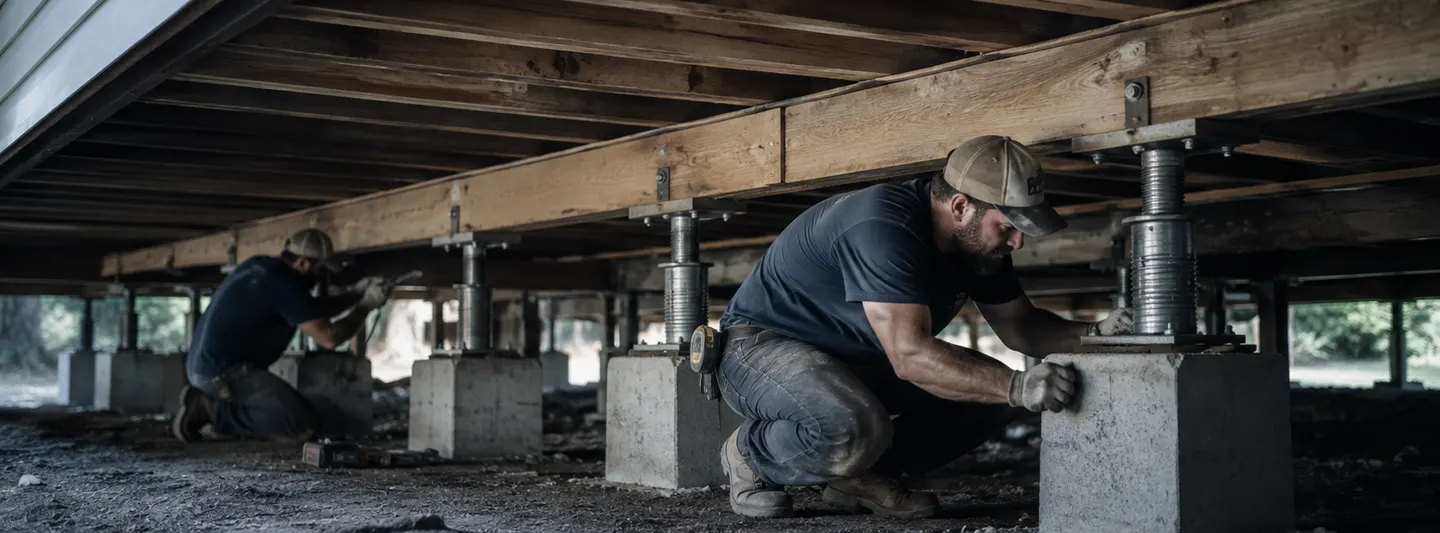
Pier-and-beam houses are easier to look under than slab-on-grade homes, but access does not automatically make the repair inexpensive. The foundation is a chain of structural components: soil supports piers; piers support beams; beams support joists; joists support the floor system. A defect at one layer can transfer load or movement into the next.
That chain is the reason a useful estimate should be built from components rather than from house size alone. A 1,400-square-foot home with two deteriorated piers may need less work than a smaller home with widespread beam rot, poor drainage and multiple low areas.
THE SUPPORT CHAIN
What you are actually paying to repair
Pier-and-beam estimates make more sense when the foundation is read as a stack. The contractor is not repairing an abstract “foundation”; the scope targets one or more layers below.
2026 COST MAP
Repair cost by method and component
The most useful published breakdowns separate leveling, individual piers, beams, moisture work and deep stabilization. These ranges are better planning tools than one average because they help explain what changed between two contractor proposals.
| Repair scope | 2026 planning range | What typically drives the number |
|---|---|---|
| Shimming / leveling | $1,500–$10,000 | Number of low areas, lifting required, access and how many supports must be adjusted. |
| Pier reinforcement | $1,500–$3,000 per pier | Pier material, excavation, access and whether reinforcement or replacement is required. |
| Beam replacement | $1,500–$4,000 per beam | Beam size, length, temporary support and how much framing must be opened or sistered. |
| Moisture management | $3,000–$8,000 | Drainage, vapor barrier, drying, dehumidification and extent of moisture-related deterioration. |
| Support jacks | $5,000–$10,000 | Number of supports and complexity of the lift. |
| Piering / underpinning | $10,000–$20,000+ | Pier count, depth, soil conditions and engineering requirements. |
A $6,000 leveling proposal and a $14,000 proposal may not be competing prices for the same work. One may only adjust existing supports; the other may replace beams and add permanent piers.
BUDGET FINGERPRINT
Where a pier-and-beam bill tends to grow
Relative complexity map—not a price scale. The expensive end appears when several repair categories overlap in the same crawl space.
INTERACTIVE PLANNING TOOL
Pier & Beam Repair Cost Estimator
Estimate a rough national planning range from the primary repair scope, number of affected supports, crawl-space access and moisture involvement.
Estimated planning range
$2,000 – $13,000Planning midpoint: $7,500THE MOST MISUNDERSTOOD LINE ITEM
Leveling is not the same thing as fixing the cause
Leveling a pier-and-beam house generally means raising low areas gradually and adjusting the supports beneath them. Depending on the condition, contractors may use hydraulic lifting equipment and then install or adjust shims, blocks, piers or permanent supports.
The critical distinction is whether the existing support system is still sound. If a beam is rotten or a pier has lost bearing capacity, simply bringing the floor back toward level does not restore that component. The leveling number can therefore be only one part of the contract.
Supports are mostly intact
The problem is primarily elevation or localized settlement. Adjustment and shimming may dominate the scope.
Structural members are damaged
Beams, joists or piers need reinforcement or replacement before the floor system can be reliably supported.
Existing supports keep moving
Soil or bearing problems may shift the project toward new piers, deeper supports or underpinning.
This is also why a low spot should not be priced from interior floor measurements alone. HUD residential inspection guidance calls for foundation walls and piers to be examined for cracking, deterioration, moisture penetration and structural adequacy. The visible slope is only one part of that inspection.
THE SECOND BUDGET
Moisture can turn structural repair into a two-system project
Crawl-space moisture is economically important because many pier-and-beam systems contain wood beams and joists. Persistent water or humidity can therefore affect the same members that carry the building load.
EPA guidance notes that moisture accumulating in a crawl space can move into other parts of the building and contribute to mold growth. In practical repair terms, a foundation quote and a moisture-control quote may both be necessary.
Current consumer guides place moisture-management work associated with pier-and-beam repair around $3,000–$8,000. A full crawl-space encapsulation is a separate project category and may cost more, depending on area and specification.
WHAT THE PIERS ARE MADE OF
Repair cost by pier material
Material matters because the way a pier fails—and the way a contractor reaches or rebuilds it—changes the labor. Published estimates for pier repairs vary widely by construction type.
Often adjusted, rebuilt or selectively replaced.
Brick or stone work can require more careful reconstruction.
Repair commonly centers on deterioration, reinforcement or replacement.
Specialized labor and fabrication can raise the repair cost.
More difficult access and heavy concrete work push the scope upward.
HOW $2,000 BECOMES $15,000
The cost cascade
- 01A low floor is discovered
The starting symptom may suggest a simple leveling job.
- 02Several supports are no longer reliable
Pier reinforcement or new support points enter the contract.
- 03A beam shows deterioration
Temporary support and beam work are added before final leveling.
- 04The crawl space is persistently wet
Drainage or vapor-control work becomes a separate budget.
- 05Finish repairs remain after movement is corrected
Flooring, trim, drywall or plumbing adjustments can sit outside the foundation contract.
COMPARE THE QUANTITY, NOT THE SALES PITCH
What a useful pier-and-beam quote should tell you
Pier-and-beam proposals are easiest to compare when the work is counted. “Level foundation” is too vague. A useful scope identifies how many supports are adjusted, how many new piers are installed, which beams are repaired and which moisture items are included.
What measurements or observations define the affected area?
How many are adjusted, reinforced, rebuilt or added?
Which members are replaced, sistered or left in place?
Is adjustment temporary, final or dependent on later stabilization?
Does the bid include drainage, vapor control or drying?
Who repairs disturbed finishes, plumbing, access points or landscaping?
One contractor may be selling adjustment; another may be pricing permanent structural work. The totals cannot be compared until the quantities and repair methods are aligned.
WHEN TO PAY FOR A SECOND SET OF EYES
Inspection and engineering costs can be small compared with a wrong repair scope
A periodic foundation inspection is commonly priced around $300–$750 in current consumer cost data. Structural-engineer inspection/report costs can extend from several hundred dollars into the low thousands depending on complexity and location.
A web article cannot determine whether a floor slope, cracked pier or deteriorated beam is safe. Structural concerns should be evaluated locally by an appropriately qualified professional.
RELATED COSTS THAT OFTEN APPEAR LATER
Budget beyond the foundation contract
Exterior grading, French drains or sump work may be separate.
Moisture control can become its own crawl-space project.
Damaged wood may require treatment in addition to structural repair.
Lines can require adjustment after lifting or movement correction.
Previously distorted materials may not return to perfect condition.
These may be contractor inclusions or owner-paid line items.
QUICK ANSWERS
Pier and beam foundation repair cost FAQ
How much does pier and beam foundation repair cost?
Current U.S. consumer guides commonly place pier-and-beam repairs around $1,500–$15,000, with broader estimates reaching roughly $800–$25,000 depending on scope.
How much does it cost to level a pier and beam house?
A common planning range is about $1,500–$10,000. Cost depends on how many areas require adjustment and whether existing piers, beams and supports remain serviceable.
How much does pier reinforcement cost?
Current consumer cost data commonly places pier reinforcement around $1,500–$3,000 per pier, although access, material, excavation and repair design can change the final price.
How much does beam replacement cost in a pier-and-beam foundation?
A useful planning range is roughly $1,500–$4,000 per beam for this type of foundation. Temporary support, beam size and tight access can increase the price. For a complete main-beam project, see our main support beam replacement cost guide.
Does crawl-space moisture increase foundation repair cost?
It can. Moisture can contribute to deterioration of wood structural members and may require drainage, vapor control, drying or encapsulation in addition to structural repairs.
Is pier and beam foundation repair a DIY project?
Structural lifting, pier adjustment and beam replacement are different from routine crawl-space maintenance. Work that changes structural support or building elevation should be handled by appropriately qualified professionals.
METHODOLOGY
How Repair Cost Ledger built this report
This page separates the overall pier-and-beam repair range from the component costs that create it. Current U.S. consumer pricing was cross-checked across multiple sources, while federal sources were used for inspection and moisture-control context.
We deliberately do not convert every repair into a square-foot number. The number of piers, damaged beams, low areas, access conditions and moisture scope can matter more than total floor area. The calculator follows the same principle and is presented as a planning model rather than a quote predictor.
Cost data reviewed August 8, 2026. Figures are U.S. planning ranges, not local contractor quotes.