
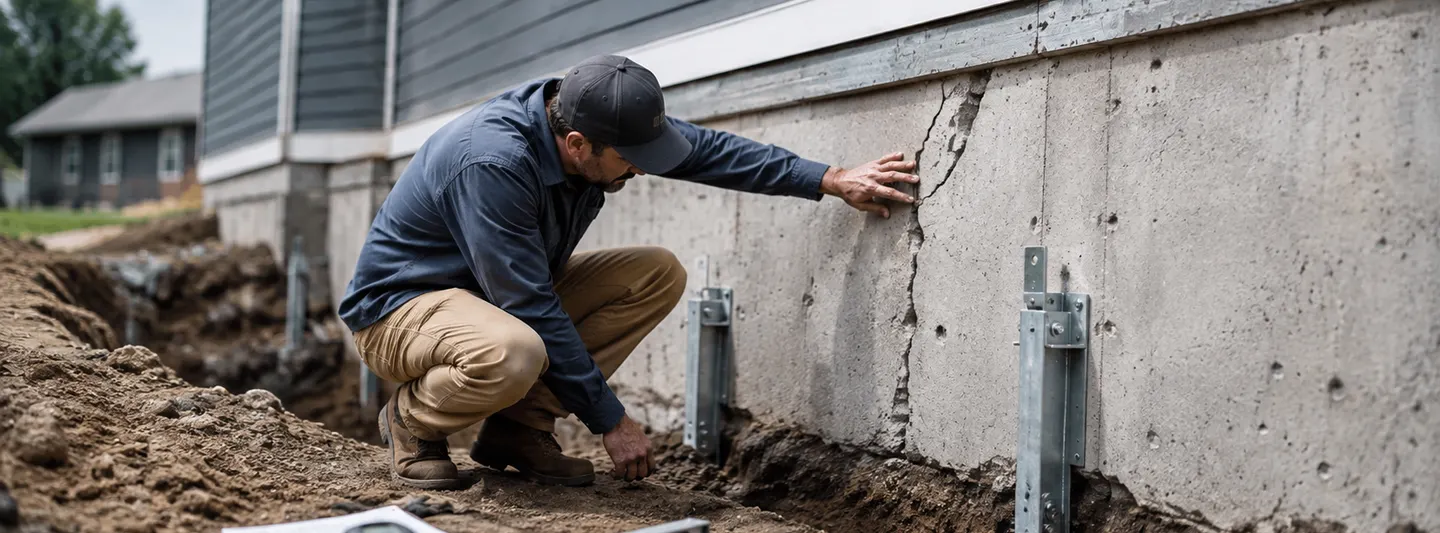
THE SHORT ANSWER
Foundation repair costs average about $5,175 in the United States in 2026, with a commonly reported range of $2,225 to $8,135.
That average stops being useful once the repair becomes structural. A localized crack may cost $250–$800, while underpinning can run $10,000–$30,000+ and lifting a home with foundation replacement can reach $20,000–$100,000. The right budgeting question is therefore not “What is the average?” but “What repair method does this structure actually require?”
Foundation repair is a category, not a single service. The same search term can describe epoxy injection into one crack, drainage correction, wall anchors, slab leveling, helical piers, push piers, beam work, underpinning or the temporary support and reconstruction of an entire foundation. Those jobs use different equipment, different amounts of labor and, critically, solve different structural problems.
This is why price-per-square-foot estimates should be treated as a secondary reference rather than the main decision tool. Angi currently reports a broad average of about $1.50–$12 per square foot, but a 3,000-square-foot house with one localized crack can still be cheaper to repair than a 1,200-square-foot house with differential settlement requiring multiple piers. Scope dominates size.
Cosmetic or limited repair situations usually stay in the hundreds or low thousands when broader movement is not the core issue.
Once the structure needs stabilization, underpinning or multiple support points, the project moves into a very different cost band.
COST LADDER
Foundation repair cost by method
Repair method is the strongest practical predictor of price. The ranges below combine current 2026 consumer cost data into a planning ladder, from localized crack work to projects that require lifting or rebuilding the foundation.
| Repair method | 2026 planning range | What the scope usually means |
|---|---|---|
| Epoxy / crack stitching | $250–$800 per crack | Localized cracking where larger movement is not the underlying problem. |
| Foundation sealing | $1,500–$7,300 | Moisture entry and exterior access without major structural stabilization. |
| Foundation leveling | $1,000–$10,000 | Support correction ranging from shims to more substantial leveling work. |
| Bowed wall stabilization | $5,000–$15,000 | Wall anchors, carbon fiber or tiebacks used to resist inward movement. |
| Underpinning / piering | $10,000–$30,000+ | Deeper structural support when the existing foundation is no longer adequately bearing the load. |
| House lifting | $10,000–$40,000 | Hydraulic lifting followed by support with piers, beams or another engineered system. |
| Lift + foundation replacement | $20,000–$100,000+ | Temporary support, demolition and reconstruction of substantial foundation elements. |
The national average is most useful for moderate repairs. Once a proposal includes multiple piers, house lifting or replacement, method-specific pricing is more informative than any single “average foundation repair cost.”
THE STRUCTURE BELOW
How foundation type changes the cost model
Similar symptoms can require different work depending on what is beneath the building. Access, load path, moisture exposure and the way the structure transfers weight into the ground all change the repair plan.
Concrete slab
Current national data places slab-foundation repairs anywhere from a few hundred dollars to around $20,000 because the category includes both small cracks and substantial settlement. Slab jacking, polyurethane injection or piers may enter the scope when the slab is moving rather than simply cracked.
Pier and beam
Access beneath the structure can make diagnosis easier, but deteriorated beams, piers, joists, moisture damage and uneven supports can expand the job quickly. Many pier-and-beam repairs land around $2,000–$15,000+, depending on severity and scope.
See the pier and beam cost report →Basement
Basement foundations add lateral soil pressure and water management to the equation. A quote may combine crack work, structural wall reinforcement, drainage and waterproofing. Those should be separated so you can see what is structural and what is moisture control.
Crawl space
Crawl-space work often mixes structural repair with moisture, insulation and drainage. HomeGuide currently places many crawl-space foundation repairs around $2,500–$8,000, with more complex multi-step projects exceeding $15,000.
See the crawl space cost report →Slab
Minimal beneath-structure access, direct interaction with settlement and cracking.
Pier & Beam
Accessible beneath the structure, but more structural members can enter the scope.
Basement
Wall pressure, moisture and drainage often overlap with structural repair.
Crawl Space
Repair, moisture control and insulation issues can combine into one project.
INTERACTIVE PLANNING TOOL
Foundation Repair Cost Estimator
Build a rough national planning range from the repair method, foundation type, property size and severity. This is not a structural diagnosis or contractor quote.
Estimated planning range
$11,000 – $33,000Planning midpoint: $22,000BEFORE THE QUOTE
The useful sequence is symptom → cause → repair method → price
Online cost articles often reverse that order. They start with a price and then list symptoms. For structural work, that can produce a false sense of precision. A crack is evidence that something happened; it is not, by itself, the engineering explanation for why it happened.
Cracking, floor slope, sticking doors, wall movement, water entry or visible settlement.
Localized shrinkage, soil movement, drainage, deteriorated supports, lateral pressure or another cause.
Crack treatment, drainage, anchors, leveling, piers, underpinning, lifting or replacement.
Quantities, access, engineering, permits and restoration can now be compared between proposals.
For expensive, disputed or clearly structural work, an independent structural assessment can help separate diagnosis from sales. Current consumer pricing places many foundation inspections around $400–$750, while structural engineer reports may run roughly $500–$3,000 depending on complexity.
Repair Cost Ledger cannot determine from a crack width, photo or floor slope whether a building is structurally safe. Where movement appears significant, conditions are worsening, or a large repair is proposed, use an appropriately qualified local professional.
WHAT MOVES THE QUOTE
Seven variables that can turn a moderate repair into a major project
How much of the foundation is involved
Stabilizing one corner is not the same job as supporting an entire perimeter. Pier count, wall length, affected beams and the number of work locations can multiply labor and materials.
The repair system specified
Crack injection, shimming, wall anchors, carbon fiber, slab jacking and deep-foundation piers solve different problems and live in different price bands. Compare the system, not just the contractor's total.
Ground and soil conditions
The ground is part of the structural system. USGS documents multiple mechanisms of subsidence and ground movement, including aquifer-system compaction, hydrocompaction, natural compaction and sinkholes. Site-specific soil conditions can therefore influence both diagnosis and repair depth.
Access to the work area
Finished basements, decks, porches, patios, landscaping and confined crawl spaces can add demolition, hand labor and restoration that a clean cost-per-pier figure does not show.
Water management outside the structural scope
Drainage, grading or waterproofing may be separate from the structural repair. If water conditions are contributing to the problem, solving only the visible structural symptom may leave an important part of the project unresolved.
Engineering, permits and testing
Soil reports, engineering, inspections and permits can appear as separate line items. Angi currently suggests budgeting $500–$3,000 for a soil report, while HomeGuide lists structural engineer reports around $500–$3,000.
What must be rebuilt after the structural work
Concrete, drywall, flooring, tile, landscaping and patios may need restoration after access. A proposal can look cheap simply because those costs sit outside the contractor's scope.
THE GROUND IS NOT STATIC
Why local conditions make national averages imperfect
USGS notes that land subsidence has directly affected more than 17,000 square miles across 45 states and documents ground compaction associated with groundwater withdrawal. This does not mean every foundation crack is caused by subsidence. It illustrates a more important point for budgeting: the structure and the ground beneath it cannot always be priced as separate systems.
THREE BUDGETS, SAME SEARCH TERM
What “foundation repair” can mean in the real world
These are illustrative planning scenarios, not customer testimonials and not contractor quotes. Their purpose is to show how quickly the economics change when the scope changes.
One crack, no confirmed broader movement
The problem is limited and the specified scope is a localized repair rather than structural stabilization.
$250–$800+- Small work area
- No pier system
- Limited restoration
Settled section requiring multiple support points
Movement affects a meaningful portion of the structure and the repair includes underpinning or piering.
$10,000–$30,000+- Multiple installation points
- Structural system
- Engineering may be required
Failure extensive enough to require lifting and replacement
The existing foundation cannot simply be stabilized in place and major foundation elements are reconstructed.
$20,000–$100,000+- Temporary structural support
- Demolition
- Reconstruction and restoration
QUOTE ANATOMY
A lower foundation quote is not necessarily the same repair for less money
Two bids can differ by $10,000 because the contractors are not proposing the same scope. One might stabilize four locations; another might specify ten. One may include engineering, excavation and concrete restoration; another may exclude all three. Before comparing totals, normalize the proposals.
What condition is each contractor actually proposing to correct?
Are the proposed systems technically comparable?
How many piers, anchors, straps, beams or linear feet are included?
Are plans, calculations or inspections included or billed separately?
Who removes and restores patios, finishes, decks or landscaping?
Is water management part of the scope or a separate project?
Who obtains them, and are fees included in the quoted total?
What work is covered, for how long, and under which exclusions?
The most useful comparison document is often a one-page scope table: rows for each repair item and one column per contractor. That exposes missing quantities and exclusions far faster than comparing proposal totals at the bottom of the page.
THE UPPER END OF THE MARKET
When repair becomes foundation replacement
Foundation replacement is not simply a more expensive crack repair. It is a different construction project. Parts of the building may require temporary support or lifting while deteriorated foundation elements are removed and rebuilt. That introduces demolition, engineering, temporary works, concrete or masonry, utilities and finish restoration.
HomeGuide currently places house lifting with foundation replacement at roughly $20,000–$100,000. An extreme regional example shows why a universal maximum is impossible: FEMA's 2026 case study on pyrrhotite-related crumbling concrete in Connecticut reports replacement costs of roughly $100,000–$250,000 for affected homes. That is a specific material-failure program, not a normal national benchmark, but it demonstrates how far a true rebuild can sit above the everyday foundation-repair average.
BUDGET OUTSIDE THE STRUCTURAL BID
Eight costs owners commonly overlook
Ask for exclusions with the same attention you give inclusions. A lower structural bid can produce a higher all-in project cost when restoration, drainage and engineering have simply been pushed outside the contract.
QUICK ANSWERS
Foundation repair cost FAQ
How much does foundation repair cost in 2026?
Current national consumer data puts the average at about $5,175, with a common range of roughly $2,225–$8,135. Localized crack repairs can cost hundreds, while underpinning, lifting or replacement can reach tens of thousands of dollars.
What is the most expensive foundation repair?
Major lifting and foundation replacement sit at the upper end because the project may require temporary structural support, demolition and reconstruction. Broad published ranges can reach $100,000 or more in severe or unusual cases.
Does house size determine foundation repair cost?
Size matters, but it is not the main variable. Repair method, extent of movement, soil conditions, access and the number of structural work locations can outweigh square footage.
How much does a foundation inspection cost?
Current consumer estimates place many foundation inspections at roughly $400–$750. A structural engineer report can cost around $500–$3,000 depending on complexity and location.
How many foundation repair quotes should I compare?
Multiple bids can be useful, but the critical step is comparing equivalent scope. Method, quantities, engineering, access, permits, restoration and exclusions should be aligned before the totals are treated as competing prices for the same job.
METHODOLOGY
How Repair Cost Ledger built this cost report
We do not treat one contractor quote as a national benchmark. This report separates broad consumer averages from method-specific ranges, cross-checks current 2026 U.S. cost publications, and uses federal technical sources where they add context about ground movement or exceptional foundation failures.
The estimator on this page is intentionally a planning model. It uses published repair-method ranges and transparent multipliers for foundation type, building size and observed scope. It does not infer structural safety and should not be used as a substitute for a local inspection or engineering evaluation.
Cost data reviewed August 8, 2026. Repair Cost Ledger updates reports when underlying market data materially changes.