
2026 COST RANGE
Most roof-truss repairs fall between $500 and $5,000.
THE SHORT ANSWER
A localized repair may stay near the lower end of the range. Damage involving several trusses, difficult attic access, roof removal or a custom engineered repair can move toward $5,000 or beyond.
Angi and HomeAdvisor both use approximately $500–$5,000 as the current national planning range for roof-truss repair.
That range is wide for a good reason. “Damaged truss” can mean a small split in one member, a connector plate that has pulled away from the wood, a truss cut during an HVAC installation, several storm-damaged trusses or a roof structure that has sagged after years of moisture damage.
The last number is included only for perspective. HomeAdvisor currently places professional roof-truss installation for an entire standard-size home around $7,500–$35,000. Replacing one damaged truss is not the same project, but the comparison shows why saving an existing truss with an engineered repair can be worthwhile when repair is structurally appropriate.
ROOF TRUSSES IN PLAIN ENGLISH
A roof truss is a triangle-shaped structural frame that carries the roof.
If you look inside many modern attics, you will see repeated wooden triangles running from one exterior wall to the other. Those are roof trusses.
They are usually built from relatively small pieces of lumber connected together so the entire triangle works as one structural unit. That is why one cut or broken piece matters more than its size might suggest.
You do not need to become a structural engineer. You only need to know which part of the triangle is damaged.
The sloping wood members close to the roof sheathing.
The long lower member that often runs above the ceiling.
The shorter diagonal or vertical members inside the triangle.
The toothed metal plate pressed into the wood where truss members meet.
When an estimate says “broken web,” “split bottom chord” or “damaged plate,” these are the parts it is describing.
TRUSS OR RAFTER?
They both hold up a roof, but they are not repaired the same way.
Many individual members and metal connector plates work together as one engineered unit.
Rafters are conventionally framed members and follow a different structural layout.
This article is specifically about wood roof trusses. If a contractor is actually repairing rafters or replacing roof decking, the scope belongs in a different cost category.
WHAT ACTUALLY WENT WRONG?
The cause of the damage usually matters more than the length of the crack.
A top chord, bottom chord or web can split because of handling damage, impact, excessive loading or deterioration.
The plate can pull away from the wood, lose tooth engagement or become damaged around a joint.
HVAC ducts, plumbing, electrical work and attic renovations sometimes leave unauthorized cuts or holes.
A long-running roof leak can soften, rot or deteriorate the lumber around the leak path.
Visible roof deformation may point to a broader loading, bracing, bearing or moisture problem rather than one isolated break.
Falling trees, wind events or other impacts can damage multiple members and surrounding roof materials at once.
THE MOST IMPORTANT RULE
Do not cut a truss because a pipe, duct or attic opening is in the way.
Residential building codes treat roof trusses differently from ordinary nonstructural lumber. The IRC states that truss members should not be cut, notched, drilled, spliced or otherwise altered without approval from a registered design professional—typically someone qualified to design structural repairs, such as a structural engineer where appropriate.
In everyday language: if a truss is blocking the new air-conditioning duct, you cannot assume that cutting one web and adding a board beside it will restore the original strength.
The repair has to restore the structural job that the cut or damaged piece was doing before it was changed.
WHAT A TRUSS REPAIR LOOKS LIKE
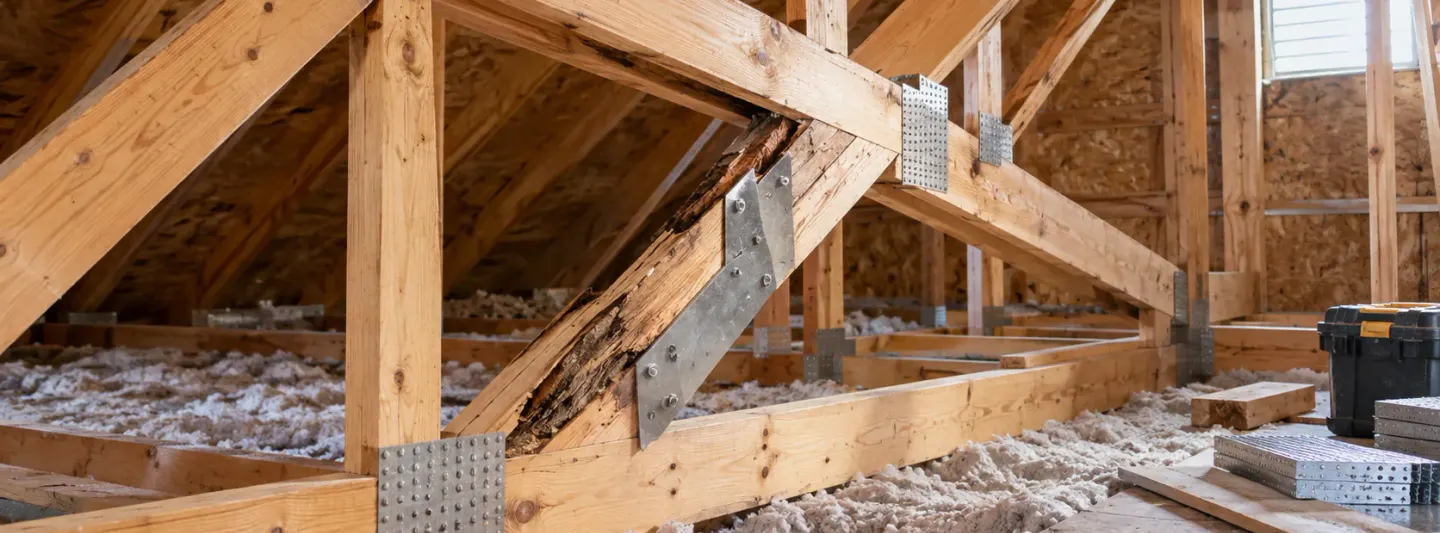
Many repairs add material around the damaged area instead of replacing the entire truss.
MiTek's engineering literature describes several repair approaches, including added lumber, plywood or OSB gussets—reinforcing panels fastened across a damaged area—steel plates and other reinforcement.
The important phrase is “repair detail.” The engineer or truss design professional specifies what gets added, where it goes and how it is fastened.
Photographs, truss dimensions and the exact damaged location establish what needs to be evaluated.
An engineer, truss manufacturer or qualified design professional develops or approves the repair detail.
The crew needs enough working room in the attic or roof assembly to install the repair correctly.
Lumber, gussets, screws, nails, plates or other specified components are installed exactly as detailed.
Required inspection is completed before disturbed insulation, ceiling or roofing materials are restored.
WHY A SMALL REPAIR CAN STILL COST REAL MONEY
You are paying for access, design and execution—not just a few pieces of lumber.
A truss reinforcement may use inexpensive lumber or plywood, but that does not make the project equivalent to fastening another board beside a cracked 2×4.
Inspection
Someone has to determine whether the truss is actually damaged and whether the problem extends beyond one member.
Engineering
The repair detail may need to specify reinforcement dimensions, material and exact fastener spacing.
Attic access
Low roof pitches, insulation, ductwork and finished ceilings can make a theoretically simple repair difficult to reach.
Temporary support
Some damaged conditions need stabilization or unloading while the permanent repair is installed.
Roof or ceiling removal
If the damaged area cannot be reached from the attic, surrounding finishes can become part of the project.
Underlying cause
Fixing a truss without repairing the roof leak or other source of damage leaves the original problem in place.
DO YOU NEED A STRUCTURAL ENGINEER?
For structural damage or an altered truss, budget for professional design rather than guessing at the repair.
Angi's August 2026 structural-engineer data puts a targeted beam, joist or truss inspection at roughly $350–$500. A broader structural investigation or custom drawings can cost more.
This fee is separate from the carpenter or contractor who physically installs the repair.
Evaluates the condition and provides or approves the structural repair detail where required.
Installs the specified reinforcement and handles associated roof or framing work within the agreed scope.
For identifiable manufactured trusses, original drawings and manufacturer engineering can be valuable.
MiTek's current repair-request process illustrates how specific this can become. Its repair forms ask for the exact truss, location of damage, accessibility, number of affected plies, photographs and whether a previous field repair was already performed.
That is a much better model than emailing someone a photograph and asking, “Can I sister a board onto this?”
ACCESS CAN CHANGE THE PRICE MORE THAN THE REPAIR MATERIAL
A visible garage truss and a buried attic truss are not the same job.
The damaged joint can be measured and reinforced without removing major finishes.
Access exists, but insulation, ducts, wiring and low headroom can slow the work.
Roofing, sheathing or interior ceiling finishes may have to be opened before the repair can even begin.
WATER DAMAGE
If the truss is rotten, the leak is part of the structural repair whether it appears on the same invoice or not.
HomeAdvisor specifically notes that leaks can travel along trusses before becoming visible at the ceiling. By the time the homeowner notices a stain, the water path may extend beyond the point directly above it.
That means the inspection should separate at least three things: the roofing failure that allowed water in, any damaged roof decking and the structural condition of the truss itself.
TRUSS REPAIR
Structural lumber, connections and engineered reinforcement.RELATED ROOF WORK
Leak repair, shingles, flashing, underlayment or damaged roof decking.Our roof leak repair cost guide and roof deck replacement cost guide cover those adjoining scopes separately.
DAMAGE FROM HVAC, PLUMBING OR REMODELING
An accidental cut does not necessarily mean the whole roof has to be rebuilt.
Trusses are sometimes altered because someone needs room for a duct, plumbing line, attic stair, recessed feature or other building component.
Discovering that cut can be alarming, but the next step is evaluation—not assuming the roof is beyond repair. MiTek publishes standard repair details for several specific truss conditions, and custom repair designs can address situations outside those standard details.
If possible, photograph and measure the condition before anyone adds boards, screws or plates. The person designing the permanent repair needs to understand the original damage and any work already performed.
REPAIR OR REPLACE?
A damaged truss can often be repaired, but replacement becomes more realistic as damage spreads.
MiTek's technical guidance describes repairs ranging from relatively simple lumber reinforcement to more involved gussets, beams, prefabricated truss sections and steel components.
That means a cracked member does not automatically condemn the entire truss. The repair professional is trying to restore a safe load path—the route the roof's weight follows through the truss and into the supporting walls—using a repair designed for the actual damage.
Replacement also creates its own costs. Roof finishes and sheathing may need to be removed, the new truss has to reach the structure, adjacent framing may have to be temporarily supported and lifting equipment can be needed.
WHAT IF SEVERAL TRUSSES ARE BAD?
Once the damage is repetitive, stop treating the estimate as a one-truss repair.
Several damaged trusses can indicate a shared cause: storm impact, a chronic leak, installation damage, inadequate bracing, a modification repeated across the attic or another building-wide condition.
At that point, the useful question changes from “How much does one truss cost to fix?” to “How much of the roof structure needs to be opened, engineered and repaired?”
For context, current HomeAdvisor and Angi data puts new truss installation for a standard-size home around $7,500–$35,000, with an average near $16,500. Very large or complex projects can exceed that range.
Those are new-installation figures, not a prediction of what your damaged roof will cost. They are useful only as a boundary between localized repair and roof-structure replacement economics.
THREE WAYS A $500–$5,000 RANGE PLAYS OUT
The same search term can describe very different jobs.
One accessible damaged member
Lower part of the rangeA single condition is visible from an open attic and can be handled with a defined engineered repair.
- One truss
- Easy access
- No active water damage
- Limited finish disturbance
Cut or damaged truss in a finished attic
Middle of the rangeEngineering and structural work remain manageable, but access and restoration add labor.
- Custom repair detail
- Insulation or ceiling access
- Several reinforcement pieces
- Inspection and restoration
Multiple or badly deteriorated trusses
Upper range or beyondThe project starts to behave like structural roof reconstruction rather than a spot repair.
- Several trusses
- Roof opening
- Temporary support
- Possible replacement work
These scenarios deliberately avoid invented per-truss prices. The published national repair range is $500–$5,000, but there is not enough consistency between damage types to pretend that every cracked web or connector plate has one fixed national price.
HOW TO READ A TRUSS-REPAIR QUOTE
A useful quote should tell you what is damaged and exactly how the repair was determined.
Which truss or group of trusses is damaged, and where is the damage located?
Is it a split chord, web, connector plate, unauthorized cut, moisture damage or something else?
Is there an engineered or manufacturer repair drawing supporting the proposed work?
Clarify lumber, plywood/OSB, plates and specified fasteners rather than accepting “reinforce truss.”
State whether insulation, drywall, roofing or sheathing has to be removed.
If water or impact caused the damage, identify who fixes that problem.
Define responsibility for any local permit, engineering submission or final inspection.
Ceiling, insulation, sheathing and roofing should be clearly included or excluded.
COMMONLY MISSED COSTS
The structural repair can be only one line in the final bill.
WARNING SIGNS
A roof that is visibly changing shape deserves more than a cosmetic repair.
A cracked piece of attic lumber is not always an emergency, but some conditions justify prompt professional evaluation: a noticeably sagging roofline, a truss that has visibly separated, widespread cracking, recent tree impact, fire damage or movement that appears to be getting worse.
From the living space, new ceiling movement, pronounced cracks or doors suddenly binding after a major roof event can also justify a structural inspection.
Do not climb onto, cut or attempt to straighten a visibly unstable roof structure to investigate it yourself.
FAQ
Questions homeowners ask after someone says, “You have a damaged truss.”
How much does it cost to repair one roof truss?
Current national cost guides place roof-truss repair broadly around $500–$5,000. There is no reliable fixed national price per truss because a small accessible repair and a heavily damaged truss requiring roof removal are fundamentally different projects.
Can a cracked roof truss be repaired?
Often, yes. Engineered repairs can reinforce damaged chords, webs and joints. Whether repair is appropriate depends on the location, severity and cause of the damage.
Do I need a structural engineer for a damaged truss?
Structural alteration or significant damage often requires professional engineering input. The IRC specifically restricts cutting, drilling, notching, splicing and other truss alterations without approval from a registered design professional.
How much does a structural engineer cost for a truss inspection?
Angi's August 2026 data places a targeted beams, joists or trusses inspection around $350–$500. Custom repair drawings, extensive investigation or follow-up work can add to that fee.
Can I sister a 2×4 to a broken roof truss?
Adding lumber beside a damaged member can be part of an engineered repair, but the size, length, location and fastening pattern should come from an appropriate repair detail rather than a generic rule.
Can plumbers or HVAC installers cut roof trusses?
Not simply because a truss is in the way. Truss alterations need structural review and approval consistent with applicable building requirements.
Does a damaged truss mean the entire roof needs replacement?
No. Localized truss damage can often be repaired. Extensive deterioration, multiple damaged trusses or conditions that make an engineered repair impractical can move the project toward replacement.
Is roof-truss repair included in a normal roof repair?
Not necessarily. Roofing contractors may repair the weatherproof roof covering while structural truss work remains a separate engineered scope. Ask the quote to identify both explicitly.
HOW WE BUILT THIS 2026 COST GUIDE
We separated general roof repair prices from structural truss repair.
The $500–$5,000 national repair range is supported by current 2026 data from both Angi and HomeAdvisor. Structural-engineering allowances use Angi's current residential engineer data, including its published range for beam, joist and truss inspections.
Technical repair principles were checked against International Residential Code truss provisions and MiTek engineering resources covering damaged chords, webs, connector plates and field repair.
We do not assign invented prices to individual cracks, webs or plates. A truss repair has to be priced after the location, access, damage and repair detail are known.
Cost evidence reviewed September 21, 2026. Structural repair requirements, permits and applicable codes vary by jurisdiction and project.