
2026 NATIONAL COST ANSWER
Sewer line replacement costs $50–$250 per linear foot, or about $2,000–$10,000 for a 40-foot residential replacement.
HomeGuide's December 2025 guide—its current 2026 sewer-replacement pricing—places a residential replacement at $50–$250 per linear foot, with a $6,000 national average and $2,000–$10,000 typical range. Its examples rise to $3,000–$15,000 for 60 feet and $4,000–$20,000 for 80 feet.
These sewer-lateral figures assume a property connected to a sewer system. A home using onsite wastewater has a different replacement scope; see the septic system replacement cost guide rather than applying sewer-line pricing to the tank and drain field.
Angi's August 3, 2026 national data uses essentially the same installed unit envelope—$50–$250 per linear foot—and an average around $3,319. Angi's most common professional replacement band is $1,388–$5,323, reflecting a mix of shorter and partial projects as well as complete replacements.
WHAT TURNS A $3,000 JOB INTO A $15,000 JOB?
Before comparing contractor totals, identify these five cost drivers
A camera may show one failed section rather than a failed 60-foot lateral. Partial replacement can change the project before method or material is even discussed.
Soil and lawn are cheap to disturb compared with a basement slab, driveway, sidewalk, retaining condition or congested utility corridor.
Angi says trenchless methods are not appropriate for every condition, including some collapsed lines or improper slopes.
Landscaping, concrete and driveway repairs can sit outside the plumber's headline sewer-line price.
The private lateral boundary is local. Do not assume that a defect near the street automatically belongs to the municipality.
SEWER REPLACEMENT ESTIMATOR
Estimate the pipe run first, then expose the access costs that sit outside it
HomeGuide and Angi both currently use about $50–$250 per linear foot as a broad installed replacement envelope. This estimator keeps that pipe-run cost separate from camera inspection and surface restoration so the same expense is not silently counted twice.
DIAGNOSIS BEFORE EXCAVATION
A sewer problem does not automatically mean you need a new sewer line
HomeGuide puts ordinary sewer-line repairs around $150–$3,800, depending on method and problem. Angi's August 2026 guide gives several useful repair benchmarks: $600–$1,050 for a cracked-pipe spot repair, $100–$600 for root removal, and $1,500–$3,000 for sewer-trap replacement.
One crack, one bad joint or removable roots can justify a targeted repair if the rest of the lateral remains serviceable.
CIPP or another lining method may restore function without excavating the full corridor, provided geometry and structural condition are compatible with the process.
Angi identifies severe shifting, major structural failure, extensive damage, repeated backups and outdated pipe as common reasons replacement becomes more rational.
TRADITIONAL VS. TRENCHLESS
Choose the method around the defect and the corridor—not around the word “trenchless”
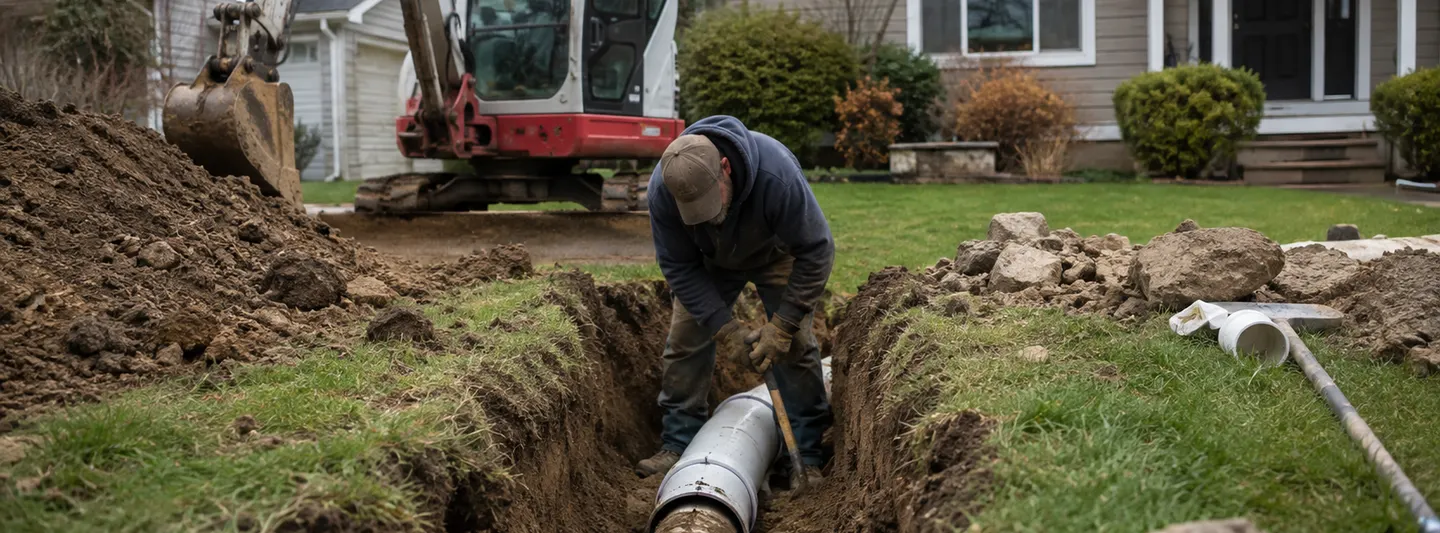
Excavation exposes the line, making it possible to correct severe collapse, geometry and some alignment problems directly. The tradeoff is disturbance to soil, landscaping and hardscape.
HomeGuide trench digging: $5–$12/lfThe existing pipe is fractured / displaced while new pipe is pulled through. It still requires access points, but avoids a continuous open trench.
$60–$200/lfCured-in-place pipe is rehabilitation rather than excavated replacement. It depends on having a host line that can accept the liner and on the defect type being suitable.
$90–$250/lf“Trenchless” is not automatically cheaper in unit price. Its financial advantage often appears in the surfaces it does not destroy: driveway, mature landscaping, patios and long lawn corridors.
THE MOST IMPORTANT QUANTITY IS REPLACEMENT LENGTH, NOT LOT SIZE
Ask the contractor to mark the defect location and proposed endpoints
HomeGuide says partial repairs may involve only 1–15 feet, while a typical full sewer replacement is around 40 feet. Angi likewise notes that the entire distance from house to street does not necessarily need replacement.
CAMERA DISTANCE“Defect at 31 feet” creates a physical reference for the excavation / access point.
REPLACEMENT STARTWhy start here? Tie the endpoint to sound pipe, connection geometry or the chosen method.
REPLACEMENT ENDWhy stop here? A full replacement should be justified by condition, not simply contractor convenience.
CONNECTION POINTWhat happens at the city main / property-side connection? Scope, permits and ownership rules can change near the public system.
ACCESS CAN COST MORE THAN PIPE
PVC may cost only a few dollars per foot while the corridor above it costs thousands to disturb and rebuild
HomeGuide's material-only PVC benchmark is $3–$8 per linear foot. Compare that with an installed sewer replacement at $50–$250 per linear foot. The gap is a reminder that the homeowner is buying excavation, labor, equipment, access, connections, inspection, permits and restoration—not simply plastic pipe.
Open trench can be economically attractive where access is easy and the surface above is inexpensive to restore.
Mature planting, irrigation and designed landscape can make a “cheap” trench expensive after plumbing work ends.
HomeGuide flags concrete directly as a sewer-line location cost. Angi notes slab breaking / restoration can push a difficult section much higher.
Traffic control, pavement and right-of-way rules can create a project that no national per-foot rate captures cleanly.
PIPE MATERIAL RARELY EXPLAINS THE WHOLE BID
The material line can be small compared with the installed corridor cost
PVC$3–$8 / linear ft. material HomeGuide current 4-inch pipe benchmark.
ABS$3–$11 / linear ft. material Availability and permitted use vary by local code.
CAST IRON$20–$75 / linear ft. material More expensive material; existing cast iron is also common in older systems.
COPPER$30–$80 / linear ft. material High material price and uncommon as a default residential sewer-lateral choice.
Angi's 2026 material figures are in the same general direction: approximately $4.50/lf PVC, $6 ABS, $50 cast iron and $85 copper. The larger lesson is more important than the exact retail pipe number: changing pipe material does not eliminate excavation and access labor.
AGE IS A RISK SIGNAL, NOT A REPLACEMENT DIAGNOSIS
An old sewer that still has usable geometry can be a different project from a younger pipe that has collapsed
HomeGuide gives a broad 30–100 year sewer-line service life depending on material and conditions. It places older Orangeburg and clay around 30–60 years, while PVC, cast iron and copper can fall around 50–100 years. Soil movement, roots and maintenance can shorten those ranges.
If the camera shows an open line with isolated defects, a spot repair or rehabilitation discussion may still be reasonable.
Several offsets, root-entry points, cracks or recurring backups increase the value of pricing a longer replacement against the next few likely repairs.
A newer pipe that has collapsed, shifted severely or lost proper drainage geometry can require excavation or replacement regardless of its theoretical material lifespan.
This distinction matters commercially. “Your line is 60 years old” is not the same statement as “the camera shows 42 feet of structurally failed pipe.” Ask contractors to connect age claims to documented condition before using age to justify the replacement length.
THREE COSTS THAT OFTEN APPEAR BESIDE THE NEW PIPE
Cleanouts, backflow protection and backup cleanup solve different problems and should not disappear inside the replacement total
HomeGuide's current sewer-replacement guide lists several adjacent items that can legitimately appear on the same proposal. They are not interchangeable with pipe replacement, and they should be priced and explained separately.
CLEANOUT$500–$2,000 A new or improved access point can make future camera inspection, snaking and maintenance easier. It is an access feature, not extra replacement footage.
BACKFLOW PREVENTER$150–$1,200 Intended to reduce reverse sewage flow toward the building in applicable systems. Whether it is suitable depends on local plumbing design and code.
BACKUP CLEANUP$500–$2,000 minor benchmark A failed sewer can create indoor contamination before the underground line is repaired. Cleanup is a separate loss from replacing the pipe itself.
Keeping these costs separate improves bid comparison. One contractor may quote $7,500 for replacement only, while another quotes $9,000 with camera, cleanout and surface restoration. The second number is not necessarily the more expensive pipe project.
WHEN $/LINEAR FOOT HELPS—AND WHEN IT HIDES THE JOB
Unit pricing is strongest after the access conditions are already comparable
Per-foot pricing is valuable because replacement length is a real quantity. It becomes weak when contractors are pricing different access corridors. A 40-foot lawn trench and a 40-foot run under concrete are both “40 feet,” but they are not equivalent production work.
Dividing each total by linear feet can expose meaningful contractor pricing differences.
A lower $/lf can simply mean less scope rather than better value.
“Sewer line replacement cost per foot” is the obvious budgeting question. Once bids arrive, the more valuable follow-up becomes: what exactly is included in each foot?
WHO PAYS FOR THE LATERAL?
Do not assume the property line or curb is automatically the responsibility boundary
Responsibility varies by municipality and utility. HomeGuide says that in most cases homeowners maintain the pipe connecting their property to the public main, while the municipality handles the main itself. But the exact boundary must be confirmed locally.
New York City is a useful concrete example: NYC DEP states that property owners are responsible for their sanitary sewer service line from the property to the city sewer main in the street. DEP says sewer service-line breaks in New York City average $10,000–$15,000, illustrating how street-side access in a dense market can sit far above a generic national average.
THE REPLACEMENT-CORRIDOR MODEL
The line item to compare is the entire path from access point to access point
The illustration is intentionally placed lower in this report because the numbers and decision logic matter first. Once those are understood, the corridor makes the quote easier to audit: each surface above the line represents a different possible restoration cost, permit condition or reason to consider trenchless work.
FIVE SEWER REPLACEMENT COST FILES
The same 40 feet can produce radically different bids depending on what lies above and what condition lies below
HomeGuide's broad installed math gives $1,000–$5,000. With straightforward soil access and limited restoration, this is the type of project most likely to remain near ordinary national replacement economics.
HomeGuide's published range is $2,000–$10,000. Camera, permits, cleanout, landscape restoration or difficult depth can all sit inside or outside a local contractor's version of that number.
The pipe length has not changed, but excavation and pavement restoration have. This is where a trenchless method can be more attractive even when its per-foot pipe work is not cheaper.
HomeGuide's $60–$200/lf pipe-bursting benchmark gives roughly $3,600–$12,000 before project-specific access, permits or restoration.
NYC DEP's $10,000–$15,000 average sewer-line break is a useful warning against assuming national yard-access costs translate directly to dense urban street work.
A GOOD SEWER REPLACEMENT QUOTE SHOULD BE MEASURABLE
Make every contractor bid the same pipe problem before comparing price
01Camera finding — defect type, distance from access point and video / still documentation?
02Replacement length — exact start / end points and why that length is required?
03Method — trench, pipe bursting, lining or mixed access?
04Pipe specification — material, diameter and connections included?
05Excavation depth / access — any shoring, dewatering, utility conflict or slab opening?
06Surface restoration — lawn, landscaping, concrete and driveway restored by whom?
07Permits / inspections — included in bid or paid separately?
08Hidden conditions — how are extra collapsed footage, bad connections or unexpected obstructions priced?
“Replace sewer line — $8,500” is not comparable with another bid until length, method, access and restoration are normalized.
COMMON COST QUESTIONS
Sewer line replacement cost in plain terms
How much does sewer line replacement cost per foot? HomeGuide and Angi both currently use about $50–$250 per linear foot as a broad national installed replacement range.
How much does a 40-foot sewer line cost to replace? HomeGuide's current 2026 planning range is $2,000–$10,000.
How much does a sewer camera inspection cost? HomeGuide uses $125–$500; Angi's August 2026 guide uses $100–$500.
How much does pipe bursting cost? HomeGuide uses $60–$200 per linear foot. It is a trenchless replacement method that pulls new pipe through the old alignment.
How much does CIPP sewer lining cost? HomeGuide uses $90–$250 per linear foot. CIPP rehabilitates the inside of a suitable existing host pipe rather than excavating a new pipe corridor.
Is trenchless always cheaper? No. The unit price can overlap traditional replacement. Its economic value often comes from avoiding driveway, landscape or other surface restoration.
Who pays for the sewer line from the house to the street? Local rules control. HomeGuide says homeowners are responsible for the connecting line in most cases. NYC DEP, for example, explicitly assigns the owner's sanitary sewer service line all the way to the city main.
How long does sewer line replacement take? HomeGuide says repair or replacement commonly takes 1–5 days, depending on length, obstacles and method.
METHODOLOGY & SOURCES
Current national pricing, current 2026 contractor-market data and a municipal responsibility example
Pricing was reviewed August 8, 2026. HomeGuide supplies the primary per-foot model, method pricing and restoration allowances. Angi's August 3, 2026 update provides an independent market check. NYC DEP is used only as a concrete example of why private-lateral ownership must be checked locally rather than assumed nationally.
$50–$250/lf; $2,000–$10,000 typical; $6,000 national average; camera, methods, materials, excavation and surface-restoration costs.
02 · ANGI · AUG 3 2026Sewer Line Replacement Cost$3,319 average; $1,388–$5,323 common professional range; $50–$250/lf broad installed cost, inspection and access factors.
03 · NYC DEP · CURRENTService Line Protection ProgramNYC property-owner responsibility to the city main and current $10,000–$15,000 average sewer service-line break example.
04 · NYC 311Broken Sewer LineConfirms owner responsibility for the sewer service line connecting the property to New York City's sewer main and licensed-plumber requirement.
This report is U.S. cost-planning information. Sewer ownership, plumbing licenses, pipe materials, slope, cleanouts, permits, public right-of-way work and inspection requirements vary by jurisdiction. Confirm local requirements before authorizing excavation or connection work.