
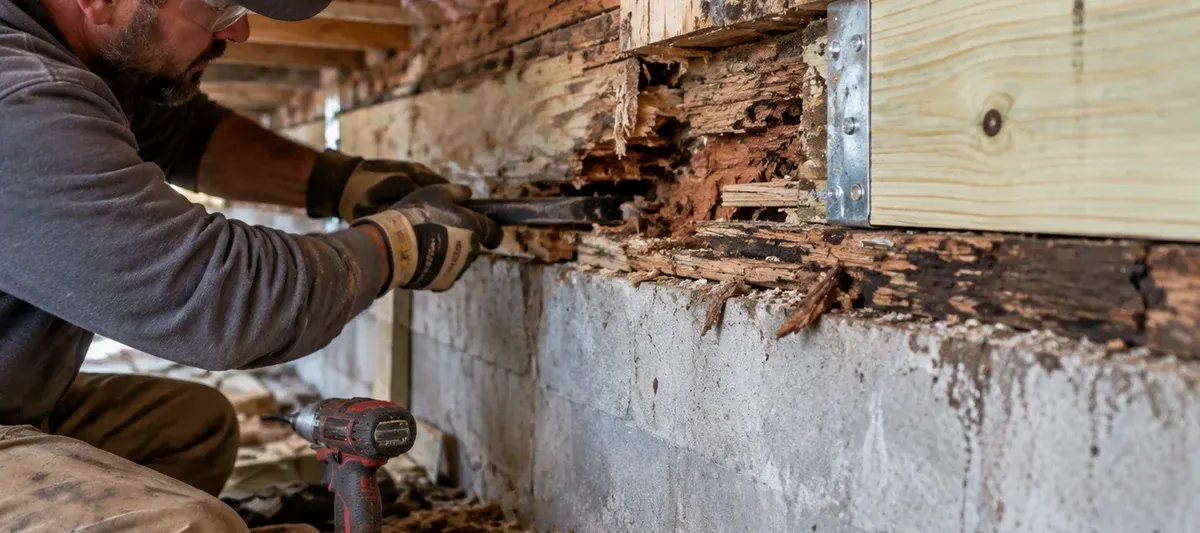
THE COLONY IS TREATED. NOW WHAT?
A $900 termite treatment can still leave a $9,000 building repair behind it
This is the distinction that makes termite costs confusing.
Pest-control work addresses the infestation. Carpentry and structural work address what the insects have already damaged.
Those bills should not be treated as though they were interchangeable.
Angi's August 2026 national data places termite-damage repair around $1,000–$10,000 or more, with an average near $3,000.
HomeGuide gives a useful severity breakdown: $300–$2,000 for minor damage, $2,000–$5,000 for moderate repair, and $5,000–$15,000+ when major structural components are involved.
The important word in those ranges is not termite. It is damage.
The repair price follows the building component that was damaged: trim, drywall, subfloor, joists, sill plates, beams, wall framing or another structural member.
ONE PROPERTY PROBLEM · TWO DIFFERENT CONTRACTS
Termite control stops future damage. Structural repair deals with the damage already there.
Control the infestation
- Inspection
- Identify active infestation
- Soil treatment, bait or other appropriate method
- Monitoring / follow-up
- Prevention recommendations
Restore damaged materials
- Open concealed areas where necessary
- Determine actual damage extent
- Repair or replace structural members
- Restore subfloor, walls and finishes
- Correct associated moisture conditions
The U.S. Environmental Protection Agency notes that termites cause billions of dollars in structural damage every year. Its consumer guidance focuses on identifying infestation, preventing access and using appropriate termite treatments.
None of those treatment methods can put missing wood back into a joist.
A house can be termite-free today and still contain structural damage created by termites years earlier.
WHAT DOES $300 VS. $15,000 ACTUALLY BUY?
The price changes when the damage crosses from surface material into the load path
Trim, small drywall repairs, surface wood damage, paint and limited finish restoration.
Subfloor, localized framing or a defined structural member requiring repair.
Multiple joists, support beams, bearing walls, floors or connected structural components.
This progression explains why “termite damage repair” is too broad to be a useful line item by itself.
A carpenter replacing damaged trim and a structural contractor temporarily supporting a house while rebuilding a sill plate are not performing expensive and cheap versions of the same service.
TRACE THE DAMAGE THROUGH THE BUILDING
The repair budget should identify where the termite path intersects the structural load path
Common high-consequence repair zones Joist ends and sill / perimeter framing can connect pest damage directly to the structural support system.
Damage can also occur elsewhere Wall framing, beams, subfloor and roof framing can create entirely different repair scopes.
PRICE THE COMPONENT, NOT THE INSECT
Once damage is exposed, the repair belongs to the component that failed
Limited panel damage may remain a contained carpentry job. Larger areas can require flooring removal and complete panel replacement.
Subfloor Replacement Cost →Damaged joists may be reinforced or replaced depending on the member, location and remaining condition.
Floor Joist Repair Cost →Damage at the foundation edge can require temporary support and rebuilding of the foundation-to-frame connection.
Sill Plate Replacement Cost →Beam replacement can involve shoring, posts, footings and major structural sequencing rather than ordinary wood replacement.
Main Support Beam Replacement Cost →Studs, bottom plates and sheathing may require wall opening, temporary support and reconstruction when damage extends vertically.
Scope depends on whether the wall is load-bearing.Pest damage may coexist with high humidity, rot, poor drainage and other below-floor problems.
Crawl Space Repair Cost →CONTROL THE UNCERTAINTY
A termite repair can contain unknown damage without becoming an unlimited change order
Identify members and areas already visible before demolition.
Preserve evidence of newly exposed deterioration before it is removed.
Name the additional joist, wall, beam, panel or finish instead of adding a vague “extra termite damage” line.
Use agreed unit rates or a documented change order before substantial additional work proceeds.
Unknown extent does not require unknown pricing rules.
WHEN TERMITE DAMAGE BECOMES STRUCTURAL
Load-Bearing Termite Damage Is the Key Structural Repair Threshold
Termites consume cellulose. In structural lumber, that can mean a member loses material internally while part of its outer surface remains visible.
The USDA Forest Products Laboratory identifies termites as one of the principal insect threats capable of degrading wood. Its Wood Handbook treats insect damage alongside fungi and other forms of biodeterioration because material condition matters directly to the long-term performance of wood products.
HomeGuide's 2026 repair data makes the cost consequence visible: cosmetic work may remain below $2,000, while repairs involving floors, load-bearing walls or multiple beams can reach $5,000–$15,000 or more.
Repair remains primarily demolition, carpentry and restoration.
Temporary support, engineering and a defined load path may become part of the project.
WHEN AN ENGINEER ADDS VALUE
Engineering becomes useful when contractors disagree about what must be rebuilt
HomeGuide places a structural engineer inspection around $350–$900 for severe termite-damage situations. More extensive investigation, calculations or repair documents can cost more.
The engineer's value is greatest when the question is not simply whether damaged wood exists, but whether a member can remain, needs reinforcement or must be replaced.
Independent structural input can also give multiple contractors the same repair basis to price, which can make quotes substantially easier to compare.
PEST DAMAGE AND MOISTURE OFTEN MEET IN THE SAME PART OF THE HOUSE
Repair Termite-Damaged Wood Only After Correcting Crawl-Space Moisture
Moisture does not create termites by itself, and different termite species have different environmental behavior.
But water management still belongs in the inspection.
EPA prevention guidance specifically recommends keeping soil around the foundation dry through proper grading and drainage, fixing leaks promptly and avoiding conditions that give termites unnecessary access to wood.
Moisture can also produce its own wood deterioration through fungal decay. That means framing exposed during a termite repair may show more than one mechanism of damage.
SEQUENCE MATTERS
The building should not be closed back up before the pest and structural scopes agree on what happens next
Confirm evidence, activity and known damage areas.
Use the appropriate pest-management strategy.
Open construction only where necessary to define repair scope.
Restore damaged framing and connected materials.
Close walls and floors after concealed work is complete.
SAME INSECT · VERY DIFFERENT INVOICE
Termite Damage Repair Cost Examples: Hundreds to Five Figures
Treatment is complete and inspection finds no compromised load-bearing framing. Damaged trim and limited wall finishes are replaced.
The affected floor area is opened, compromised subfloor is replaced and adjacent framing remains serviceable.
Damage sits at the perimeter of a crawl space where joists meet the foundation edge. Temporary support and structural carpentry are required.
Opening the building reveals damage in multiple joists, a support beam and wall framing. Engineering, shoring and significant restoration follow.
BUYING A HOUSE WITH TERMITE HISTORY
“Previously treated” and “structurally repaired” are two different pieces of evidence
A history of termites does not automatically mean a house still has an active infestation or an unresolved structural problem.
It also does not prove that every damaged component was repaired.
When reviewing a property with known history, useful documentation can include:
- 01Pest inspection / treatment records
What was found, when treatment occurred and what monitoring followed?
- 02Repair invoices
Which framing, floors or finishes were actually repaired?
- 03Engineering documentation
Was structural repair designed or evaluated where necessary?
- 04Photos before closure
What did concealed framing look like after damaged material was exposed?
This documentation is more informative than a seller simply stating “the termites were taken care of.”
QUOTE REVIEW
How to Compare Termite Damage Repair Quotes
“Replace four damaged joist ends and 12 linear feet of sill plate” can be compared with another proposal. “Repair termite damage” cannot.
THE NUMBER THAT MATTERS
Translate Termite Damage Into Construction Scope Before Pricing
For early budgeting, current national data supports a broad repair spectrum from roughly $300 for limited cosmetic work to $15,000 or more for extensive structural repair.
Angi's current overall range of $1,000–$10,000+ captures why many real projects sit somewhere between those extremes.
Before applying either range to a property, identify:
- whether the infestation is active or already controlled;
- which building components have confirmed damage;
- whether any of those components carry structural load;
- how much demolition is required to expose the repair;
- whether moisture or another durability problem is also present;
- and what finishes must be rebuilt afterward.
Once those facts are known, the estimate stops being a “termite bill” and starts becoming what it really is: a construction repair budget.
SOURCES & METHODOLOGY
Sources and Methodology for Termite Damage Repair Costs
Repair Cost Ledger treats termite treatment and building reconstruction as separate cost scopes. Current repair ranges were compared across Angi and HomeGuide. Pest-control and prevention context was checked against the U.S. Environmental Protection Agency, while structural wood deterioration context was reviewed against the USDA Forest Products Laboratory.
National cost ranges are planning references. Actual structural condition, pest activity, repair design, engineering, permits and treatment requirements depend on the property and jurisdiction.