
THE SHORT ANSWER
A floor joist repair can cost $800 or $12,000 without either quote being unreasonable
A damaged floor joist sounds like a very specific problem. In practice, it describes several different jobs.
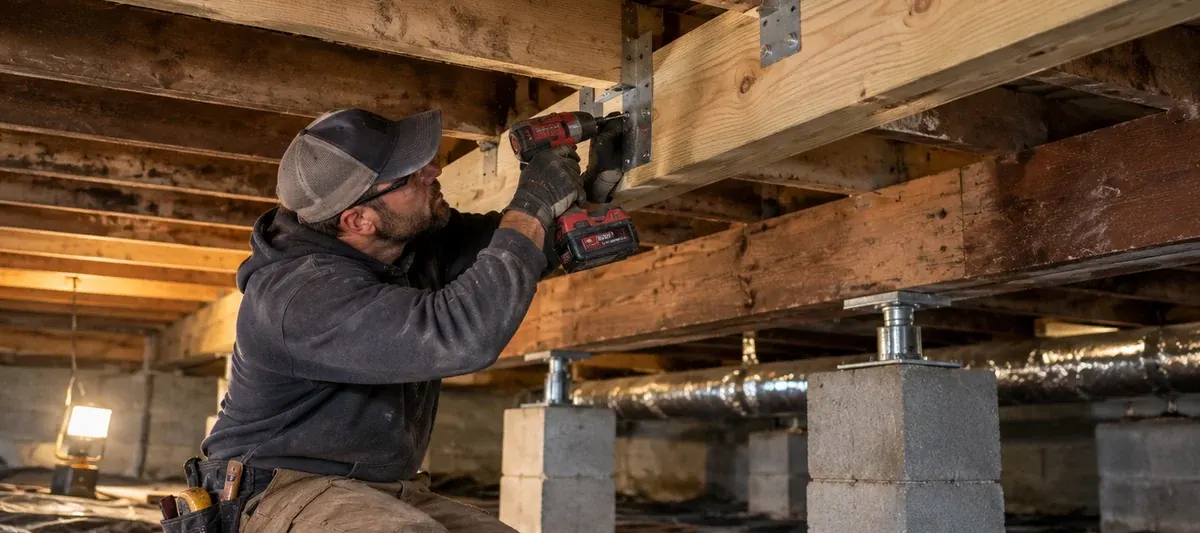
One contractor may be reinforcing a single exposed joist in an unfinished basement. Another may be replacing six rotted members inside a low crawl space while supporting the floor above, working around plumbing and repairing damaged subfloor.
Those projects should not have similar prices.
For 2026 budgeting, many professional floor-joist repair projects fall around $1,000–$10,000 overall. Current national cost data places sistering around $200–$1,000 per joist and full joist replacement around $500–$2,500 per joist. Larger projects involving multiple members, difficult access, temporary support and associated structural damage can reach $10,000–$20,000 or more.
The useful question is not “What does a joist cost?” It is what happened to the joist, how much capacity has been lost, and what must be opened or supported to repair it correctly?
WHAT THE NUMBERS MEAN
A per-joist price is useful only until the surrounding work becomes more expensive than the lumber
One accessible joist
$200–$1,000+Localized reinforcement with good access and no significant subfloor or utility work.
Several damaged joists
$1,000–$5,000+Repeated structural work, more material, more fastening and potentially temporary support.
Joists + subfloor
$5,000–$10,000+Structural work combined with demolition, sheathing replacement and finish restoration.
Extensive reconstruction
$10,000–$20,000+Multiple joists, difficult access, bearing damage, moisture, pests or connected structural failures.
The material itself is rarely the expensive part of a difficult repair. A dimensional-lumber joist may contain only a modest amount of wood. What costs money is reaching it, unloading it safely, transferring the floor load while work is underway, fitting the repair around pipes and ducts, fastening it correctly and rebuilding everything that had to be opened.
That is why two houses with apparently identical damaged 2x10 joists can receive dramatically different proposals.
REPAIR METHOD 01
Sistering is usually cheaper because the damaged joist can stay in the building
Sistering means installing another structural member alongside an existing joist so the repaired assembly can carry the required load. It is one of the most common joist repairs because it can avoid the disruption involved in removing the original member.
Current national pricing places sistering at roughly $200–$1,000 per joist, but the word itself does not describe one universal repair detail.
Size, material and length of the new sister.
Where the repaired assembly transfers load at each end.
How the new and existing members are fastened together.
Plumbing, wiring, blocking, ducts and other framing in the way.
This matters because putting another board beside damaged lumber is not automatically a complete structural repair. The new member needs an appropriate load path and connection for the actual condition.
Sistering tends to make the most sense when damage is localized and the surrounding framing still provides usable support. It becomes a different project when deterioration reaches the bearing end, affects several adjacent members or continues into the sill plate, beam or foundation.
REPAIR METHOD 02
Replacement costs more because the house has to remain supported while the old joist comes out
Full joist replacement commonly falls around $500–$2,500 per joist, with multi-member work moving considerably higher.
The extra cost is not simply another piece of lumber.
Reach the damaged member from below or open the floor above.
Temporarily carry loads that cannot remain on the damaged member.
Work around utilities, blocking, bearing points and existing finishes.
Install framing and restore the subfloor or finishes disturbed by access.
A proposal that says only “replace three joists” may therefore conceal several separate budgets: temporary shoring, structural carpentry, plumbing or electrical coordination, subfloor repair and finish restoration.
The difference between two quotes may have less to do with carpentry rates than with which contractor included the rest of the job.
WHY JOISTS FAIL
Rot changes the project because the damaged wood is usually evidence, not the original problem
A rotten joist means moisture was present long enough to damage structural wood. Replacing the deteriorated member while ignoring the moisture source does not complete the repair.
The USDA Forest Products Laboratory documents the relationship between wood moisture, material performance and biodeterioration. In practical terms, a repair budget should separate the damaged framing from the condition that allowed it to deteriorate.
Plumbing or fixture leak
Bathroom, kitchen and laundry leaks can damage the subfloor and joists together.
Damp crawl space
Structural repair may need to sit beside drainage, vapor control or dehumidification work.
Termites or wood-destroying insects
Pest treatment stops infestation; structural repair restores damaged framing. They are separate scopes.
Improper cutting or drilling
A joist weakened for plumbing or HVAC can become a structural repair even when the wood itself is dry.
If broad crawl-space moisture is contributing to the deterioration, compare the carpentry scope with the separateCrawl Space Repair Cost andCrawl Space Encapsulation Costguides rather than hiding moisture work inside a generic floor price.
LOCATION OF DAMAGE
A damaged joist end can be a more complicated problem than damage in the middle of the span
Location matters because the ends of a joist must transfer load into whatever supports them. Localized damage in an accessible middle section can leave several repair options. Deterioration at the bearing point can involve the support itself.
Sill plate, beam, hanger, wall or other bearing condition may be involved.
Cracks, localized damage or alterations may allow reinforcement without rebuilding the support below.
The repair must restore a usable path into the supporting structure.
If deterioration extends into the foundation-to-frame connection, seeSill Plate Replacement Cost. If the primary support line below the joists is failing, use theMain Support Beam Replacement Costguide instead.
ACCESS
The cheapest joist to repair is usually the one a carpenter can actually stand underneath
Unfinished basement
Exposed framing, room for full-length lumber, tools and temporary supports. Less demolition often means the structural work dominates the invoice.
Low crawl space
Restricted movement, insulation, moisture, pipes and ducts can make simple carpentry much slower.
Access from above
Flooring and subfloor may need to be removed. Tile, hardwood, cabinetry and partitions can turn access into a major cost category.
This is where per-joist pricing eventually stops being useful. If reaching two damaged members requires two days of demolition and reconstruction, the project will not behave like two copies of an easy $500 repair.
ADJACENT MATERIALS
Joist, subfloor and finish flooring should appear as separate lines in the budget
Joists support the subfloor, so water, pests or long-term movement can damage both. That does not mean every joist repair requires a new subfloor. It means the boundary should be visible.
Hardwood, tile, carpet, laminate or other visible material.
The structural panel sitting directly over the framing.
The structural members this report is pricing.
The support system receiving load from the joists.
One contractor may price only layer three. Another may include layers one through three. Comparing their totals without checking that boundary can make the more complete proposal look artificially expensive.
STABILIZATION VS LEVELING
Repairing a joist does not automatically make an old floor perfectly level
Structural stabilization and floor leveling answer different questions. A joist can be reinforced so it carries load correctly while some historic slope remains.
The reverse is also possible: a flooring contractor may improve the surface without correcting a structural problem underneath.
When a floor has moved significantly, changing its elevation may require controlled lifting. That can affect drywall, doors, plumbing and brittle finishes elsewhere in the building.
If the visible problem is primarily an uneven or moving floor and the failed component has not yet been identified, start withSagging Floor Repair Cost.
ENGINEERED FRAMING
An engineered I-joist should not automatically receive the same repair as an old 2x10
Traditional dimensional lumber and engineered I-joists perform the same broad job but are built differently.
An I-joist uses top and bottom flanges connected by a structural web. Damage to a flange, an oversized web penetration or a cut near bearing therefore cannot simply be treated as though the member were a solid piece of lumber.
ICC guidance explains that the prescriptive cutting and notching rules for dimensional lumber do not automatically apply to engineered wood. Alterations must be permitted by the product manufacturer or addressed by appropriate structural design.
Weyerhaeuser's current TJI guidance provides a good example. Where a damaged TJI cannot be repaired, its published replacement procedure may leave the damaged member in place and install a new joist alongside it, with the damaged member ignored when evaluating structural capacity.
GOOD QUESTION FOR THE CONTRACTOR“What joist product is this, and which repair detail are you using?”
WHEN THE JOIST IS NOT THE ROOT CAUSE
Several joists sagging together may point to the support below them
A beam can deflect. A post can settle. A pier can move. A foundation can shift. A bearing wall may have been removed during a previous remodel.
When several members follow the same movement pattern, reinforcing each joist independently may address the symptom rather than the support condition producing it.
The more repetitive or widespread the movement, the more important it becomes to understand this full load path before signing a large repair contract.
THREE HOUSES, SAME GOOGLE SEARCH
Floor Joist Repair Cost Examples: $900 to $14,000
One exposed joist beside an old plumbing alteration
The joist is visible in an unfinished basement. The framing around it is dry and accessible. A localized reinforcement may keep the project near the lower end of the market.
Six deteriorated joists inside a damp crawl space
Structural repair is only part of the work. Access is slower, subfloor may also be damaged and the moisture condition needs its own solution.
Engineered joists hidden below a finished kitchen
The floor must be opened, manufacturer-specific or engineered repairs are required, utilities interfere with access and finishes have to be reconstructed afterward.
All three owners can search “floor joist repair cost.” Only the first one is really pricing simple carpentry.
ENGINEERING
A structural engineer is most useful when the repair scope itself is still disputed
Not every isolated joist requires an independent engineering report. Engineering becomes more useful when movement is widespread, several members are damaged, load paths are unclear, bearing points have deteriorated, previous remodeling changed the structure or an engineered product lacks an obvious approved repair.
Current national joist pricing data commonly places structural assessment or engineering involvement in the few-hundred-dollar range, with more involved analysis or stamped repair documents costing more.
The value is often not the inspection itself. It is turning“fix the floor” into a defined scope that several contractors can price against.
QUOTE AUDIT
How to Compare Floor Joist Repair Quotes
Exactly which members are included?
Dimensional lumber, I-joist or another system?
Sistering, designed reinforcement or replacement?
Size, length and specification?
Where will the repaired member transfer load?
Is shoring or controlled lifting included?
Who handles plumbing, wiring or HVAC conflicts?
Included, excluded or assumed reusable?
Flooring, drywall, trim and paint?
Is moisture or pest correction part of the contract?
How will extra scope be approved and priced?
“Sister six 2x10 joists from bearing to bearing, including temporary support and defined subfloor repair” is comparable scope. “Fix damaged floor” is not.
PERMITS & INSPECTIONS
Structural framing work is local even when the cost guide is national
Permit requirements and fees vary by jurisdiction and project scope. A localized approved reinforcement may be handled differently from multiple replacements, engineered framing alterations or work requiring stamped repair documents.
Ask whether the proposed repair requires a permit where the property is located, who will obtain it and whether required inspections are included in the price.
THE DECISION
Repair the joist, but understand why it failed before paying for more wood
The best repair is not necessarily the one that replaces the most framing. It is the one that restores the actual structural condition without leaving the cause of failure untouched.
Sometimes that means one sistered joist. Sometimes the member needs replacement. Sometimes the joist is only one part of a larger moisture, pest, sill, beam or foundation problem.
For initial budgeting, $1,000–$10,000 is a useful planning range for many professional projects, while substantial multi-member repairs can move beyond it. Before applying that range to a property, determine five things:
- What type of joist is installed?
- Where is the damage?
- What repair method is proposed?
- How will the contractor reach it?
- What surrounding material also has to be repaired?
Those answers explain far more about the eventual invoice than the square footage of the room above.
SOURCES & METHODOLOGY
Sources and Methodology for This Floor Joist Cost Guide
Pricing benchmarks are treated as national planning references rather than property-specific contractor quotes. Current consumer pricing was cross-checked against HomeGuide and Angi, while structural context was reviewed against ICC, USDA Forest Products Laboratory and manufacturer guidance for engineered framing.
Repair Cost Ledger provides U.S. property cost-planning information. Final member sizing, repair design, bearing, fastening, temporary support, permitting and inspection requirements must be established for the actual structure and local jurisdiction.