
2026 NATIONAL COST ANSWER
Trenchless sewer line replacement and rehabilitation generally costs about $60–$250 per linear foot, with pipe bursting commonly around $60–$200 per foot and CIPP lining around $90–$250 per foot.
HomeGuide's current national sewer guide prices pipe bursting at $60–$200 per linear foot, CIPP lining at $90–$250 per linear foot, and spin-cast lining at $80–$250 per linear foot. Angi's current 2026 sewer-line guide uses a broader $60–$250 per linear foot trenchless envelope.
Angi's dedicated trenchless cost guide was updated July 10, 2026 and places many trenchless projects in the low-thousands while also publishing pipe-bursting pricing around $150–$190 per linear foot in its current dataset. Different national guides group preparation, lining and replacement scope differently, so method and included work matter more than one blended average.
WHICH TRENCHLESS METHOD ARE YOU ACTUALLY BUYING?
The method determines whether the old pipe remains part of the finished system
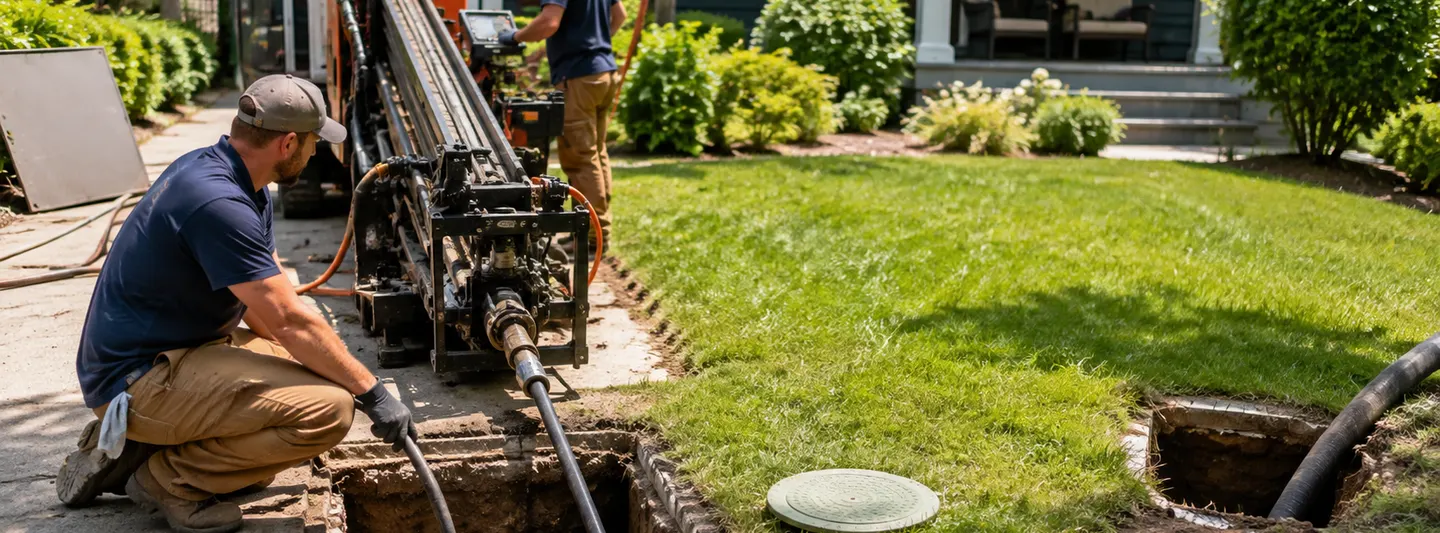
EPA classifies pipe bursting as a trenchless replacement method. The bursting head follows the existing alignment while new pipe is pulled behind it. Access pits or manhole access are still required.
$60–$200 / lf · HomeGuideASTM F1216-24a describes reconstruction using a resin-impregnated tube cured inside the existing conduit. The host pipe's route and basic geometry remain fundamental to the project.
$90–$250 / lf · HomeGuideThis is another rehabilitation family rather than excavated replacement. Applicability depends on pipe condition, access, preparation and the selected product system.
$80–$250 / lf · HomeGuideThat distinction protects the homeowner from a common quote-comparison mistake. A $7,000 bursting bid and a $6,000 CIPP bid are not simply two contractors offering different prices for the same new pipe. One may replace the conduit while the other relies on the existing line as the pathway for a new liner.
WHEN DOES TRENCHLESS ACTUALLY SAVE MONEY?
Usually when the surface above the sewer is expensive enough to protect
Trenchless work can cost as much or more per linear foot than ordinary replacement. The economic case often appears after adding the avoided restoration bill.
If a shallow sewer crosses open soil and inexpensive turf, there may be little hardscape value to save. Trenchless can still reduce disruption, but its financial advantage is less automatic.
Angi currently places landscaping restoration around $4.50–$12 per square foot. Irrigation, trees and established planting can raise the real cost of an open trench.
Angi's 2026 sewer guide puts common hardscape repairs broadly around $1–$25 per square foot, depending on the material and work. A trench through finished concrete can erase a lower open-cut pipe price.
EPA notes that trenchless methods can reduce traffic and pedestrian detours, tree removal, noise and the overall construction footprint.
Compare “pipe + access + restoration” against “pipe + access + restoration”—not trenchless $/ft against open-cut $/ft in isolation.
TRENCHLESS IS A CONDITION-BASED OPTION
The sewer has to be compatible with the method before price matters
Angi's current national sewer guide warns that trenchless methods are not suitable for every pipe, including some cases involving collapse or improper slope. EPA's pipe-bursting fact sheet adds a more detailed set of project constraints: nearby utilities, obstructions, difficult soil, groundwater, pipe material and the possibility of ground movement all affect suitability.
GEOMETRYDoes the existing route have acceptable grade and alignment? Lining cannot correct every sag or bad slope simply because it avoids excavation.
CONTINUITYCan equipment or liner physically pass through the host line? Complete collapse can prevent some trenchless processes or require localized excavation before the main work can proceed.
UTILITIESWhat else lies close to the sewer? EPA flags adjacent underground utilities as a pipe-bursting concern because outward ground movement must be controlled.
SOIL / WATERCan the surrounding ground tolerate bursting forces and access pits? EPA notes less favorable bursting conditions in densely compacted soils and below the water table.
PIPE MATERIALCan the old pipe be burst or rehabilitated by the selected system? Existing material and previous repairs can create impediments that change method selection.
THE CAMERA VIDEO IS THE PURCHASE DOCUMENT
A trenchless proposal should begin with a mapped defect, not a generic claim that the yard can be saved
Angi places sewer video inspection around $100–$500; HomeGuide uses $125–$500. EPA's pipe-bursting implementation guidance likewise begins by obtaining pipe history and using closed-circuit TV to view the line.
A footage marker should connect the image to a physical point along the lateral.
Different problems support different repair methods.
CIPP depends on host-pipe geometry; bursting depends on a viable pull path and site conditions.
Trenchless should not become an excuse to replace or line every accessible foot without diagnosis.
“NO-DIG” DOES NOT MEAN “NO EXCAVATION”
Trenchless usually trades one continuous trench for one or more controlled access points
EPA's pipe-bursting fact sheet says an insertion pit is normally needed unless a system can use manholes or another specialized access method. The project may also require an exit pit, cleanout access, service disconnection / reconnection and removal of obstructions.
PIT 1Launch / insertion access Where will equipment and replacement pipe enter?
PIT 2Receiving / connection access Where will the new pipe be tied into the existing system?
BRANCHESHow are lateral connections reinstated? Main-line technology does not make branch reconnections disappear.
SURFACEWho restores each access point? A small pit in concrete is still concrete restoration.
A useful contractor proposal therefore describes how many openings are required, their approximate locations and who closes them. “Minimal digging” is a marketing phrase until access points are shown on the scope.
THE AVOIDED-DAMAGE LEDGER
Price what open-cut work would disturb before deciding whether trenchless carries a premium
Angi current landscaping benchmark. A trench can also disturb irrigation and established planting outside the exact excavation width.
Angi's current sewer guide uses this broad range because repair type and extent vary considerably.
Another surface where the replacement corridor can matter more than the pipe material.
Structures and finished outdoor features can make direct excavation disproportionately expensive.
These are planning figures, not automatic savings. Trenchless still uses access points, and some surface repair remains unavoidable. The correct comparison is the specific surface area the open trench would disturb versus the smaller access footprint the trenchless method actually requires.
CIPP: THE HOST PIPE STILL MATTERS
Lining can create a continuous new interior pipe, but it does not erase bad geometry outside the liner
ASTM's current F1216-24a standard describes CIPP as a resin-impregnated flexible tube installed inside an existing conduit and cured to create a continuous, tight-fitting finished pipe. ASTM's current F1743-25 covers pulled-in-place CIPP.
EPA's trenchless research distinguishes rehabilitation from replacement: lining restores much or all of the hydraulic and/or structural function of an existing pipe, while replacement technologies install a new pipe whose structural performance is not dependent on the existing host pipe.
PIPE BURSTING: NEW PIPE, OLD ALIGNMENT
Its strongest economic case is replacement beneath surfaces you do not want to remove
EPA calls pipe bursting particularly valuable in urban environments because it can reduce construction impacts on homeowners, businesses, traffic and pedestrians. It can also allow pipe upsizing in suitable conditions, unlike liners that generally reduce internal diameter.
Useful where open-cut surface disturbance is expensive and the existing alignment is suitable for the new pipe.
EPA notes that pipe bursting can maintain or increase pipe size and works across a broad range of existing pipe diameters.
EPA flags nearby services, saturated or unfavorable soils, difficult pipe materials, internal impediments and possible ground heave / vibration as project constraints.
The method still requires connections, access and careful utility coordination.
WHAT A PROFESSIONAL TRENCHLESS JOB SHOULD LOOK LIKE ON PAPER
The contract sequence matters because most of the work disappears underground
01Diagnose CCTV + locating + defect map.
02Select method explain why bursting, CIPP or another method fits the defect.
03Locate utilities confirm conflict risk before excavation / bursting.
04Prepare line cleaning, root / obstruction removal and flow management as required.
05Create access pits, cleanout or manhole setup documented in advance.
06Install new pipe or liner using the specified system.
07Reconnect services / branches and restore flow.
08Verify post-work CCTV, required tests / inspection and surface closeout.
WHY THE SURFACE CAN STAY MOSTLY INTACT
Trenchless concentrates access instead of opening the entire pipe corridor
The drawing belongs here—not at the top of the article—because the buying decision should be driven first by cost, method suitability and scope. Visually, the idea is simple: an open trench disturbs the whole corridor; trenchless work concentrates most surface disturbance at access points while work proceeds underground.
FIVE TRENCHLESS SEWER COST FILES
The method earns its keep in different ways depending on the property above the pipe
HomeGuide's broad pipe-bursting math gives $2,400–$8,000 for 40 feet. If open-cut excavation would disturb only inexpensive turf, compare both methods rather than assuming no-dig wins financially.
The same underground run now crosses hardscape. Even if trenchless pipe work is more expensive per foot, the total project can become competitive once demolition and driveway restoration are added to an open-cut bid.
HomeGuide's $60–$200/lf benchmark suggests $3,600–$12,000 for the pipe-bursting work before project-specific access, preparation and restoration.
HomeGuide's $90–$250/lf CIPP range suggests $4,500–$12,500. That is a lining project—not the same construction product as 50 feet of new pipe installed by bursting.
If CCTV shows a complete collapse or improper slope, Angi warns that traditional excavation may be needed. The cheapest trenchless quote is poor value if it cannot correct the failure mechanism.
HOW TO COMPARE TRENCHLESS BIDS
Make contractors price the same method, access and restoration endpoint
01Pre-work CCTV — defect location, host-pipe material, diameter, condition and footage?
02Method definition — true pipe replacement, CIPP rehabilitation, spin-cast or another system?
03Treated length — exact linear footage and reason for each endpoint?
04Preparation — cleaning, root removal, obstruction removal or bypass work included?
05Access points — number, location, dimensions and who restores them?
06Connections — cleanouts, branches, house connection and municipal-side interface included?
07Product / specification — replacement pipe or liner system, diameter and relevant standard / manufacturer requirements?
08Post-work verification — CCTV, testing, local inspection and closeout documentation?
“Trenchless sewer replacement — $7,900” is not a comparable bid until you know whether it means new pipe, lining, how many feet and what remains to be excavated.
WHY THERE IS NO SECOND TRENCHLESS CALCULATOR HERE
Article 27 already calculates length. The useful decision here is whether the method avoids enough surface work to justify itself.
A second `length × rate` calculator would reproduce the same logic as our Sewer Line Replacement Cost estimator and add little new value. More importantly, it could imply that $7,000 of CIPP and $7,000 of pipe bursting are interchangeable. They are not.
For trenchless work, compare four actual numbers from contractor bids: method price, preparation / access price, surface restoration left behind, and the open-cut alternative total. That is a stronger purchasing model than manufacturing a precise-looking national savings percentage.
COMMON COST QUESTIONS
Trenchless sewer line replacement in plain terms
How much does trenchless sewer line replacement cost per foot? Angi's current national sewer guide uses $60–$250 per linear foot for trenchless methods. HomeGuide uses $60–$200/lf for pipe bursting and $90–$250/lf for CIPP.
How much does pipe bursting cost? HomeGuide's current planning range is $60–$200/lf. Angi's dedicated 2026 trenchless dataset publishes a narrower pipe-bursting benchmark around $150–$190/lf.
How much does CIPP sewer lining cost? HomeGuide uses $90–$250/lf. CIPP is normally a rehabilitation method installed inside a suitable existing host pipe rather than a conventional excavated replacement.
Is trenchless sewer replacement cheaper than digging? Not always per foot. It can be cheaper as a total project when it avoids substantial driveway, concrete, landscape or other restoration.
Does trenchless mean no digging? Usually no. Pipe bursting commonly needs access pits unless the equipment can work from existing manholes or another specialized access configuration.
Can trenchless fix a collapsed sewer pipe? It depends on method and conditions. Pipe bursting can replace badly damaged pipe in some situations, but Angi and EPA both identify limitations involving collapse, obstructions, utilities, soil and geometry. A camera inspection is needed.
Can CIPP fix a sewer belly or improper slope? Lining follows the host pipe's route. It should not be assumed to correct bad grade or geometry simply because it creates a new inner pipe.
How much does sewer camera inspection cost before trenchless work? Angi uses $100–$500 and HomeGuide $125–$500. It is one of the most useful pre-project costs because it establishes defect type and location.
METHODOLOGY & SOURCES
Current 2026 consumer pricing separated from trenchless engineering terminology
Pricing was reviewed August 8, 2026. HomeGuide and Angi provide current consumer cost ranges. EPA sources provide the technical distinction between rehabilitation and replacement and the practical constraints of pipe bursting. ASTM's current F1216-24a and F1743-25 standards confirm current CIPP practice terminology.
$60–$200/lf pipe bursting; $90–$250 CIPP; $80–$250 spin-casting; camera and restoration-cost benchmarks.
02 · ANGI · JUL 10 2026Trenchless Sewer Line Replacement CostCurrent dedicated trenchless market data, including pipe-bursting pricing and project-cost context.
03 · ANGI · 2026Sewer Line Replacement Cost$60–$250/lf broad trenchless envelope; $100–$500 camera inspection; excavation and hardscape / landscape restoration context.
04 · U.S. EPAPipe Bursting Fact SheetMethod, CCTV preparation, access pits, reduced surface disruption, utilities, soils, obstructions, ground movement and other limitations.
05 · U.S. EPAState of Technology for Wastewater RehabilitationDistinguishes rehabilitation / lining from replacement technologies and documents trenchless renewal options.
06 · ASTM · F1216-24a ACTIVECIPP by Inversion and CuringCurrent ASTM practice for reconstruction of pipelines using an inverted resin-impregnated flexible tube.
07 · ASTM · F1743-25 ACTIVEPulled-in-Place CIPPCurrent ASTM practice for pulled-in-place cured-in-place thermosetting resin pipe rehabilitation.
This is U.S. cost-planning information. Trenchless feasibility depends on actual pipe condition, slope, diameter, material, depth, soil, groundwater, nearby utilities, access, connections and local plumbing / right-of-way requirements. A contractor should inspect and locate the sewer before recommending a method.