
2026 NATIONAL COST ANSWER
Sewer line repairs cost about $150–$3,800 for many residential problems, while structural lining or partial replacement can move into per-foot pricing.
HomeGuide's current national sewer guide puts sewer line repair at $150–$3,800, depending on the method and the defect. Small clogs and obstructions can stay near the low end; cracks, collapse and structural defects move toward lining or partial replacement.
This repair path applies to a sewer lateral. For a property served by an onsite tank and drain field, use the septic system replacement cost guide because diagnosis and replacement scope are materially different.
Angi's May 2026 national data gives more specific repair examples: $600–$1,050 for cracked-pipe spot repair, $1,500–$3,000 for sewer-trap replacement, $100–$600 for root removal, and $80–$250 per linear foot for CIPP.
PAY FOR DIAGNOSIS BEFORE YOU PAY FOR EXCAVATION
The most valuable sewer repair question is “what failed?”
HomeGuide prices a standalone sewer camera inspection at $125–$500. Angi uses roughly $100–$500. For recurring backups or suspected structural failure, that is often the most decision-dense part of the project.
Cleaning can be the actual repair when the obstruction is the problem.
Cutting roots restores flow; the camera should show where they entered.
Spot repair or lining may be rational when surrounding pipe is serviceable.
Lining follows the host pipe and should not be assumed to correct poor slope.
EPA notes that point repairs may still require digging even when trenchless rehabilitation is otherwise considered.
A useful camera report ties the image to a footage marker and location. “Crack at approximately 34 feet from the cleanout” is actionable. “Your sewer is bad” is not.
CLOG COST VS. PIPE-REPAIR COST
Do not turn every blockage into a structural sewer project
HomeGuide's December 2025 cleaning guide—current for 2026—puts snaking at $200–$500 and hydro jetting at $600–$1,400. A basic service-call or diagnostic fee can add roughly $50–$200+.
If the line clears and there is no evidence of structural damage, a cleaning invoice may genuinely be the end of the project.
HomeGuide recommends camera inspection especially for complex or recurring problems because roots, structural defects or a belly may be creating the obstruction repeatedly.
A line that cannot be opened may have a hard obstruction, collapse or condition requiring excavation or structural repair.
Repeatedly paying $300–$1,000 to reopen the same line can be rational maintenance—or evidence that you are postponing the real repair.
ROOT REMOVAL RESTORES CAPACITY; IT DOES NOT EXPLAIN THE ENTRY POINT
The durable cost question begins after the roots are cut
Angi prices root removal at $100–$600. HomeGuide's dedicated cleaning guide uses $200–$600+ as an added root-removal cost and says heavy root intrusion often requires a specialized auger or hydro-jetting with a cutting attachment.
STEP 1Restore flow Remove enough root mass to make the pipe inspectable and functional.
STEP 2Inspect the entry point Roots typically exploit a crack, joint or other opening; document the actual defect.
STEP 3Choose maintenance or structural correction A serviceable old joint may be monitored; a badly broken section may justify repair or lining.
The expensive mistake is paying for root cutting and assuming the pipe itself has been repaired. Root removal and pipe repair can be two separate line items because they solve two separate things.
SPOT REPAIR: THE ECONOMICS OF FIXING ONLY THE BAD SECTION
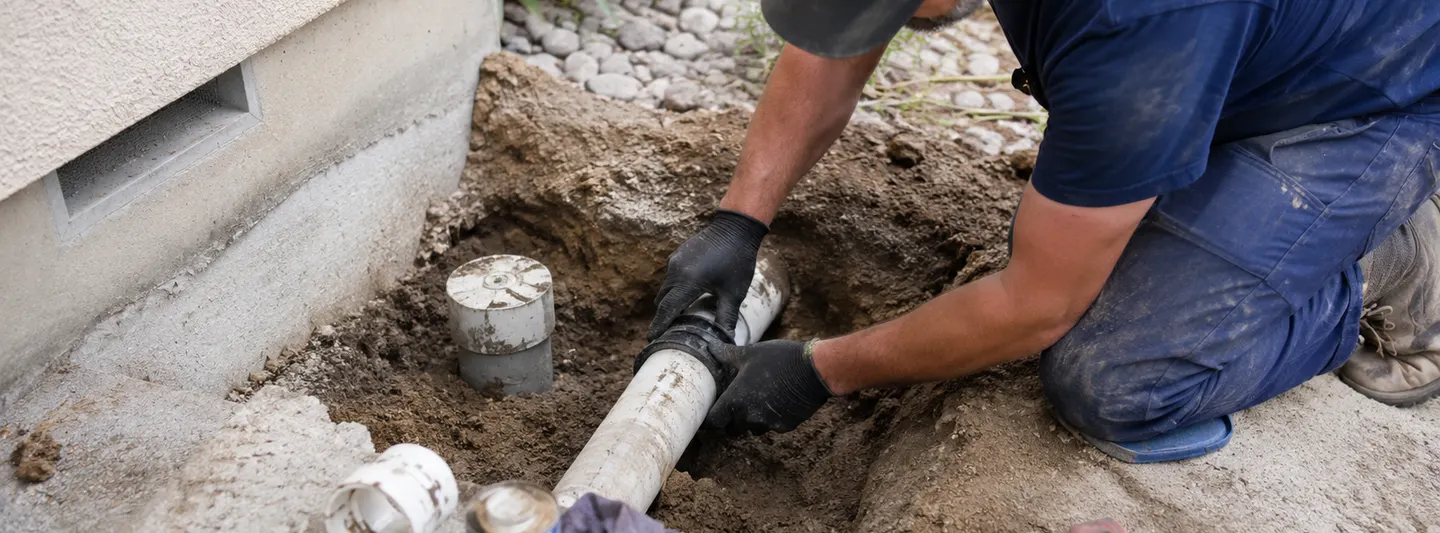
Localized excavation can beat full replacement when the rest of the lateral still has useful life
Angi's current national benchmark for a cracked-pipe spot repair is $600–$1,050. HomeGuide notes that partial repairs and replacements may involve only 1–15 feet, while a typical full sewer replacement is closer to 40 feet.
The camera shows a localized crack or failed joint and the pipe immediately upstream and downstream remains serviceable.
Fixing one defect may simply move the next excavation a few feet down the lateral.
Surface removal, excavation depth and restoration can exceed the cost of the replacement pipe itself.
The quote should identify the exact footage being opened and the condition that justifies stopping there. That turns “spot repair” from a vague promise into a measurable scope.
LINING: REPAIR WITHOUT REMOVING THE WHOLE HOST PIPE
CIPP makes sense when the pipe's pathway is worth preserving
HomeGuide uses $90–$250 per linear foot for CIPP. Angi's May 2026 sewer guide uses $80–$250 per linear foot. EPA describes trenchless sewer rehabilitation as using the existing pipe as a host for a new pipe or liner and notes that it generally requires less restoration and causes less disturbance than dig-and-replace.
HOST PIPEIs there a continuous pathway for the liner? Complete collapse or certain geometry failures can prevent straightforward lining.
SLOPEDoes the existing line drain correctly? Lining restores an interior conduit; it should not be sold as a cure for every grade or belly problem.
PREPARATIONWhat cleaning and obstruction removal occurs first? The quoted liner price should say whether preparatory work is included.
BRANCHESHow are connections handled? A continuous liner still belongs to a drainage network with branch and endpoint interfaces.
VERIFYWill post-work CCTV document the result? Most of the finished work becomes inaccessible once the job is complete.
SEWER TRAP REPLACEMENT
A failed trap can create a four-figure repair without requiring a new lateral
Angi's current benchmark for sewer-trap replacement is $1,500–$3,000. The cost can be high because the trap itself may be buried, old, difficult to access or integrated into a larger section of underground piping.
LOCATEIdentify the component and access route Avoid opening more slab or soil than the job actually requires.
REMOVEExcavate or open the surrounding assembly Access work can be a larger cost than the fitting.
RECONNECTRestore the drainage path Connections and local code requirements belong in the plumbing scope.
RESTOREClose slab, soil or finish surfaces Clarify whether restoration is included in the plumber's price.
THE REPEAT-REPAIR TEST
A cheap repair becomes expensive when you have to buy it repeatedly
Suppose a recurring main-line problem requires two $400 service calls per year. That is $2,400 over three years before camera inspections, cleanup or emergency premiums. If the underlying defect is a localized $800 crack, continued cleaning is poor economics. If the pipe is structurally sound and the problem is recurring grease buildup, periodic maintenance can still be the rational choice.
Repeated cleaning is predictable, infrequent and materially cheaper than structural work.
A targeted structural repair can eliminate a recurring service-call cycle.
Compare the next few likely repairs with a longer replacement before authorizing another excavation.
The point is not to invent a universal “three repairs means replace” rule. It is to put the maintenance history beside the camera evidence and ask whether the next dollar buys temporary flow or useful remaining life.
WHEN REPAIR STOPS BEING THE VALUE OPTION
Replacement becomes stronger when defects are structural, repeated and distributed along the line
Angi's current sewer guide identifies collapse, severe shifting, improper slope, extensive damage, frequent backups despite cleaning and outdated piping as common reasons replacement may be necessary.
ONE DEFECTRepair remains attractive if surrounding pipe is sound and access is manageable.
MANY DEFECTSRepair costs begin to stack when several joints, cracks or root-entry points require separate work.
BAD GEOMETRYReplacement may be necessary to correct alignment / grade rather than simply restore the inside surface.
COLLAPSEPhysical access may become unavoidable because the pipe no longer provides a useful continuous pathway.
REPEATED BACKUPSMaintenance history becomes part of the economic case instead of evaluating each service call as an isolated event.
Our Sewer Line Replacement Cost report uses the current national benchmark of $50–$250 per linear foot. That is the comparison point once repair scope starts approaching substantial footage.
ACCESS CAN TURN A SMALL DEFECT INTO A LARGE INVOICE
The repair is underground; the homeowner pays for the path to reach it
HomeGuide says concrete removal can add about $3–$8 per square foot, permits can run roughly $30–$500, and plumbers commonly charge $75–$150 per hour in its current sewer guide.
The plumbing repair can dominate because surface restoration is relatively inexpensive.
A localized underground repair can require a visibly larger restoration footprint above it.
The pipe defect may be short while slab access and finish restoration expand the total job.
HomeGuide prices adding a sewer cleanout around $500–$2,000 in its replacement guide.
THE PIPE-DEFECT MAP
Different defects can sit inside the same 40-foot sewer lateral
The drawing appears lower because the buying information comes first. Its purpose is simple: one sewer can contain several distinct failure types. A contractor should price the defect that exists—not apply one favorite repair method to every camera image.
SIX SEWER REPAIR COST FILES
The correct budget follows what the camera finds after flow is restored
HomeGuide's current benchmark is $200–$500. If this is a one-time obstruction and inspection gives no reason to suspect structural damage, the repair can genuinely stop here.
HomeGuide uses $600–$1,400. The important distinction is that the higher cleaning cost buys more complete pipe-wall cleaning—not a new sewer pipe.
Angi uses $100–$600 for root removal. The owner then decides whether the cracked joint or opening that admitted the roots deserves structural repair.
Angi's current cracked-pipe spot-repair range is $600–$1,050. Easy yard access can keep this repair economical compared with replacing dozens of good pipe feet.
Angi's $80–$250/lf range implies roughly $2,400–$7,500. HomeGuide's $90–$250 range produces $2,700–$7,500. Preparation and access still need to be checked in the quote.
Once several spot repairs, repeated cleaning and significant footage are involved, compare the package with the current $50–$250/lf replacement benchmark instead of approving each repair independently.
HOW TO AUDIT A SEWER REPAIR QUOTE
The proposal should connect one diagnosed failure to one proposed intervention
01Symptom — backup, slow flow, odor, recurring clog or visible leak?
02Diagnosis — what exactly did camera / cleaning reveal and at what footage?
03Repair method — snake, jet, root cut, spot excavation, trap, lining or another method?
04Treated length — for structural work, how many linear feet are actually being repaired?
05Access — soil, slab, concrete, driveway, cleanout or street-side work?
06Preparation — cleaning, root cutting, camera, bypass or demolition included?
07Restoration — who closes concrete, landscaping, flooring or other disturbed surfaces?
08Verification — post-repair camera or other documentation included?
A sewer repair bid becomes credible when the contractor can point to the failure and explain why the proposed method fixes that failure.
WHY THERE IS NO GENERIC SEWER-REPAIR CALCULATOR
A $300 clog, an $800 crack and a $6,000 liner cannot be estimated from the same input
Sewer repair is intervention-driven. Cleaning is usually priced as a service, root removal as an added procedure, spot repair as a localized construction job and lining by linear foot. Combining all four into one calculator would create a number without a coherent scope.
For footage-based structural work, use our Sewer Line Replacement Cost estimator to understand line-length economics. For this search intent, the more useful tool is the repair menu above: identify the defect first, then benchmark the intervention that actually addresses it.
COMMON COST QUESTIONS
Sewer line repair cost in plain terms
How much does sewer line repair cost in 2026? HomeGuide's current range is $150–$3,800 for sewer-line repair, depending on the problem and repair method.
How much does it cost to snake a sewer line? HomeGuide's dedicated current sewer-cleaning guide uses $200–$500 for professional snaking / rodding.
How much does hydro jetting cost? HomeGuide currently uses $600–$1,400 for most residential main-sewer hydro-jetting jobs.
How much does tree-root removal cost? Angi uses $100–$600 for sewer root removal. HomeGuide says effective root removal can add roughly $200–$600+ to a sewer cleaning job.
How much does a cracked sewer pipe spot repair cost? Angi's May 2026 benchmark is $600–$1,050.
How much does sewer lining cost? Angi uses $80–$250 per linear foot for CIPP; HomeGuide uses $90–$250 per linear foot.
How much does a sewer camera inspection cost? HomeGuide uses $125–$500 and Angi roughly $100–$500.
When should I replace instead of repair a sewer line? Replacement becomes more compelling when the line is collapsed, severely shifted, has improper slope, widespread defects or frequent backups despite repeated cleaning and repair.
METHODOLOGY & SOURCES
Current 2026 repair pricing separated by intervention type
Pricing was reviewed August 8, 2026. HomeGuide provides the current national repair envelope plus dedicated current sewer-cleaning data. Angi supplies current spot-repair, trap, root-removal and CIPP benchmarks. EPA collection-system guidance supports the distinction between point repair, lining / rehabilitation and full replacement.
$150–$3,800 repairs; $90–$250/lf CIPP; $125–$500 camera; access, permits, cleanouts and replacement-threshold context.
02 · HOMEGUIDE · CURRENT 2026 GUIDEMain Sewer Line Cleaning Cost$200–$500 snaking; $600–$1,400 hydro jetting; $50–$200+ service call; $200–$600+ tree-root removal; recurring-clog diagnosis.
03 · ANGI · MAY 2026Sewer Line Repair vs. Replacement$600–$1,050 cracked-pipe spot repair; $1,500–$3,000 sewer trap; $80–$250/lf CIPP; $100–$600 roots; replacement signals.
04 · U.S. EPATrenchless Sewer Rehabilitation Fact SheetExisting-pipe rehabilitation, point-repair excavation, reduced-restoration benefits and method-selection considerations.
05 · NYC DEP · CURRENTService Line Responsibility ExampleCurrent example showing that private sanitary service-line responsibility can extend from the property to the public sewer main.
This report is U.S. cost-planning information. Sewer ownership, repair methods, permits, acceptable materials, cleanout requirements, right-of-way work and plumbing-license rules vary locally. Camera diagnosis and site conditions should control the actual repair scope.