
2026 U.S. PRICE BENCHMARK
Trenchless water service line replacement averages $70–$250 per linear foot installed.
HomeGuide reports $70–$250 per linear foot for trenchless replacement of a residential water service line, including typical materials and installation labor. Its comparable open-trench benchmark is $50–$200 per linear foot. These ranges overlap because length, ground conditions, pipe diameter and site access can matter more than the method alone.
If you are still deciding whether to replace the line at all, our main water line cost guide covers repairs, pipe materials and total replacement budgets. This page answers the next question: Can the crew use a trenchless method on your property, and what exactly will you pay for?
| Measured run | At $70/ft | At $150/ft | At $250/ft |
|---|---|---|---|
| 25 feet | $1,750 | $3,750 | $6,250 |
| 40 feet | $2,800 | $6,000 | $10,000 |
| 60 feet | $4,200 | $9,000 | $15,000 |
| 80 feet | $5,600 | $12,000 | $20,000 |
Multiply the contractor's measured, chargeable length by the unit rate only if the contract actually prices the work that way. Short jobs may have mobilization minimums; unusual access, connection fees and reinstatement may be treated separately. Never use this table as a substitute for a site survey.
WHAT “TRENCHLESS” ACTUALLY MEANS
Two methods can avoid a continuous open trench — but they solve different problems.
The contractor chooses a technique after locating the line, checking the existing material and inspecting the route. Neither method means “no digging”: entry and exit pits, connections and work at the foundation may still require excavation.
Directional boring
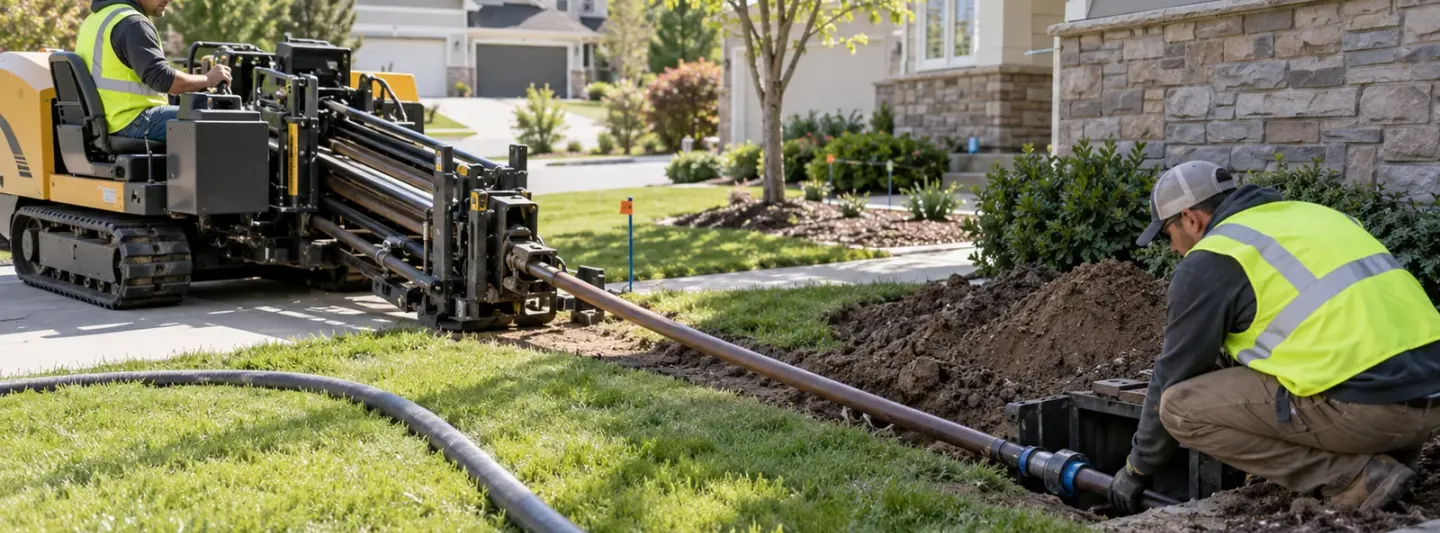
A guided drill creates an underground path, often beneath a driveway or landscaped area. A suitable new pressure-rated water pipe is installed along the bore. The old pipe can sometimes be disconnected and abandoned where permitted.
Pipe bursting
A bursting head fractures or splits an existing suitable pipe while pulling replacement pipe through the corridor. It can avoid a full-length trench, but pipe material, nearby utilities, bends and available space for pits may make it inappropriate.
Sewer cured-in-place lining and residential pressurized drinking-water service replacement are not interchangeable specifications. Do not assume a resin lining proposed for a drain is approved for potable water. Ask whether the proposed product and method are accepted by the utility and local authority, and whether drinking-water-contact components meet applicable standards such as NSF/ANSI/CAN 61.
If your problem involves wastewater rather than the drinking-water supply, read the separate trenchless sewer line replacement guide. The pipe function, acceptable materials, installation constraints and cost assumptions are different.
BEFORE YOU PAY FOR A TRENCHLESS BID
Which approach could work on your property?
Imagine the water pipe crosses your driveway. It is reasonable to ask about installing a new pipe underneath it. But if the old line runs through a tight maze of bends or past other buried utilities, the contractor may need a different route. “Trenchless” describes a family of methods, not a promise that every yard is suitable.
A new route could avoid the driveway
Ask where the drill would enter and exit, how the new pipe would connect, and whether the route can be cleared of nearby utilities. Boring may be useful even when the old line cannot be reused.
The existing route may be usable
The old pipe must be suitable for the process, with enough access for equipment and new connections. Tight bends, material or utility conflicts can rule it out.
If a contractor says there will be no digging at all, ask how the crew will reach the meter, the house connection and both ends of the pipe. Those access details belong in the written scope.
COMPARE THE SAME SCOPE
A low boring price is not necessarily a low water-line replacement price.
HomeGuide publishes a $10–$30 per linear foot reference for directional boring as an activity. That is not a turnkey drinking-water service replacement price. The full project also needs a suitable pipe, approved fittings, utility connections, testing and restoration of disturbed areas. Comparing boring-only rates with full replacement rates can make a bid look artificially inexpensive.
Locate and authorize
Confirm pipe ownership, route, utility marks, meter location, permit responsibility and access to the building.
Open the working pits
Account for launch and reception pits, safe access, excavation spoils and any shoring or surface protection.
Provide the new service
Identify the material, size, pressure rating, joints, boring or bursting method and installation length.
Restore water service
Clarify meter and house connections, isolation, pressure testing, flushing and any required disinfection.
Repair disturbed surfaces
Specify which lawn, paving, landscape and foundation-area finishes are included, rather than relying on “minimal digging.”
Hand over the record
Request materials documentation, permit sign-off when required, warranty, route record and final scope of work.
For overall water-service replacement costs, material comparisons and access factors, see our existing Main Water Line Replacement Cost report. This article focuses on the additional decision: when a trenchless route is worth paying for and how to compare the two installation methods fairly.
TWO BUDGETS, ONE PROPERTY
The apparent savings disappear when two quotes exclude different work.
These are constructed arithmetic examples, not actual contractor bids or reported customer projects. We deliberately use round figures within HomeGuide's published installation ranges and a separately identified, hypothetical surface-restoration allowance.
50-foot trenchless service
*Assumes the quoted rate covers connections and the limited surface repair actually necessary. Ask the contractor to verify inclusions in writing.
50-foot open-trench service
The $2,500 is an assumed example allowance, not a published national average. It would be wrong to add it if the contractor's $80/ft already includes reinstatement.
The difference here is only $250, despite the $2,250 gap between the initial installation lines. On another property, open trenching may still be materially cheaper. The point is to compare full scopes, not to prove that one method always wins.
THE METHOD DECISION
Preserving a driveway can justify trenchless work. An open lawn may not.
| Decision factor | Trenchless route | Open trench |
|---|---|---|
| Surface disruption | Usually limited to pits and connection points | Continuous excavation along route |
| Driveway crossing | May preserve most paving if boring is feasible | Could require opening and reinstatement |
| Unknown utilities | Requires careful locating and route control | Requires locating; excavation exposes the corridor |
| Rock, bends or crowded corridor | May increase price or make the method unsuitable | May be more direct, but excavation can also be costly |
| Quote comparison | Confirm pits, pipe, tie-ins and testing | Confirm backfill, compaction and surface restoration |
Ask each bidder to explain why the proposed method fits the specific route. For a short pipe in open turf, the added mobilization of a boring crew may offer little benefit. For a mature garden, a long paved drive or a route close to structures, reduced reinstatement can matter more than the installation rate alone.
THE COSTS ARE SITE-SPECIFIC
Four site details can turn a straightforward line into a difficult underground project.
Length and depth
A longer route uses more pipe and labor. The required burial depth may be substantial in colder climates; a deep tie-in changes pit excavation and access.
Ground and obstructions
Rock, wet soil, existing foundations, retaining walls and tree roots affect the achievable route. Directional boring is not a promise that every obstruction can be bypassed.
Old pipe condition
Corrosion, collapse, unsupported joints, tight bends and prior repairs can make bursting difficult or favor a separately bored route.
Connections and ownership
Meter position, municipal approval, curb-stop access and which side of the service line the homeowner owns can change the contractor's responsibility.
If the only problem is a confirmed, isolated leak in an otherwise serviceable line, full replacement may be unnecessary. Compare the diagnosis with the costs in our main water line replacement report; ask whether a localized repair is technically reasonable before authorizing an entirely new underground service.
BEFORE EXCAVATION AND RECONNECTION
Trenchless does not mean risk-free or permit-free.
Before boring or opening pits, the contractor must follow applicable utility-locating procedures. In the United States, 811 is the starting point for notifying participating utilities. Privately owned or unmarked lines may require additional investigation. OSHA specifically warns that horizontal directional drilling can strike buried gas, electrical or other services, even when the work appears minimally invasive.
The new pipe and contact materials must be suitable for drinking water and accepted by the local authority. NSF/ANSI/CAN 61 addresses health effects of materials in contact with potable water; compliance with that standard does not by itself replace local product approvals, pressure-rating requirements or proper installation.
Older lead service lines deserve special handling. If lead or galvanized material requiring replacement is suspected, contact the water utility before choosing a method. EPA's Lead and Copper Rule Improvements establish service-line inventory and replacement requirements for water systems, with specific protections and implementation details. Do not assume an informal partial replacement solves the underlying exposure problem. Have the utility or a qualified local professional advise on full-line replacement, water quality, flushing and any appropriate filtration after the work.
USE THIS WITH EVERY WRITTEN BID
Nine questions reveal whether the cheap-looking quote is actually complete.
- Which exact route and measured length are being priced, and how was the old line located?
- Is this horizontal boring, pipe bursting or open excavation — and why is it suitable?
- What pipe material, diameter, pressure rating and drinking-water certifications are specified?
- Are entry/exit pits, spoil removal, backfill and safe access included?
- Who handles the 811 request, private utility locates and required permits?
- Are the meter, shutoff, house connection and utility coordination fully priced?
- What testing, flushing, inspection and water-service restoration are included?
- Which driveway, landscaping and interior finishes will be restored, and to what standard?
- What conditions can trigger a change order, and how will those costs be authorized?
When comparing proposals, mark every line included, excluded or conditional. A professional-sounding method description is not a substitute for a specific scope and documented responsibilities.
COMMON HOMEOWNER QUESTIONS
Trenchless water line replacement: short answers.
How much does trenchless water line replacement cost per foot?
HomeGuide's national reference is $70–$250 per linear foot installed. Measure the run and clarify which connections, permits and restoration are included before applying that rate.
Can a water service line be replaced without digging up a driveway?
Often, yes, by boring beneath it if the route, utilities and soil allow. Entry and exit pits, plus work at connection points, are still usually needed.
Is directional boring the same as pipe bursting?
No. Boring creates a path for a new line; bursting uses an eligible existing corridor while replacing the pipe. The old pipe condition and route influence the choice.
Does a $10–$30-per-foot boring quote cover my new water service?
Not necessarily. That reference concerns boring activity, not a complete potable-water service replacement with pipe, fittings, connections, testing and any site restoration.
Can I use sewer pipe lining to fix my drinking-water line?
Never assume a sewer-lining system is suitable for pressurized potable water. Any proposed drinking-water rehabilitation method must be specifically approved for that use by the relevant authorities.
Will trenchless installation always cost less overall?
No. It can reduce pavement and landscape restoration, but equipment mobilization and underground constraints can offset the savings. Compare itemized totals for the same completed project.
METHODOLOGY AND SOURCES
Published prices and technical standards — not invented contractor quotes.
This report uses HomeGuide's national water-service replacement benchmarks, checked in October 2026, and separates installed costs from boring-only activity. The per-foot length table and two sample bids are transparently labeled arithmetic examples. They are not observations from real Repair Cost Ledger customer projects. Local utility ownership rules, code requirements and contractor prices may differ.
- HomeGuide — Water Line Replacement Cost. $70–$250/ft trenchless and $50–$200/ft trenched, installed; broader project averages.
- HomeGuide — Directional Boring Cost. Boring-only cost reference; not treated as a complete drinking-water installation.
- OSHA — Avoiding Underground Utilities during Horizontal Directional Drilling. Utility-strike hazards and locating requirements.
- 811 — Excavator Resources. Utility locate process before excavation.
- NSF — NSF/ANSI/CAN 61. Drinking-water-contact material health-effects criteria.
- U.S. EPA — Lead and Copper Rule Improvements. Lead service-line inventory and replacement framework.