
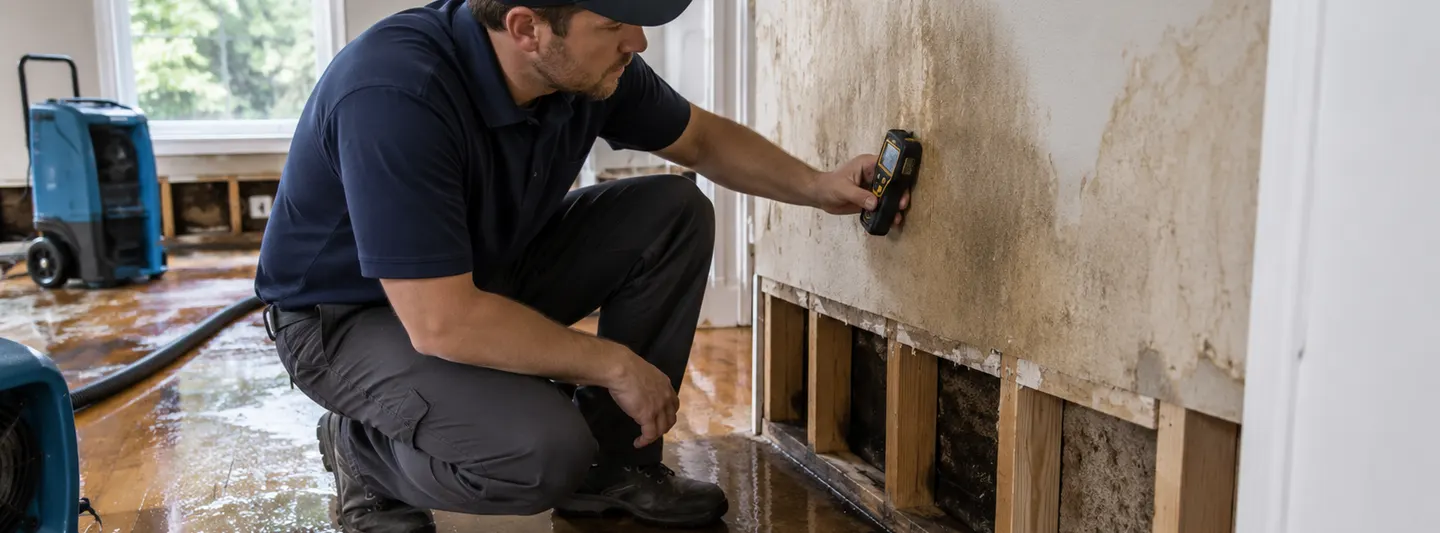
2026 PER-SQUARE-FOOT ANSWER
Use $3–$7.50 per square foot as a broad repair benchmark and $4–$12 per square foot for extraction and drying by water category—but do not treat those as the same cost.
Angi's August 2026 national water-damage guide places broad repair cost at $3–$7.50 per square foot. Its current category examples are about $3.50/sq. ft. for clean water, $5.25 for gray water, and $7.50 for black water in its general repair model.
HomeGuide's February 2026 model separates the mitigation phase more explicitly. It prices water removal and drying at $4–$12 per square foot: $4–$6 for Category 1, $6–$9 for Category 2, and $9–$12 for Category 3. Reconstruction materials are then priced separately.
Useful as a national reasonableness check across complete repair projects.
Category-specific mitigation before separate material reconstruction.
The dangerous part of a square-foot estimate is usually not the rate. It is the denominator.500 square feet of floor is not 500 square feet of wet wall, ceiling, hardwood and mold.
This is the central distinction for the entire article. Water-damage pricing often combines several kinds of area under one phrase: affected room area, extraction area, wall finish area, flooring area and remediation area. A responsible estimate keeps those quantities separate and applies a rate only to the surface that the rate actually describes.
FOUR DIFFERENT SQUARE FEET CAN EXIST IN ONE ROOM
A 500-sq.-ft. loss can contain more than 1,000 sq. ft. of damaged building surface
PLAN AREAThe footprint being extracted and dried. Often the number used for category-based mitigation pricing.
WALL / CEILING AREAThe actual finish surface being removed or replaced. A room perimeter multiplied by cut height can easily exceed floor area.
FLOORING AREAThe carpet, hardwood or other finish actually being replaced. This may equal floor-plan area, but not always.
REMEDIATION AREAThe confirmed mold or contaminated-material scope. It should not automatically equal the entire affected room.
LAYERED WATER-DAMAGE ESTIMATOR
Estimate mitigation first, then add only the surfaces that actually need rebuilding
The first layer uses HomeGuide's current extraction-and-drying ranges by water category. Optional reconstruction fields use separate current material-specific ranges. Wall area and floor area are entered separately so the calculator does not pretend one room square-foot number describes every damaged surface.
WATER CATEGORY CHANGES THE MITIGATION RATE
Contamination determines how aggressively material has to be cleaned, handled or removed
HomeGuide's current category ranges are unusually useful because they separate water removal and drying from later reconstruction. They are planning benchmarks, not a homeowner classification system; the actual source and conditions need professional assessment.
Clean-source benchmark
Examples in HomeGuide include a broken water line, faucet or rainwater leak. Cleanup can remain relatively selective when the source is sanitary and materials have not deteriorated or become contaminated through time and contact.
Gray-water benchmark
HomeGuide examples include dishwasher or washing-machine overflow. Additional cleaning, handling and material decisions push the mitigation range above the clean-water band.
Highly contaminated benchmark
HomeGuide examples include sewer backup, toilet-source water, groundwater or rising seawater. Contamination can make replacement rather than drying the central economic decision for porous materials.
DAMAGE CLASS CHANGES HOW MUCH BUILDING MUST BE DRIED
Category answers “what kind of water?” Class answers “how much of the assembly is involved?”
HomeGuide's current project totals illustrate why square-foot pricing alone can miss the difference. Its Class 1 range is $150–$500, Class 2 approximately $1,500–$5,000, Class 3 $5,000–$15,000, and Class 4 $15,000–$100,000 for severe disaster-scale losses.
small area · limited material involvement
significant saturation in one or more materials
walls · floor · ceiling · subfloor / insulation may be affected
prolonged water in low-permeance or structural materials
The same 300-square-foot footprint can therefore have different drying economics depending on whether moisture is limited to a finish surface or has moved into wall cavities, subfloor and structural wood.
RECONSTRUCTION COSTS LIVE ON THEIR OWN SURFACES
After mitigation, material choice can matter more than the original water-category rate
HomeGuide separates repair / replacement materials from extraction and drying. That avoids a common mistake: adding a generic “repair per sq. ft.” number to an entire room even when only one material needs replacement.
Use damaged wall or ceiling board area, not floor area. Texture, insulation, trim and painting can add scope depending on the contract.
Apply to actual carpet area being replaced. Carpet pad, subfloor condition and contamination determine whether the visible carpet is the whole job.
The spread is much wider because wood species, replacement versus repair, matching, subfloor and refinishing can all change the project.
Use actual wall or ceiling restoration area. Decorative or historic plaster can fall outside a generic national range.
HomeGuide's water-damage guide also publishes a total mold range of roughly $1,500–$15,000+. Do not add mold cost unless remediation is actually part of the assessed scope.
ROOM MATH
A 12×15 bedroom proves why one area input cannot price an entire water loss
The floor / plan area is 180 sq. ft.. If Category 1 mitigation truly covers that entire area, HomeGuide's $4–$6 band produces a first-pass $720–$1,080 extraction-and-drying benchmark.
But suppose water damaged only the lower two feet of all four walls. The perimeter is 54 feet, so the lower-wall surface is about 108 sq. ft., not 180. HomeGuide's drywall range gives about $160–$380 for that board area before any separate trim, insulation or paint assumptions.
If 180 sq. ft. of hardwood also requires replacement, its separate $7–$25 band contributes roughly $1,260–$4,500. This one room can therefore have three legitimate square-foot quantities: 180 for mitigation, 108 for wall board and 180 for flooring.
THE DOUBLE-COUNTING PROBLEM
Online estimates go wrong when one installed rate already contains work that gets added again
HomeGuide's $4–$12 category bands are described as removing water and drying the area. They should not be treated as a bare equipment rental number and then automatically stacked with another full “restoration” rate covering the same phase.
Different unit rates applied to different work packages.
One footprint is repeatedly charged as if every surface had equal damage.
The estimator above uses the better model. It still cannot know local labor, minimum charges, cabinetry, contents, electrical work, structural repair or source correction, but it makes its arithmetic visible.
WHY SMALL LOSSES CAN HAVE HIGH $/SQ.-FT. COST
Emergency mobilization does not shrink in proportion to the wet floor area
A 50-square-foot bathroom loss may require a technician visit, extraction equipment, moisture inspection, containment, demolition, dehumidification and return monitoring. Those fixed activities can produce a much higher effective cost per square foot than a larger, straightforward open-area loss.
This is why a national $/sq.-ft. number should not be used to reject a small-loss quote simply because division produces an effective rate above the published band. Ask what fixed activities are inside the invoice.
TIME CAN CHANGE THE COST MODEL
The same wet area can move from drying to removal if it remains wet long enough
EPA's February 2026 mold guide says water-damaged areas and items should be dried within 24–48 hours to help prevent mold growth. EPA's March 2026 flood-cleanup guidance says mold can grow on wood, drywall, carpet and furniture if they remain wet for more than 24 hours.
Those statements do not create an automatic dollar surcharge at hour 49. They explain why elapsed time affects material decisions. Hidden moisture, microbial growth and deterioration can turn a planned dry-in-place surface into demolition and replacement.
EPA drying window
WHEN $/SQ. FT. STOPS BEING THE BEST UNIT
Some expensive water-damage work is priced by object, opening or trade rather than by area
Square-foot pricing works best for repetitive surfaces: extraction over an affected plan area, drywall replacement, carpet, hardwood or a defined mold-remediation surface. It becomes weaker when the expensive part of the job is a discrete object or a difficult interface.
Water can enter toe kicks, cabinet boxes and wall cavities while leaving most of the room floor dry. Removing stone counters or preserving reusable fronts can dominate labor even when affected square footage is small.
Wet receptacles, fixtures, panels or wiring need trade-specific evaluation. Their cost does not scale cleanly with the number of wet floor square feet below them.
A small stair footprint can contain many pieces, edges and finish transitions. Unit pricing by tread, riser or repair scope can be more meaningful than applying a room-floor rate.
Moving, cleaning, drying, storing or disposing of contents can be a substantial restoration cost while contributing zero square feet to the building-repair denominator.
A narrow plumbing chase, tiled shower wall or ceiling below a second-floor leak may require careful opening and finish matching around a relatively small wet area.
A good estimate therefore uses square-foot rates where the work is repetitive and switches to another unit where the construction itself is discrete. Forcing every item into $/sq. ft. makes the estimate look consistent while making it less transparent.
NATIONAL UNIT COST IS A BENCHMARK, NOT A ZIP-CODE PRICE
Current Angi city data shows why the same loss can price differently across U.S. markets
Angi's August 2026 national article publishes materially different total restoration averages across cities—for example about $2,732 in Denver, $4,788 in Dallas, $5,850 in New York City, and $5,650 in San Francisco in its current dataset. Those totals mix project sizes and scopes, so they should not be converted into a crude city multiplier.
LABOR MARKETwage levels, contractor overhead and emergency-response availability affect local bids.
BUILDING STOCKplaster, hardwood, older assemblies, slab construction or high-rise access can change the materials being restored.
DISASTER DEMANDstorms and widespread flooding can temporarily change contractor availability, drying-equipment demand and disposal logistics.
CODE + ACCESSlocal requirements, permits, elevators, parking, occupied buildings and disposal conditions can create costs that national $/sq.-ft. figures cannot see.
The practical use of the national range is to test scale. If a local Category 1 mitigation quote is dramatically above $4–$6 per affected square foot, ask what the national model is missing from that job. The explanation may be legitimate—but it should be identifiable.
FIVE SQUARE-FOOT COST FILES
The same formula behaves differently once the surfaces are defined correctly
HomeGuide Category 1 math: 250 × $4–$6 =$1,000–$1,500. If all materials remain salvageable, this is the kind of project where the mitigation rate may explain most of the restoration invoice.
Mitigation: $3,000–$4,500. Drywall at 200 sq. ft.: roughly $300–$700. Layered planning total: approximately $3,300–$5,200 before source repair, paint, contents or other finishes.
HomeGuide Category 3 extraction / drying gives $3,600–$4,800 before adding replacement of contaminated porous materials. This is exactly why “$5 per sq. ft. for water damage” is not a safe universal shortcut.
Clean-water mitigation is roughly $1,200–$1,800. If all 300 sq. ft. of hardwood needs replacement, the separate $7–$25 range adds $2,100–$7,500. The finish can cost several times the drying phase.
HomeGuide's $15–$30/sq.-ft. mold benchmark implies $1,500–$3,000 for 100 sq. ft., aligning with the lower end of its published $1,500–$15,000+ total remediation range. Do not apply this to every water-damaged area by default.
WHY ANGI SAYS $3–$7.50 WHILE HOMEGUIDE SAYS $4–$12
The ranges answer slightly different pricing questions
A broad water-damage repair benchmark based on size, water type, severity and root cause. Its specific national category examples are $3.50 clean, $5.25 gray and $7.50 black water per square foot.
Explicitly described as water removal and drying by category, with reconstruction materials such as drywall and flooring published as separate square-foot costs.
Repair Cost Ledger therefore does not average the two sources into one artificial “$3.50–$9.75” number. Keeping the models separate preserves what each source is actually measuring.
HOW TO CHECK A PER-SQUARE-FOOT QUOTE
Ask the contractor to expose both halves of the multiplication
plan area · wall area · flooring area · remediation area
extraction · drying · removal · material · labor · finish
quantity and unit price should reconcile with the written scope
01Measure the affected area used for mitigation. It should not default to total house size.
02Identify the category assumption. $4–$6 and $9–$12 describe different cleanup conditions.
03Separate floor and wall quantities. Do not use room footprint as wall-replacement area.
04Separate drying from rebuild. Know whether the quote ends at “dry” or at finished construction.
05Keep source repair visible. Plumbing, roofing or drainage correction may sit outside the restoration unit rate.
COMMON COST QUESTIONS
Water damage cost per square foot in plain terms
What is the average water damage repair cost per square foot? Angi's August 2026 national guide uses about $3–$7.50/sq. ft. as a broad repair benchmark. HomeGuide uses $4–$12/sq. ft. specifically for extraction and drying by water category.
How much is clean water damage per square foot? HomeGuide's Category 1 extraction-and-drying range is $4–$6/sq. ft. Angi's broader clean-water repair example is about $3.50/sq. ft.
How much is gray water damage? HomeGuide uses $6–$9/sq. ft. for Category 2 extraction and drying. Angi's broad repair example is about $5.25/sq. ft.
How much is black water damage? HomeGuide uses $9–$12/sq. ft. for Category 3 extraction / drying. Angi's broad repair example is about $7.50/sq. ft. Highly contaminated water can also increase material-removal scope.
Does water damage cost include drywall replacement? Not necessarily. HomeGuide publishes extraction / drying separately from drywall at $1.50–$3.50/sq. ft. Read the local estimate to see whether reconstruction is included.
How much does hardwood add? HomeGuide currently publishes $7–$25/sq. ft. for hardwood repair / replacement in its water-damage cost guide. Apply that only to the hardwood area actually being repaired or replaced.
How much does mold remediation add per square foot? HomeGuide uses $15–$30/sq. ft. or about $1,500–$15,000+ total. Mold-remediation cost should not be added without an actual mold scope.
Why does my small loss cost more per square foot? Emergency response, equipment setup, inspection and monitoring have fixed costs. Dividing those costs by a very small affected area can produce a high effective $/sq.-ft. rate.
METHODOLOGY & SOURCES
Why the calculator keeps mitigation and reconstruction separate
Pricing was reviewed August 8, 2026. HomeGuide is the primary source for category-specific extraction / drying and material reconstruction ranges. Angi is an independent national cross-check for broad repair cost per square foot. IICRC and EPA are used for restoration process and moisture-control context.
$4–$12/sq. ft. extraction and drying by category; drywall, carpet, hardwood, plaster and mold unit costs.
02 · ANGI · AUG 2026Water Damage Restoration Cost$3–$7.50/sq. ft. broad repair benchmark; clean $3.50, gray $5.25 and black $7.50 category examples.
03 · ANSI / IICRCS500 Standard for Professional Water Damage RestorationConsensus restoration framework covering evaluation, drying, documentation, structural systems and contents.
04 · U.S. EPA · FEB 2026A Brief Guide to Mold, Moisture and Your HomeMoisture control and the EPA recommendation to dry water-damaged areas and items within 24–48 hours.
05 · U.S. EPA · MAR 2026Flood Cleanup to Protect Indoor Air and Your HealthFloodwater contamination and mold risk when wood, drywall, carpet and furniture remain wet.
This calculator is a national planning model, not a professional water classification or restoration scope. Local labor, minimum service charges, source repair, contents, cabinets, electrical systems, structure, demolition and code requirements can change actual bids.