
2026 NATIONAL COST ANSWER
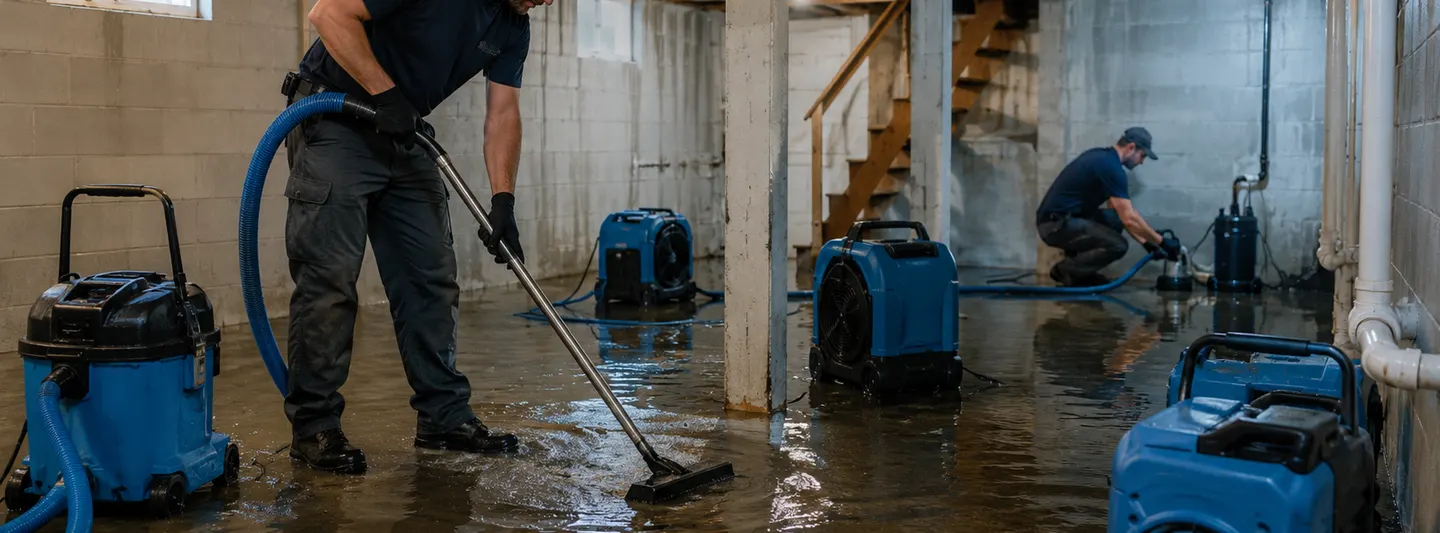
Flooded basement cleanup costs about $4–$12 per square foot, while complete repair and restoration commonly runs $2,000–$8,000 for a 500–1,000 sq. ft. basement.
HomeGuide's current cleanup model puts extraction, drying and sanitizing at $4–$12 per square foot, depending on contamination. Its published examples place a 500-square-foot cleanup around $2,000–$3,000 for clean water, $3,000–$4,500 for gray water, and $4,500–$6,000+ for black water before major repairs.
HomeGuide's separate February 2026 repair guide puts basement flooding repair at $2,000–$8,000 on average for a small- to medium-sized 500–1,000-square-foot basement, with most homeowners in its dataset spending around $5,000. Larger or more heavily finished basements move beyond that range quickly.
water removal · drying · sanitizing
HomeGuide small / medium basement model
disaster-scale basement restoration
The fastest way to understand a basement flood is to draw a horizontal line where the water stopped.Everything below that line deserves a material-by-material decision.
The flood line does not tell you what is contaminated or what must be demolished, but it organizes the investigation. Flooring, baseboard, lower drywall, insulation, cabinet toe kicks, appliances, receptacles and stored contents can all occupy different heights within the same room.
This article does not repeat the calculator from Water Damage Repair Cost per Square Foot. That tool already handles area × water-category math. Here the useful question is what did the water line intersect in a below-grade space?
THE FLOOD-LINE MODEL
Six inches of water can affect much more than six inches of building
Water can wick upward into drywall and insulation, move underneath floating flooring, enter wall cavities through openings and soak stored contents above the visible puddle line. The height of standing water is therefore the start of the scope, not the final demolition height.
BELOW WATERAssume direct contact until evaluated. Flooring, low wall finishes, stored contents and equipment may have been immersed or repeatedly wetted.
ABOVE WATERDo not assume dry. Porous materials can wick moisture upward, and wall cavities can trap water where surface paint still looks normal.
BELOW FLOORLook beneath the finish. Floating floors, carpet pad, sleepers and subfloor layers can hold moisture after visible water is gone.
THE WATER SOURCE CHANGES THE CLEANUP BEFORE IT CHANGES THE REBUILD
A broken supply pipe, sump failure, groundwater intrusion and sewer backup are not equivalent basement floods
HomeGuide treats a sanitary broken water line or faucet as Category 1. Quick response can preserve more materials when the source is stopped and the assembly has not remained wet long.
Used water from sources such as washing machines or bathroom fixtures carries a higher cleaning / handling burden and can reduce the number of porous materials worth keeping.
HomeGuide places groundwater intrusion, sewer backup and similar highly contaminated sources in its Category 3 benchmark. Material removal and sanitizing become more important than simple drying.
FINISH LEVEL IS A COST MULTIPLIER WITHOUT NEEDING A FORMULA
An unfinished concrete basement and a finished family room can contain the same water and completely different reconstruction budgets
Concrete floor · exposed walls · utilities
Cleanup may focus on extraction, cleaning, drying and utility inspection. There are fewer finish layers to remove and recreate.
Cost concentration:water category · equipment · contents · mechanical / electrical exposure
Drywall · insulation · flooring · trim · cabinetry
The same flood line can intersect several finish systems. Removal is only half the cost; matching and rebuilding those layers comes later.
Cost concentration:demolition · drying · flooring · drywall · paint · millwork · contents
HomeGuide explicitly lists basement finish level as a major repair-cost factor. Its current material examples include roughly $2–$6 per square foot for drywall, $2–$8 for carpet replacement, and $9–$25 for hardwood flooring in its basement-flood repair guide.
CLEANUP IS NOT RECONSTRUCTION
The $4–$12 per square foot number stops before many of the expensive finish repairs begin
HomeGuide's flooded-basement cleanup guide explicitly says its square-foot examples cover water removal, drying and sanitizing and do not include major repairs or restoration. That boundary matters when comparing internet estimates to contractor proposals.
remove standing water and reduce the load on porous materials.
discard contaminated or unsalvageable material and open cavities where needed.
treat retained surfaces according to the contamination and material condition.
use air movement, dehumidification and monitoring until retained materials are dry enough to close.
replace flooring, drywall, insulation, trim and finishes after the assembly is ready.
A $5,000 cleanup invoice can be complete work and still leave you with exposed studs, bare concrete and no finished room.
FLOORING AND LOWER WALLS USUALLY CONTROL THE REBUILD
The two most expensive surfaces often respond differently to the same flood
Water can remain in pad and at perimeter tack strips even after the visible carpet surface looks improved. Contamination changes salvage decisions.
Cupping, buckling, finish damage and subfloor moisture can make drying, refinishing and replacement very different projects.
The measured quantity should be actual wall area being cut and rebuilt, not basement floor area.
Trim removal can provide drying access. Rebuild cost depends on profile matching, paint and the condition of wall material behind it.
EPA flood-cleanup guidance tells homeowners to sort wet materials and remove items that cannot be cleaned and dried. For actual floodwater, porous finish systems generally deserve more conservative handling than they would after a small clean-water plumbing loss.
BASEMENTS CONCENTRATE EXPENSIVE EQUIPMENT NEAR THE FLOOR
Water height can turn a finish-restoration project into a mechanical and electrical project
HomeGuide's current basement-flood repair guide lists appliance repair around $100–$400+ per unit, electrical repairs around $50–$130+ per hour, and plumbing around $45–$200 per hour. Those are broad service benchmarks, not a rule that submerged equipment is repairable.
EPA's flooded-home resources treat electrical and other hazards as safety issues before cleanup. A flooded mechanical room should not be approached as “dry the furnace and see what happens.” Equipment exposed to water needs trade-specific evaluation before being energized or operated.
THE 24–48 HOUR CLOCK
Delay can turn a water-removal problem into a demolition and remediation problem
HomeGuide advises beginning basement flood cleanup within 24–48 hours to reduce mold risk. EPA's current mold guidance likewise recommends drying water-damaged areas and items within that general window.
HomeGuide's basement-flood guide places mold remediation at $15–$30+ per square foot or $1,500–$6,000 on average. Its dedicated basement-mold guide publishes a similar $1,500–$6,000 average. Do not add those figures to every flood automatically; use them only if mold becomes an actual remediation scope.
THE REBUILD DECISION
Restore the basement you need, not necessarily the basement that existed the day before the flood
A major flood is a costly event, but it also exposes the material stack. If a basement has a history of moisture, rebuilding the exact same vulnerable finishes can recreate the same future loss mechanism.
Appropriate when the flood was an isolated event and the previous materials remain sensible for the basement's normal moisture conditions.
Owners with recurring minor water events may choose less moisture-sensitive flooring, removable trim details or other finishes that reduce the cost of a future limited event.
Utility rooms, sump zones and known seepage edges do not always need to be rebuilt to the same finish level as a living area.
This is a design decision, not a generic mandate to “waterproof” every basement after one incident. The correct prevention scope depends on why water entered in the first place.
DO NOT CONFUSE RESTORATION WITH PREVENTION
A dry basement after cleanup can still have the same drainage problem that caused the flood
HomeGuide's 2026 basement-flood guide lists several prevention projects separately from restoration: a sump pump at $600–$2,500 installed, full basement waterproofing at $6,000–$18,000, and in its cleanup guide an interior French drain around $40–$80 per linear foot.
PIPE FAILURErepair / replace plumbing source Restoration alone does not improve the failed pipe.
SUMP FAILUREpump capacity · controls · power / backup A new finish package cannot compensate for a dead pump during the next event.
GROUNDWATERdrainage · waterproofing · discharge path The recovery project and the water-management project should be budgeted separately.
SURFACE RUNOFFgrading · gutters · downspouts · entry points Exterior water management may be more important than interior finish choices.
SEWER BACKUPwaste-system diagnosis / backflow strategy where appropriate Contaminated cleanup solves the current loss, not the upstream system condition.
WATER DEPTH CHANGES WHICH SYSTEMS ENTER THE LOSS
One inch, six inches and two feet of basement water are not scaled versions of the same event
HomeGuide identifies water depth and volume as direct cost factors because deeper water increases extraction, drying time and material absorption. In a basement, depth also changes which building components physically intersect the flood.
A shallow event can still destroy carpet pad, enter floating-floor joints, wet baseboard and migrate beneath cabinets. The room may look only lightly flooded while moisture spreads horizontally under finishes.
Once water rises above trim, wall cavities and electrical devices become more likely to require inspection. The demolition quantity grows vertically as well as horizontally.
Furnaces, water heaters, storage, appliances and higher wall finishes can be affected. The restoration begins to resemble a multi-system building recovery rather than a flooring job.
Depth therefore should appear in the incident documentation even when the contractor ultimately prices by square foot, labor hour or unit. It helps explain why two basements with identical floor area can have very different demolition and reconstruction quantities.
THE BUILDING IS ONLY HALF OF SOME BASEMENT LOSSES
Stored contents can create labor and disposal work without adding a single square foot to the restoration area
Basements often function as storage spaces even when they are partly finished. Boxes, furniture, seasonal equipment, rugs, shelving and electronics can obstruct extraction and drying or require moving before crews can reach the building surfaces behind them.
MOVEClear access to the structure. Labor can begin before any damaged wall or floor is removed.
SORTSeparate dry, cleanable and unsalvageable items. EPA flood guidance emphasizes deciding what can be kept, cleaned or removed.
CLEAN / DRYRetained items may need their own treatment. That work is distinct from drying studs, concrete and drywall.
DISPOSE / STOREWaste volume and off-site storage can add logistics. These costs do not scale neatly with basement floor area.
When comparing proposals, confirm whether contents manipulation is included, billed hourly, excluded or handled by the owner. A low square-foot cleanup rate can still produce a higher total if the crew spends substantial time clearing and handling stored property before structural drying begins.
FIVE BASEMENT FLOOD COST FILES
The useful comparison is not “how many inches?” but “what layers and systems did those inches reach?”
HomeGuide's cleanup math gives $2,000–$3,000 for 500 sq. ft. of Category 1 water. With bare concrete and limited finish demolition, cleanup may explain most of the invoice.
The same $2,000–$3,000 cleanup benchmark now sits underneath carpet, drywall, baseboard and paint reconstruction. Finish level, not water category, creates most of the difference.
HomeGuide publishes $4,800–$7,200 for cleanup of an 800-sq.-ft. gray-water basement before major repair. Porous flooring and wall materials can push the complete restoration higher.
HomeGuide's cleanup model reaches $9,000–$12,000+ before major repairs. This is where an online “$5,000 average flooded basement” becomes a poor budgeting shortcut.
HomeGuide's 2026 repair guide places disaster-scale basement restoration around $10,000–$20,000+. Deeply wet materials, mold, utilities and reconstruction can move the project beyond ordinary cleanup economics.
THE BASEMENT RESTORATION QUOTE
Make the contractor state where cleanup ends and reconstruction begins
01Source / water category — what entered and who is correcting the source?
02Affected floor area — what area is being extracted, cleaned and dried?
03Demolition height / material scope — which wall, floor and insulation layers are being removed?
04Utility scope — are electrical, HVAC, appliances or plumbing separately evaluated?
05Drying endpoint — what evidence allows retained materials to be closed?
06Reconstruction endpoint — bare dry structure, primed drywall or fully finished basement?
07Prevention work — is sump / drainage / waterproofing included or deliberately outside this loss?
A contractor can be correct about the cleanup price and still be quoting only half of the owner's eventual out-of-pocket project.
COMMON COST QUESTIONS
Flooded basement restoration in plain terms
How much does flooded basement cleanup cost per square foot? HomeGuide's current national benchmark is $4–$12/sq. ft. for water removal, drying and sanitizing, depending on contamination level.
How much does a 500-sq.-ft. flooded basement cost? Cleanup alone is approximately $2,000–$3,000 for clean water, $3,000–$4,500 for gray water and $4,500–$6,000+ for black water in HomeGuide's current model, before major repairs.
How much does a 1,000-sq.-ft. basement flood cost? HomeGuide publishes $4,000–$6,000 clean, $6,000–$9,000 gray, and $9,000–$12,000+ black-water cleanup. Its separate repair guide uses $4,000–$8,000 for a typical 1,000-sq.-ft. repair scenario, showing why source and scope matter.
How long does basement cleanup take? HomeGuide says simple professional cleanup commonly takes about 3–5 days. Extensive drying and reconstruction can continue for weeks or months.
How much does basement mold remediation cost after flooding? HomeGuide uses about $15–$30+ per sq. ft. or $1,500–$6,000 total on average in its basement-flood guide.
Does cleanup include new drywall and flooring? Not necessarily. HomeGuide's $4–$12 cleanup benchmark specifically excludes major repairs / restoration. Check whether your local scope stops at drying or includes reconstruction.
How much does a sump pump cost after a basement flood? HomeGuide's 2026 planning range is approximately $600–$2,500 installed. A sump pump is a prevention / water-management project, not part of every cleanup automatically.
METHODOLOGY & SOURCES
Cleanup pricing, full restoration and federal flood-safety guidance
Pricing was reviewed August 8, 2026. HomeGuide's September 2025 dedicated cleanup guide remains its current basement-cleanup cost page; its February 2026 flooded-basement repair guide provides a fresher cross-check for complete restoration. EPA sources provide current flooded-home cleanup and mold guidance.
$4–$12/sq. ft.; area × water-category examples; cleanup excludes major repairs; drywall, carpet, hardwood and prevention costs.
02 · HOMEGUIDE · FEB 2026Basement Flooding Repair Cost$2,000–$8,000 average for 500–1,000 sq. ft.; size, class, finish level, mold and reconstruction benchmarks.
03 · ANGI · 2026Flooded Basement Cleanup CostIndependent current market context for repair, mold and basement equipment damage.
04 · U.S. EPA · MAY 2026Flooded Homes Cleanup GuidanceCurrent federal hub covering entry hazards, standing-water removal, wall / floor cleanup, drying, mold and disposal.
05 · U.S. EPA · MAR 2026Flood Cleanup to Protect Indoor Air and Your HealthFloodwater contamination, wet-material handling and mold risk after prolonged moisture exposure.
06 · U.S. EPA · FEB 2026A Brief Guide to Mold, Moisture and Your HomeMoisture control and the 24–48-hour drying guidance used in this report.
This is U.S. cost-planning information, not an instruction to enter a flooded basement. Standing water can create electrical, structural, sewage, chemical and microbial hazards. Follow local emergency guidance and use qualified professionals when conditions are unsafe or contaminated.