
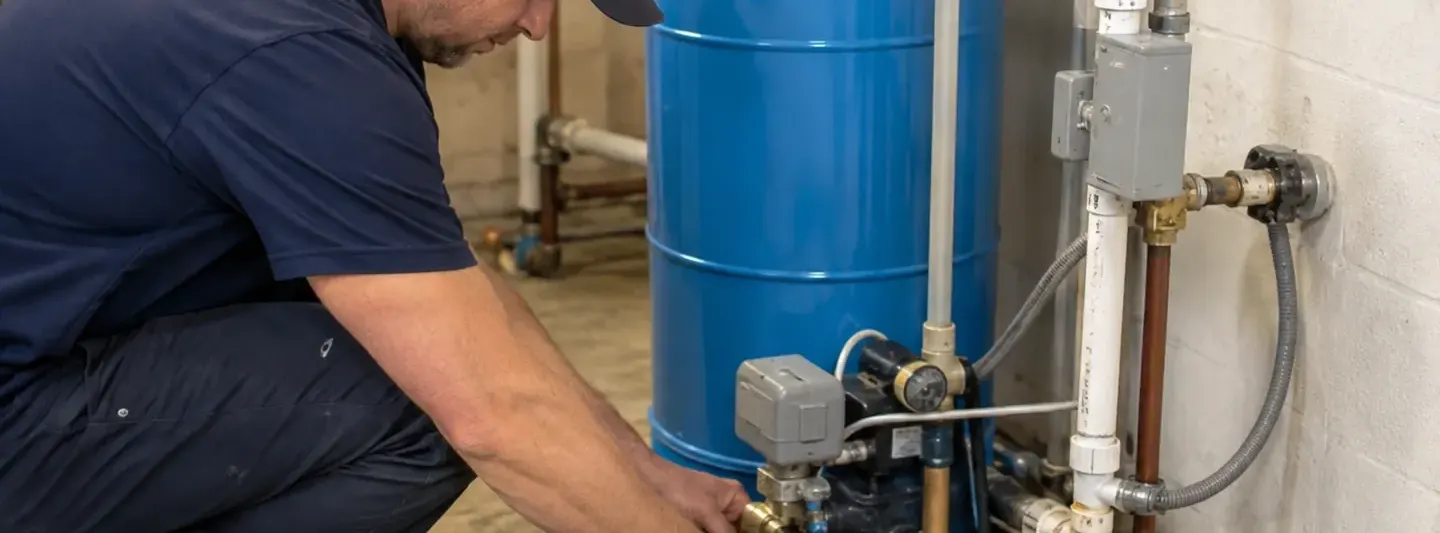
Well-pump replacement is one of those repairs where homeowners often need an answer quickly. When a house suddenly has little or no water, waiting several days to compare every possible option is not always realistic.
Current national cost guides give us a useful starting point. Angi's March 2026 data puts replacement at $975 to $2,821. This Old House gives a similar typical range of $900 to $2,500. HomeGuide places many replacements between $1,000 and $2,500.
For planning, $900 to $2,800 is a useful range for many normal residential replacements, but it should not be treated as a ceiling. Deep wells, new pipe, damaged wiring or a more complex pressure system can push the final bill higher.
A useful starting point for a residential replacement before unusual depth, difficult access or additional system work enters the quote.
No water is a symptom, not a diagnosis
A private well system contains more than a pump. The pressure tank, pressure switch, controls, electrical supply and piping all take part in getting water from the ground to a faucet.
That matters because several failures can feel similar from inside the house. Low pressure or no water does not by itself prove that the pump motor has failed.
No water anywhere
The pump may have failed, but power, controls and the condition of the well system also need to be considered.
Pressure rises and falls
The pressure tank or controls may be involved. Replacing a healthy pump would not solve that underlying problem.
The pump starts unusually often
Frequent cycling can point toward a pressure-system problem and may also put additional wear on the pump.
Weak pressure throughout the house
The well is one possibility, but restrictions farther inside the home's supply plumbing can create similar symptoms.
Electrical and down-well diagnosis belongs with qualified professionals. For a homeowner comparing estimates, the useful question is whether the contractor clearly states what has failed and why.
The pump type changes the starting price
DEEPER WELLS
Submersible pumps
A submersible pump works down inside the well. HomeGuide puts many installed replacements at $1,000 to $2,500. Angi reports the same basic range, with higher costs possible as the job becomes more difficult.
SHALLOW WELLS
Jet pumps
Jet pumps sit above ground. HomeGuide reports roughly $400 to $1,400 installed across shallow and deeper jet-pump configurations. Angi puts shallow-well jet pumps around $450 to $1,500.
STEADIER PRESSURE
Constant-pressure pumps
These are normally a different budget from a basic like-for-like replacement. Angi places many constant-pressure pumps around $1,300 to $4,000+, while HomeGuide reports installed systems around $2,000 to $5,000.
A cheap shallow-well jet-pump estimate and a deep submersible estimate are therefore not two bids for the same job. The well itself helps determine what equipment and installation method make sense.
Depth matters because the old pump has to come back out
A submersible pump may sit tens or hundreds of feet below grade. Replacing it means retrieving equipment from inside the well rather than simply disconnecting an appliance in a utility room.
Angi identifies well size, depth and width as important cost drivers. Deeper wells can require stronger equipment and more installation effort.
This Old House makes the physical reason easy to understand: submersible pumps can be attached to long sections of pipe and electrical wiring extending deep into the well. Contractors may need lifting equipment to bring that assembly back to the surface.
Existing pipe and cable also have to be considered once they come out. Their condition may add work that was impossible to judge from the pump's retail price alone.
What the replacement job actually involves
- Confirm the fault. The contractor first determines whether the pump really is the failed component.
- Retrieve the existing equipment. A submersible pump has to be pulled from the well together with the components connected to it.
- Inspect what comes out. Existing pipe, wiring and related parts may still be usable or may add scope to the replacement.
- Install the correct replacement. Pump size and configuration should suit the well and household demand rather than simply matching an online price.
- Return the system to service. The new pump has to operate correctly with the pressure tank and controls that manage water delivery.
The pressure tank can be a separate repair
The pressure tank stores water under pressure so the pump does not need to start every time somebody briefly opens a faucet. Problems with the tank can therefore create symptoms that homeowners may initially blame on the pump.
HomeGuide currently puts pressure-tank replacement around $500 to $1,000. It lists a pressure switch at only $25 to $100, while a replacement pump motor is around $500 to $1,000.
Those differences are exactly why “well system problem” and “failed well pump” should not be treated as interchangeable diagnoses. Finding the failed component can change a four-figure replacement decision into a much smaller repair.
Three jobs that should produce different quotes
Accessible shallow-well jet pump
The equipment sits above ground, existing connections remain usable and the project does not require major electrical or pressure-system work.
Planning range: roughly $400–$1,500Typical submersible replacement
The existing pump has to be retrieved and replaced, but the pipe, wiring and pressure equipment remain generally serviceable.
Planning range: roughly $1,000–$2,500Deep well with additional pipe or electrical work
Retrieval is more involved and some supporting components need replacement while the system is already open.
The final cost can move beyond $2,800.Pipe and wiring are easy to miss when comparing prices
Angi says new pipework and electrical-wiring repairs can add roughly $250 to $1,000 in labor. HomeGuide separately puts normal plumbing labor for a pump installation around $250 to $800, with difficult installations capable of exceeding $1,000.
A proposal should therefore tell you whether the existing drop pipe and cable are being reused. “Replace well pump” is not detailed enough if another contractor's price includes substantial additional work.
Electrical repairs should be performed by appropriately qualified professionals. This guide is for comparing scope and costs, not for troubleshooting energized well equipment yourself.
Low pressure can begin after the well
A functioning pump can still feed a house with disappointing pressure when interior supply piping has its own problems. Old, restricted or failing plumbing changes the project from a well repair into a larger water-distribution job.
If a proposal starts extending through much of the home's supply plumbing, our Whole-House Repipe Cost guide covers that separate scope.
A well pump is not a main water line
A private well pump brings groundwater into the home's water system. A house connected to a public utility normally receives water through a buried service line.
Those jobs use different equipment and different cost models. Excavating a municipal water service is not comparable with pulling a submersible pump from a private well.
For a property connected to public water, see our Main Water Line Replacement Cost guide instead.
Well and septic may share a property, not a repair bill
Rural homes often have both systems. The well supplies water. The septic system receives wastewater. A failure in one does not automatically create work in the other.
Keeping those budgets separate makes proposals easier to understand. If wastewater equipment also needs work, our Septic System Replacement Cost guide covers tanks, drain fields, soil conditions and excavation.
Repair can still make more sense than replacement
HomeGuide currently lists individual well-system component repairs from around $25 to $2,000, depending on what failed. That is a very wide range because a pressure switch, pressure tank, pump motor and booster pump are completely different repairs.
Age gives the decision more context. HomeGuide says a well pump typically lasts about 10 to 15 years with proper care. A relatively young pump with one failed component presents a different choice from an older unit that has already needed repeated work.
Personally, I would not use a fixed percentage rule to choose between repair and replacement. The more useful comparison is the pump's age, the failed component, recent repair history and the replacement warranty.
A useful quote makes the unknowns visible
Before comparing totals, each estimate should make these points clear.
- Pump
- Type, size and rating of the proposed replacement.
- Depth
- Approximate depth of the existing installation.
- Removal
- Whether pulling and disposing of the old pump is included.
- Drop pipe
- Whether the existing pipe will be reused or replaced.
- Electrical
- Whether cable, controls or related electrical work is included.
- Pressure tank
- Whether it has been checked separately from the pump.
- Unknown conditions
- How extra work will be approved if another problem appears.
- Warranty
- Coverage for both the equipment and the installation.
The people behind the cost data
ANGI · UPDATED MARCH 17, 2026
Timothy Moore · reviewed by Jeff Botelho
Angi is the primary current benchmark used here for the $975–$2,821 replacement range, pump-type pricing and additional pipe and electrical labor. Angi identifies Jeff Botelho as a journeyman plumber and expert reviewer.
Read the Angi guideTHIS OLD HOUSE · UPDATED MARCH 5, 2026
Alexis Carthan · guidance from Richard Trethewey
This Old House provides the second current benchmark, placing replacement at $900–$2,500 and explaining why pump type, depth, accessibility and installation complexity change the project.
Read This Old HouseHOMEGUIDE · AUGUST 7, 2025
Tamatha Hazen · edited by Kristen Cramer · fact-checked by Tara Farmer
HomeGuide is used as supporting data for submersible and jet-pump costs, pressure-tank pricing, individual component repairs, installation labor and the typical 10–15 year pump lifespan.
Read the HomeGuide dataThese figures are national planning references rather than local contractor quotes. Well depth, equipment requirements, access, labor rates and the condition of existing pipe or wiring can move a real project outside the published ranges.