
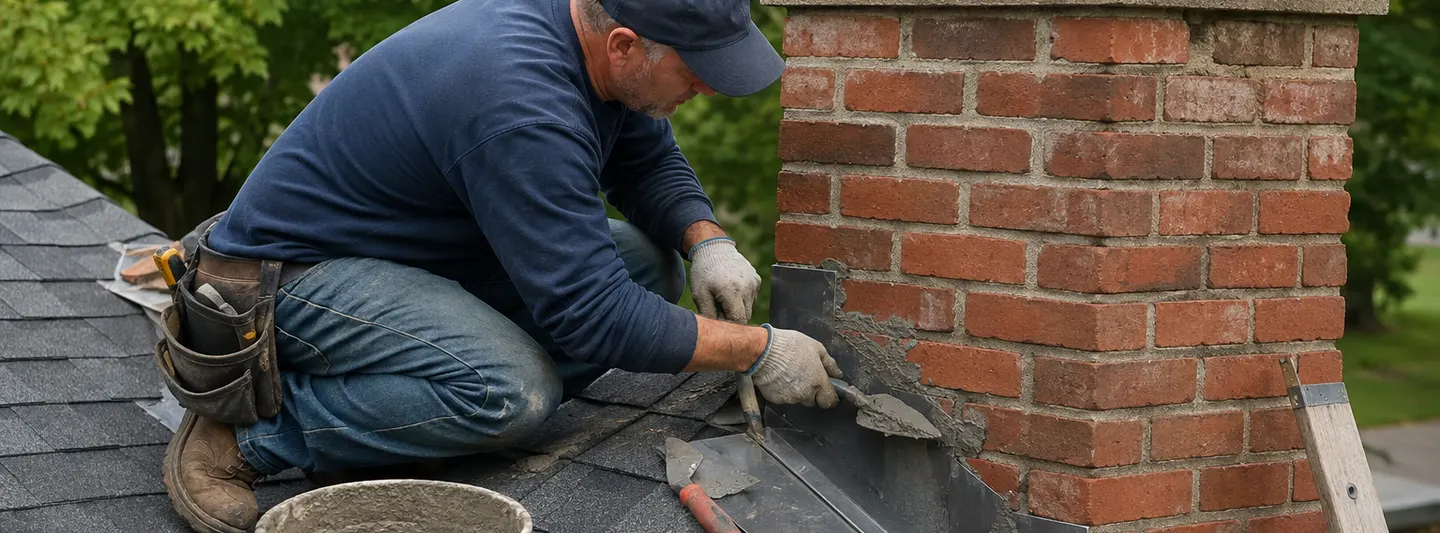
ONE CHIMNEY · VERY DIFFERENT REPAIR BILLS
A $455 repair and a $10,000 repair can both be reasonable answers to “How much does chimney repair cost?”
Angi's August 2026 national data puts a simple chimney repair at an average of about $455, with basic work commonly falling between $160 and $750. Once the problem moves beyond minor masonry, cap or localized repair, the budget can change quickly.
Angi places partial rebuilding broadly around $1,000–$5,000, while complete replacement can reach roughly $15,000. This Old House uses an average of around $750 and a very wide overall range of $250–$13,300.
I would not try to reconcile those figures into one supposedly precise national average. Their width is useful information: chimney repair is not one job.
START WHERE THE HOMEOWNER ACTUALLY STARTS
You usually notice a symptom before you know the name of the repair.
From the ground, several chimney failures can look almost interchangeable. A sensible budget starts by separating what you can observe from what still needs diagnosis.
Leak around the chimney
Could point toward flashing, crown, cap, masonry absorption or a roofing detail adjacent to the chimney.
Do not assume “flashing” before inspection.Masonry is taking on moisture
Efflorescence, spalling faces and deteriorating joints can indicate prolonged water movement through masonry.
The visible brick may be the consequence, not the source.Joint repair may be enough
Localized mortar deterioration can lead toward repointing or tuckpointing rather than rebuilding the entire stack.
Depth and extent matter more than appearance alone.The problem may be inside
Cracked liner, obstruction, venting problems or other internal conditions cannot be priced from an exterior photograph.
This is a safety-system question, not cosmetic masonry.Stop treating it as a patch
Movement, widespread brick failure or major structural deterioration can move the project toward partial or complete rebuilding.
Diagnosis comes before another coat of sealant.THREE REPAIR ZONES
The fastest way to understand a chimney quote is to identify which system the contractor is repairing.
Flashing + water entry
Flashing closes the transition between chimney masonry and roofing. Angi's August 2026 guide places chimney flashing repair or replacement around $400–$1,600, while a minor reseal can begin around $200.
If the ceiling stain appears close to the chimney, this is an obvious area to inspect. It is not the only one.
Crown + brick + mortar
The crown sheds water from the top of a masonry chimney. Current Angi data places crown repair broadly between $100 and $3,000, with an average around $1,550.
Mortar-joint work occupies another cost band. Professional chimney tuckpointing is currently estimated around $500–$2,500.
Flue + liner + venting system
The liner is not decorative. It forms part of the path carrying combustion products through the chimney. Angi's current liner guidance places professional liner replacement around $650 to $5,000+ in many cases, with larger or more demanding installations able to move higher.
A masonry quote that never addresses a known liner defect has not priced the whole problem.
THE LEAK IS A PATH, NOT A LABEL
“Water next to the fireplace” does not automatically mean “replace the flashing.”
Water can enter at the cap, crown, porous or cracked masonry, failed mortar joints or the roof-to-chimney transition. Once inside, it can travel before it becomes visible on a ceiling or wall.
CSIA inspection guidance specifically tells inspectors to look for signs of water entry, inspect the crown and flashing, and look for water damage below the flashing when accessible from an attic.
That is the distinction I would want reflected in the estimate: what evidence points to the proposed repair as the entry point rather than merely the place where water finally became visible?
MORTAR REPAIR IS NOT THE SAME AS A REBUILD
The useful dividing line is whether sound masonry remains to repair.
Remove deteriorated mortar to the appropriate depth and replace it while the surrounding masonry remains serviceable.
Individual damaged bricks and surrounding joints may be replaced without dismantling the complete stack.
When deterioration is concentrated above the roofline, dismantling and rebuilding that exposed portion may make more sense than repeated patches.
Leaning, instability or extensive deterioration changes the conversation from masonry maintenance to structural reconstruction.
Current Angi rebuilding guidance puts smaller partial chimney rebuilds around $1,000–$3,000 in some cases, while complete rebuilding can reach roughly $3,100–$15,500. A separate 2026 Angi replacement dataset gives a similar average of about $9,300 for replacement projects.
Exterior masonry can look acceptable while the flue still needs attention.
A chimney liner provides a defined passage for combustion gases and helps separate heat and combustion byproducts from the surrounding masonry. Its condition is therefore a different issue from the appearance of the chimney stack.
Angi's July 2026 liner guidance places professional liner replacement around $650 to more than $5,000 depending on liner type, chimney height and access. Its broader liner-installation dataset stretches from about $625 to $7,000.
This is one area where I would resist trying to save money by turning an inspection finding into a DIY diagnosis. The correct liner material and sizing depend on the appliance and venting configuration, not simply on the chimney's exterior dimensions.
THE 2026 COST LADDER
Think of chimney cost as a progression in repair depth, not as one average getting larger.
Localized basic repair
Small masonry work, minor component repair or another contained issue.
Defined component project
Tuckpointing, crown work or a similarly bounded exterior repair can sit in this territory.
Deeper repair
Partial rebuilding, significant liner work or multiple overlapping failures.
Major reconstruction
Extensive structural work, full rebuilding or complete chimney replacement.
These bands deliberately overlap. They are a way to understand project depth using current published data, not a substitute for inspection or a local estimate.
THE INSPECTION EARNS ITS MONEY WHEN THE PROBLEM IS AMBIGUOUS
Before comparing repair prices, make sure the contractors are describing the same defect.
The Chimney Safety Institute of America's Level 2 masonry chimney guidance illustrates why a serious inspection can extend well beyond looking at the bricks from the driveway. It includes accessible attic areas, signs of leakage, flashing, the crown, rain cap, flue dimensions and interior chimney conditions.
That does not mean every chimney repair needs the same inspection level. It means that the inspection scope should match the reason for concern. A localized missing cap is a different diagnostic problem from a chimney after a fire, property transfer, appliance change or suspected concealed damage.
READ THE ESTIMATE LIKE A REPAIR MAP
A good chimney proposal tells you where the work starts and where it stops.
Crown crack, deteriorated mortar, failed flashing, damaged liner, unstable masonry or another defined defect.
Exact brick courses, mortar depth, flashing, liner or other material being removed.
New material, repair method, dimensions and component specification.
How crown, cap, masonry and roof flashing interact after the work is complete.
What happens if demolition reveals deeper brick, framing, roof or liner damage.
Cleanup, roof restoration, masonry finish, inspection documentation and warranty boundaries.
If two estimates are thousands of dollars apart, I would compare this repair map before comparing contractor margins. Often the quotes simply stop at different points.
SOURCES CHECKED AUGUST 24, 2026
Current consumer price data is used for budgeting; inspection guidance is used for diagnosis and scope.
Repair Cost Ledger provides planning information rather than a chimney inspection, structural opinion, code determination or contractor quote. Chimneys are combustion-venting systems as well as exterior structures. Suspected liner, venting, fire, carbon-monoxide or structural problems require appropriate professional evaluation rather than a cost-guide diagnosis.