
THE SHORT ANSWER
A small flashing repair is often $200–$500. More extensive work can run $500–$1,500 or more.
There's a brown mark on the ceiling near the chimney. You call a roofer, expecting a small patch, and the estimate says $1,200. Is that a fair price—or are you paying to replace something that could simply be sealed?
HomeGuide's 2026 roof flashing guide puts many minor repairs at $200–$500, with larger repairs or full flashing replacement at $500–$1,500+. Angi's broader 2026 roof-repair data also lists flashing work at $200–$500. These are U.S. reference ranges, not a quote for your home.
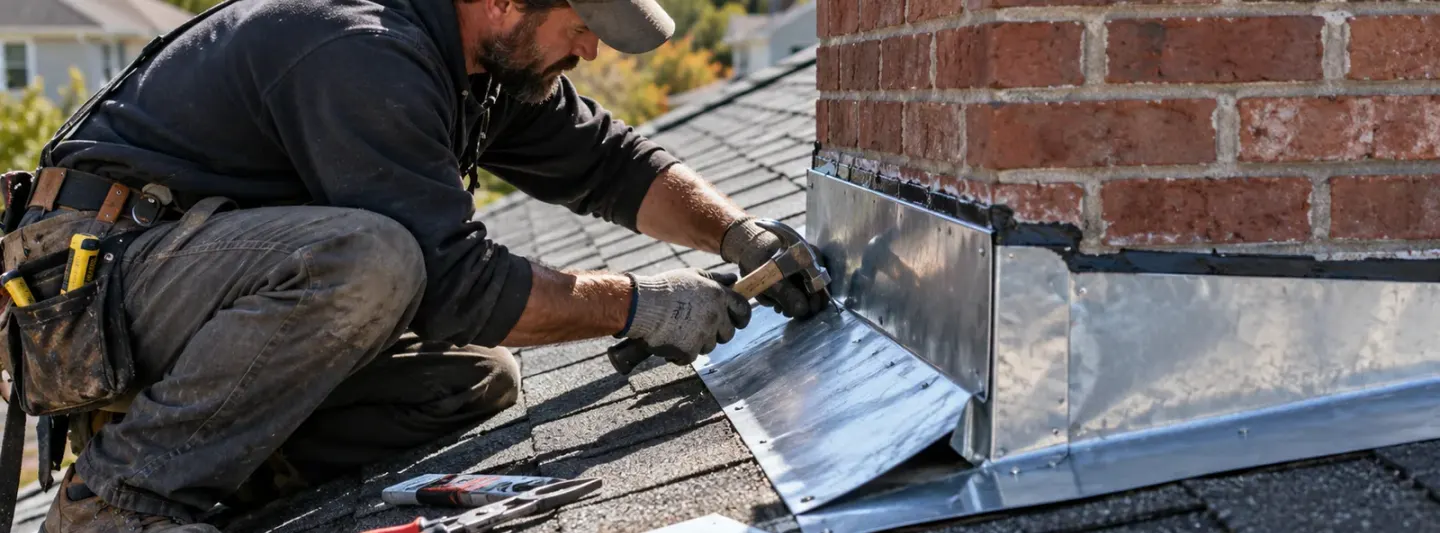
The confusing part is that flashing isn't one item. It's the metal or formed seal that keeps water out where the roof meets something else: a chimney, a wall, a skylight, or a vent pipe. Fixing a rubber seal on one vent is different from taking off shingles and rebuilding the metal around a chimney.
FIRST, FIND THE SPOT
A vent boot, chimney, and roof valley are three different jobs.
Think of flashing as the seams of a raincoat. The coat may be fine, but a damaged seam lets water through. The repair price depends on which seam failed and how much roofing has to come off to reach it.
| Where the flashing is | Published range | What the roofer may need to do |
|---|---|---|
| Vent pipe | $200–$500 | Replace a worn boot or correct flashing around the pipe. |
| Roof valley | $200–$850 | Lift shingles and repair the metal channel where two roof slopes meet. |
| Skylight | $200–$500 | Fix flashing at the frame; a leaking skylight unit is a separate problem. |
| Chimney | $200–$1,000 | Repair part of the system around the chimney; a full rebuild can cost more. |
| Dormer / roof-to-wall joint | $250–$1,000 | Correct the layered metal where roofing meets a vertical wall. |
| Drip edge | $250–$1,500 | Repair or replace edge metal, potentially along a long roof edge. |
A note about chimneys: HomeGuide's separate chimney flashing cost guide estimates $300–$1,800 for chimney flashing repairs, because an entire chimney assembly is a more demanding job than a small patch. The $200–$1,000 roof-table figure and the $300–$1,800 chimney-specific figure measure overlapping but not identical work. Don't average them together.
Likewise, Angi's October 2026 vent-boot study quotes $250–$600 for a professional replacement. That doesn't mean the $200–$500 broader HomeGuide vent range is wrong; they use different source samples and service definitions.
BEFORE ANYONE STARTS TEARING OFF SHINGLES
The stain tells you where water ended up, not necessarily where it got in.
Water can travel along a rafter or under the roof covering before it drips into a room. A ceiling stain near the chimney is a reason to check the chimney flashing—not proof that the flashing is the cause.
Wet ceiling after wind-driven rain
Check the metal at the roof-to-chimney joint, but also look for cracked mortar or chimney damage. Those can require different trades.
Water mark close to a pipe
A cracked rubber boot is one possibility. Condensation, plumbing, or another roof opening can create similar symptoms.
Drips where two roof slopes meet
Debris, damaged shingles, underlayment, or valley flashing may be involved. The visible metal isn't always the only issue.
A useful roofer should inspect the likely entry point and the surrounding materials before recommending a fix. If possible, ask for photos showing the gap, rust, loose edge, or failed boot. If water has been entering for months, ask whether the wood underneath is still sound.
THE BIG DECISION
Sometimes sealant helps. Sometimes the metal needs to come out.
Here's the question behind almost every flashing quote: Is the existing flashing still doing its job? If a sound piece has a small, accessible gap, a targeted repair may make sense. If the flashing is rusted through, bent out of shape, or installed incorrectly, adding more caulk may only hide the problem for a while.
The GAF technical bulletin on proper flashing explains why step flashing and counterflashing are essential at roof-to-wall junctions. In plain English, those overlapping pieces are meant to guide water back onto the roof instead of allowing it behind the wall.
If the roof itself is old or has multiple failing sections, read our general roof repair guide or roof replacement cost guide before approving a larger project. This page is about the junctions, not the cost of an entirely new roof.
WHAT A QUOTE CAN LOOK LIKE
Two made-up estimates show why the final bill is more than a piece of metal.
These are hypothetical examples for learning how a quote works. They are not contractor invoices, local price surveys, or promises that a roofer will charge these amounts.
- Visit and roof inspection
- $95
- New boot and supplies
- $65
- Removal, installation and check
- $215
This stays relatively small if the surrounding roof is sound and the contractor can reach the vent safely.
- Access and setup
- $250
- Remove old metal and lift roofing
- $320
- New metal and supplies
- $240
- Install, re-cover and test
- $460
- Cleanup
- $80
More work happens under and around the shingles. Any masonry or rotten wood repairs would be extra unless included.
A low bid that says only “seal chimney” and a higher bid that says “remove damaged metal, install new flashing and repair affected shingles” may not be competing offers for the same job. Ask both contractors to explain their scope in writing.
READ THE SMALL PRINT
Five reasons your flashing estimate can rise.
- The minimum service charge.HomeGuide says many roof repair contractors have minimum job fees of $250–$300 or more, even if the part costs very little.
- Steep or difficult roof access.Special equipment and extra time can make an otherwise modest repair expensive.
- Hidden wet wood.Leaking water may have damaged the roof deck. That's a different repair—see our roof deck replacement cost guide.
- More than one failed junction.Water may enter at a chimney and a nearby valley. Ask for a price per area rather than a vague whole-roof allowance.
- Extra repairs to masonry or interiors.Cracked chimney mortar, stained drywall, or wet insulation might need separate work. See our chimney repair and ceiling water damage guides.
Always ask whether inspection, shingles removed and replaced, disposal, water testing, permits if required, and a workmanship warranty are included. You shouldn't need to guess what “flashing repair” means on the invoice.
MATCH THE METAL TO THE PROBLEM
What should the roofer actually replace at each trouble spot?
The words “flashing repair” aren't detailed enough to compare estimates. A vent pipe uses a different waterproofing detail from a brick chimney or a wall. Use this as a conversation guide with your roofer; which parts must be replaced depends on what the inspection finds.
| Leak location | Parts the quote should name | What to ask the roofer |
|---|---|---|
| Vent pipe | Boot, flange and surrounding shingles | Is only the flexible seal split, or is the whole boot being replaced and integrated with the roof covering? |
| Brick chimney | Step flashing, counterflashing and adjoining roofing | Will the overlapping metal be rebuilt? Is cracked mortar a separate masonry repair? |
| Roof against a wall | Step flashing and, where needed, kick-out flashing | Will water be directed back onto the roof and away from the wall rather than behind the siding? |
| Valley between slopes | Valley detail, nearby shingles and water barrier | Is the failed valley covering being repaired, or only a surface gap being sealed? |
| Skylight | Flashing kit and the skylight unit itself | Is the leak from the roof-to-frame joint or the skylight? The repair scope can be very different. |
If the roof is generally worn out, this is no longer just a flashing job. Use our roof repair cost guide for wider repairs or roof leak repair guide to investigate other possible entry points. This page is specifically about the joints that keep water out.
TAKE THIS TO THE ROOFER
Seven questions that make two estimates easier to compare.
Where exactly is the leak coming in? Ask for a photo and an explanation, not just a circle drawn on the roof.
Is the metal damaged or only the seal? The answer should explain why a patch or replacement is the better choice.
Which parts will be replaced? Around a chimney, ask about step flashing, counterflashing and nearby shingles.
Could water have reached the wood beneath? Ask how additional damage would be priced if discovered.
What is included in the total? Check access equipment, labor, materials, cleanup and any minimum fee.
How will you check that the leak is fixed? Ask what inspection or test the contractor will perform when conditions allow.
What happens if the same spot leaks again? Get the written workmanship warranty and exclusions.
Bottom line: A flashing repair can be a few hundred dollars if it's small and accessible, but a chimney or multi-area repair can be much more. The best quote doesn't simply offer the lowest number—it identifies the failed part, explains the work, and gives you a way to know what you're paying for.
HOW WE CHECKED THE FIGURES
Sources, methodology and limitations
We used published U.S. homeowner cost references and manufacturer safety or installation guidance, checked in October 2026. We did not interview local roofers or collect new contractor invoices for this article. The two invoice examples are intentionally hypothetical. Quotes vary by city, roofing material, access, size, underlying damage, and exactly what a contractor includes.
- HomeGuide — Roof Flashing Repair Cost (2026): $200–$500 minor repairs; $500–$1,500+ major work; vent, valley, skylight, chimney, dormer and drip-edge price categories.
- HomeGuide — Chimney Flashing Repair Cost (2026): separate chimney-specific $300–$1,800 reference and differences between patching and replacement.
- Angi — Roof Vent Boot Replacement Cost (October 2026): $250–$600 for vent boots and the influence of roofing access.
- Angi — Roof Repair Cost (October 2026): broader repair context, including flashing work.
- GAF — Proper Flashing Technical Advisory: how step and counterflashing protect roof-to-wall joints.
- OSHA — Fall Protection in Residential Construction: working-at-height hazards and fall-protection context.
Editorial check: October 2026. Ranges are for general budgeting only. They are not local bids or guarantees of repair performance. Have a qualified roofer inspect the actual entry point before deciding on repairs.