
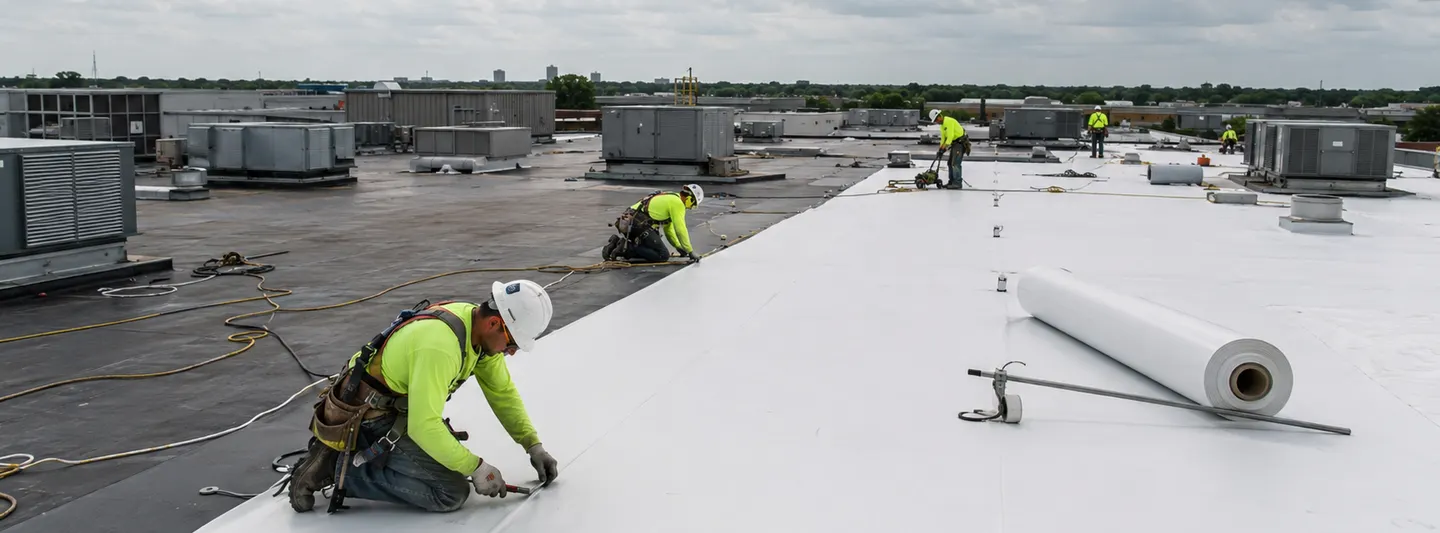
2026 COMMERCIAL COST ANSWER
Commercial flat-roof replacement is roughly $4–$11 per square foot in HomeGuide's current national data. Current commercial contractor data places broader replacement projects around $5.50–$15 per square foot, especially when system specification and assembly scope move beyond a basic membrane install.
HomeGuide's November 2025 guide—its current 2026 flat-roof dataset— uses $4–$11 per square foot installed for commercial flat roofing, including labor and materials. It notes that very large roofs can gain material-volume efficiencies but may also require cranes, storage and special permitting.
Windward Roofing's February 2026 commercial guide uses $5.50–$15 per square foot as a broader replacement range. Its current system examples put EPDM around $5.50–$8.50, TPO around $6–$10, modified bitumen around $6.50–$10, and commercial metal around $10–$15+.
COMMERCIAL ROOF ASSEMBLY ESTIMATOR
Price the measured roof area, then expose tear-off and insulation as separate layers
HomeGuide's current installed ranges are used for the roof-system layer. Add tear-off or polyiso only when those scopes are excluded from the base proposal. This calculator does not price unknown deck replacement, edge metal, cranes, curbs, drainage changes or occupied-building protection.
COMMERCIAL ROOF PRICING IS AN ASSEMBLY LEDGER
The membrane is priced by area; the expensive surprises often live below it or around its perimeter
TPO, EPDM, PVC, modified bitumen, BUR or metal establishes the primary system cost but does not define the complete reroof scope.
Mechanically fastened, adhered and other assemblies use different attachment strategies. Existing substrate condition matters.
Additional polyiso can change both thermal performance and total roof height; tapered insulation can also create drainage slope.
HomeGuide's current flat-roof tear-off benchmark is $1–$2 per square foot including disposal.
Unknown deterioration should be converted into a unit-price rule before demolition rather than hidden inside a contingency guess.
For a large commercial property, ask for the bid as a layer stack: existing roof disposition → deck → insulation → cover layer → membrane → flashing / edge package.
SYSTEM CHOICE MOVES THE BASE RATE BEFORE THE BUILDING-SPECIFIC WORK BEGINS
Current installed ranges span roughly $3.50 to $16 per square foot depending on roof type
HomeGuide's current flat-roof material ranges provide a consistent national comparison: EPDM $3.50–$10, TPO $4–$10, PVC $5–$12, modified bitumen $4–$7.50, built-up roofing $3.50–$7.50, and metal $5–$16 per square foot installed.
EPDM$3.50–$10 / sq. ft. Thermoset rubber membrane; often a low-cost single-ply baseline.
TPO$4–$10 / sq. ft. Thermoplastic single-ply. Angi's current dedicated TPO guide is broader at $4.50–$16 per square foot for its overall flat / low-slope dataset.
PVC$5–$12 / sq. ft. Thermoplastic single-ply with a higher current national installed range than TPO / EPDM.
MODIFIED BITUMEN$4–$7.50 / sq. ft. Asphalt-based sheet system; current commercial contractor examples can be higher depending on ply count and assembly.
BUILT-UP ROOFING$3.50–$7.50 / sq. ft. Multi-ply asphalt / felt system in HomeGuide's current flat-roof model.
METAL$5–$16 / sq. ft. Broad flat-roof / metal range; current commercial-specific contractor data commonly starts higher for standing-seam assemblies.
These prices are useful for procurement only when the compared bids use the same assembly assumptions. A $6 TPO line installed over usable insulation is not cheaper in a meaningful sense than a $9 TPO proposal that includes complete tear-off and a new insulation package.
RECOVER AND REPLACEMENT ARE TWO DIFFERENT CAPITAL PROJECTS
NRCA defines replacement as tear-off to install a new roof system; recover leaves most or all existing roof materials in place
NRCA's reroofing guidance distinguishes re-cover—adding a new low-slope roof membrane or system over an existing assembly—from replacement, which removes the existing roof system and installs a new one. That distinction should appear in the first page of a commercial proposal.
Avoids full demolition and can preserve useful insulation where the existing assembly is suitable, dry and compatible with the new design.
Exposes the deck, removes unsuitable / wet materials and gives the new assembly a defined substrate—but adds demolition, disposal and reconstruction.
Recover is not simply “replacement without the $1–$2/sq.-ft. tear-off charge.” NRCA says the existing system must be evaluated for deck condition, load capacity, site-specific conditions and hidden conditions, and notes that wet insulation should not be trapped below a new roof system.
THE MOST EXPENSIVE SQUARE FEET MAY BE THE WET ONES
Moisture survey results can change the project from selective replacement to full assembly removal
NRCA's low-slope reroofing guidance states that building codes do not allow a new roof system to be installed over existing roof systems with wet insulation and says NRCA does not recommend designs intended to “dry out” wet insulation under the new system.
DRY ASSEMBLYRecover may remain an option Subject to system compatibility, attachment, structural, perimeter and code considerations.
LOCALIZED WET AREASSelective cut-out / replacement may be investigated The bid should define how wet areas are mapped, quantified and priced.
WIDESPREAD MOISTURERecover economics can collapse Large quantities of wet insulation can drive the project toward tear-off and full assembly reconstruction.
DECK DETERIORATIONUnit prices become critical Steel, wood, gypsum or other deck repairs should be quantified under agreed unit rates when concealed condition cannot be known before removal.
The commercial bid therefore needs more than “replace damaged decking as necessary.” The stronger contract states a pricing unit—square foot, sheet or another appropriate quantity—for each likely deck repair type. That converts an unknown quantity into a known commercial rule.
INSULATION CAN BE A SIX-FIGURE LINE ON A LARGE ROOF
A $0.50–$3 per-square-foot polyiso allowance becomes $25,000–$150,000 across 50,000 square feet
HomeGuide currently uses $0.50–$3 per square foot installed for polyiso insulation boards in rubber / membrane flat-roof assemblies. On a commercial roof, that is not a small accessory: the quantity scales across the entire roof plate.
The energy-code question is project- and jurisdiction-specific. The 2024 IECC commercial existing-building chapter contains dedicated roof replacement requirements, but states and cities adopt and amend model codes on different schedules. Treat “code requires R-X” as a local design question, not a national 2026 assumption.
DOE's commercial-building envelope guidance reinforces the assembly logic: low-slope commercial roofs commonly use continuous insulation above the structural roof deck. The reroof is therefore a major opportunity—and sometimes a code trigger—to change thermal performance, not merely membrane color.
ROOF AREA PAYS FOR THE FIELD; PERIMETER AND PENETRATIONS PAY FOR DETAIL
A compact warehouse and a highly articulated retail roof can have the same area and very different labor
Copings, termination bars, wall flashing and edge details scale with perimeter and parapet geometry.
Every RTU, vent, pipe, skylight and equipment support creates flashing work and coordination around an existing asset.
HomeGuide's residential / flat-roof data uses $70–$340 for a roof drain, but commercial drain work can be broader when plumbing, tapered insulation or overflow design changes.
HomeGuide specifically flags cranes, storage and special permits as commercial-project cost considerations on large flat roofs.
Dust, fastener penetration, noise, odor, falling debris protection and shutdown windows can add logistics that no membrane rate captures.
A COMMERCIAL ROOF CAN BE CHEAP TO INSTALL AND EXPENSIVE TO DISRUPT
Replacement over an operating tenant, warehouse line or sensitive facility has a second budget: business continuity
Commercial roof bids should state working hours, interior protection, rooftop-equipment coordination, access routes, staging locations and what happens if weather interrupts an opened section. Those items may not change the nominal membrane price, but they change the owner’s risk.
Warehouse projects make that operating constraint especially visible. The warehouse roof replacement cost guide applies the same assembly logic specifically to large roof plates, active operations, insulation and replacement sequencing.
DELIVERIESWhere can membrane, insulation and tear-off containers stage? A large roof can require substantial temporary storage without blocking customer, fire or loading access.
INTERIORWhat protection exists beneath active tear-off areas? Especially important where the structural deck is exposed to occupied space.
HVACWhich rooftop units must remain operational? Curb work and flashing sequence should respect building operations.
WEATHERHow much roof can be opened in one shift? The daily production plan should leave the building watertight at the contractor's defined stopping point.
ACCESSCrane / lift / roof access windows A high-rise or restricted urban roof has different logistics from a one-story suburban warehouse.
LARGE ROOFS DO NOT HAVE TO BE ONE BUDGET YEAR
Phasing can solve capital timing—but only if the interfaces are designed as permanent roof boundaries
A 100,000-square-foot facility can create a $400,000–$1.1 million project even at HomeGuide's $4–$11 commercial range. Phasing a roof into logical areas can spread capital, but arbitrary stopping points create transition details that later phases must reopen.
The roof can be completed to a durable stopping point with a clear future tie-in strategy.
Area alone is not a roof detail. The interface may create temporary work that must be demolished and rebuilt during the next phase.
The commercial decision is therefore not only “replace all or replace half.” It is whether the roof can be divided into independently watertight zones whose edge conditions make sense for the building.
THE $/SQ.-FT. NUMBER SITS ON TOP OF A STACK
A commercial roof replacement changes as soon as one hidden layer fails
NRCA's reroofing distinction makes this visual economically useful: recover leaves most of this existing stack in place; replacement removes the existing roof system to build a new assembly. That decision can matter more than choosing between two membranes within the same price tier.
FOUR LARGE-ROOF COST FILES
At commercial scale, every $1 per square foot becomes visible capital
HomeGuide's commercial $4–$11 model yields $40,000–$110,000. Windward's broader 2026 commercial range yields roughly $55,000–$150,000.
HomeGuide: $100,000–$275,000. A separate full tear-off at $1–$2/sq. ft. can represent another $25,000–$50,000 if excluded from the base quote.
HomeGuide: $200,000–$550,000. Additional polyiso at its $0.50–$3/sq.-ft. allowance represents $25,000–$150,000 if it is a separately priced layer.
HomeGuide: $400,000–$1.1 million. A $1-per-square- foot scope ambiguity is now $100,000, which is why unit pricing for hidden conditions and exact assembly definitions matter so much.
NORMALIZE COMMERCIAL ROOF BIDS BEFORE COMPARING TOTALS
A $320,000 proposal and a $410,000 proposal are not $90,000 apart until these endpoints match
ROOF AREASame measured square footage? Exclude canopies or alternate areas consistently.
REROOF TYPERecover, selective tear-off or full replacement? NRCA treats these as distinct reroofing strategies.
MEMBRANESame material, thickness, attachment and warranty system?“TPO roof” alone is not a complete specification.
INSULATIONSame R-value / thickness / tapered package? This can be a six-figure difference on very large roofs.
DECKSame unit prices for concealed repair? Unknown quantity is acceptable; unknown price rule is not.
EDGE + PENETRATIONSSame parapets, coping, curbs, drains and flashing scope? These quantities do not scale neatly with roof area.
OPERATIONSSame crane, staging, protection, work-hours and phasing assumptions? Occupied-building logistics can be legitimate project cost.
Once the seven endpoints match, divide total project price by measured roof area. That normalized $/sq.-ft. number is far more useful than the headline rate on page one.
HIGH-INTENT PRICE ANSWERS
Commercial roof replacement cost in plain terms
How much does a commercial roof replacement cost per square foot in 2026? HomeGuide currently uses $4–$11 per square foot for commercial flat roofing. A current 2026 commercial contractor guide uses a broader $5.50–$15 per square foot replacement range.
How much does a 10,000-square-foot commercial roof cost? Roughly $40,000–$110,000 using HomeGuide's commercial range, before separately excluded tear-off, insulation, deck or special logistics.
How much does a 25,000-square-foot commercial roof cost? About $100,000–$275,000 using the current $4–$11 commercial baseline.
How much does a 50,000-square-foot commercial roof cost? About $200,000–$550,000 using HomeGuide's current commercial flat-roof range.
How much does TPO cost per square foot? HomeGuide currently uses $4–$10 installed. Angi's current dedicated TPO dataset is broader at $4.50–$16 per square foot across its flat / low-slope project sample.
How much does commercial roof tear-off add? HomeGuide's flat-roof tear-off benchmark is $1–$2 per square foot, including disposal. Confirm whether it is already included in the contractor's base price.
Is a roof recover cheaper than replacement? It often avoids full tear-off and can preserve usable existing insulation, but NRCA says the existing roof, moisture condition, deck, load capacity and other conditions must be evaluated first.
Can a new commercial roof be installed over wet insulation? NRCA's reroofing guidance says model building codes do not allow a new roof system over an existing roof system with wet insulation and NRCA does not recommend trying to dry trapped wet insulation beneath a recover.
METHODOLOGY & SOURCES
Current 2026 market ranges separated from reroofing and energy-code design guidance
Pricing was reviewed August 9, 2026. HomeGuide provides the primary national commercial flat-roof, roof-system, tear-off and insulation cost model. Windward Roofing's February 2026 commercial dataset is used as an industry cross-check at larger commercial scope. Angi's current TPO data provides a second membrane-specific check. NRCA supplies recover / replacement definitions and wet-insulation reroofing guidance. ICC / DOE sources are used only for building- envelope and code context, not as roofing-price datasets.
$4–$11/sq. ft. commercial; EPDM, TPO, PVC, BUR, modified bitumen and metal ranges; $1–$2 tear-off; polyiso, labor and commercial logistics.
02 · WINDWARD ROOFING · FEB. 1 2026Commercial Roof Replacement Cost$5.50–$15/sq. ft. broad commercial range; current EPDM, TPO, modified-bitumen and metal commercial-system cross-checks.
03 · ANGI · CURRENT 2026 DATATPO Roofing Cost$4.50–$16/sq. ft. broad TPO flat / low-slope dataset; labor, insulation and penetration-cost context.
04 · NRCA · REROOFING GUIDANCELow-Slope ReroofingDefinitions of recover, replacement and reroofing; existing-system preparation, deck / perimeter / penetration considerations and wet-insulation guidance.
05 · ICC · 2024 IECCCommercial Existing BuildingsCurrent model energy-code chapter containing dedicated roof-replacement provisions; local adoption and amendments vary.
06 · U.S. DOE · BUILDING ENERGY ASSET SCOREBuilding Upgrade Guide · Roof InsulationCommercial building-envelope guidance on insulation at flat / built-up roofs and continuous insulation above the roof deck.
This is U.S. commercial property cost-planning information. Commercial roof design depends on existing assembly, moisture, structural deck, wind uplift, fire classification, insulation, drainage, edge / flashing design, rooftop equipment, adopted codes, manufacturer requirements and building operations. Final reroof design and construction scope should be established by qualified project professionals.