
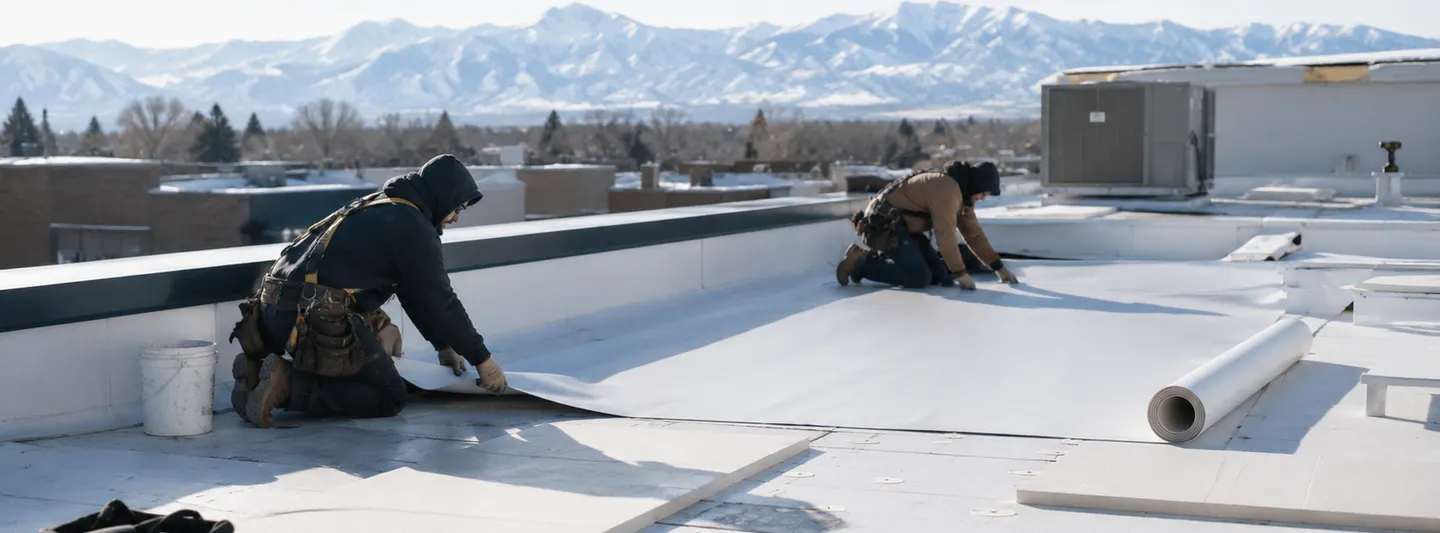
2026 NATIONAL COST ANSWER
Flat roof replacement costs about $3–$11 per square foot, with many complete projects landing around $4,000–$16,800.
HomeGuide's current national flat-roof guide places residential replacement at $3–$11 per square foot and an average project range of $4,000–$16,800. Its published size model puts a 1,000-square-foot roof at roughly $3,000–$11,000, 1,500 square feet at $4,500–$16,500, and 2,000 square feet at $6,000–$22,000.
The material system changes the answer considerably. Current HomeGuide installed bands run about $3.50–$10 for EPDM, $4–$10 for TPO, $5–$12 for PVC, $4–$7.50 for modified bitumen, and $3.50–$7.50 for built-up roofing.
The visible membrane is the top line of the invoice. Drainage, insulation and details decide whether it becomes a durable roof.
Low-slope roofing behaves differently from a steep shingle roof. Water is not shed rapidly by gravity across a steep plane, so the roof depends more heavily on a continuous membrane, correctly detailed penetrations, functioning drains or scuppers, and enough slope to move water toward them.
Department of Energy Building America guidance for reroofing an existing flat roof treats the project as a full assembly: remove the old membrane, inspect framing and decking, provide continuous air control, install rigid insulation and cover board where specified, install the roofing membrane, flash penetrations and slope the roof toward drains or scuppers.
A FLAT ROOF SHOULD STILL MOVE WATER
“Flat” describes the roof category, not a design goal of zero drainage
Building America identifies drainage as the fundamental principle of roof water management. In its flat-roof retrofit guidance, it specifically recommends creating slope to a drain or scuppers with tapered sleepers beneath sheathing or tapered insulation where needed.
Pooling water can therefore be evidence of more than an aging membrane. Building America says pooling water on an existing flat roof is a sign that more slope and drains or scuppers may be needed. If the old roof failed partly because water had nowhere to go, replacing only the membrane reproduces the geometry beneath it.
FLAT ROOF COST ESTIMATOR
Estimate the membrane portion from actual roof area
Enter the low-slope roof area and choose the replacement system. The estimator uses current national installed price ranges published by HomeGuide. It does not add hidden complexity, tear-off or insulation multipliers.
READ THE QUOTE FROM BOTTOM TO TOP
A low-slope roof is an assembly, not one waterproof sheet
Building America's retrofit detail uses a fully adhered air barrier membrane, polyisocyanurate rigid foam, insulation cover board and a roofing membrane as the water-control layer. It also requires penetration flashing and connection of the roof air-control layer to the wall system.
Your project may use a different assembly, but the procurement lesson is universal: two TPO bids are not automatically the same roof. Membrane thickness, insulation quantity, cover board, attachment method, substrate work, edge metal and penetrations can differ before the contractor changes the membrane brand.
MEMBRANE SYSTEMS
The useful comparison is not “rubber vs plastic.” It is price, seam method, substrate and detail compatibility.
A flexible single-ply rubber baseline
HomeGuide lists EPDM as one of the lower-cost membrane systems. Its seams are commonly adhered rather than heat-welded. The material is widely used on low-slope roofs, but the total quote still depends on insulation, attachment, flashing and substrate preparation.
Heat-welded thermoplastic seams
HomeGuide's dedicated TPO guide puts installed TPO around $4–$10 per square foot, with common membrane system materials around $1.80–$3.50 per square foot before labor depending on thickness and application.
A higher-cost thermoplastic option
PVC carries the highest current HomeGuide price band among the three common single-ply membrane families. A serious comparison should identify membrane thickness, manufacturer, attachment method and compatible flashing details rather than relying on the PVC label alone.
Multi-layer asphalt-based low-slope roofing
Modified bitumen can be installed with several application methods, including self-adhered systems and heat-applied methods. Application choice affects labor, sequencing and site risk.
Multiple bituminous layers with aggregate surfacing
Built-up roofing uses repeated waterproofing layers rather than one single-ply sheet. Removal weight, gravel, multiple plies and disposal can make an old BUR tear-off a very different project from removing a lightweight membrane.
RECOVER OR TEAR-OFF?
A cheaper recover preserves more of the existing roof—good material and bad information alike
HomeGuide's current flat-roof repair guide places membrane recover around $4–$10 per square foot for PVC, TPO or EPDM and describes it as an option when damage is limited to the roof surface rather than insulation or decking. Its full flat-roof tear-off benchmark is about $1–$2 per square foot.
Preserve the existing assembly
Potentially less demolition, disposal and disruption. The existing roof must still provide an acceptable substrate, and trapped moisture or deteriorated insulation can undermine the logic.
Best question:What evidence shows the layers being covered are dry and serviceable?
Expose the underlying assembly
Higher removal and disposal scope, but direct access to wet insulation, damaged deck, framing, air-control details and slope deficiencies.
Best question:Which concealed conditions are expected, and how will they be priced?
“Recover is cheaper” is not enough to choose it. The economic question is whether the preserved layers still deserve to remain inside the new roof assembly.
INSULATION IS OFTEN PART OF THE ROOFING CONTRACT
Low-slope replacement can become an energy and condensation project at the same time
HomeGuide currently lists polyiso insulation used beneath rubber membrane roofs at roughly $0.50–$3.00 per square foot installed. That range is useful only after the required thickness and layer arrangement are defined.
THERMAL LAYERMore insulation changes roof height at parapets, drains, door thresholds and curbs. It may therefore change flashing scope even when the roof footprint stays identical.
TAPERED INSULATIONRigid boards can also be used to create drainage slope. The owner may be buying thermal resistance and water-management geometry in the same material package.
MOISTURE CONTROLBuilding America cautions that the relationship between above-deck rigid insulation and cavity insulation must satisfy applicable requirements to reduce condensation risk. Adding insulation is not just an R-value purchase.
THE DRAINAGE PLAN
A membrane warranty cannot move water uphill
Building America says rainwater control is the most important factor in durable roof assemblies and calls drainage the key principle. Its low-slope retrofit guidance directs roof surfaces toward drains or scuppers and identifies pooling water as a sign that more slope or drainage capacity may be needed.
HomeGuide lists an individual roof drain around $70–$340 installed in its current flat-roof guide, but replacing one drain is not the same as correcting roof geometry. A tapered-insulation package, new sump at the drain, added scuppers or substrate work can make drainage correction a meaningful part of the reroof budget.
The more valuable question is why the water remains there and whether the replacement is the practical moment to improve that condition.
DETAIL DENSITY
A 1,000-square-foot roof with two drains and eight penetrations can cost more than a cleaner 1,500-square-foot rectangle
The membrane field is repetitive. Edges and interruptions are not. Every drain, pipe, curb, skylight, parapet and wall transition requires the water-control layer to turn, terminate or connect to another assembly.
IBHS notes that roof flashing exists to shed or direct water away from roof edges and penetrations. Its low-slope flashing guidance treats parapet copings, fascia / gravel stops and counterflashing as distinct conditions requiring secure attachment and water-control detailing.
PARAPETS CHANGE THE ROOF PERIMETER
The membrane does not end at the roof edge—it usually has to turn up a wall
On many low-slope buildings, the membrane rises at parapet walls before terminating beneath counterflashing or coping. Building America likewise shows the roof air and water layers integrated up parapets in its flat-roof retrofit assembly.
IBHS states that parapet tops need to be covered to prevent water infiltration and describes metal coping as a common solution. Coping joints, cleats, fasteners and underlayment can therefore become meaningful replacement scope even when the field membrane appears simple.
COMPARE ASSEMBLIES, NOT TOTALS
Six lines can explain most of the gap between two flat-roof bids
01Existing roof disposition recover, one-layer tear-off, multi-layer removal, ballast removal.
02Substrate deck repairs included, unit-priced or excluded.
03Insulation package type, thickness, layers, cover board and tapered sections.
04Membrane system manufacturer, membrane family, thickness and attachment method.
05Water exits drains, scuppers, overflow paths and slope corrections.
06Detail package parapets, coping, edge metal, curbs, pipes and other penetrations.
If one bid is $8.50/sq. ft. and another is $11.00/sq. ft., the difference is not meaningful until these six lines describe the same roof.
USE THE OLD ROOF AS EVIDENCE
Replacement should explain why the previous assembly failed where it did
A low-slope roof nearing the end of service life may simply need a normal system replacement. But repeated defects in the same locations are more informative than age alone. Chronic ponding points toward geometry or drainage. Repeated leakage at one curb points toward a detail. Blisters, trapped moisture or widespread wet insulation can change the logic of a recover. Perimeter failures can raise attachment or edge-metal questions.
IF LEAKS CLUSTER AT DRAINSask whether drain elevation, sump geometry or surrounding taper is being changed.
IF LEAKS CLUSTER AT PARAPETSask how base flashing, counterflashing and coping interfaces are being rebuilt.
IF WATER PONDS IN THE SAME FIELDask whether the replacement scope changes slope or only installs a new membrane over the same surface.
IF THE ROOF HAS BEEN PATCHED REPEATEDLYmark those locations before tear-off. They may identify concealed moisture or recurring detail defects worth opening deliberately.
This turns maintenance history into design information. The goal is not to prove fault in the old roof; it is to prevent the new contract from treating every pre-existing failure as if it were random.
RESIDENTIAL VS. COMMERCIAL LOW-SLOPE WORK
The field price can be similar while logistics become completely different
HomeGuide currently puts residential flat-roof replacement at $3–$11 per square foot and commercial flat-roof construction around $4–$11 per square foot. The overlap is large because the same membrane families appear in both markets.
Commercial projects can add crane lifts, occupied-building sequencing, rooftop mechanical equipment, safety requirements, larger drainage systems, staging, special permits and much larger areas. At the same time, very large simple fields may obtain better material economics than a small roof packed with details.
That is why Repair Cost Ledger keeps Commercial Roof Replacement Cost per Square Foot as a separate report rather than treating a 1,200-square-foot residential addition and a 100,000-square-foot warehouse as scaled versions of the same transaction.
FOUR FLAT-ROOF COST FILES
Same search term, different project underneath
HomeGuide's TPO band gives a first-pass $4,000–$10,000. A local proposal still needs to say whether removal, insulation, cover board, drains and perimeter details are inside that figure.
PVC's published installed range produces $5,000–$12,000. The project can move toward or beyond the high end if perimeter and penetration work dominates the relatively small field area.
The generic flat-roof envelope begins around $4,500–$16,500, but this is precisely where price-per-foot becomes incomplete. The owner is buying a new drainage geometry in addition to the membrane.
HomeGuide's generic size range is $6,000–$22,000, but a wet system can require demolition, insulation replacement and deck work before the new roof assembly starts. A recover price is no longer an equivalent comparison.
A BETTER WAY TO READ THE PROJECT
Follow the roof from demolition to drainage
remove or prepare the existing roof.
deck, framing, moisture and existing drainage.
substrate, slope and damaged construction.
thermal layer, taper and cover board where specified.
install the membrane system and attachment.
drains, scuppers, parapets, edges and penetrations.
documentation, warranty and drainage verification.
COMMON COST QUESTIONS
Flat roof replacement in plain terms
How much does a 1,000-square-foot flat roof cost? HomeGuide's current general range is about $3,000–$11,000. System-specific examples include roughly $4,000–$10,000 for TPO, $3,500–$10,000 for EPDM and $5,000–$12,000 for PVC using current installed national bands.
How much does tear-off add? HomeGuide lists flat-roof tear-off around $1–$2 per square foot. Multi-layer built-up roofs, ballast, difficult access and local disposal can change the real demolition price.
How much does flat-roof insulation cost? Current HomeGuide data places polyiso insulation used with membrane roofs around $0.50–$3.00 per square foot installed. Tapered insulation and greater thickness can materially change the package.
Can a flat roof be recovered instead of replaced? Sometimes. HomeGuide describes membrane recover as an option when damage is at the surface and not in insulation or decking. The existing assembly still has to be an acceptable substrate for the proposed new system.
Which is cheaper: EPDM, TPO or PVC? Current HomeGuide installed bands overlap: EPDM $3.50–$10, TPO $4–$10 and PVC $5–$12 per square foot. Project scope can matter more than the difference between the low ends of those material ranges.
Why is my quote above $11 per square foot? The national range cannot see wet insulation, deck repair, tapered insulation, multiple roof layers, difficult access, complex parapets, numerous penetrations, premium membrane specifications or local labor. Compare the assembly before deciding the bid is high.
METHODOLOGY & SOURCES
Cost evidence and low-slope roof science
Pricing was reviewed August 8, 2026. National cost ranges use current HomeGuide flat-roof, TPO, EPDM and related cost guides. Technical assembly and drainage principles use U.S. Department of Energy Building America guidance and IBHS roof-detail guidance.
$3–$11/sq. ft.; $4,000–$16,800 average; material systems, tear-off, drains and insulation.
02 · HOMEGUIDETPO Roofing Cost$4–$10/sq. ft. installed; system materials, insulation and labor context.
03 · HOMEGUIDEEPDM / TPO / PVC Roofing CostIndependent membrane-family price ranges and installed-cost context.
04 · HOMEGUIDE · CURRENT 2026 GUIDEFlat Roof Repair & Recover CostMembrane recover context and repair-vs-replacement distinctions.
05 · DOE / BUILDING AMERICARe-roofing and Adding Insulation over a Flat RoofDrainage, deck inspection, rigid insulation, air control, membrane, penetrations and tapered slope.
06 · IBHS / RICOWIMetal Flashing GuidanceParapet coping, fascia, gravel stops, counterflashing and roof-edge water management.
Figures are U.S. planning benchmarks, not roof specifications. Membrane selection, insulation, drainage, attachment and flashing must fit the actual building, local code and manufacturer requirements.