
THE 2026 COST ANSWER
A professionally installed ground vapor barrier typically costs $2–$4 per square foot.
HomeGuide's January 2026 cost data places a crawl-space moisture barrier at $0.30–$0.70 per square foot for material alone and approximately $2–$4 per square foot installed. A quoted price depends on the area covered, how difficult the space is to enter and whether the installer seals the liner to the walls, columns and service penetrations.
These are published national planning figures, not a guaranteed local quote. The installed rate includes the liner as part of the job; do not add material pricing to it again. Full encapsulation is listed for comparison, not as an upgrade automatically required in every house.
| Ground area | Floor liner at $2–$4/ft² | Full encapsulation at $3–$10/ft² |
|---|---|---|
| 750 ft² | $1,500–$3,000 | $2,250–$7,500 |
| 1,000 ft² | $2,000–$4,000 | $3,000–$10,000 |
| 1,500 ft² | $3,000–$6,000 | $4,500–$15,000 |
The totals are arithmetic illustrations, not additional contractor price samples. A minimum service charge, restricted access, cleanup or active water damage can make a small project disproportionately expensive.
UNDERSTAND WHAT YOU ARE BUYING
A ground liner is one moisture-control layer. Encapsulation is a larger system.
A ground vapor retarder slows moisture vapor and soil gases entering from exposed earth. It is an important component even where the crawl space is vented. But it does not stop a pipe leak, fix bad grading or replace a drainage system. Those are separate diagnoses.
Install a sealed ground liner
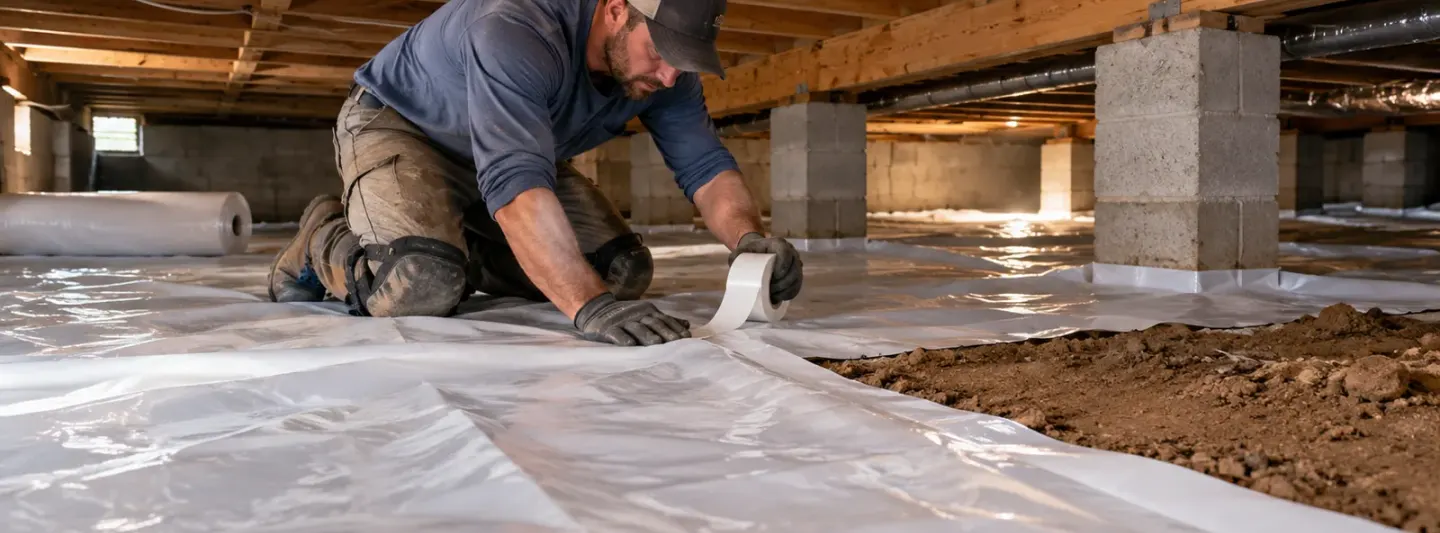
Cover exposed soil, lap and seal the seams, and make durable connections around walls, piers and penetrations according to the chosen assembly.
$2–$4/ft² installedDoes not inherently include wall insulation, conditioning or liquid-water drainage.
Encapsulate the crawl space
A broader project may add wall treatment, air sealing, vent changes, insulation and humidity control. Drainage or repairs may be additional.
$3–$10/ft²Compare the written scope, not just the two unit prices.
For a complete breakdown of sealed walls, vents, insulation and humidity management, see our crawl-space encapsulation cost guide. A floor-only barrier can be the appropriate task when the rest of the building assembly and moisture management are already sound.
MATERIAL SPECIFICATION
6-mil is a common baseline. Thickness alone does not make an installation effective.
The U.S. Department of Energy's crawl-space ground-cover guidance calls for polyethylene at least 6 mil thick, with continuous coverage, properly sealed seams and secure edges. One mil equals one thousandth of an inch; it is not one millimeter. More durable liners can be useful where equipment is serviced regularly or the surface may puncture thin plastic.
| Thickness | Material / ft² | Specification question |
|---|---|---|
| 6 mil | $0.30–$0.35 | Will a basic liner withstand this crawl space's maintenance traffic? |
| 10 mil | $0.40–$0.50 | Is added puncture resistance useful at this site? |
| 20 mil | $0.60–$0.70 | Is the product specified and protected for long-term access? |
These are material references, not installed quotes. Different products have different reinforcement, permeability and performance. Ask for the product specification and compatible seam-sealing materials rather than selecting solely by mil thickness.
DOE's Building America guidance describes laps of approximately 6–12 inches, sealed seams and polyethylene brought up walls or piers and secured. Its 2024 weatherization job aid specifies a 12-inch overlap for that particular assembly. Follow the applicable design, product instructions and local requirements instead of assuming one overlap measurement is universal.
HOW THE JOB SHOULD PROCEED
Installation quality depends on the edges, not just the middle of the floor.
A smooth sheet across bare soil is easy to photograph. The details around foundations, supports and plumbing are harder to execute and are the first places to inspect when comparing workmanship.
Find the water source first
Check for standing water, wet soil after rain, leaking pipes, soft framing and blocked drains. A barrier should not be used to conceal an unresolved intrusion.
Clear and protect the substrate
Remove debris and sharp objects. Record any necessary cleanup, insulation removal or structural repairs as separate items in the estimate.
Lap and seal every sheet
Cover the ground continuously and use sealants or tape compatible with the membrane. Do not leave unsealed gaps at cut edges.
Detail piers, walls and penetrations
Secure and seal the membrane where it turns upward, meets a support or wraps a pipe. Protect frequently walked service routes from punctures.
Standing water near electrical equipment, suspected sewage, pest contamination or damaged structure requires appropriate professional assessment. A vapor barrier is not a substitute for drainage, electrical safety work, mold remediation or a radon mitigation system where one is required.
TWO WAYS TO READ AN ESTIMATE
A 1,000-square-foot crawl space can have two very different budgets.
These are mathematical planning examples, not contractor estimates or real customer projects. They show which quantities belong in a material purchase and which belong in an installed quote.
Barrier material purchase
Seam tape, wall attachments, disposal, labor and site work are not included. The 10% allowance is hypothetical: actual geometry and upturns must be measured.
Professionally installed ground liner
Contractor charges can fall outside this range if clearance is tight or preparation is extensive. Confirm precisely what the unit price includes.
A reliable bid states the measured ground area, approximate material area including overlaps and wall upturns, material specification, sealant and fastening details, and any exclusions. If the contractor charges per square foot of installed liner rather than floor area, the quantity may differ; compare the basis before comparing totals.
WHAT THE LINER WILL NOT REPAIR
Vapor is not the same problem as water flowing across the crawl-space floor.
Picture a crawl space that gets wet each time a downspout dumps near the foundation. A new ground cover may slow evaporation from the soil, but water can still enter at the wall or pool over the liner. The first repair is to address the water entry and drainage, not to order thicker plastic.
Exposed ground, otherwise controlled moisture
- No unexplained standing water after rain.
- Framing and existing services are in sound condition.
- Seams, walls and piers can be sealed continuously.
Active water entry or hidden damage
- Water collects after storms or near a leaking pipe.
- There is suspected mold, damaged insulation or soft wood.
- Drainage, grading, sump or structural work may be necessary.
Those additional tasks should be separately scoped. Compare our crawl-space repair cost guide, interior French drain cost guide, and sump pump replacement cost guide only when those systems are relevant to the actual problem.
BEFORE SIGNING THE CONTRACT
Seven questions to ask before approving a vapor-barrier quote.
- How was the area measured? Is the rate based on dirt-floor area, purchased liner area or finished membrane area including wall upturns?
- What product will be installed? Request membrane brand or specification, thickness in mil and any reinforcement or puncture-resistance details.
- How will seams be sealed? Ask for the overlap dimension and compatible tape or sealant specification.
- How will the liner end at walls and piers? Confirm termination height, attachments and seals around supports and pipes.
- What must be fixed before the liner goes down? Separate drainage, cleanup, pest or mold work and damaged framing from the ground-cover proposal.
- What is excluded? Clarify existing liner removal, debris disposal, vent changes, wall insulation, dehumidification and access repairs.
- What proves completion? Request photographs of seams and transitions, warranty terms and clear responsibility for future puncture repairs.
Ask each contractor to price the same scope and provide a separate line for optional work. A lower price for loose floor sheets is not a fair comparison with a continuous sealed system attached to walls and piers.
QUICK ANSWERS
Crawl-space vapor barrier FAQ
Is a 6-mil ground liner enough?
DOE guidance identifies 6-mil polyethylene as a minimum for its referenced ground-cover assembly. A more robust membrane may make sense where sharp surfaces, service access or durability are concerns. The seams and edge details still matter.
Should the membrane cover the walls?
A typical ground-cover detail includes a sealed and secured upturn at the walls and piers. Full wall encapsulation extends beyond a basic perimeter upturn and should be specified separately.
Will a vapor barrier prevent a crawl space from flooding?
No. It reduces moisture vapor from soil but is not designed to intercept bulk water entering from runoff, groundwater or plumbing leaks. Investigate the source of liquid water first.
Is DIY installation always cheaper?
Materials cost much less than an installed system, but a cramped or contaminated crawl space can present safety hazards. DIY is not a substitute for proper diagnosis, safe access or professional treatment of electrical, structural and water problems.
METHOD & REFERENCES
Where the prices and installation details come from
Price benchmarks are reported by their original publishers, not represented as quotes collected by Repair Cost Ledger. The size-based tables and 1,000-square-foot examples are explicitly hypothetical arithmetic. DOE references establish installation principles and examples, not a single universal construction code for every jurisdiction. Reviewed October 2026; regional labor, access and local requirements may change the final scope.
- HomeGuide — Crawl Space Encapsulation Cost (January 2026). Ground barrier installed, membrane-only price and total encapsulation benchmarks.
- Angi — Crawl Space Encapsulation Cost (July 2026). Scope distinctions, preparation and project conditions.
- DOE Building America Solution Center — Capillary Break at Crawlspace Floors. Polyethylene thickness, laps, attachment and penetrations.
- U.S. DOE — Install or Repair a Crawl Space Vapor Retarder (2024 PDF). Weatherization installer checklist and sealed-ground-cover details.