
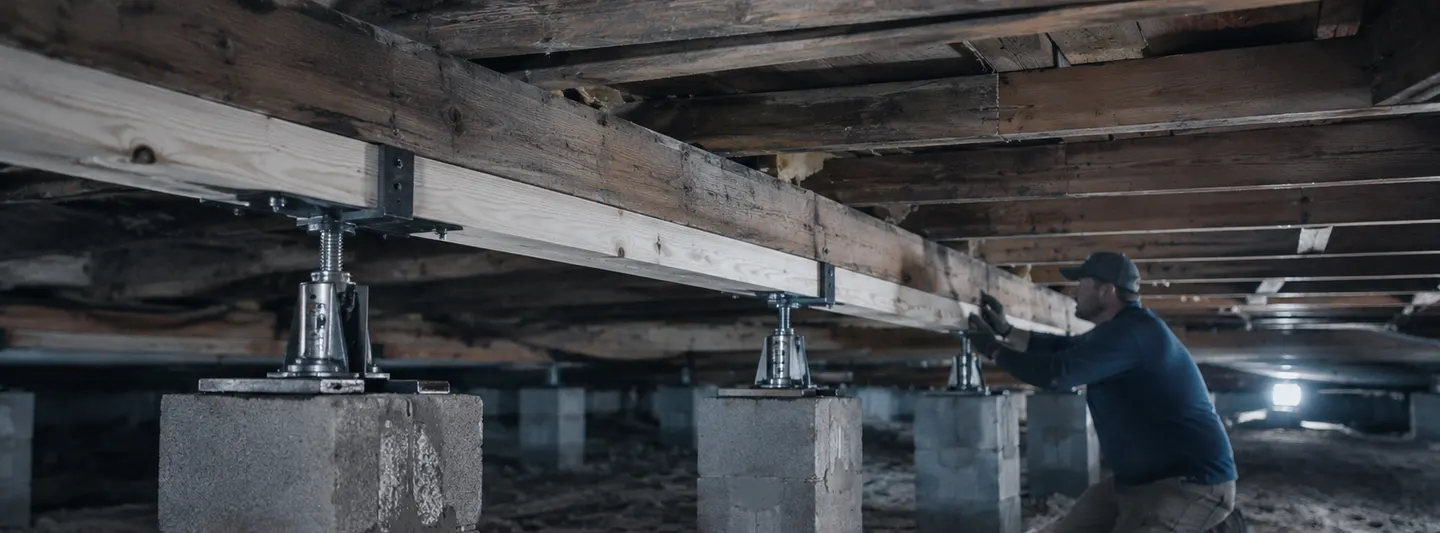
THE SHORT ANSWER
Sagging floor repair can cost anywhere from $300 to $20,000+ in 2026 because the visible dip may come from a cheap surface-level problem or a major structural failure. Current national cost data places surface repairs around $300–$2,000, subfloor replacement around $2,000–$7,000, and structural reinforcement around $4,500–$20,000+.
When joists are the problem, sistering commonly costs about $150–$325 per joist in sagging-floor estimates, whilebroader floor-joist repair data places many professional joist projects around $1,000–$10,000. Main support-beam replacement can add roughly $2,000–$10,000. If the floor is sagging because the foundation moved, the project can move into an entirely different cost category.
The biggest mistake in pricing a sagging floor is starting with the floor covering. Carpet, hardwood or tile is what you see, but it is usually not what carries the load. Underneath may be a subfloor, joists, a beam, columns or piers, and finally a foundation or footing system. A dip at walking level can originate at any of those layers.
HUD's residential inspection guidance treats sloping or springy floors as possible signs of wood structural problems and notes that sagging, sloping or springing floors can be associated with foundation settlement, excessive spans, altered framing, overloading or removal of supports. A separate HUD rehabilitation guideline also states that sagging floor joists should be visually inspected and that both the structural damage and its cause should be corrected.
That distinction shapes this entire report: price the failed layer, not the symptom upstairs.
THE FLOOR IS A STACK
Find the lowest failed layer before comparing repair prices
A contractor who repairs only the first visible layer may leave the actual structural problem untouched. The useful diagnosis moves from the finished floor downward until the first failed support layer is identified.
THE SHAPE OF THE DIP IS A CLUE, NOT A DIAGNOSIS
Different floor shapes point the inspection toward different support layers
A small soft area can come from a localized water or material problem without requiring whole-floor structural work.
A repeated dip or bounce between support lines can direct attention toward the joists and their span.
A broader low line through multiple rooms can justify inspecting the main support path below.
A continuous slope may reflect foundation movement, support settlement or an old out-of-level condition rather than one joist.
These are inspection clues only. Floor shape cannot establish the structural cause without examining the framing and supports below.
2026 COST MAP
Sagging floor repair cost by failed layer
Current pricing becomes much more coherent when it is organized by the layer being repaired rather than by the visible size of the dip.
| Repair scope | 2026 planning range | What the homeowner is actually buying |
|---|---|---|
| Surface-level correction | $300–$2,000 | Shims, localized leveling compound or finish-floor work where deeper structure is not the cause. |
| Localized subfloor repair | $300–$700 typical small repair | Remove and replace damaged sheathing over otherwise sound framing. |
| Whole-home / basement subfloor | $2,000–$7,000 | Large-area subfloor replacement due to rot, water damage or inadequate support. |
| Joist sistering | $150–$325 per joist | Add a new structural member alongside a suitable existing joist. |
| Single joist replacement | $350–$1,000+ | Remove and replace a damaged structural member; broader joist guides can run higher. |
| Multiple joist repair / replacement | $5,000–$20,000+ | Temporary support, multiple framing members, subfloor access and related restoration. |
| Support beam / posts | $1,000–$5,000 supplemental support | Add a beam or posts beneath joists where span or support is inadequate. |
| Main support beam replacement | $2,000–$10,000 | Temporary shoring, beam replacement and connections around utilities / finishes. |
| Foundation repair | $4,500–$20,000+ | Correct foundation movement when every floor layer above is low because the support below moved. |
A square-foot calculator would produce a neat number while hiding the most important variable. This topic is better served by a diagnostic cost map and quote-comparison framework.
JOISTS: THE MOST COMMON STRUCTURAL CONVERSATION
Sister, reinforce or replace?
HomeGuide's dedicated 2026 floor-joist guide places most professional joist repairs around $1,000–$10,000, with an average project around $5,000. It lists single-joist sistering around $200–$1,000, steel-plate reinforcement around $300–$1,200, a single full replacement around $500–$2,500, and multiple-joist replacement around $5,000–$20,000+.
Those broader ranges are higher than the $150–$325 sistering and $350–$1,000 replacement figures in HomeGuide's sagging-floor guide. The difference is useful rather than contradictory: one page is pricing sagging-floor solutions at a broad level, while the dedicated joist guide captures more complicated structural joist projects. Repair Cost Ledger therefore shows both instead of pretending there is one universal per-joist number.
New lumber is fastened alongside an existing joist to increase capacity or stiffness and bridge localized damage.
Not simply “put another board next to it.” Bearing, fastening and load transfer matter.Engineered plates, structural lumber or another designed repair can address a defect without removing the full member.
Best fit depends on damage location and the remaining member.Severe rot, breakage or widespread deterioration can move the project toward full joist removal and replacement.
Usually requires more temporary support and access.A quote that lists “sister 6 joists” should also make clear member size, length, fastening / connection approach and what support exists at the ends or along the new load path.
WHEN THE DIP CROSSES MULTIPLE JOISTS
The support beam may be the more important price
A main girder or support beam carries load from multiple joists. Damage, settlement or inadequate support at this level can create a broad depression across a larger area than a single joist defect.
If the beam itself needs full replacement, use our main support beam replacement cost guide for the full 2026 cost breakdown. It covers temporary support, access, wood, LVL, steel, posts and footings. On this page, the important point is that a beam problem can create a broad sag across several joists.
Existing floor and walls may need temporary support before the beam is altered.
Access may require moving utilities or opening finishes.
The replacement beam and posts must connect into the existing structure.
Adding a beam without adequate post footings can move the problem downward.
THE OLD-HOUSE SURPRISE
The floor can sag because someone changed the structure years ago
HUD's Residential Rehabilitation Inspection Guide explicitly lists cut or drilled structural members and removed supporting walls or columns among potential contributors to sagging, sloping or springing floors. That makes renovation history a useful part of the investigation.
A joist bored for plumbing, a beam cut for ductwork, or a removed basement post can remain hidden behind finishes until deflection becomes noticeable. In those cases, repairing rot or “leveling the floor” may miss the original structural alteration.
WHEN WOOD DAMAGE IS THE BILL, WATER IS OFTEN THE SECOND BILL
Do not sister wet or decaying framing and call the project complete
The USDA Forest Products Laboratory's Wood Handbook treats moisture relations, mechanical properties, drying and biodeterioration as separate core topics in structural wood performance. That matters in a crawl space or basement because a sagging floor can involve both loss of structural capacity and an environmental condition that continues to damage the repair area.
HomeGuide places sagging-floor water-damage repair around $1,200–$5,000 per room. Angi's 2026 sagging-floor guide gives a similar broader water-damage range around $1,400–$6,300. If water has reached the joists or beam for long enough to produce decay, the structural repair may sit on top of drying, leak repair, drainage or mold work.
One contractor can repair the framing while another corrects the plumbing, drainage, crawl-space moisture or remediation problem. The all-in project is the sum of both scopes, not whichever invoice arrives first.
TERMITE / INSECT DAMAGE
Structural repair should follow control of the active damage source
Angi's current sagging-floor guide places termite-related structural damage repair around $1,000–$10,000, while treatment itself can be a smaller separate line item. The useful budgeting distinction is the same as with water: extermination and structural reconstruction are different services.
Treatment / extermination / inspection.
Sister, reinforce or replace damaged wood.
Subfloor, flooring, drywall or trim restoration.
WHEN EVERY GOOD JOIST IS STILL LOW
The floor may be sagging because the support below the floor moved
Foundation-related sagging changes the repair unit completely. HomeGuide's sagging-floor data places foundation repairs associated with the problem around $4,500–$20,000. Angi's current general sagging-floor guide gives a lower average foundation-repair band around $2,200–$8,200 but notes that projects can exceed $20,000 when foundation lifting is required.
The critical point is not which average wins. It is that once the foundation is the failed layer, pricing by joist or subfloor square foot no longer describes the job. The relevant quantities become support points, foundation repair method, affected perimeter, settlement and possibly house leveling.
See our dedicated house leveling cost guide, pier-and-beam foundation repair guide and foundation repair cost guide when the problem extends below the floor framing.
LEVEL DOES NOT MEAN STRONG
A cosmetic leveling layer can hide a structural sag instead of fixing it
Floor-leveling compound, extra underlayment or tapered shims can make a finish surface flatter. Those can be legitimate solutions when the supporting structure is stable and the problem is dimensional or surface-level. They are poor substitutes for repairing a failed joist, beam, post or foundation.
Useful only when the structural support below has already been confirmed suitable.
Repair acts on the framing or support layer that caused the deflection.
HOW MUCH CORRECTION SHOULD YOU EXPECT?
Repairing structure and making an old floor perfectly flat are different promises
Old houses accumulate permanent geometry. Joists can take a long-term set, subfloors can be installed unevenly, and later renovations can follow an already-sloped floor. A structural repair can restore support without turning every finished room into a perfectly flat plane.
If the contractor plans to jack framing upward, the proposal should distinguish structural stabilization from elevation recovery. Aggressive lifting can also affect partitions, tile, plumbing, doors and finishes above.
Repair support without promising complete geometry recovery.
Correct part of the sag while limiting collateral movement.
May still require subfloor or finish work after structural repair.
WHAT TO DOCUMENT BEFORE THE FIRST BID
A simple floor file makes contractor opinions easier to compare
Which rooms and directions are affected?
A springy floor and a rigid sloped floor can point toward different investigations.
If safely visible, record joists, beam lines, posts and obvious damage.
Leaks, standing water, crawl-space dampness or previous plumbing events.
Removed walls, moved plumbing, new tile, heavy islands or structural alterations.
For larger projects, objective measurements are more useful than “looks low.”
THE SAGGING-FLOOR BID AUDIT
Normalize these 12 fields before comparing repair proposals
Finish, subfloor, joist, beam, post or foundation?
Rot, span, alteration, settlement, insect damage or another condition?
How many joists, how much subfloor, how much beam?
What size and length of framing is being repaired?
How is the occupied structure carried during work?
What remains after jacks and temporary shoring are removed?
Stabilize only, partial recovery or finish-floor leveling?
Has the cause of wood deterioration been separately addressed?
Who opens and restores access above?
Are plumbing, electrical or HVAC conflicts included?
Who provides design and approvals where required?
What is warranted: member repair, floor position or workmanship?
SAME DIP, THREE DIFFERENT REPAIRS
Why a 10-by-12-foot low area does not have one price
These are representative planning scenarios, not customer cases. Each begins with the same observation: a bedroom floor has a visible low area.
Localized damaged sheathing
$300–$1,500Joists and beam remain suitable. The repair is concentrated on a damaged section of subfloor and finish-floor access.
Lower-scope planning exampleSeveral joists need structural repair
$1,000–$5,000+Multiple members are sistered or reinforced, with some access and finish restoration.
Current moderate joist-repair bandSupport line has moved
$5,000–$20,000+The framing above is low because a main support or foundation condition needs structural correction.
Structural-reinforcement categoryWHEN A NEUTRAL STRUCTURAL OPINION CAN SAVE MONEY
Especially when the repair method changes between contractors
Angi's 2026 sagging-floor guide places a structural-engineer inspection around $300–$500, while its support-beam guide cites roughly $350–$750 for structural engineering on beam work. The exact local fee varies, but a neutral assessment can be economically useful before a five-figure structural repair.
Independent input becomes particularly valuable when one contractor proposes subfloor work, another wants to sister joists, and a third says the foundation must be lifted. At that point you are comparing different diagnoses, not simply different prices.
A suddenly changing floor, severe bounce, visibly broken framing, major rot, displaced supports or other substantial structural damage warrants prompt local professional assessment rather than continued loading or DIY jacking.
QUICK ANSWERS
Sagging floor repair cost FAQ
How much does it cost to repair a sagging floor?
Current 2026 cost data ranges from roughly $300–$2,000 for surface-level problems to $4,500–$20,000+ for structural repairs. Angi gives an overall common sagging-floor range around $1,000–$8,500, but the underlying cause determines the useful price category.
How much does it cost to sister floor joists?
HomeGuide's sagging-floor guide places sistering around $150–$325 per joist. Its more detailed joist-repair guide gives a broader $200–$1,000 per-joist range, reflecting more complex structural conditions and access.
How much does floor joist replacement cost?
Current guides place individual joist replacement from a few hundred dollars into the low thousands depending on complexity. Multiple-joist replacement commonly reaches $5,000–$20,000+, and whole-level replacement can exceed that.
What if the sagging floor is caused by the main support beam?
If the beam itself needs full replacement, see our main support beam replacement cost guide for beam prices, materials, temporary support and access costs. This sagging-floor guide stays focused on finding which layer of the floor and support system has failed.
Can a sagging floor be fixed from the crawl space?
Many joist, beam, post and pier repairs can be performed from a crawl space when there is adequate access. Tight access, moisture, utilities and limited working height can increase labor and may change the repair method.
Does a sagging floor always mean foundation problems?
No. HUD guidance identifies multiple possible causes including foundation settlement, excessive structural spans, altered framing, overloading and removed supports. Subfloor damage, joist deterioration and support-beam problems can also create sagging.
Will sistering joists make the floor perfectly level?
Not necessarily. Sistering can restore or increase structural support, but a contractor may stabilize the existing geometry rather than attempt full elevation recovery. Finish-floor flatness can require separate subfloor or flooring work.
Should I use self-leveling compound on a sagging floor?
Leveling products can address suitable surface irregularities but should not be used as a substitute for repairing an active structural problem below. The support system should be evaluated first when sagging, bounce or structural damage is suspected.
METHODOLOGY & SOURCES
How Repair Cost Ledger built this sagging-floor report
This report is organized around the failed-layer model: finish floor → subfloor → joists → beam → posts / piers → foundation. This structure explains why the same visible floor dip can belong to repair categories separated by tens of thousands of dollars.
A calculator is not used here. Square footage is useful once the repair category is known, but it is a weak first input for diagnosing sagging floors. A 100-square-foot area can involve a subfloor patch, several joists, a failed beam or settlement beneath the entire support line.
Current pricing was cross-checked using 2026 HomeGuide and Angi data. HUD guidance was used to avoid equating sloping floors automatically with foundation settlement. USDA Forest Products Laboratory material supplies the technical background for wood moisture, mechanical properties and biodeterioration.
Cost data reviewed August 8, 2026. Figures are U.S. planning ranges, not structural diagnoses, repair designs or local contractor quotes.