
THE SHORT ANSWER
Expect about $2,000–$4,000 per helical pier for an existing home's foundation.
Maybe you noticed a crack above a doorway months ago. Now it is wider, and a bedroom door is beginning to stick. Someone has suggested helical piers—large steel supports screwed into the soil beneath your foundation. The first thing you want to know is simple: how much will this cost?
For foundation repair on an existing house, HomeGuide reports an installed price of $2,000–$4,000 per helical pier, or around $3,000 each as a midpoint. Angi's 2026 underpinning guide also uses roughly $3,000 per helical pier. These are national planning figures, not offers for your particular house. HomeGuide's helical-pier guide and Angi's underpinning pricing provide the benchmarks.
Four supports and ten supports are not the same project. Do not compare two contractor totals until you know how many they plan to install—and why.
For example, five piers work out to $10,000–$20,000 using HomeGuide's installed range. Engineering, permits, difficult access or repairs to damaged floors and walls may add to the final project. And a small helical anchor for a new backyard deck is a different product and installation: it is not a valid price comparison for stabilizing a house.
PLAIN ENGLISH, NO ENGINEERING DEGREE REQUIRED
What are you paying the crew to put under your house?
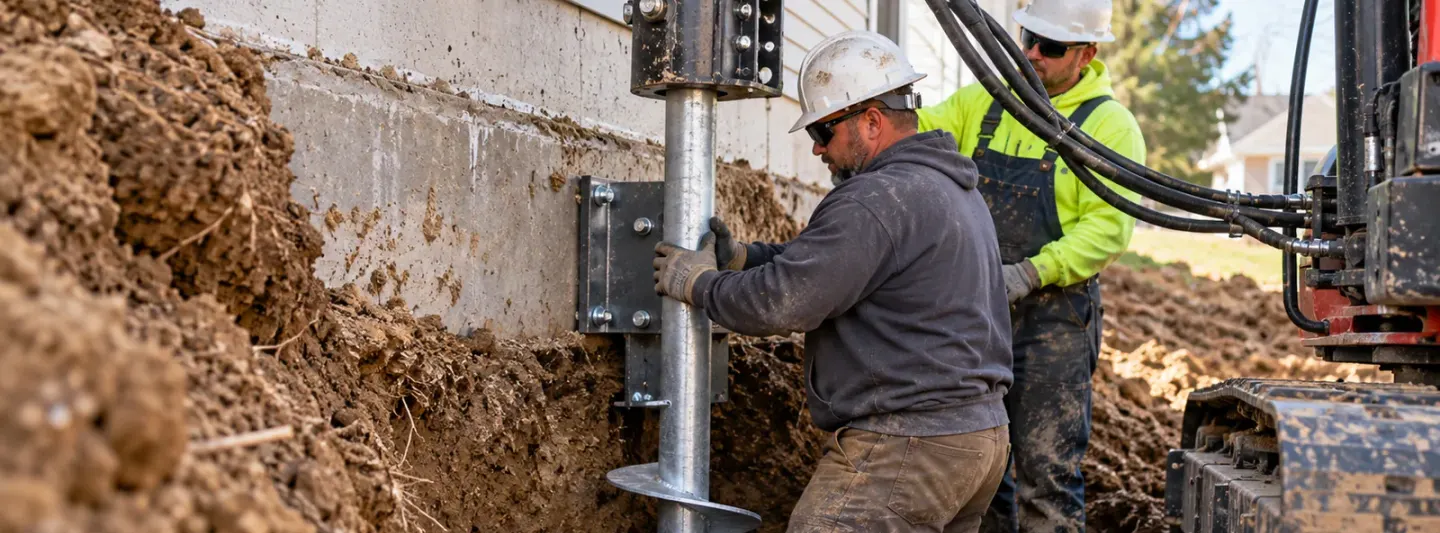
Picture a long steel rod with a wide metal spiral near its tip. A contractor turns it into the ground with special equipment—more like driving a giant screw than digging a deep hole. They keep going until the support reaches the conditions called for in the engineered plan. Then they connect it to the foundation with a steel bracket.
The goal is to carry some of the weight of a sinking part of the home down to soil that can support it. The work is often called underpinning, which simply means giving an existing foundation additional support from below.
Find the cause
Work out which part is moving and whether deeper support is the right fix.
Install supports
Expose the foundation where necessary, screw in the piers and connect their brackets.
Check the result
Document the installation and stabilize the structure to the planned extent.
Stabilizing is not the same as making every crack disappear. Some projects may include a controlled attempt to raise a settled section, but the amount of lift depends on the building's condition and the engineer's plan. Old cracks, tilted finishes and damaged masonry may still need separate repair. You should not accept a promise that every door and wall will become perfectly level again.
For the broader process and alternatives, see our foundation underpinning cost guide. This page focuses specifically on the price and decision-making around helical piers.
COMPARE TWO OFFERS, NOT JUST TWO TOTALS
Both bids say five piers. Why is one actually more expensive?
The general foundation underpinning guide compares pier methods and project sizes. Here, we'll do something narrower: read two helical-pier contractor bids side by side. Both pretend the same engineer has specified the same five support locations. The numbers below are made up for teaching, not contractor invoices or published averages for extra work.
| What the quote says | Bid A | Bid B |
|---|---|---|
| Five installed piers | 5 × $3,000 = $15,000 | 5 × $2,700 = $13,500 |
| Engineering / inspection | Included in example | $1,000 assumed |
| Concrete restoration | Included in example | $1,500 assumed |
| Example total | $15,000 | $16,000 |
| Included depth | Must be specified | Must be specified |
| Extra-depth price | Ask in writing | Ask in writing |
Bid B has the cheaper per-pier number, but the hypothetical total is $1,000 higher. In real life, engineering and restoration might be bundled, unnecessary, or billed separately. Never add an allowance twice. Ask each company to use the same pier layout and label what is included, excluded or provisional.
WHY THE SAME HOUSE SIZE DOESN'T MEAN THE SAME PRICE
Five reasons one home's quote can be much higher than another's
The piers need to go deeper
The crew may need extra steel sections to reach the support conditions specified in the design. HomeGuide notes that some installers charge $20–$25 or more per additional foot beyond the depth included in the quote. Ask where that included depth ends.
The work area is hard to reach
A wide-open driveway is easier than a narrow side yard beside a fence. Tight access can mean smaller equipment, hand digging, more labor and damage to landscaping that will need restoring.
The existing foundation needs preparation
Installing a pier under an already-built house is not like placing an anchor for a new deck. The crew may have to expose and prepare the existing concrete footing so the new bracket connects properly.
The soil does not behave as expected
Soft or variable ground, rock and changing groundwater conditions affect the design and installation. The depth cannot always be predicted from a photo of a crack.
The house needs other work as well
Fixing movement doesn't automatically repair broken drains, a persistent water problem, cracked masonry or a damaged floor. Those may need separate specialists and separate budget lines.
There is a useful contract detail here: Does your price include whatever depth is needed, or will each additional foot cost extra? Contractors sometimes call this a depth clause. Ask them to put the answer in writing rather than relying on a verbal estimate.
WHAT YOU SHOULD GET AFTER INSTALLATION
Ask for a record of each pier—not just a paid invoice.
Once the crew has covered the holes, you will not be able to see much of the work you paid for. Before signing, ask what proof you will receive when the job is complete. These are useful records to discuss with the contractor and the engineer, not instructions for homeowners to assess structural safety themselves.
A location sketch and pier identification numbers so you can match the finished job to the agreed design.
Record the installation depth and any extensions added beyond the quote allowance. This is also how you can check agreed extra-depth charges.
Ask which installation measurements and acceptance checks the design requires, who reviewed them and whether those records will be supplied.
Keep the bracket details, inspection sign-offs when applicable, photographs before backfill and a list of disturbed areas that were repaired.
Clarify whether the warranty concerns workmanship, future settlement, attempts at lifting, or something else. These are not interchangeable promises.
For example, if a bill lists three extra shaft extensions but the documents do not show which supports needed them, ask the contractor to reconcile the final invoice with the installation record. You do not need to interpret engineering measurements to request a complete account of the work.
WHAT SHOULD BE WRITTEN ON THE ESTIMATE?
The costs that may sit outside the per-pier price
The price of the supports is only one part of a safe, well-documented foundation repair. Depending on the home and local requirements, an estimate might also involve an engineering assessment, plans, permits, an inspection, utility locating or repairs to disturbed surfaces.
HomeGuide gives a broad $1,000–$5,000 reference for a geotechnical report when one is needed. That is a separate type of service, and not every property requires the same investigation. Ask who determines the pier locations, sizes and installation targets.
Ask your local building office what applies to your project. Depending on the building and the adopted code, an engineered foundation installation may require special inspection and records of installation depth and torque.
Removing a section of walkway or working around a deck can cost more than reaching an exposed edge of a foundation. Confirm who repairs concrete, patios, plants and interior finishes afterward.
DON'T PAY FOR THE WRONG REPAIR
Helical piers are one possible fix—not a cure for every crack.
The engineer may conclude that a different support system, drainage correction or another repair is more suitable. Do not choose helical piers just because their price per support looks attractive. Our foundation underpinning cost guide compares the broader repair methods; this article stays focused on how to buy and verify a helical-pier installation.
Steel supports screwed into soil
Often considered where the design calls for screw-in supports that can work in the available soil and site conditions. The engineer must verify capacity and connections.
Steel supports pushed downward
Another underpinning method that may be suitable for some existing foundations. The building, ground conditions and design determine whether it fits.
Sometimes the real issue is water near the foundation, a damaged floor beam, or ordinary shrinkage cracking—not a section of the house that needs deep support. Our foundation repair cost guide covers a wider range of possible repairs, and our foundation crack repair guide explains why the crack itself and its underlying cause are different questions.
If a salesperson wants you to sign an expensive stabilization contract after a brief look at one wall, it is reasonable to seek an independent opinion first. For significant movement, a qualified structural engineer can help establish what needs fixing before you choose a contractor. This is structural work, not a DIY project.
TAKE THIS WITH YOU TO THE APPOINTMENT
Eight questions that can save you from comparing the wrong quotes
You don't need to sound like an engineer. Ask these questions in ordinary language, and ask for the answers in writing:
- What is causing the movement?What evidence says the foundation is settling rather than simply cracking?
- Why helical piers?Why is this method suitable here instead of another repair?
- How many and where?Can I see the pier layout and the reason for each location?
- Who designed the work?Is a licensed engineer responsible for the plan, and what documentation will I receive?
- How deep is included?What happens to the price if the piers must go deeper?
- What is excluded?Permits, inspections, extra depth, excavation, concrete repair, landscaping and interior finishes?
- What is the actual goal?Stabilization, lifting, or both? What happens if lifting is limited?
- How will you verify it?Who checks the installation, what records are kept and what does the warranty cover?
Budget roughly $2,000–$4,000 per installed helical pier for an existing home's foundation. But don't buy a number of piers based on the lowest total alone. First understand the cause, get a sensible design, and compare what each contractor actually promises to do.
SOURCES AND RESEARCH NOTES
Where these prices and recommendations come from
Repair Cost Ledger uses published U.S. pricing to explain how homeowners can plan for a repair and compare estimates. The $2,000–$4,000 installed helical-pier range is HomeGuide's national foundation-repair figure. Angi independently reports around $3,000 for this pier category. The two five-pier bid comparisons above use deliberately invented fees to show why scope matters; they are not projects we observed. Local quotes can fall outside the published price range.
- HomeGuide — How Much Do Helical Piers Cost? (February 6, 2026). Installed per-pier price, quantity examples, depth charges and related costs.
- Angi — How Much Does Underpinning a Foundation Cost? (July 10, 2026). Comparison of foundation support methods and pricing.
- International Code Council — 2024 IBC, Section 1705.9. Special inspection of helical-pile foundation installation; local applicability must be confirmed.
- ICC Evaluation Service — ESR-5473. Example of a published evaluation report setting product-specific installation and inspection conditions, not a universal specification for all helical piers.
Research checked October 17, 2026. All costs are in U.S. dollars. This guide is educational and does not diagnose structural damage or replace a site-specific assessment from a qualified professional.