
THE SHORT ANSWER
Most minor foundation crack repairs cost about $250 to $800 per crack in 2026. Professional epoxy or polyurethane injection often falls around $250 to $800+, while larger structural cracks, leaking wall cracks, bowing walls or settlement can move the project into the thousands—or into a broader foundation-repair budget.
The price is determined less by the visible line in the concrete than by the repair category behind it. A stable poured-concrete crack may need injection. A crack that leaks may need water-control work. A horizontal basement-wall crack may be part of a wall-pressure problem. A stair-step masonry crack accompanied by differential movement may point toward settlement. Those are not interchangeable jobs.
Homeowners often begin with the wrong unit of measurement: the crack. Contractors ultimately price work. If a crack is merely being sealed, the crack itself is the useful unit. If the wall needs anchors, reinforcement or excavation, the wall becomes the useful unit. If the house is settling, pier count and stabilization scope matter far more than crack length.
Repair Cost Ledger therefore treats foundation cracks as a triage problem first and a pricing problem second. The goal is not to diagnose a house online. It is to help you identify which questions must be answered before a quote becomes meaningful.
THE 4-QUESTION TRIAGE
Four observations that change the cost category
Crack orientation is useful context, but it is not a standalone structural diagnosis. Combine it with displacement, progression, water and surrounding building movement.
A visible step, bulge or offset matters differently from a narrow crack whose surfaces remain in the same plane.
Changes: crack-only → possible structural scopeA repaired crack that reopens, lengthens or appears with new symptoms raises a different question from a stable old crack.
Changes: repair → diagnosis + repairA dry crack and a leaking crack may use different materials and may require drainage or waterproofing outside the crack itself.
Changes: concrete scope → concrete + moisture scopeUneven floors, sticking openings, wall bowing or multiple cracks can shift the budget toward a broader foundation evaluation.
Changes: local defect → system-level investigationORIENTATION WITHOUT OVERDIAGNOSIS
What vertical, horizontal, diagonal and stair-step cracks can tell you
Orientation helps a professional understand the force pattern, but similar-looking cracks can have different causes. Use the categories below as questions for inspection—not as a remote safety rating.
Some vertical cracks are associated with concrete shrinkage; others can be movement-related. Cost commonly stays lower when there is no broader structural issue.
A horizontal crack in a basement wall deserves attention to wall pressure and shape. Larger repairs can involve reinforcement rather than simple injection.
Diagonal cracking can appear where different parts of the structure move differently. Context determines whether the crack or the movement is the real repair.
Stair-step patterns through mortar joints can accompany masonry movement. Repair may involve mortar/masonry work, stabilization or both.
2026 COST LEDGER
Foundation crack repair cost by repair scope
Current 2026 cost data is most consistent at the low end: approximately $250–$800 for many minor crack repairs. The range expands quickly when the job changes from sealing a crack to correcting the reason it formed.
| Repair scope | 2026 planning range | What the price is really buying |
|---|---|---|
| Minor patch / seal | $250–$800 per crack | Localized crack preparation and sealing where structural stabilization is not part of the scope. |
| Epoxy / polyurethane injection | $250–$800+ | Professional injection into a prepared crack; complexity and access can push higher. |
| Larger basement wall crack | $1,000–$5,000+ | Crack repair where larger, horizontal or structural conditions increase scope. |
| Foundation leak repair | $2,000–$12,000 | Water problem extending beyond a simple crack injection. |
| Bowing wall repair | $4,000–$12,000+ | Reinforcement or wall-stabilization system rather than crack-only treatment. |
| Sinking / settling foundation | $4,500–$20,000+ | Structural stabilization where the crack is a symptom of foundation movement. |
If a contractor is proposing wall anchors, carbon reinforcement, drainage, excavation, piers or underpinning, compare that system against competing systems—not against a $500 injection price.
THE SCOPE ESCALATOR
How a $500 crack turns into a $10,000 project
- 01Crack only$
Prepare, inject or seal a stable localized crack.
- 02Crack + active water$$
Stop leakage and evaluate the water source around the foundation.
- 03Crack + wall deformation$$$
Reinforcement or anchoring enters the repair design.
- 04Crack + settlement$$$$
Stabilization targets the footing or soil support rather than the visible line.
INTERACTIVE PLANNING TOOL
Foundation Crack Repair Cost Estimator
Estimate a rough U.S. planning range from crack count, repair category, water involvement, access and signs of broader movement.
Estimated planning range
$300 – $1,200Planning midpoint: $800THE TWO COMMON INJECTION CONVERSATIONS
Epoxy vs. polyurethane: rigidity and water behavior matter
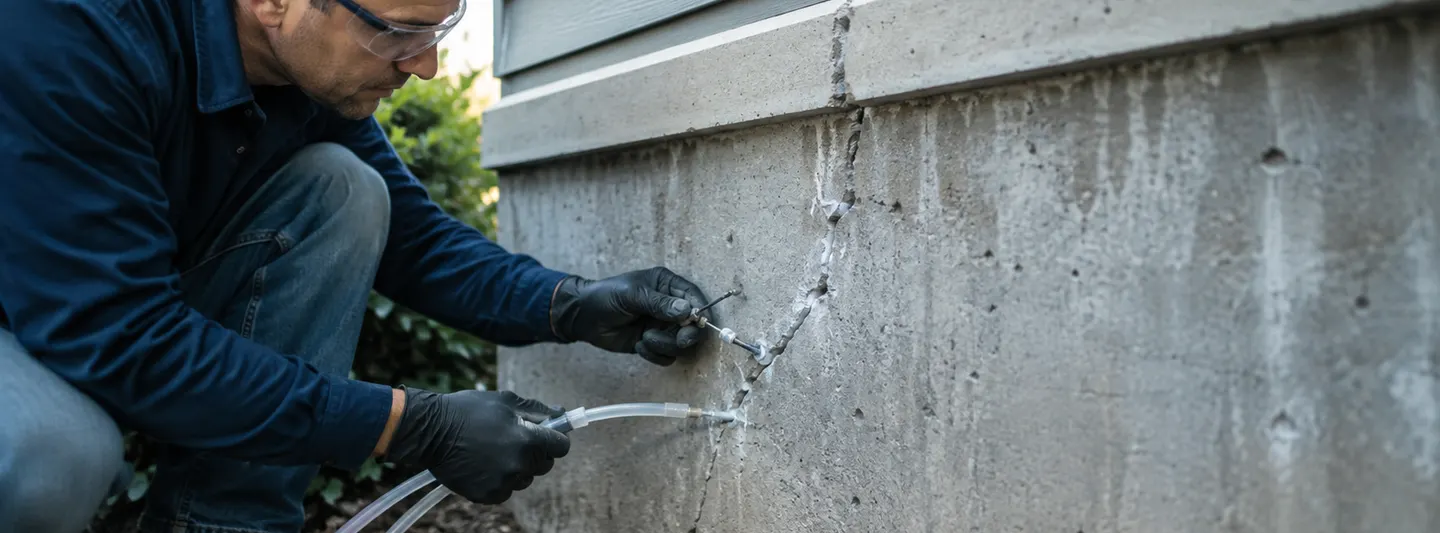
Professional crack injection is one reason minor poured-concrete foundation cracks can remain relatively inexpensive. HomeGuide's current foundation-crack guide places professional injection around $250–$800+ per crack. But “injection” is not one material or one purpose.
U.S. Army Corps of Engineers guidance describes epoxy-resin grouts as materials used for grouting cracked concrete to perform structural repairs. FHWA guidance likewise notes that epoxy injection can bond crack surfaces and restore concrete continuity in appropriate applications. Flexible injection materials are used differently, particularly where sealing water paths or accommodating limited movement is the primary objective.
Rigid bond
Typically discussed when bonding crack faces and restoring continuity in suitable stable concrete is part of the objective.
Flexible sealing
Often discussed where water sealing, void filling or limited movement accommodation matters more than creating a rigid bond.
A technically good injection can still be the wrong project if the crack is being driven by ongoing foundation movement. Material selection comes after the failure mode is understood.
WHEN THE CRACK LEAKS
Water can make a $500 repair look successful while leaving the real problem outside
If water is entering through a crack, injection may stop that specific pathway. It does not automatically correct grading, hydrostatic pressure, clogged drainage, failed exterior waterproofing or another source of groundwater around the wall.
This is why Angi's 2026 foundation-cost data separates simple foundation cracks, $250–$800, from foundation leaks, approximately $2,000–$7,000. HomeGuide's broader foundation-leak range reaches about $2,000–$12,000. Those are different repair categories because water control can extend well beyond the crack surface.
Injection or localized sealing addresses the opening itself.
Grading, gutters, drains or exterior systems may need separate work.
Bowing or displacement is not solved by waterproofing alone.
BLOCK, BRICK & STONE
Masonry cracks are priced differently because the crack can run through a system of units and joints
Poured concrete often presents a continuous crack that can be injected. Masonry foundations behave differently. Cracking may follow mortar joints, pass through blocks or bricks, appear at corners, or occur alongside inward wall movement.
HUD's Residential Rehabilitation Inspection Guide specifically calls for foundation walls and piers to be inspected for cracking, deterioration, moisture penetration and structural adequacy. For a masonry wall, the useful quote should therefore distinguish mortar repair from wall stabilization and from footing/foundation movement.
Repointing or local masonry work may be appropriate where the wall remains stable and the defect is limited.
If the wall is bowing or displaced, the repair category moves beyond filling mortar joints.
If footing movement is driving the pattern, masonry repair alone can leave the underlying movement unresolved.
WHEN THE CRACK IS A SYMPTOM
Settlement changes the economic unit from “per crack” to “per stabilization system”
HomeGuide currently places sinking-foundation repairs around $4,500–$15,000 on average and notes that severe cases can reach about $40,000. That is why it is misleading to compare a $500 crack quote directly with a $12,000 stabilization quote when the contractors are diagnosing different scopes.
Ground movement is not one phenomenon. USGS documents subsidence from multiple mechanisms, including compaction in aquifer systems. In shrink-swell soil regions, moisture changes can also produce differential ground movement. A house-specific cause requires local evaluation, but the cost lesson is universal: if the support below the foundation is moving, the concrete crack is only part of the repair story.
The bid becomes a stabilization design with multiple locations.
Installation depth and equipment needs affect labor and material.
Understand whether the proposal aims to stabilize, lift or both.
Drywall, flooring and trim can be separate after movement correction.
For the full cost model, see our foundation repair cost guide and foundation underpinning cost guide.
ENGINEER TRIGGERS
When paying for independent structural input can protect the repair budget
USEFUL BEFORE-AND-AFTER EVIDENCE
How to document a crack without pretending to diagnose it yourself
Crack monitoring is most useful as evidence for a professional: location, date, visible change, water events and nearby symptoms. It is less useful when reduced to a homemade rule such as “anything wider than X inches is structural.” A single width threshold cannot capture wall shape, differential movement, reinforcement or cause.
Capture both the crack and enough surrounding wall to locate it later. Close-up-only images lose context.
A ruler or crack comparator in the frame makes later photographs more useful than visual memory.
Note heavy rain, prolonged drought or visible seepage if relevant.
Note new sticking doors, floor changes, bowing or adjacent cracks rather than looking at one line in isolation.
Monitoring is not a substitute for prompt professional evaluation where substantial movement, wall deformation or other serious symptoms are present.
THREE QUOTES, SAME VISIBLE CRACK
Why contractor totals can differ by 20× without one necessarily being dishonest
These are representative scenarios for understanding scope, not customer stories. Each starts with the same observation: a homeowner sees one visible basement crack.
$550 injection
Crack is localized, accessible and dry; no significant displacement or broader movement is identified.
Contract unit: one crack$3,800 wall / water scope
Crack is leaking and wall conditions require more than a simple injection; water-control work is included.
Contract unit: affected wall system$12,000 stabilization scope
Crack appears with measured movement elsewhere and a contractor proposes structural stabilization.
Contract unit: foundation support systemQUOTE NORMALIZATION
Eight things a foundation crack proposal should make clear
Seal water, bond concrete, reinforce wall, stabilize foundation—or several?
What surface preparation or ports are included before material is installed?
Epoxy, polyurethane, grout, mortar or a structural reinforcement system?
Per crack, linear foot, wall section, anchor, pier or lump sum?
Is the quote only sealing the leak path or addressing exterior water too?
Does the proposal state whether broader structural movement was evaluated?
Who replaces drywall, flooring, excavation areas or exterior finishes?
Does the warranty cover the injected crack, water entry, wall movement or the full system?
COSTS THAT OFTEN SIT OUTSIDE THE CRACK LINE
Budget items homeowners commonly discover after the first estimate
Independent diagnosis, report or repair design.
Access to the outside face of a foundation wall.
Membranes, drainage or broader basement water control.
Anchors, bracing or other structural system.
Piers or deeper support if settlement drives the crack.
Repointing, block or brick replacement.
Interior finishes opened for access or already damaged.
Exterior access may disturb patios, walks or planting.
QUICK ANSWERS
Foundation crack repair cost FAQ
How much does it cost to repair a foundation crack?
Current U.S. consumer cost data commonly places minor foundation crack repairs around $250–$800 per crack. Injection can fall in a similar range, while larger structural or leaking cracks cost more.
How much does epoxy foundation crack injection cost?
HomeGuide currently places professional-grade foundation crack injection around $250–$800+ per crack. More complex access, multiple cracks and structural work can increase the total.
Is polyurethane or epoxy better for a foundation crack?
They serve different repair objectives. Epoxy is a rigid material used in appropriate concrete-bonding/structural applications, while flexible materials are often considered where sealing leakage or accommodating limited movement matters. The correct choice depends on the crack condition and repair objective.
Does a horizontal foundation crack cost more to repair?
It can if the crack is associated with wall deflection or lateral pressure, because the scope may require reinforcement rather than simple injection. Current basement-wall cost data places larger structural crack repairs around $1,000–$5,000+ per crack, with broader wall stabilization potentially costing more.
How much does it cost to fix a leaking foundation crack?
A localized injection may remain in the hundreds, but when the project is categorized as a foundation leak rather than a crack alone, current estimates are commonly in the low thousands and can extend toward $7,000–$12,000 depending on drainage, waterproofing and repair scope.
Can I tell whether a foundation crack is structural by its width?
Width can be one observation, but it is not enough to diagnose structural significance remotely. Displacement, orientation, progression, wall shape, nearby movement, reinforcement and the building system all matter.
Should I repair a crack before selling a house?
Repairing a known defect can be reasonable, but when the cause is uncertain an independent evaluation may be more useful than a cosmetic repair. Documentation of diagnosis, scope and completed work can also be valuable in a transaction.
What if a repaired foundation crack opens again?
A recurring crack deserves attention to whether the underlying movement or water condition was corrected. Repeatedly treating the surface can become poor value if the driver remains active.
METHODOLOGY
How Repair Cost Ledger built this foundation-crack report
We separated crack-only costs from wall, moisture and settlement repairs so a low-cost injection is not presented as if it were equivalent to structural stabilization. Current consumer pricing was cross-checked using 2026 HomeGuide and Angi data. Federal technical sources were used for concrete-repair, inspection and ground-movement context.
The calculator intentionally escalates price when water, multiple cracks, difficult access or broader movement indicators are selected. It does not classify a crack as safe or unsafe and should not be used as a substitute for local inspection.
Cost data reviewed August 8, 2026. Figures are national U.S. planning ranges—not local contractor quotes, warranties or structural diagnoses.