
THE SHORT ANSWER
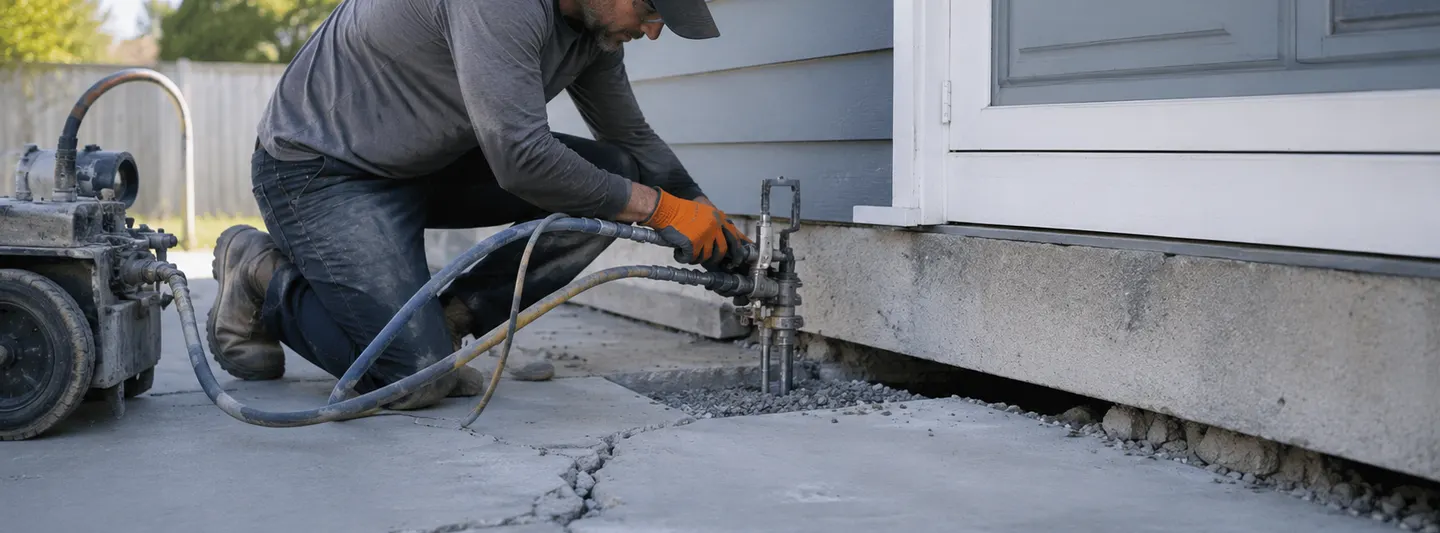
Many concrete slab foundation repairs fall around $1,000 to $10,000 in 2026. Broader market data spans roughly $350 to $20,000 because “slab repair” includes everything from a small crack to structural stabilization.
Minor non-structural slab cracks may cost $250–$1,500 to repair. Structural cracking can move into the $2,000–$12,000+ range, and serious settlement requiring piers or underpinning can push the project well beyond the everyday slab-repair average. A confirmed plumbing leak beneath the slab can add another repair and restoration budget on top.
The phrase slab foundation repair hides an important distinction: concrete damage is not always foundation movement, and foundation movement is not always solved by repairing concrete. A contractor can seal a crack without correcting settlement beneath it; conversely, a slab can be lifted or stabilized while the existing crack remains visible and still requires a cosmetic repair.
That distinction is the central budgeting idea for this page. Before asking how much the slab costs to repair, identify which of five conditions is actually driving the scope: cracking, a void, settlement, heave, or an under-slab utility problem. The correct repair method follows from that diagnosis, and the price follows from the method.
THE SLAB IS ONLY THE TOP LAYER
Why surface cracks can mislead the budget
A slab-on-grade foundation transfers building loads through reinforced concrete into prepared soil below. What appears at the surface can originate in the concrete itself, in a void beneath it, or in moving soil farther below.
DIAGNOSIS BEFORE DOLLARS
Five slab problems that look similar from inside the house
Floors that feel uneven, cracks through tile, gaps at trim and doors that no longer close smoothly can all occur in a slab-foundation home. Those symptoms do not identify the repair method on their own. A useful cost estimate separates the likely mechanisms.
The concrete is cracked, but elevation may be stable
Shrinkage and localized cracking can sometimes be repaired without structural lifting. The key question is whether the two sides of the crack have moved relative to each other or whether a broader movement pattern is present.
Typical budget: $250–$1,500 minorA portion of the slab has lost uniform support
Erosion, poor compaction or other conditions can leave space below the concrete. Grout or polyurethane injection may be considered when the concrete itself remains suitable for lifting.
Typical budget: method + area dependentThe slab and structure are moving downward
A sinking foundation can require support deeper than the slab itself. Piering or underpinning becomes relevant when the issue is bearing support rather than simply an isolated void.
Typical budget: often $7,000–$20,000+Part of the foundation is being pushed upward
Expansive soils can shrink and swell as moisture changes. USGS notes that structures on expansive soils may shift, crack or break as soils shrink, subside or expand. Heave therefore needs a different diagnosis from settlement.
Budget depends heavily on cause and correctionThe structural symptom may be sharing space with plumbing
Water lines routed beneath or through a slab can create a second repair scope. Locating and accessing the leak, repairing the pipe and restoring finishes can sit outside the foundation contractor's structural number.
Slab leak repair: roughly $630–$4,4002026 REPAIR LADDER
Slab foundation repair cost by method
A single “average slab repair cost” is useful only as a starting point. Method-specific ranges explain the economics more clearly. They also make contractor bids easier to compare because you can see whether the proposals are actually solving the same problem.
| Repair method | Planning range | Best interpreted as |
|---|---|---|
| Minor crack repair | $250–$1,500 | Localized non-structural crack work when broader movement is not driving the problem. |
| Concrete resurfacing | $3–$7 / sq. ft. | Surface deterioration and cosmetic repair—not structural stabilization. |
| Mudjacking | $4–$9 / sq. ft. | Slurry injection below suitable concrete to fill voids and lift a section. |
| Polyjacking / foam lifting | $8–$25 / sq. ft. | Polyurethane injection for void filling and precision lifting. |
| Structural crack + stabilization | $2,000–$12,000+ | Cracking associated with displacement or structural movement. |
| Piering / underpinning | $10,000–$20,000+ | Deeper support when soil bearing or settlement is the primary problem. |
| Severe replacement scope | $20,000–$50,000+ | Extensive structural failure where localized repair is insufficient. |
Resurfacing, sealing or filling a crack can improve the concrete itself. It does not automatically correct settlement beneath the slab. That is why a quote should state the diagnosed failure mode, not simply the word “repair.”
INTERVENTION MAP
How the repair gets deeper as the problem gets deeper
This is a depth-of-intervention diagram, not a universal price chart. The deeper the repair must act in the load path, the less useful a simple cost-per-square-foot figure becomes.
INTERACTIVE PLANNING TOOL
Slab Foundation Repair Cost Estimator
Build a national planning range from the type of intervention, affected area, structural severity and access complications. The model is for budgeting—not diagnosis.
Estimated planning range
$8,000 – $24,000Planning midpoint: $16,000LIFTING WITHOUT REMOVING THE SLAB
Mudjacking vs. polyurethane foam: the price difference is not the whole decision
Both methods attempt to restore support and elevation by injecting material below existing concrete rather than demolishing and repouring it. Current national consumer pricing places mudjacking around $4–$9 per square foot and polyurethane foam lifting around $8–$25 per square foot.
Those figures explain why foam can look expensive on a square-foot basis, but they do not determine whether either method is appropriate for a structural foundation. A patio slab, garage slab and load-bearing residential foundation do not present the same risk or load conditions.
$4–$9 / sq. ft.
- Cementitious/slurry material injected below the slab
- Usually lower material cost
- Larger injection holes are common
- Useful for many exterior or noncritical concrete applications
$8–$25 / sq. ft.
- Expanding polyurethane foam fills voids below concrete
- Smaller injection points
- Fast expansion and controlled lifting
- Often considered for applications where lower added weight matters
If the slab is severely fractured, the underlying soil problem is not compatible with injection, or the building requires deeper load-bearing support, a contractor may recommend piers, underpinning or reconstruction rather than slabjacking.
WHEN THE REPAIR MOVES BELOW THE SLAB
Piers and underpinning change the cost model
Slab lifting fills a void or raises concrete. Underpinning transfers structural load to new or deeper support. Those are fundamentally different interventions. Once a slab-foundation quote specifies helical piers, push piers or another deep-support system, the budget should be evaluated by number of support locations, depth, access and engineering scope, not simply by floor area.
A settled corner and a settled perimeter produce very different quantities.
Ground conditions can change installation depth and equipment time.
Finished flooring, patios and tight work zones can increase demolition and restoration.
Structural calculations, plans or inspection requirements can become separate line items.
This is the point where the general foundation repair cost report becomes a useful companion: the price now reflects a structural stabilization system rather than a concrete-surface problem.
THE CRACK DECISION
A cheap crack repair can be correct—or completely beside the point
HomeGuide's 2026 cracked-slab data separates minor non-structural cracks, roughly $250–$1,500, from cracks associated with structural damage, where repairs may reach $2,000–$12,000+. That gap is useful because it describes the real decision: whether the crack is the repair or merely the evidence.
No meaningful displacement is identified and the scope is localized concrete repair.
LOWER COST CATEGORYThe two sides are no longer behaving as one plane, pointing toward movement rather than cosmetic deterioration alone.
STRUCTURAL EVALUATION CATEGORYPrevious cosmetic repair has failed or new symptoms continue to develop, increasing the importance of identifying the cause.
CAUSE-FIRST CATEGORYCrack width alone is not enough for an online article to classify structural safety. Orientation, displacement, location, progression, reinforcement and the building's overall movement pattern matter. Repair Cost Ledger therefore treats crack prices as cost categories, not remote structural diagnoses.
THE HIDDEN SECOND PROJECT
Under-slab plumbing can change both the diagnosis and the bill
Slab homes often have plumbing lines routed beneath or through the concrete. Angi's July 2026 data places slab-leak repair around $630–$4,400, with accessibility playing a major role. Leaks beneath finished floors or cabinets can require more demolition and build-back than leaks reached from a utility area.
That creates an important quoting problem: the foundation contractor, plumber and flooring contractor may each be pricing a different slice of the same event. The all-in cost is the sum of detection, access, plumbing repair, concrete closure and finish restoration—not necessarily the number on the plumber's invoice.
Leak detection and diagnostic work
Flooring, concrete or alternate routing
Pipe section, reroute or plumbing scope
Concrete patch and structural finish
Tile, flooring, cabinets and paint
A slab leak and slab settlement can coexist without a simple one-way cause. The useful sequence is still diagnosis first: identify the plumbing failure and the structural condition separately, then determine where they overlap.
SPECIAL CASE
Post-tensioned slabs deserve a different level of caution
Some residential slab-on-ground foundations are post-tensioned. The Post-Tensioning Institute describes these systems as using compressive stresses to improve performance on shrink-swell soils, and publishes dedicated guidance for evaluating and repairing existing post-tensioned structures.
For owners, the practical budgeting implication is simple: do not treat drilling, cutting or structural modification of a post-tensioned slab as ordinary concrete work. The presence, location and condition of tendons can affect investigation, repair planning and contractor specialization.
Verify the slab system before intrusive drilling or cutting is included in a proposal.
GROUND CONDITIONS
Slab foundations make soil movement visible quickly
USGS defines expansive soils as soils that shrink or swell as moisture content changes and notes that structures built on them can experience shifting, cracking and breaking damage. USGS also documents land subsidence associated with mechanisms including compaction in aquifer systems.
Neither source can diagnose a particular house. Their value here is conceptual: a concrete slab is a rigid element sitting on changing ground. If the ground condition is the driver, repairing only the visible concrete can leave the costliest part of the problem unresolved.
THREE BUDGET PATHS
What the same 12-foot interior crack can lead to
These examples are illustrative scenarios, not customer cases. They show why a visible crack cannot be converted directly into a repair price without knowing the surrounding movement pattern.
Stable slab, localized crack
No significant differential elevation is found and there are no broader settlement indicators.
$250–$1,500Localized crack-repair categoryVoid / sunken section
A portion of the slab has lost support but the concrete remains a candidate for controlled lifting.
$4–$25 / sq. ft.Mudjacking or foam categoryStructural settlement
Elevation data and cracking indicate a larger load-bearing issue that requires deeper stabilization.
$10,000–$20,000+Pier / underpinning categoryQUOTE NORMALIZATION
How to compare slab foundation proposals without comparing different jobs
Slab-repair estimates are especially easy to misread because one proposal may be priced by square foot, another by pier, another as a lump-sum crack repair and another as a combined structural and plumbing project. Normalize the scope before comparing totals.
What evidence supports crack-only, void, settlement or heave?
Was the affected area measured or only visually inspected?
Injection, foam, piering and reconstruction are not equivalent scopes.
How many piers, how many square feet, how much crack length?
Is leak detection, access or pipe repair included or excluded?
Has the slab system been identified before intrusive work?
Who provides drawings, reports and permit coordination?
Who restores flooring, tile, cabinets and concrete access areas?
A pier count, treated square footage and restoration allowance tell you more about the scope than the contractor's headline total.
WHEN THE LOW-COST REPAIR IS THE WRONG ECONOMIC CHOICE
Repair, stabilize or replace?
The cheapest method is only economical when it solves the actual mechanism. Repeated crack filling can become expensive if the slab is continuing to move. Conversely, full replacement can be unnecessary when the concrete is serviceable and a localized support issue can be corrected.
Crack or surface deterioration without a larger structural pattern.
Void filling, leveling or deeper support addresses the movement mechanism.
Severe structural deterioration may require removal and replacement.
THE COSTS OUTSIDE THE FOUNDATION BID
What can remain after the slab is structurally repaired
Independent assessment, calculations or design.
Where ground conditions need separate evaluation.
When plumbing below the slab is suspected.
Tile, wood, carpet or underlayment removed for access.
Built-ins may complicate an interior access point.
Closing openings after plumbing or structural access.
Movement correction can reveal or alter existing finish damage.
Surface-water correction may be separate from foundation stabilization.
QUICK ANSWERS
Slab foundation repair cost FAQ
How much does slab foundation repair cost in 2026?
HomeGuide and Fixr both place many concrete slab foundation repairs around $1,000–$10,000. Angi's broader 2026 foundation-type range for concrete slabs extends from roughly $350 to $20,000, reflecting everything from minor work to structural repair.
How much does it cost to repair a cracked slab foundation?
Current 2026 cost data places minor non-structural cracked-slab repairs around $250–$1,500 and structural crack repairs around $2,000–$12,000+. Severe cases requiring major replacement can cost $20,000–$50,000 or more.
How much does slabjacking cost?
HomeGuide currently places mudjacking around $4–$9 per square foot and polyurethane foam lifting around $8–$25 per square foot. Project minimums, void depth, access and the amount of lift can materially change the total.
Can foundation piers be used on a slab house?
Deep-support systems can be used in slab-foundation repair when settlement requires transferring structural load to more reliable support. Whether a particular system is suitable depends on the structure, soil, access and engineering.
How much does a slab leak cost to repair?
Angi's July 2026 data places slab-leak repair around $630–$4,400. The all-in project can be higher when finished flooring, cabinets, concrete access or other build-back work is required.
Is every slab crack a structural problem?
No. Concrete can crack for multiple reasons. The cost decision changes when cracking is accompanied by differential elevation, continuing movement or other structural indicators. A website cannot determine structural safety from crack width alone.
Should a post-tensioned slab be repaired differently?
Post-tensioned slabs contain structural tendons and should not be treated as ordinary unreinforced concrete during invasive work. PTI publishes dedicated guidance for evaluation and repair of existing post-tensioned structures.
METHODOLOGY
How Repair Cost Ledger built this slab-foundation report
The cost model separates concrete-surface repairs from interventions that act below the slab. We cross-checked current 2026 U.S. consumer cost publications for overall slab repair, cracked slabs, concrete leveling and slab leaks. Technical sources from USGS, HUD, ACI and the Post-Tensioning Institute were used to clarify ground movement, slab-on-grade construction and post-tensioned systems.
We intentionally do not present a single price-per-square-foot formula for all slab-foundation work. Square footage is meaningful for resurfacing and injection-based leveling, but less useful once pier count, deep support, plumbing access, engineering or reconstruction enters the project.
Cost data reviewed August 8, 2026. All prices are U.S. planning ranges, not contractor quotes or structural diagnoses.