
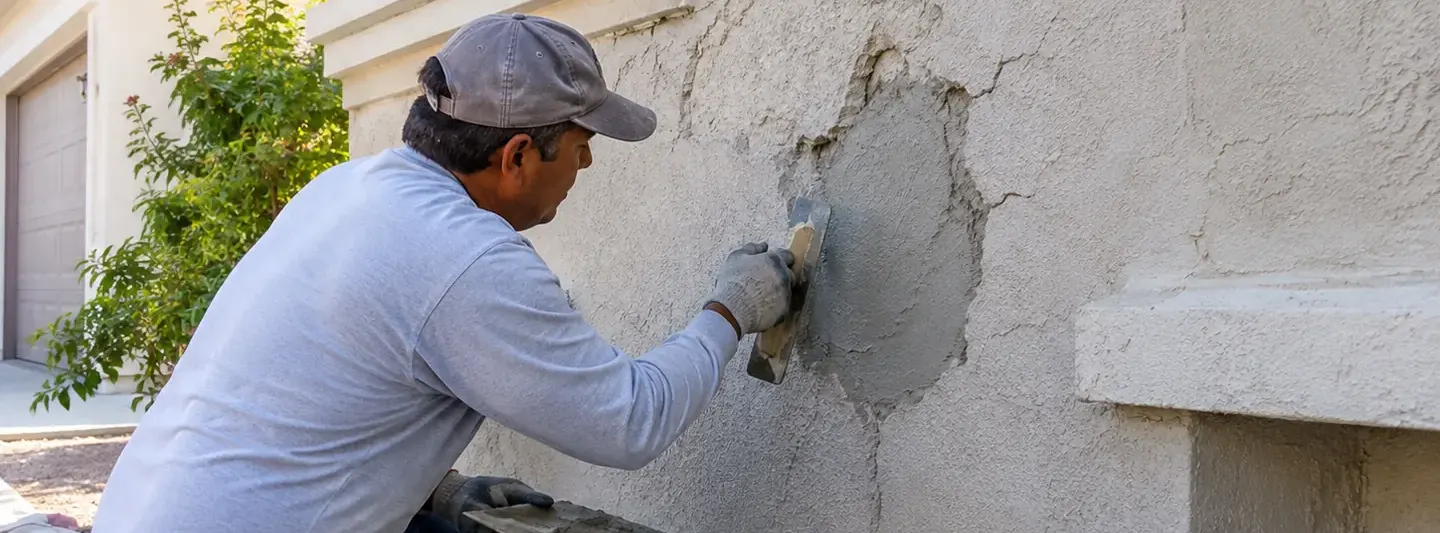
Stucco is difficult to price from a photograph. Two walls can show similar cracks from the driveway and still need very different work once a contractor starts removing loose material.
Angi's April 2026 cost data puts most professional stucco repairs between $599 and $2,662, with an average of about$1,630. HomeGuide gives a typical total of$500 to $1,500. Those numbers overlap, but neither should be treated as a fixed quote.
SMALL REPAIR$200–$800Cracks, chips and small patches.
TYPICAL PROJECT$500–$2,700A useful national planning range.
WATER DAMAGE$1,000–$4,000+When the problem extends behind the finish.
The expensive part may be behind the stucco
A straightforward repair stays near the surface. Loose material is removed, the damaged area is prepared, new stucco is applied and the texture is blended into the surrounding wall.
The job gets larger when removal exposes damaged lath, water-resistant layers, sheathing or framing. Problems around windows, roof-to-wall joints and other openings can also require flashing or moisture work before the exterior finish goes back on.
That is why square footage alone does not explain the quote. Ten square feet of clean surface damage is not the same project as ten square feet covering wet material underneath.
If I were comparing two stucco quotes, I would temporarily ignore the final price and look at what each contractor intends to remove. A $900 quote and a $2,200 quote may not be competing prices for the same repair at all.
What does stucco repair cost per square foot?
Current 2026 guides commonly place professional repair around$8 to $50 per square foot. HomeGuide separates simpler hairline cracks and chips toward the lower part of that range and more involved repairs toward the upper end.
Small jobs can have a high price per square foot because a contractor still has travel, setup, preparation, mixing, curing and cleanup. Working on a second story also costs more than repairing an open, easy-to-reach first-floor wall.
HomeGuide reports roughly $60 to $120 per square footwhen severe water or deeper damage is involved. At that point, the customer is paying for more than a cosmetic patch.
A hairline crack and a recurring crack are different problems
Several stable hairline cracks are usually among the cheaper repairs. Wider cracks, broken edges and areas where stucco has separated from the wall need more preparation and more finish work.
Repeated cracking deserves more attention. The stucco itself may not be the original cause. Movement elsewhere in the building can reopen a patch after the surface has been repaired.
That does not mean every stucco crack is structural. But when exterior cracks appear together with other signs of movement, it makes sense to separate the two questions. Our Foundation Crack Repair Cost guide covers the structural side rather than mixing it into a stucco estimate.
Three ordinary-looking repairs can produce very different bills
A few cracks on an otherwise sound wall
There is no staining, soft material or obvious movement. The work is mainly preparation, filling, finish work and perhaps paint.
Planning range: about $200–$800A larger damaged patch that needs texture matching
More old material has to come off and the repair must disappear into an older finish. Painting may extend well beyond the patch.
Planning range: about $800–$2,500Damage below a window with signs of moisture
The contractor may need to open the wall, inspect the water path and repair material behind the stucco before closing it again.
Planning range: about $1,000–$4,000+Water damage changes the job quickly
Staining, bulging, soft areas or repeated damage below a window can point to moisture rather than ordinary surface wear. Covering the damaged finish does not solve an active water path.
Once stucco is removed, a contractor may find damaged sheathing or another layer that needs work. The wall may also need to dry before the exterior can be rebuilt.
If water has already reached interior materials, it is clearer to separate those costs. Drying, demolition and interior reconstruction belong in our Water Damage Restoration Cost guide rather than hiding them inside a stucco number.
The same distinction applies to mold. Moisture does not prove mold is present, but confirmed growth becomes a separate job. Our Mold Remediation Cost guide covers that scope.
Texture matching is part of the labor
A patch can be technically sound and still look obvious from the street. Existing stucco has its own texture, color, paint history and years of weather exposure.
Sometimes a contractor has to work beyond the exact damaged area so the repair blends into the wall. Corners, decorative bands and areas around windows also take longer than a flat open section.
Windows deserve particular attention because appearance and water management meet at the same opening. If the window itself also needs replacement, the separate costs are covered in our Window Replacement Cost guide.
Personally, I would ask more questions about a cheap quote when the damage sits directly below a window. I would want to know whether the contractor is repairing only what is visible or whether the proposal includes checking why that area became damaged in the first place.
When does patching stop making sense?
Local repair works best when most of the existing finish is still sound. The calculation changes when cracks cover much of a wall, old patches keep failing or large areas have detached.
HomeGuide puts re-stucco work at roughly $3 to $9 per square foot for many projects, while complete installation on severely damaged homes can be higher. That is a different scope from filling a few cracks, so the two prices should not be compared as if they describe the same work.
If several exterior walls are reaching that point, another useful comparison is full exterior replacement. Our Siding Replacement Cost guide gives the broader budget for that decision.
A good quote explains what happens after demolition starts
Hidden wall damage cannot always be priced with certainty before the stucco comes off. That is normal. What matters is whether the proposal explains how additional work will be handled.
Area: Which parts of the wall are included?
Removal: How far will loose material be opened?
Wall layers: Are lath or damaged sheathing included?
Finish: How will the texture be matched?
Paint: Is the patch or the entire wall being painted?
Access: Are ladders or scaffolding included?
Unknowns: What happens if hidden moisture is found?
A higher quote can therefore be the better-defined quote. The useful comparison is not simply which contractor wrote the smaller number, but which one has described the actual repair more clearly.
Material is only one small part of the bill
Stucco mix itself is rarely what makes a repair expensive. Labor, removal, access, preparation, finish matching and painting often have a much larger effect.
Height matters too. HomeGuide notes that work above eight feet can require ladders or scaffolding and increase labor. Windows, shutters, corners and other details also slow down the job.
Stucco work happens in stages as well. Preparation, coats and curing time mean a contractor is pricing a sequence of work rather than simply the minutes spent putting new material on the wall.
References behind these 2026 figures
Tom Grupa — How Much Does It Cost to Repair Stucco?
Used for small-repair ranges, the national average, per-square-foot figures, water-damage pricing, access costs and re-stucco context.
Read Tom Grupa's guideStucco Repair Cost — reviewed by Maddie Radcliff
Used for the $599–$2,662 professional range, $1,630 average and the current $8–$50 per-square-foot benchmark.
Read the Angi guideStephanie Minasian-Koncewicz — Stucco Repair Cost
Used as an additional 2026 reference for the broad repair-cost range and the difference between small and larger repair scopes.
Read Stephanie Minasian-Koncewicz's guideThese are national planning figures. A local quote can fall outside them because of wall height, access, finish type, labor rates and hidden damage.