
THE SHORT ANSWER
Exterior basement waterproofing typically costs $10,000 to $18,000 in 2026 for a substantial residential project. Costs rise when crews must excavate deeply, work around utilities or hardscape, rebuild foundation drainage, repair the wall, or restore patios, decks and landscaping afterward.
Exterior French drains commonly cost $30–$90 per linear foot. A full exterior perimeter or weeping-tile system commonly falls around $6,000–$15,000, with roughly $1,500–$4,000 per side of a house as a current planning benchmark. Those drainage figures can overlap with a broader waterproofing contract, so they should not automatically be added to the $10,000–$18,000 total.
The headline cost hides the most important economic fact: most of the project is not the membrane. Before a waterproofing layer can be installed, the foundation has to become accessible. After it is installed, the excavation has to disappear without destroying drainage, grade or the owner's property.
For that reason, this guide uses an excavation-envelope model. Instead of treating exterior waterproofing as one material price, it follows the job through seven separate cost zones: access, excavation, foundation condition, water-control layer, footing drainage, discharge and site restoration.
There is deliberately no calculator on this page. Linear footage alone cannot account for wall depth, machine access, excavation support, underground utilities, rocky soil, patios, porches, structural defects or the location of a viable drain outlet. Those variables can dominate the budget.
THE OUTSIDE-FACE REBUILD
What a complete exterior waterproofing project actually buys
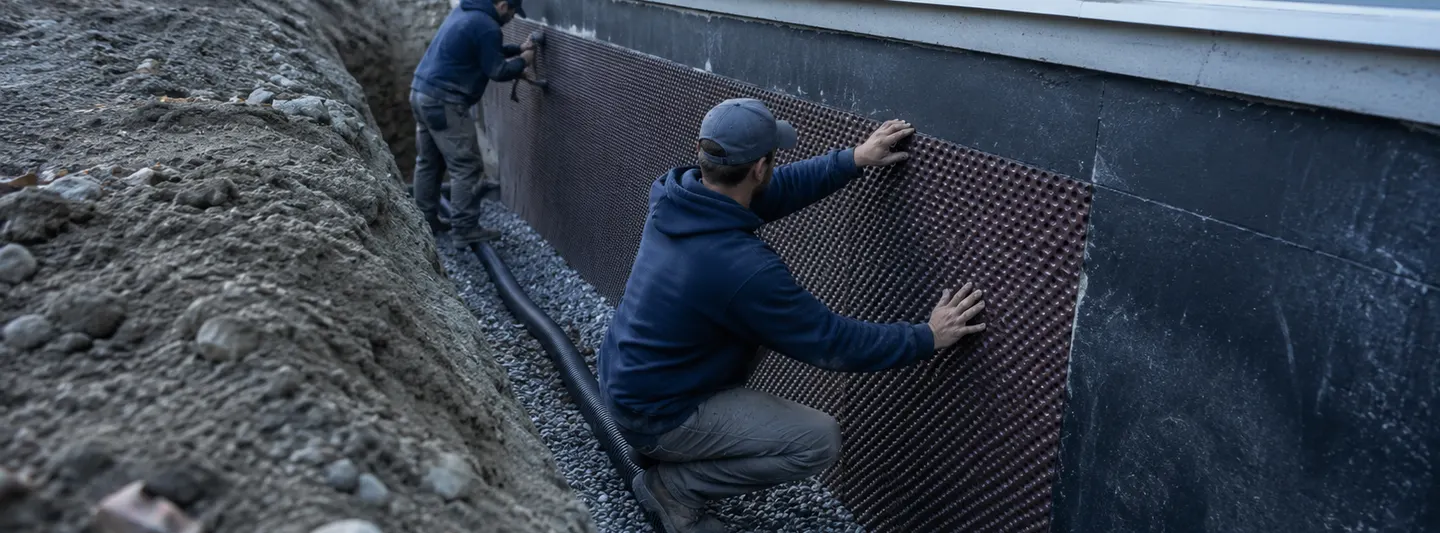
Building America guidance for existing foundation walls describes a sequence that starts with locating utilities and excavating the perimeter, then installing footing drainage and an exterior damp-proofing or waterproofing membrane before backfilling.
Remove or protect landscaping, decks, AC equipment, fences and other obstacles.
Expose the foundation wall down toward the footing without undermining the structure.
Clean substrate and address cracks, deterioration or structural conditions before covering it again.
Apply the specified membrane or damp-proofing assembly with required preparation and protection.
Install or service perimeter drain tile, washed stone and filtration at foundation depth.
Route collected water to daylight, drywell, approved storm connection or sump strategy.
Rebuild grade and restore exterior surfaces without recreating the water problem.
CODED CUTAWAY
The layers that should still make sense after the trench is backfilled
Conceptual section only. Actual membrane, protection, insulation, drainage and footing details vary by project, product and local requirements.
2026 COST MAP
Exterior basement waterproofing cost by work package
A good proposal separates the expensive temporary work from the permanent system. Published consumer pricing is strongest for the overall system and exterior drainage; other elements are often bundled into contractor totals.
| Work package | 2026 planning range | How to read the number |
|---|---|---|
| Full exterior basement waterproofing | $10,000–$18,000 | Broad project range including excavation, exterior wall treatment and drainage work. |
| Exterior French drain | $30–$90 / linear ft. | Installed exterior drainage benchmark; excavation increases labor. |
| Perimeter / weeping drain tile | $6,000–$15,000 | Deep foundation drainage around multiple sides or the full perimeter. |
| Exterior drain tile · one side | $1,500–$4,000 | Useful planning unit when water is concentrated on one accessible wall. |
| Liquid waterproofing membrane | About $3–$6 / sq. ft. | Material/application benchmark in current national consumer data; excavation is a separate major driver. |
| Residential excavation | Often several thousand dollars | General excavation pricing varies with volume, access, soil and equipment; foundation-depth work can differ materially. |
| Surface drainage / grading | Project-specific | May be a smaller separate fix or part of the final exterior restoration scope. |
| Structural wall repair | Separate if required | Cracks, bowing or deterioration can change the project beyond waterproofing. |
Before adding published component costs together, mark every line item as included, excluded, allowance or owner-provided.
COST DRIVER #1 · EXCAVATION
The same wall can cost thousands more because of what is sitting beside it
Building America guidance for an exterior retrofit instructs crews to locate underground utilities before work and describes excavating the foundation perimeter down to the footing. That sequence explains why access is not a small logistics issue—it is part of the core project.
HomeGuide notes that exterior footing-drain cost depends on excavation depth, foundation repairs and working around landscaping, decks, patios and sidewalks. Current Angi excavation data likewise identifies labor and accessibility as major drivers of residential excavation price.
Fewer obstacles, easier soil handling and simpler restoration.
More hand work, protection and coordination around buried services.
Demolition or limited equipment access can become a substantial part of the bill.
Soil, depth and excavation safety can change means, methods and professional requirements.
Useful details include wall length, approximate excavation depth, access width, spoil handling, what is removed, what is protected and what exterior surfaces are restored afterward.
ONE WALL OR THE WHOLE HOUSE?
The largest scope decision may happen before a shovel enters the ground
A leak concentrated on one elevation does not automatically justify excavating every side of the house. Conversely, repairing only one wall can be a false economy when groundwater and failed perimeter drainage affect multiple elevations.
Best economic case when the water path, wall condition and drainage problem are genuinely localized.
Published exterior drain tile: about $1,500–$4,000 per side before broader waterproofing scope.Makes more sense when several walls leak, old footing drainage has failed, or the intended system requires continuity.
Published perimeter drain tile: about $6,000–$15,000.COST DRIVER #2 · THE WALL YOU DISCOVER
Exterior waterproofing exposes defects that were previously hidden by soil
Once the wall is uncovered, the project can change. Cracks may be larger outside than they appeared inside. Mortar can be deteriorated. Previous coatings may be failing. Block walls may need parging or repair before a new coating can perform as intended.
Building America guidance on below-grade wall damp-proofing notes that rough concrete masonry block may need parging before an exterior coating is applied. Its exterior-retrofit guidance also recommends evaluating structural integrity before major excavation.
Cleaning and specified preparation may be the dominant wall work.
Repair method must be compatible with the wall and waterproofing assembly.
Block or irregular surfaces may require additional work before coating.
Bowing, displacement or settlement can require a separate structural design.
If structural movement is present, see the bowed basement wall repair cost and foundation repair cost reports before treating the exterior membrane as the complete repair.
THE MEMBRANE IS IMPORTANT—BUT IT IS ONLY ONE LAYER
Price the assembly, not the black coating
Current Angi data places liquid membrane waterproofing around $3–$6 per square foot as a general national exterior method benchmark. That cost is useful for understanding material and application, but it should not be mistaken for the all-in cost of reaching a buried basement wall.
Building America guidance describes waterproofing or damp-proofing applied directly to the exterior foundation, with a drainage mat or free-draining assembly helping move water vertically. The detail matters because waterproofing works best as part of a layered system, not as a standalone painted surface trapped behind saturated soil.
COST DRIVER #3 · FOOTING DRAINAGE
The pipe is cheap; getting foundation-depth water into and out of it is the system
The Building America Solution Center describes exterior footing drain pipe as perforated drainage pipe installed outside the footing and below the bottom of the slab, surrounded by washed stone and filter fabric. The pipe is intended to receive surface or groundwater that reaches the footing and carry it away rather than allowing it to pool at the wall.
HomeGuide currently prices deep exterior perimeter / weeping drain tile at $6,000–$15,000, or $1,500–$4,000 per side. Exterior French-drain pricing is commonly quoted at $30–$90 per linear foot.
Filter fabric and clean washed stone help reduce fines entering the system.
A drain without a usable discharge point can leave water at foundation level.
Placement relative to footing and slab affects what the system can collect.
Gaps can leave vulnerable wall sections outside the drainage path.
THE QUESTION AT THE END OF EVERY DRAIN
Where does the water go?
Building America guidance says footing drainage should carry water to an appropriate outlet such as daylight, a drywell, an approved storm sewer or a sump system that then discharges appropriately. This is more than a technical footnote: the outlet determines whether the system can actually move water away from the foundation.
Works where site elevation allows a non-perforated outlet pipe to drain to an acceptable lower location.
Site and local rules determine whether collected water can be managed this way.
Availability and permission are jurisdiction-specific; never assume connection is allowed.
Necessary where gravity cannot deliver the water to a suitable lower outlet.
THE LAST 10 FEET MATTER
Backfill and final grade can either protect the investment or recreate the problem
Federal Building America guidance emphasizes keeping soil around the foundation from becoming saturated. It recommends sloping permeable surfaces away from the home by at least 0.5 inch per foot for 10 feet where feasible, with swales or drains where setbacks prevent that geometry.
It also calls for mechanically compacting backfill to reduce later settlement. That matters after exterior waterproofing because a newly filled trench can settle and create a trough that sends surface runoff back toward the foundation.
COST DRIVER #4 · PUTTING THE PROPERTY BACK
The waterproofing contract can end while the homeowner still has a construction site
Restoration is one of the easiest ways for two bids to look cheaper than they really are. One proposal may include only excavation, membrane, drainage and rough backfill. Another may include topsoil, final grading, seeding and reinstallation of removed features.
Rough backfill is not the same as a restored yard.
Mature planting and irrigation repair can be separate costs.
Removal and reconstruction can materially change a one-wall project.
Temporary removal may require another trade or separate contract.
Relocation or protection may be required before excavation.
Restoration should leave water flowing away, not toward the repaired wall.
Ask each bidder what the property physically looks like on the day they consider the job complete.
WHEN THE EXTERIOR PREMIUM CAN MAKE SENSE
Situations where paying for excavation buys something an interior system cannot
The buried wall itself needs access for repair and water control.
Rebuilding drainage at foundation depth requires access to the outside.
The goal is to intercept water before it crosses the below-grade wall.
Coordinating foundation work with excavation, landscaping or additions can change economics.
An exterior approach may preserve interior assemblies, depending on the actual water source.
Excavation can expose defects that interior coatings or drains do not address.
WHEN NOT TO BUY THE MOST EXPENSIVE ANSWER FIRST
Exterior excavation is not automatically the right response to every damp basement
EPA moisture guidance notes that water entering from outside can be addressed by solutions ranging from simple landscaping to extensive excavation and waterproofing. That range is useful: the mere presence of basement moisture does not prove that full exterior excavation is necessary.
Those conditions can still coexist with a legitimate exterior waterproofing need. The point is to diagnose them before committing to a five-figure excavation.
THE EXTERIOR WATERPROOFING BID AUDIT
Normalize these 16 fields before deciding which proposal is cheaper
Exactly which walls / linear feet are included?
To footing, partial wall height or another elevation?
Machine access, hand digging and spoil handling?
Who coordinates underground services before excavation?
Cleaning, parging, crack repair and old coating removal?
Exact product, thickness / application and substrate requirements?
How are penetrations, footing interface and top edge treated?
What protects the membrane and moves water downward?
Pipe type, diameter, location and included length?
Washed aggregate and filter-fabric details?
Where does the footing drain terminate?
Reuse excavated soil, free-draining material or combination?
How is settlement risk after backfill addressed?
What finished slope is included?
Lawn, plants, patio, deck, irrigation and concrete?
What water paths and system components are actually covered?
If a proposal cannot complete that sentence clearly, its total price is difficult to compare.
THREE $12,000 QUOTES THAT ARE NOT THE SAME
Price equality can hide major scope inequality
One wall, full restoration
Deep excavation on one difficult elevation, wall prep, membrane, drain work and restoration of hardscape.
Three walls, rough backfill only
More linear footage but simpler lawn access; landscaping and final cosmetic restoration remain with the owner.
Drain tile + membrane, no structural wall repair
Contractor excludes unexpected masonry or structural defects discovered after excavation.
PROJECT SEQUENCING
Do the irreversible decisions in the right order
- 1Confirm water source and exterior scope.
- 2Locate utilities and plan safe access.
- 3Excavate and inspect the actual buried wall.
- 4Resolve structural / substrate defects before covering them.
- 5Install membrane, protection and drainage as a coordinated assembly.
- 6Verify drain outlet before backfill makes it invisible.
- 7Backfill, compact, restore and establish positive grade.
- 8Keep photographs and product / warranty records.
BEFORE THE TRENCH DISAPPEARS
Photograph the system you will never see again
Exterior waterproofing is unusual because the most important work is buried at project completion. A simple photographic record can make future troubleshooting, warranty claims and property transactions easier.
QUICK ANSWERS
Exterior basement waterproofing cost FAQ
How much does exterior basement waterproofing cost in 2026?
Current national consumer pricing commonly places full exterior basement waterproofing around $10,000–$18,000. Persistent leaks, difficult excavation, structural repairs and extensive site restoration can push projects higher.
How much does an exterior French drain cost?
HomeGuide currently places exterior French drains around $30–$90 per linear foot installed. Deep perimeter or weeping drain tile commonly totals about $6,000–$15,000.
How much does exterior drain tile cost on one side of a house?
Current national cost data places exterior weeping / drain tile at about $1,500–$4,000 per side of a house. Waterproofing membrane, unusual excavation and restoration may be additional or bundled.
Why is exterior waterproofing so expensive?
The membrane itself is only one part of the job. Crews may need to remove obstacles, excavate several feet deep, protect utilities, repair the wall, install drain tile, create a discharge route, backfill, compact soil and restore landscaping or hardscape.
Is exterior waterproofing better than an interior French drain?
They manage water at different points. Exterior waterproofing can intercept water before it crosses the below-grade wall, while an interior drain manages water at or inside the foundation perimeter. The better fit depends on the actual water path, foundation condition, site constraints and budget.
Does exterior waterproofing include a new footing drain?
Often, but not automatically. Some proposals include drain-tile replacement as part of the system, while others treat it as a separate line item. The quote should identify pipe, stone, filtration and discharge explicitly.
Can exterior waterproofing be done on only one wall?
Yes, localized exterior work can be appropriate when the water path and failed assembly are limited to one elevation. A contractor should explain why partial coverage is sufficient and how it ties into existing drainage.
Should grading be redone after exterior waterproofing?
Final grade is part of water management. Federal Building America guidance recommends positive slope away from the foundation and proper backfill practices so surface runoff does not collect in the newly excavated perimeter.
METHODOLOGY & SOURCES
How Repair Cost Ledger built this exterior-waterproofing report
This report focuses specifically on the exterior waterproofing sequence. Its organizing model is the excavation envelope: access → excavation → wall condition → membrane assembly → footing drainage → discharge → backfill → restored grade.
A calculator is not used because the inputs a homeowner knows before excavation—wall length and basement depth—cannot responsibly model utilities, machine access, soil, wall defects, hardscape removal, drain outlet or restoration. Those variables are precisely what make exterior work expensive.
Current pricing was cross-checked using 2026 HomeGuide and Angi data. Technical sequencing, footing-drain placement, final grading and exterior water-control details are grounded in the U.S. Department of Energy / Building America Solution Center and EPA moisture-control guidance.
Cost data reviewed August 8, 2026. Figures are U.S. planning ranges, not contractor quotes, excavation plans, engineering designs or local drainage approvals.